Johnson & Johnson's ProAla Platform Enables In Vivo Production of Complex Bispecific Antibodies with Near-Perfect Purity

Johnson & Johnson
Medical Device R&D and Manufacturer
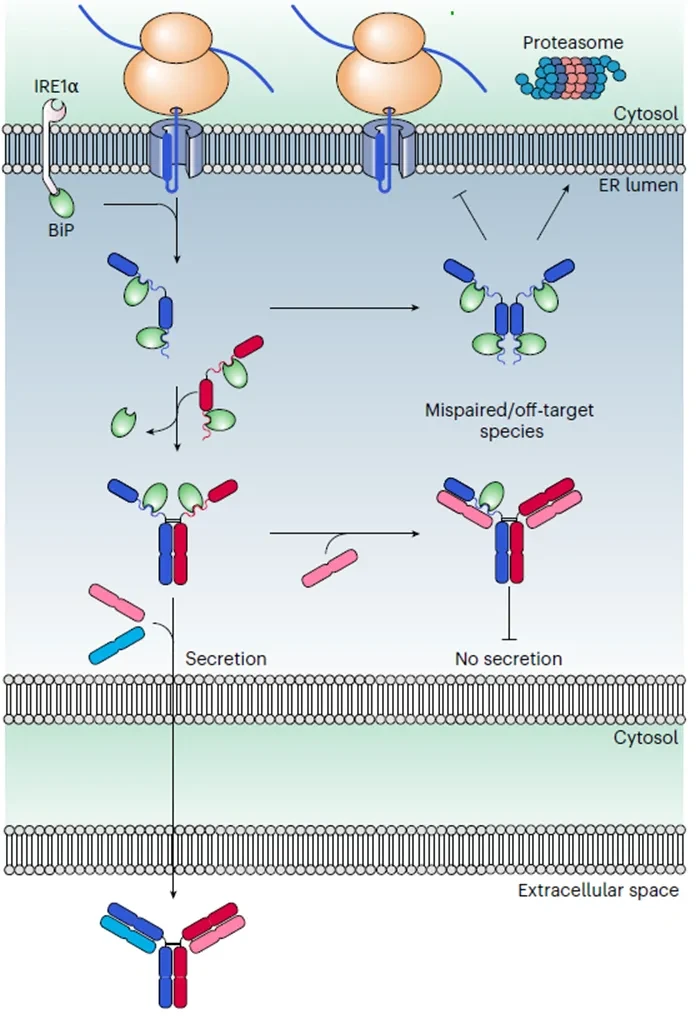
 Bispecific antibodies possess therapeutic mechanisms that cannot be achieved by monoclonal antibodies, but their production faces the issue of polypeptide chain mismatch, resulting in impure products that are difficult to purify. Although many platforms can effectively prevent mismatch, it is still unavoidable during production.Johnson & Johnson's research team developed ProAla Technology, by introducing a proline-to-alanine mutation, increases the folding energy barrier of the heavy chain, allowing it to fold, release chaperones, and be secreted only when paired with the correct light chain or another heavy chain.。Mismatched polypeptide chains due toEndoplasmic Reticulum Chaperone BiP Retained within the cells due to enhanced binding, unable to be secreted.. Secreted bsIgG Purity significantly improved, even approaching100%, which can be used for high-throughput screening without the need for complex downstream purification.ProAla Not only applicable to bispecific antibodies,It can also be extended to multispecific antibodies or more complex antibody designs.. This technology can significantly reduce production costs, simplify the process flow, and even have the potential to supportHolding advanced applications such as nucleic acid delivery for in vivo production。
Before understanding the relevant design, let's first understand this design.Main Components Utilized: ER Molecular Chaperones BiP: is located in the endoplasmic reticulumHSP70Family Molecular Chaperone. Its normal role in antibody production is:1) Not combined with unfolding/Unassembled peptide chains:When the antibody heavy chain is translated and enters the endoplasmic reticulum, it is in an unfolded state.BIPIt will immediately bind to it, covering its hydrophobic regions and preventing misfolding or aggregation.2) As the gatekeeper of quality control:BIPRetaining the heavy chain in the endoplasmic reticulum prevents incomplete antibodies from being secreted.3) Promote correct folding and assembly: Only when the correct light chain enters the endoplasmic reticulum and interacts with the heavy chain will a conformational change be triggered, leading toBIPDissociate from the heavy chain;4) Release and Secretion: OnceBIPAfter proper folding and assembly, the complete antibody can move from the endoplasmic reticulum into the subsequent secretory pathway.
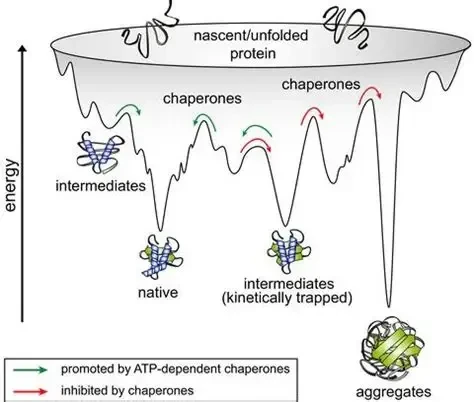
In the antibodyCH1In the domain structure, the151The proline is located in a β-turn loop.Region. Proline residues have a unique chemical property.--Its peptide bond exists in two relatively stable conformations: "cis" and "trans".The conversion speed between these two conformations is very slow, requiring overcoming an energy barrier, a process known as "proline cis-trans isomerization."". In the free heavy chains that are not bound to light chains,CH1DomainPro151Mainly in the "trans" conformation. In this conformation, the entireCH1The domain is unable to complete the final folding, remaining in a partially unfolded, relaxed state.BIPAs a molecular chaperone, its core mission isIdentify and bind to exposed hydrophobic peptide segments, which are typically present on unfolded or partially folded proteins.. Due toPro151In“Trans-”Conformation,CH1The domain is unable to fold, whichExposed its internalBIPBinding Site. Therefore,BIPWill bind tightly to this unfoldedCH1On the structural domain, like a lock, the heavy chain“Detention”In the endoplasmic reticulum, preventing it from being secreted.
The Arrival of Light Chains: Trigger“Switch”Flip:WhenCorrect Light ChainEntering the endoplasmic reticulum and binding with the heavy chain-After the variable region binds, this binding transmits a conformational signal to the constant region. This signalGreatly PromotedPro151From“Trans-”Conformational“Cis-”Conformational Transition. It can be understood that the correct light chain provides energy and initiates folding.“Start Switch”. OncePro151Transform into“Cis-”Conformation, EntireCH1The domain is like receiving the final command,Quickly complete its folding process, forming a tight, light chain-relatedCLThe three-dimensional structure of perfectly matched domains.
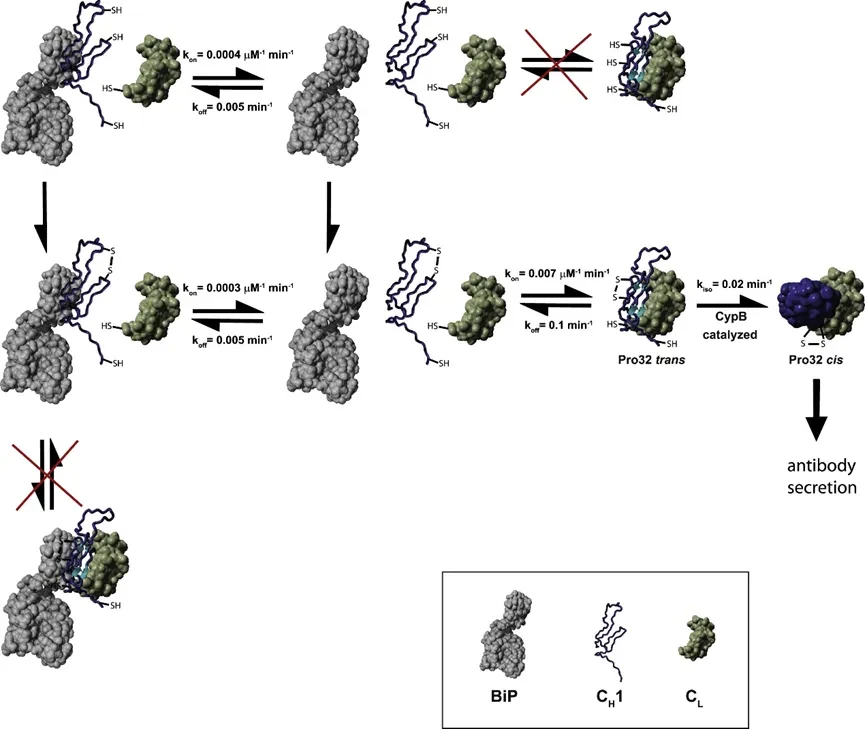
ProAlaHow does technology take advantage of this relationship? ProAlaProline was mutated to alanine,The ingenuity lies in that itDeliberately sabotaged this normal“Switch”Mechanism, thereby strengtheningBIPThe“Detention”Function. Alanine has no restriction of cis-trans isomerization, it disrupts theCH1Domain DependencyPro151Conformational changes initiate the intrinsic folding mechanism.CH1 P151AMutantExtremely difficult to fold spontaneously, almost always in an energetically unfavorable, unfolded state. This strongly unfolded state,Maximally ExposedBIPBinding Site`, leading to`BIPWith higher affinity binding to it, forming an almost inescapable“Death Hug”。InProAlaIn the design, only throughInterface-engineered, correct light chain,Only its complementary interface can provide tremendous energy., forcibly incorporating this highly unstableCH1 P151ADomain“Pull”To the correct folding state,Thereby forcingBIPRelease. AndThe mismatched light chain simply cannot provide such a large amount of energy., therefore, can effectively prevent mismatch and further improve the purity of asymmetric bispecific antibodies.
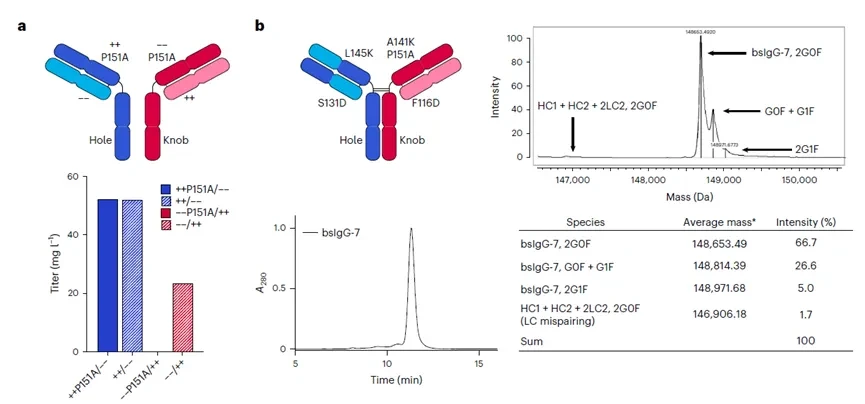
ProAlaProof of Concept: The researchers first inCH1ThePro151Perform mutations while combiningDD/KKThe charge mutation helps the correct pairing of antibodies, which inKnobAndHoleMutations were performed separately, followed by the expression of half-antibodies. The results showed that forHoleChain, Charge Mutation CombinationP151AThe mutation does not affect the secretion of antibodies, and forKnobChain, reverse charge mutation of heavy chain, pairingP151AMutations can impede the secretion of semiantigens. This demonstrates to some extent that the correct combination of charge mutations can overcome this issue.P151AMutation impedes the folding of the heavy chain.
After the proof of concept, the researchers in routine1+1Expression validation was performed on the asymmetric bispecific antibody, whereKnobThe chain has adopted the previousHoleThe design,HoleChainFabAdopted charge andCrossmabDesign (see figure below)b), the expression results indicate that, in terms of puritySECGreater than98%, and exceeds98%The components are all correctly paired target components, and this efficiency is much higher than that of the long-queue bispecific antibody platform.
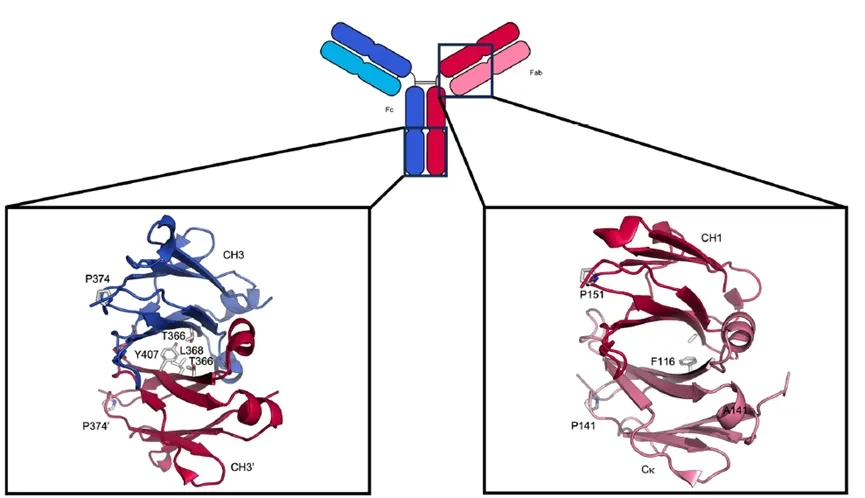
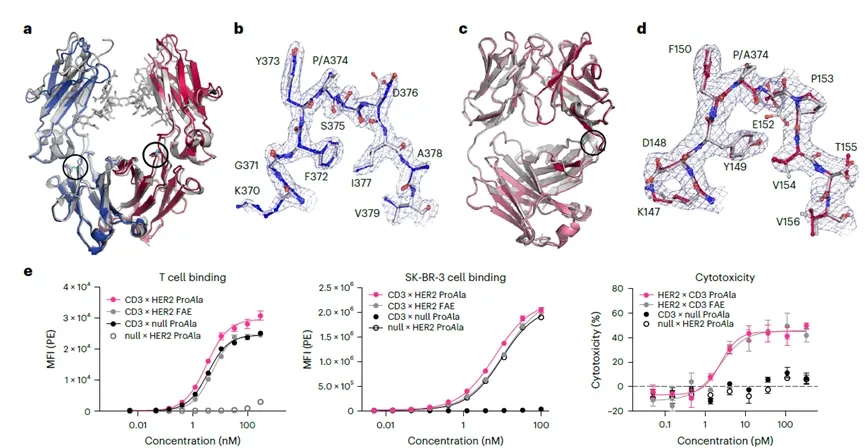
FcIntroductionProAlaMutation, Promoting Correct Pairing of Heavy Chains: Since inProAlaMutations can promoteCH1AndCLThe correct pairing, then, is whether it can be inFcHas the same effect, through comparisonCH1AndCLAndFcTheCH3The structure of the dimer, both are highly similar in structure, so researchersP374Introduce the same mutation at the site, expecting bindingKnob-in-HoleCombination mutations enhance the correct pairing of heavy chains. For conventionalKnob-in-HoleCombination, while it can increase the proportion of correct pairing to a certain extent, will still encounter issues to some degree.Hole-Hole And specifically orKnobOrHoleHemiantigen.
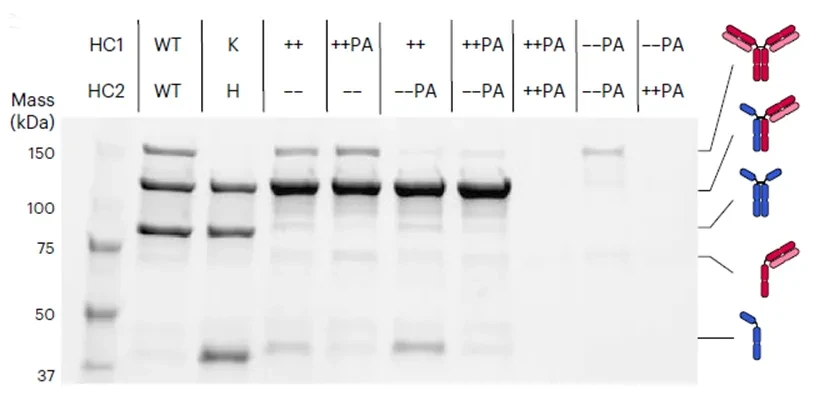
The researchers first investigated through charge mutation.Fc P374TheProAlaMutationWhether it can effectively promote the correct pairing of two heavy chains (CH3 L368K/F405K or CH3 S364D/K409D),Compared with the wild type, whether it isKnob-in-HoleWhether it is charge combination mutations, they all improve the efficiency of correct pairing to a certain extent, but there are still some by-products, such as semi-antibodies orHole-HoleMismatch. WhenHC1Introduce two positive charge mutations,HC2Introduce two negative charge mutations, simultaneously paired withPAMutation can promote the correct pairing of two heavy chains while also avoiding semi-antibodies orhome-dimerThe generation of charge mutations reversed, the antibody could not be secreted. This also proves that, apart from charge mutations, some other factors can also affect the folding and pairing of antibodies.
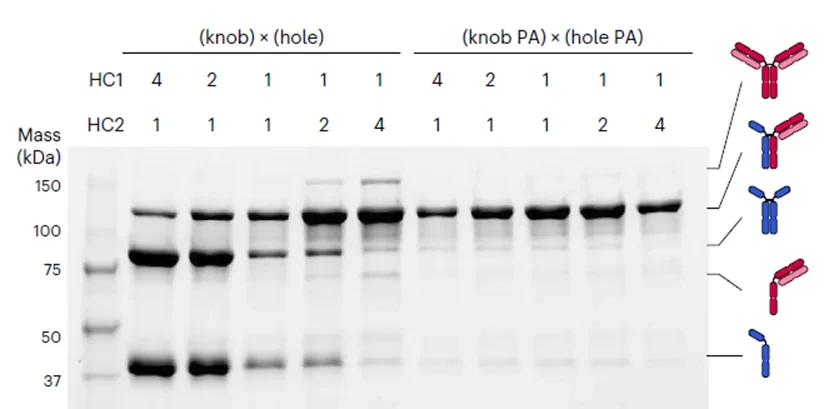
Knob-in-HoleAndProAlaMutationCombination: Subsequently, willKnob-in-HoleAndProAlaMutationPerform Combination ValidationProAlaCan it also promoteKnob-in-HoleThe correct pairing, and research on different ratios. The results show that, withoutProAlaMutation, differentKnobAndHoleThe proportion will affect the final quality of the product.And introduceProAlaAfter the mutation, regardless ofKnobOverdose orHoleIn excess, antibodies can basically all pair correctly.
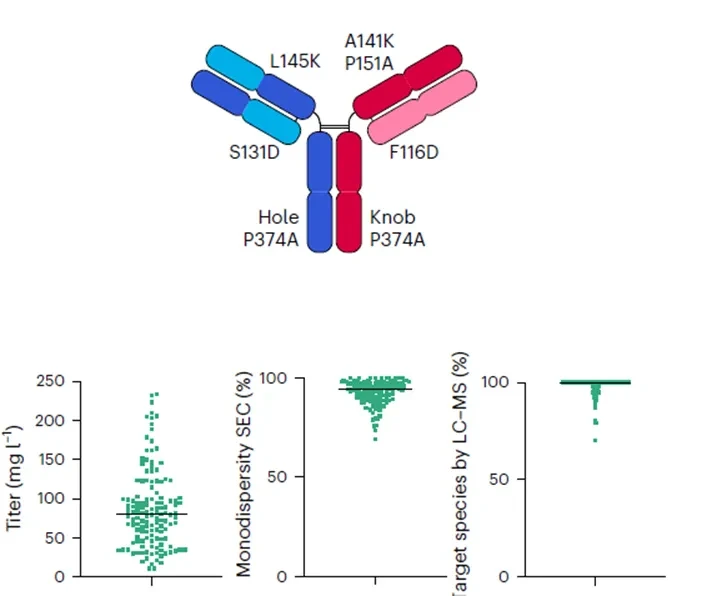
In order to verifyKnob-in-HoleAndProAlaMutationThe efficiency of the combination in other bispecific antibodies, researchers on128A bispecific antibody was transiently transfected for expression validation, and the median expression of all bispecific antibodies was87mg/L,SECPurity in94 ± 6%, and the vastMost bispecific antibodiesTheCorrect pairing rate is greater than98%, which indicatesKnob-in-HoleAndProAlaMutant combinations can promote the efficient and correct pairing of bispecific antibodies.Even without downstream purification。
ProAlaMutationImpact on Stability and Activity: In order to verifyProAlaWhether the mutation affects the stability and activity of bispecific antibodies, researchers...CD3/HER 2Validated in bispecific antibodies. Antibody structure indicatesKIHMutation CombinationProAlaBasically, it will not affect the structure of the antibody, although itsTmThe value has decreased to a certain extent, but it does not affect the quality of thermal acceleration stability.40℃,2weeks), and in terms of binding activity, due to a certain increase in the purity of the antibody, there is also a slight enhancement in binding activity. This indicates that it basically does not affect the physicochemical and biological activities of the antibody.
Summary
The article provides a detailed study on the mechanism of ProAla, which will not be elaborated further here.Compared with other technologies such as CrossMab and KIH, ProAlaChain Pairing Efficiency and Product PurityPerforms better on the surface, and isThe Only One Through CH1-CL Interface EngineeringA platform that can achieve >99% pairing efficiency,It has achieved"Host Cells as Purification Factories"The vision is to directly obtain high-purity bsIgG from the supernatant of co-expressing cells. Additionally, itsGreatly simplifies the downstream purification process,Create a brand-new production model and enableThroughIn vivo production of complex bispecific antibodies through nucleic acid deliveryPossible (i.e., directly injecting the gene encoding ProAla antibody into the body, allowing the patient's cells to produce high-purity therapeutic complex bispecific antibodies). Overall, itsBy cleverly leveraging and amplifying the inherent protein folding and quality control mechanisms of cells, it not only resolves the purity challenges in bispecific antibody production, offering a powerful platform superior to existing technologies, but also profoundly reveals the structural biology principles of antibody assembly, paving the way for new approaches in the development and manufacturing of future biologics.
References
https://doi.org/10.1038/s41587-025-02842-2