Duality Biologics Partners with Roche’s Genentech in Groundbreaking ADC Platform Deal

DualityBio
Innovative Molecular Type Drug Developer
Genentech
Pharmaceutical R&D Manufacturer
 Recently,DualityBio(Duality Biotherapeutics) andA Roche CompanyGenentechSigned a globalADC R&D Collaboration Agreement. Both parties will, based on DualityBio'sDUPAC (Dual Unique Payload Antibody Conjugate) Platform, jointly develop multiple antibody-drug conjugate projects.
Transaction Down Payment$45 million, potential milestone payments exceeding$1 billion, plus tiered sales royalties.

If we look at the numbers alone, this deal among domestically produced ones in recent yearsADCs Are Not the Most Prominent in the Global Expansion Wave, but what truly warrants attention is the transaction structure itself: this is a domestically producedADC was first introduced asUnderlying Payload PlatformCross-border collaboration targeting the subject.
From“Sell a drug”To“Selling a set of pharmaceutical manufacturing equipment”, this collaboration between DualityBio and Roche may mark the beginning of domestically producedADC Global Expansion Is Entering a New Phase.
One stroke“Different”ofADC Transactions
To understand the uniqueness of this transaction, it is first necessary to place it within the context of recent years' domestically producedIn the coordinate system of ADCs going global.
Baili Tianheng'sBL-B01D1, is a targetedEGFR/HER3 Bispecific Antibody ADC, licensed to Bristol Myers Squibb (BMS) in late 2023, with an upfront payment of $800 million and total potential value of $8.4 billion.

Alphamab Oncology'sJSKN016, is a targetedTROP2/HER3 Bispecific Antibody-Drug Conjugate (ADC): Licensed to Pathos AI in 2025, with an upfront payment of USD 125 million and total potential milestone payments of USD 2.093 billion; Alphamab Oncology retains rights for the Greater China region.

These two transactions share one commonality:The overseas rights to a single mature drug molecule are being transferred.。MNCs are acquiring a candidate drug with existing clinical data and a relatively clear mechanism of action, ensuring controllable risk.The valuation anchor is the clinical value and market potential of the molecule itself.
DualityBio andGenentech’s collaboration is different.
The basis of the protocol isDUPAC Platform:A Platform for Developing Novel PayloadsADC technology platform, rather than a specific drug。
Collaboration Model: Joint R&D of Multiple Projects. DualityBio is responsible for drug discovery and early-stage global clinical development up to the completion of Phase 1a; Genentech obtains exclusive global rights to the resulting ADCs from the collaboration and is responsible for subsequent clinical development and commercialization.
In other words, single-product licensing focuses on“How much is this medication worth?”,It is a one-time transaction.;Platform Authorization Review“How many drugs can this platform produce?”,It is the pricing of R&D capabilities for the continuous development of new drugs.
What’s New About DUPAC?
To clarifyTo understand the differentiation of DUPAC, one must first examine the technical pathways of traditional ADCs.
The three core elements of ADC areAntibody, Linker, and Payload。
Over the past decade, mainstreamThe payloads of ADCs are mainly concentrated in two categories:One category is microtubule inhibitors, such asMMAE and DM1; representative drugs are Seagen’s Adcetris and Roche’s Kadcyla;The other class is topoisomerasesI Inhibitor, such asDXd and SN-38; the representative drug is Daiichi Sankyo’s Enhertu (T-DXd).
The mechanisms of action for these two classes of payloads have been extensively studied, and the optimization of their linkers and improvement of conjugation methods are becoming increasingly mature.To some extent, it has already entered a red ocean.。
DualityBio PlatformofDUPACTechnology Platform,defined as“Novel and UniqueMOA (Mechanism of Action) Payload ADC Platform”, targeting refractory tumors and capable of overcomingThe potential for T-DXd resistance.
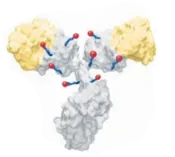
Figure:DUPAC Platform (DualityBio Official Website)
This meansThe innovation of DUPAC lies not in the linker, but in the mechanism of action of the payload itself.:It seeks to break away from the traditional frameworks of microtubule inhibitors and topoisomerase inhibitors, exploring entirely novel cytotoxic mechanisms.。
This is alsoOne of the Key Reasons Roche Chose External Platforms Over In-House Development: Roche currently hasIn the ADC pipeline, Kadcyla utilizes the microtubule inhibitor DM1, while Polivy utilizes the microtubule inhibitor MMAE.Significant Gaps in In-House R&D Reserves for Next-Generation Novel Mechanism Payloads。
However, it should be objectively pointed out thatThis time withThe collaboration with Genentech marks the platform’s first validation by a large multinational pharmaceutical company.,ButDUPAC is currently in the preclinical stage, with no public clinical data available yet.. It is premature to assertIts Value, it is premature.
RocheADC Strategy“Mingpai Pivot”
Roche is notA newcomer to the ADC field? Quite the contrary, it is one of the first multinational pharmaceutical companies to strategically position itself in the ADC sector.
Roche currently has two marketed productsADC Products: Kadcyla (T-DM1), indicated for HER2-positive breast cancer, approved in 2013; Polivy (polatuzumab vedotin), indicated for diffuse large B-cell lymphoma, approved in 2019.
However, a frequently overlooked fact is:These twoNone of the ADCs were fully developed in-house by Roche.。Kadcyla is derived from technology licensed from ImmunoGen, while Polivy stems from the collaboration with Seagen.
In the past two years, Roche hasExternal collaborations in the ADC field have clearly accelerated:
May 2024, withYilian Biologics onc-MET ADC YL211Global Collaboration, Upfront Payment$50 million upfront, with potential milestones approaching $1 billion;

In 2024, withHansoh Pharmaceutical regardingCDH17 ADC HS-20110Closing of Collaboration, Initial Payment$80 million, with a total potential value of $1.45 billion;

plus this collaboration with DualityBioThrough collaboration with the DUPAC platform, Roche has consecutively licensed in three ADC assets from Chinese biotech companies within two years.and gradually upgrade from single products to a platform。
There is a clear industrial logic behind this shift.
Daiichi SankyoofEnhertu’s strong performance across multiple indications, including HER2-positive breast cancer and lung cancer,Reshaping the Competitive Landscape of the Global ADC Market。
It also placed direct pressure on Roche.:Kadcyla Faces Replacement Threat from Enhertu, While Roche Has Yet to Unveil a Next-Generation ADC to Compete. In this context, rapidly filling gaps through external collaborations is more efficient than starting from scratch with in-house R&D.
RocheThe BD head has stated in public,The company plans toMore External Transactions in the ADC Field。
From“Primarily In-House R&D”to“External Collaboration+ Platform Introduction”, this is not only the choice of the Roche family, but also a globalCommon Trends Among MNCs in the ADC Field:When technological iteration accelerates and internal R&D pipelines cannot cover all cutting-edge directions, acquiring capabilities is more cost-effective than acquiring drugs.。
DomesticADC Second Tier: Who Can Replicate It?“Platform Global Expansion”?
DualityBio'sDUPAC collaborations have opened up new possibilities, but the barriers to global expansion for platforms are extremely high, and not all biotech companies can successfully navigate this path. Currently, the global expansion of domestically produced ADCs can be broadly categorized into three models.
The first type is single-product licensing, with Baili TianhengBL-B01D1 and Genentech's JSKN016 are representative examples. The core logic involves licensing out the overseas rights to a single mature drug molecule, with valuation anchored to the clinical value of that molecule.The risk is relatively controllable, but the growth ceiling also depends on a single product.。
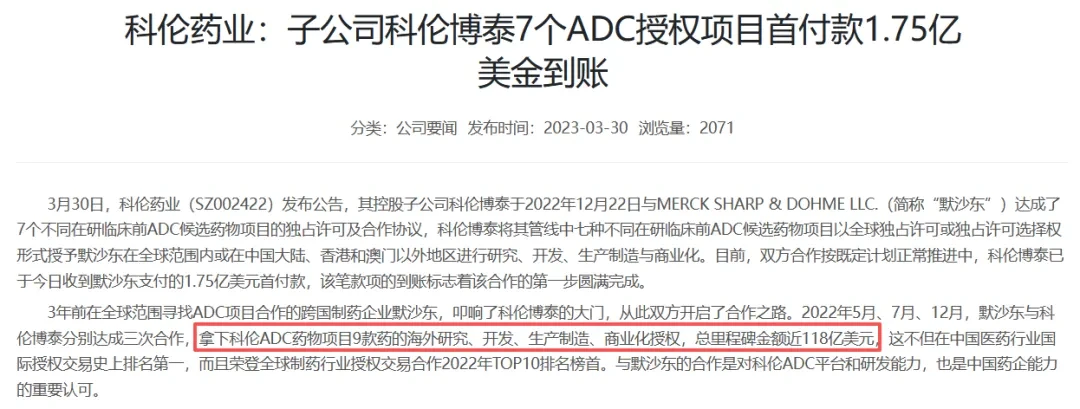
The second type is pipeline combination licensing,Represented by the collaboration between Kelun Biotech and Merck & Co., Inc. (MSD), Kelun Biotech, based on itsOptiDC platform licenses a portfolio of seven ADC projects, including SKB264 (TROP2 ADC), to Merck & Co., Inc. (MSD), for a total value exceeding $11.8 billion. This model falls between single-asset deals and pure platform licensing.,MNCs receive a batch of existing candidate molecules, rather than having access to underlying technologies that would allow them to select their own targets.
The third type is underlying platform licensing,DualityBioExemplified by the collaboration between DUPAC and Roche, the underlying technology platform is open, allowing multinational corporations (MNCs) to select targets and co-develop novel projects based on this platform. This model places the highest demands on biotech companies:Technology must have sufficient reusability and scalability., intellectual property rights must be complete and clear, and the platform must have the capability for continuous iteration.
In addition to DualityBio, domestically producedAmong the second-tier ADCs,Hengrui Medicine'sSHR-A1811(TROP2 ADC has been approved in China. Relying on its self-developed ADC platform, the company currently focuses on independent development and has not yet initiated large-scale overseas licensing of the platform.DuoXi BiologicsPossesses an autonomously linking subunit- Payload platforms and multiple ADC pipelines, but currently dominated by single-product licensing, with no large-scale platform-level collaborations yet.
It should be emphasized that,Platform collaborations are characterized by long durations and high uncertainty; the value of such platforms ultimately depends on clinical data from subsequent collaborative projects for realization.。Whether DUPAC can consistently deliver clinically validated new drugs is the ultimate benchmark for measuring the success or failure of this collaboration.
Conclusion
DualityBio and RocheThe significance of the collaboration with Genentech lies not in the $1 billion milestone figure, but in its validation of a possibility:ChinaWhat biotech companies can deliver is not just individual drug molecules, but underlying R&D capabilities.
Single-asset licensing, pipeline portfolio licensing, and underlying platform licensing: each of the three models has its own applicable conditions and risk profiles,Companies need to make choices based on their technological reserves, pipeline stages, and commercialization capabilities.
Domestically producedIn the ADC industry, DUPAC’s story has only just begun; the upcoming clinical data will serve as the ultimate litmus test.
References:
1.DualityBio, HKEX Announcement, 2026-08-28
2.Sina Finance: "DualityBio andGenentech Enters into ADC Collaboration with Potential Milestone Payments Exceeding $1 Billion, 2026-08-28
3.DualityBio Official Website - Technology Platform Introduction
4.Baili Tianheng Official Website: "Baili Tianheng and Bristol Myers Squibb on“BL-B01D1 Development and Commercialization License Agreement”
5.Alphamab Official Website: "Alphamab andPathos Reaches Licensing Agreement for TROP2/HER3 Bispecific Antibody ADC JSKN016》
6.Tianchao Capital: "Innovative Drug CompaniesBD Transaction Logic: The Paradigm Shift from “Selling Molecules” to “Selling Capabilities”
7.Tencent News: "Yilian Bio"YL211 Reaches Global Collaboration with Roche", 2024-05-28
8.Sina Finance: "Kelun Biotech and Merck & Co."ADC Collaboration, 2026-03-16