

Over $8 Billion Floods into Oral Cyclic Peptide Sector in Six Months: A High-Stakes Bet Amid Uncertainty

Syneron Bio
Novel Macrocyclic Peptide Drug Developer
Hansoh Pharma
Pharmaceutical Research, Production, and Sales

Pinnacle Medicines
Peptide Drug Developer
For some time now, investing in clinical data, investing in stable cash flows, and even investing in BD, the possibility has almost become a consensus among domestic pharmaceutical investors.
However, since the beginning of this year, as the wave of AI reshaping everything has risen, this perception has begun to waver. Capital is intensively shifting from top-tier companies to very early-stage projects with high uncertainty. One example is the AI virtual cells analyzed in a previous article by VCBeat; another example, which we will discuss today, is oral cyclic peptides.
Attracts Over $8 Billion in Funding in Half a Year
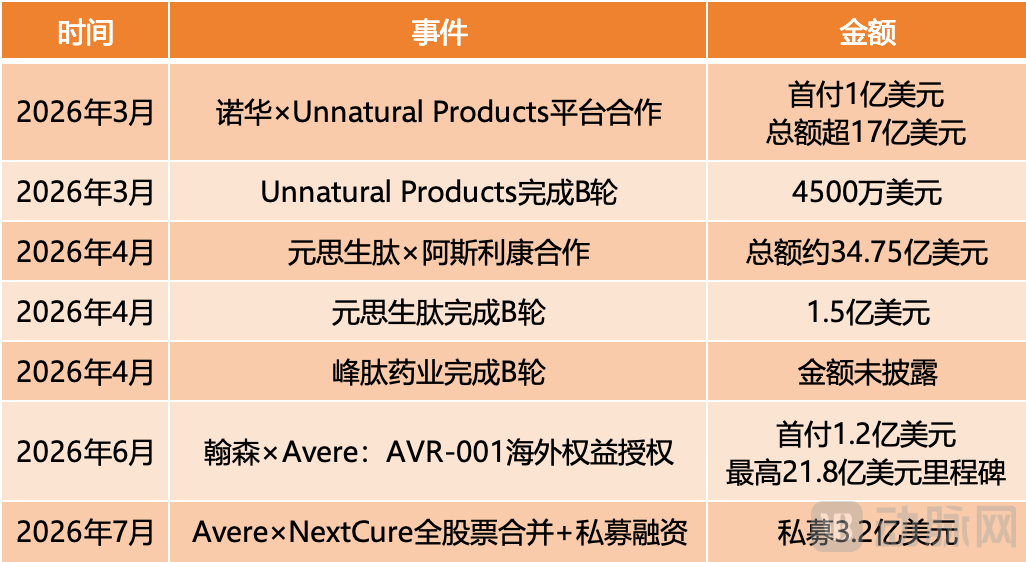
In just the past six months, financing events and business development (BD) deals in the oral cyclic peptide sector have surged, with over $8 billion flooding into this vertical. Multinational corporations (MNCs) and top-tier investment institutions have urgently deployed this capital on two fronts: acquiring platforms and securing pipelines.
First, consider platform acquisitions. When faced with disruptive technologies that are often in their early stages, multinational corporations (MNCs) choose to bet on platforms capable of continuously generating drug candidates. In February, Novartis partnered with Unnatural Products, securing access to its AI-driven macrocyclic peptide discovery platform through a deal featuring a $100 million upfront payment and a total value exceeding $1.7 billion. The following month, Syneron Bio, a leading Chinese company specializing in oral cyclic peptides, announced a licensing collaboration with AstraZeneca valued at approximately $3.475 billion. Under this agreement, AstraZeneca gained access to Syneron Bio’s proprietary Synova™ technology platform to jointly develop first-in-class macrocyclic peptide drugs for chronic diseases. This transaction also centered around platform capabilities. In April, Syneron Bio completed a $150 million Series B financing round, with AstraZeneca participating as an existing shareholder by continuing to invest in the round.
Institutions are also heavily betting on platforms. Pinnacle Medicines, a biotech company founded just two years ago, has also exceeded expectations by securing $89 million in its Series B financing round. Incubated jointly by OrbiMed and Qiming Venture Partners, this biotech firm is attempting to leverage its proprietary AI-integrated physics simulation platform to develop oral peptide therapies. In this Series B round, Pinnacle Medicines also attracted top-tier investment firms such as LAV, Foresite Capital, Hankang Capital, and RA Capital Management. Additionally, Unnatural Products, which was selected by Novartis, completed its $45 million Series B financing in March. Multinational corporations (MNCs) and capital investors have almost simultaneously lined up at the starting line, with the race now underway.
Relatively speaking, the options for acquiring pipelines are somewhat limited. In June, Hansoh Pharma signed an exclusive licensing agreement with Avere Bioscience, granting Avere the overseas rights to its oral IL-23 cyclic peptide asset, AVR-001. In return, Hansoh received a $120 million upfront payment and is eligible for up to $2.18 billion in milestone payments. The month after securing the rights to the AVR-001 pipeline, Avere announced an all-stock merger agreement with Nasdaq-listed NextCure, while simultaneously completing a $320 million private placement financing.
“The sector is experiencing significant heat, driven by the substantive warming effect of ‘product launch approvals + BD.’” Dr. Shen Qin, Managing Director at Yijing Capital, pointed out, “This is not mere conceptual hype; there is concrete evidence in the form of clinical products and large-scale BD deals.”
Previously, MSD’s oral PCSK9 cyclic peptide inhibitor, enlicitide, and Johnson & Johnson’s oral IL-23 cyclic peptide inhibitor, icotrokinra, were successively approved for marketing in the United States. The former is indicated for lowering low-density lipoprotein cholesterol (LDL-C) in adult patients with hypercholesterolemia, while the latter serves as a first-line systemic therapy for moderate-to-severe plaque psoriasis. As long-awaited oral formulations for patients with high-prevalence chronic diseases, both enlicitide and icotrokinra rapidly captured market share through a paradigm of superior efficacy and convenience outcompeting existing options. According to Johnson & Johnson’s Q2 2026 earnings conference call, since its commercial launch in Q2, approximately 18,000 prescriptions for icotrokinra had been issued to around 11,000 patients by July 15.
Uncertainty remains significant
Notably, as a cutting-edge pharmaceutical technology, oral cyclic peptides are still in a very early stage, with significant uncertainties remaining regarding related pipelines and technology platforms. Within traditional investment frameworks, this category is considered highly uncertain.
On one hand, Enlicitide and Icotrokinra face virtually no competition, as there is a significant gap in the clinical progress of most oral cyclic peptide pipelines. In a research report, Sinolink Securities pointed out that, according to Insight data, the number of global oral cyclic peptide pipelines under development increased from 72 to 93 between 2021 and 2026. Moreover, the pipeline structure has undergone a qualitative change, with a significant increase in the proportion of late-stage projects, indicating that cyclic peptide technology has moved beyond the proof-of-concept stage and entered a mature phase characterized by comprehensive, multi-tier advancement. Among the 93 oral cyclic peptide pipelines under development, those targeting IL-23R and PCSK9 are the most popular, with six and five candidates, respectively.
However, apart from the marketed Icotrokinra and AVR-001 (licensed by Hansoh Pharma to Avere), all oral cyclic peptide pipelines targeting IL-23R are in the preclinical research stage. Similarly, aside from the marketed Enlicitide, all pipelines targeting PCSK9 are also in the preclinical research stage. In fact, although Syneron Bio and Pinnacle Medicines have established extensive pipelines, the majority remain in the preclinical research stage or early-stage clinical trials.
“Both targets are extracellular, aligning well with the mechanism of action of macrocyclic peptides, making them preferred directions for prioritized technological implementation. However, given the lengthy new drug development pipeline, uncertainties remain in clinical outcomes and safety, and ultimate success is also subject to contingent factors,” pointed out Dr. Shen Qin.
Specifically, the greatest technical challenge facing the current pipeline of oral cyclic peptides remains their low oral bioavailability—meaning that only a tiny fraction of the ingested drug actually enters the bloodstream to exert its therapeutic effect, typically just 1%–5%. To achieve efficacy comparable to injectable formulations, oral doses often need to be increased by tens or even hundreds of times. The most typical example is semaglutide: while a weekly 1 mg injection suffices, the oral version requires a daily dose of 14 mg, along with strict administration conditions—taken on an empty stomach, half an hour before meals, and swallowed with no more than half a glass of water. Even drinking slightly more water can cause fluctuations in plasma drug concentrations.
Optimizing oral bioavailability is exceptionally challenging due to the inherent contradictions among several key requirements. To achieve high-affinity binding to the target, molecules tend to be large, yet the intestinal barrier only permits the passage of small, flexible molecules. Extending half-life often requires incorporating “non-natural” structural elements, which can inadvertently trigger immune responses. Enhancing absorption may involve using permeation enhancers to “open the floodgates,” but such non-selective mechanisms introduce significant inter-individual variability. Compounding these issues, gastric acid and digestive enzymes degrade peptides, intestinal efflux pumps actively transport drugs back into the lumen, and the liver further metabolizes a portion of the drug during first-pass metabolism. These interconnected physicochemical barriers collectively constitute a common ceiling for the entire field.
On the other hand, the success of Enlicitide and Icotrokinra is inherently difficult to replicate. Taking MSD’s Enlicitide as an example, it follows a technological path that is entirely different from traditional approaches. Conventional cyclic peptide synthesis relies on chemical ligation, which involves multiple steps and low yields, requiring gradual optimization to improve efficiency. In contrast, MSD employs an enzymatic cascade synthesis, splitting the molecule into three segments and using seven customized enzymes to automatically assemble them in an assembly-line fashion, resulting in fewer steps and higher efficiency.
It is akin to comparing traditional methods of synthesizing cyclic peptides to hand-sewing garments, where amino acids are stitched together one by one, with losses incurred at every step. In contrast, MSD has developed a specialized sewing machine: the raw materials are loaded in, and the machine automatically completes the stitching. This "sewing machine" is difficult to replicate; its components are custom-made, including seven proprietary enzymes screened from microorganisms and iteratively optimized through hundreds of thousands of modifications to specifically accommodate this molecule. The assembly process is complex, requiring seamless integration and fine-tuning from the outset across disciplines ranging from synthetic biology and enzyme engineering to protein crystallization. Most importantly, MSD’s technology and manufacturing processes have been validated for mass production.
Thus, a yet-unbridged chasm lies between the fervor of capital and the complexity of technology. This is precisely the fundamental reason why funding is concentrating among top-tier players; only companies with platform-level capabilities and the ability to continuously iterate on molecular entities can build a bridge across this divide.
The Unique Certainty of Oral Cyclic Peptides
Of course, the challenges facing oral cyclic peptides are, after all, common issues in new drug development. The reason this sector remains vibrant amidst a cooling capital environment lies in its unique certainty.
On one hand, the innovation of oral cyclic peptides lies in their formulation rather than their targets, offering a certain degree of certainty in existing markets. “Oral cyclic peptides can focus on mature targets, ensuring high certainty in commercial prospects,” an industry practitioner told VCBeat. This logic underpins the two approved oral macrocyclic peptide drugs. Enlicitide targets PCSK9, for which antibody drugs have long been marketed, with annual sales exceeding $1 billion, validating the lipid-lowering market. Icotrokinra targets IL-23, where the antibody drug market is equally mature; the corresponding blockbuster drugs have achieved peak annual sales exceeding $10 billion, validating the markets for psoriasis and Crohn’s disease.
This development strategy offers several predictable advantages: well-understood disease mechanisms, clearly defined patient populations, completed market education, and established clinical endpoints. Oral cyclic peptides can thus achieve rapid competitive advantage upon market entry. Even if the oral formulation captures only a small share of the antibody market, it would still support substantial commercial value. Moreover, the superior adherence associated with oral administration can expand the treatment population by attracting patients who are averse to injections, thereby enlarging the overall market.
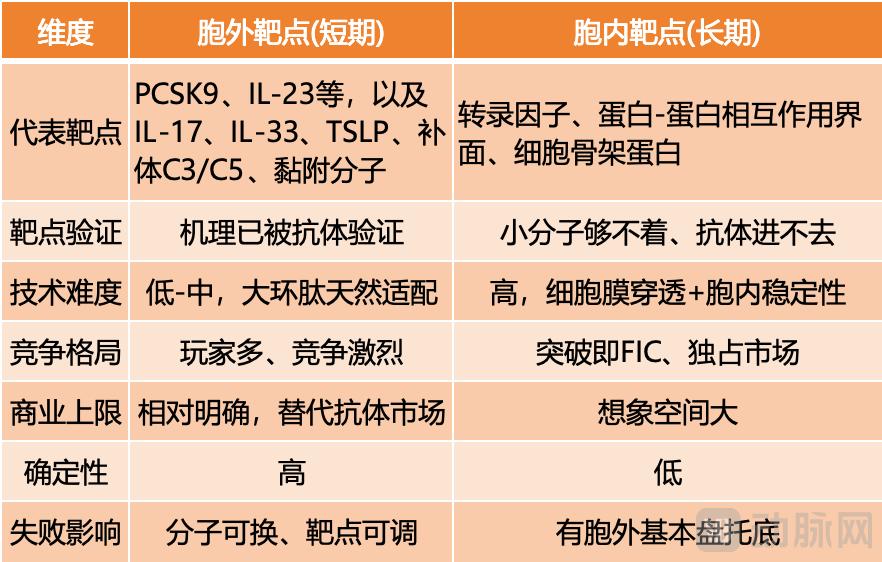
On the other hand, oral cyclic peptides also offer a certain degree of certainty in incremental markets by targeting extracellular targets in the short term and intracellular targets in the long term. The underlying logic is that the mechanisms of extracellular targets such as PCSK9 and IL-23 have been validated by antibodies; macrocyclic peptides are naturally well-suited for these targets, and the clinical development pathways are mature, resulting in high certainty. However, this space faces intense competition and has a relatively clear commercial ceiling. In contrast, for intracellular targets such as transcription factors and protein-protein interaction interfaces, small molecules often fail to engage effectively, and antibodies cannot penetrate the cell membrane. Oral cyclic peptides represent one of the few modalities with the potential to reach these targets. A breakthrough in this area could lead to first-in-class (FIC) therapies and market exclusivity, but it also entails the greatest delivery challenges and the highest risk of failure.
“Adopt a phased deployment strategy based on corporate strengths, distinguishing between short-term and mid-to-long-term horizons; short-term initiatives carry lower risk, while mid-to-long-term ones entail higher risk. It is not advisable for startups to directly bet on high-difficulty, long-term targets without prior validation. Instead, they should first leverage short-term targets to achieve platform and clinical proof-of-concept, then gradually expand into mid-to-long-term, high-value targets,” pointed out Dr. Shen Qin. In this way, failure in extracellular targets will not cripple the platform—molecules can be swapped and targets adjusted—while failure in intracellular targets will not bring down the company, as the core foundation lies in extracellular targets.
Therefore, the certainty surrounding oral cyclic peptides is actually greater than imagined, which may be the underlying logic driving the influx of industrial capital and investment institutions.
AI Drug Discovery Trends
Another interesting point lies with you: AI-driven drug discovery has been one of the most definitive trends in the pharmaceutical industry in recent years, and oral cyclic peptides are a quintessential example of this trend. This highly technically demanding field happens to align precisely with the areas where AI excels.
For orally administered cyclic peptides, the value of AI lies in multi-parameter optimization. The key challenge in peptide drug design is to find a balance among multiple parameters: high affinity, long half-life, sufficient oral bioavailability, and adequate intestinal permeability, while simultaneously evading enzymatic degradation and transporter-mediated efflux. Traditional medicinal chemistry approaches rely on extensive experimental screening, which is costly and time-consuming. In contrast, deep learning-based molecular generation models can rapidly explore vast chemical spaces, predict molecular conformations, binding interfaces, and permeability, thereby narrowing the scope for experimental validation.
This explains why significant capital is flowing toward companies with AI platform capabilities. The core selling points of Unnatural Products’ collaboration with Novartis, as well as the technological platforms of Syneron Bio and Pinnacle Medicines, all center on AI-accelerated peptide discovery. While AI is not a panacea, it does save time and costs in this highly challenging screening process.
Of course, the boundaries of AI’s capabilities are equally clear. The volume of data available for peptides is far smaller than that for small-molecule drugs. Small molecules benefit from decades of accumulated data and compound–activity databases containing millions of entries, whereas publicly available peptide data are significantly scarcer, directly limiting the depth of model training and the accuracy of predictions. “AI is a valuable auxiliary tool that can reduce the workload in screening, but the scarcity of high-quality experimental peptide data remains a challenge. At this stage, AI cannot independently resolve all the druggability bottlenecks associated with oral macrocyclic peptides,” stated Dr. Shen Qin.
AI-generated peptide candidates still require extensive wet-lab experiments to validate their final druggability. While AI can accelerate screening, it cannot bypass the physicochemical constraints of bioavailability; it can predict conformations, but it cannot compensate for the lack of experimental data; and while it can improve efficiency, it cannot replace the lengthy cycle of clinical validation.
Perhaps, in a sense, it is not that pharmaceutical investors are once again shying away from high-uncertainty projects; rather, the investment logic for innovative drugs is undergoing profound changes under the new technological paradigm.