

Using a "Digital Foundation" to Crack the Silver-Aging Challenge: Neutech's City-Level Smart Elderly Care Platform Expands from Shenyang to the Nation

Neutech
Health Technology and Elderly Care Service Provider
Recently, Neutech Group disclosed its H1 2026 financial results. The report shows that Neutech Group generated revenue of RMB 961 million and a period profit of RMB 207 million.
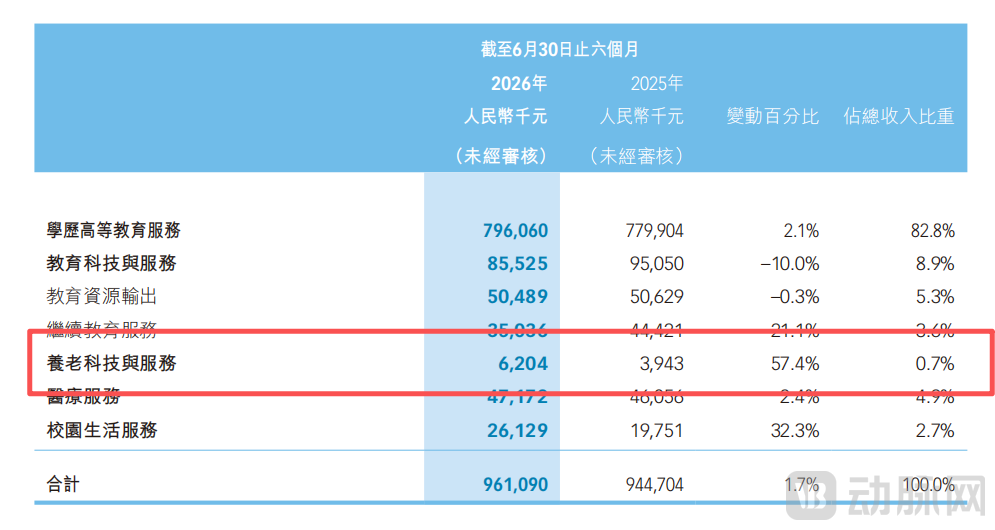
Image source: Neutech Group H1 2026 financial report
One set of figures stands out in particular — Neutech Group's elderly care technology and services segment generated revenue of RMB 6.204 million, up 57.4% year over year. It is also the fastest-growing segment within the Neutech Group.
Although RMB 6.204 million is a small absolute figure, the story behind the segment's rapid growth is worth exploring. On the one hand, the "Shengqing Kangyang" platform in Shenyang has been live for a full year, and its operational data have been validated; on the other hand, building on this foundation, Neutech Group's smart elderly care services are moving from pilot exploration to a new phase of scaled replication.
Let us first return to the problems at hand —
According to the National Bureau of Statistics, China had more than 320 million elderly people at the end of 2025. The challenges facing this vast elderly population have never been limited to a lack of services — they also include fragmented services, difficult supply-demand matching, and inadequate regulatory oversight.
As a result, institutions often operate in isolation — every nursing home has its own management system and service standards. Community services are fragmented: meal assistance, bathing assistance, and home care are provided by different entities with no data sharing between them. Families struggle to find quality services because there is no closed loop of service evaluation, leaving seniors and their children without reliable options. At the government level, precise subsidy distribution is difficult, and emergencies cannot be responded to in the first instance…
What cities need is undoubtedly an elderly care digital foundation that can better coordinate a diverse range of services — institutional and community-based care, home care and meal assistance, age-friendly products, health care, and education for seniors.
Over the past decades, elderly care informatization has produced a large number of single-point systems — institution management systems, civil affairs supervision systems, community ledger systems, and so on. But these systems do not share data, and information silos prevent resources from being effectively matched.
Policy support has been intensifying in recent years. During the "14th Five-Year Plan" period, the Ministry of Civil Affairs explicitly proposed building 15-minute eldercare service circles in cities and a county-township-village three-tier elderly care service network in rural areas. The essence of the "15-minute eldercare service circle" is clearly not to build more institutions and stack more systems as in the past, but to build a cross-institution, cross-region digital foundation that allocates resources efficiently.
Favorable technological developments are making this a reality. As AI, big data, and the Internet of Things mature, the high costs and slow responses that once plagued data collaboration have been effectively addressed, making city-level real-time data scheduling possible and creating the conditions for building a digital foundation.
Against this backdrop, the "digital foundation" question has shifted from "whether to build" to "how to build it well". Whoever can build an elderly care "digital foundation" will also hold the "infrastructure gateway" to the elderly care industry.
In June 2025, Neutech Group launched the "Shengqing Kangyang" Shenyang Integrated Platform for Basic Elderly Care Services, building a city-level smart elderly care "digital foundation" for Shenyang. It has now been exactly one year.
Unlike the common perception of a platform that simply posts information online for users to choose from, this is a service system covering government, institutions, communities, and families —
For government, the platform provides real-time supervision, data analytics, and decision support. Civil affairs authorities can precisely grasp the supply and demand of elderly care services within their jurisdictions — which areas face bed shortages in institutions, which communities have insufficient meal assistance coverage, and whether subsidies are being delivered accurately to individuals.
For institutions, combined with the "Ruixintong" integrated smart elderly care system for medicine, care, and nursing and intelligent IoT devices, they can achieve standardized services, transparent processes, and intelligent operations — from admission assessment to nursing records, from supplies management to risk alerts, everything can run on a digital track.
For communities, the platform connects grid workers, family doctors, volunteers, and other parties, delivering services to seniors' doorsteps. This corresponds precisely to the "15-minute eldercare service circle" promoted by the Ministry of Civil Affairs, solving the "last mile of service" problem.
For families, seniors and their children can easily search for services, book appointments, and leave feedback on their phones. Whether it is home nursing, meal and bathing assistance, or rehabilitation care, everything is one tap away.
Unlike other platforms, Neutech Group has thought more deeply about building an elderly care "digital foundation", consistently guided by its "integration of education, medicine, and elderly care" strategy.
Wen Tao, CEO of Neutech Group, said: "From youth to old age, what a person needs is continuous health management, not fragmented services in which 'education stays education, medicine stays medicine, and elderly care stays elderly care.'" Through the integration of "education, medicine, and elderly care," Neutech aims to connect the entire chain of health talent cultivation, disease diagnosis and treatment, elderly care, and healing and wellness, ultimately serving a person's whole-life-cycle health management.
Within this broader ecosystem, Neutech Group has further refined a closed loop tailored to the elderly. Here, "education" is the foundation. Guided by the philosophy that "elderly care begins with preventing aging, and education drives elderly care," Neutech Group established the Neusoft Phoenix College, a university for seniors. Based on its distinctive "LIFECARES — Joy, Care, Medicine, Learning, and Fulfillment" education model for seniors, the college has built "three university branch campuses plus eight wellness-travel branch colleges," developing signature content in "AI and artistic creation + health and rehabilitation + mind-body wellness travel" to help seniors rebuild their lives and gain health in the digital age. As of the end of June, the Phoenix Colleges at Neutech Group's three universities had nearly 2,000 enrollments in paid offline courses alone.
"Medicine" is the support. Neutech Group's Ruikang Cardiovascular Hospital and Ruikang Stomatological Hospital have entered stable operation, while Dalian Ruikang Rehabilitation Hospital is progressing steadily. In H1 2026, as a tertiary cardiovascular specialty hospital, Ruikang Cardiovascular Hospital was the only designated institution in Liaoning to undertake the national high-risk cardiovascular screening program. Its "Healthy Lifestyle" department has closed the loop of "prevention, diagnosis and treatment, and rehabilitation," effectively delivering lifestyle-medicine interventions to patients. Ruikang Stomatological Hospital is accelerating digital diagnosis and treatment, handling nearly 12,000 outpatient visits in H1 2026. The occupancy rate at Ruikang Home Nursing Home has remained at a consistently high 100%.
"Elderly care" is the delivery layer. The city-level digital "elderly care foundation" acts as a resource connector, integrating education, medical, and elderly care services into a single entry point. Through deep cross-sector synergy — "education assists medicine and elderly care, medicine extends into elderly care and assists education, and elderly care underpins medicine and assists education" — Neutech Group achieves deep resource linkage.
Thanks to this unique advantage, the "Shengqing Kangyang" platform in Shenyang has delivered a steady stream of milestones in its first year —
- Registered users exceeded 60,000
- Cumulative elderly public services delivered surpassed 1 million person-times
- More than 1,200 ecosystem partners onboarded
- More than 6,000 age-friendly products and services launched, covering over 30 core scenarios including home nursing visits, meal and bathing assistance, and rehabilitation care
- Platform transaction volume exceeded RMB 15 million
At the industry level, "Shengqing Kangyang", as a national pilot benchmark case, was included in the report "China AI+ Elderly Care Industry Landscape and Vendor Capability Analysis, 2026" published by International Data Corporation (IDC).
Notably, the platform's GMV exceeded RMB 15 million, indicating that transaction volume is beginning to scale. Although the share of revenue the company recognizes from it is still small, it means the commercialization path has been preliminarily validated — and is far from reaching its ceiling.
With the single-city model gradually validated, the next question is: can this model be replicated effectively?
The answer is: Yes.
To date, Neutech Group has launched 10 city-level smart elderly care platforms, and the platform model has been extended to 23 cities. By the end of 2026, it expects to complete deployment in 30 cities nationwide.
As recently as August 21, with the launch of the "Kangbaihui" platform, Neutech made a key move in the Guangdong-Hong Kong-Macao Greater Bay Area.
But going from Shenyang to the nation has never been as simple as moving a system from one city to another. What Neutech aims to export is not just a platform, but a city-level smart elderly care service system — integrating AI, big data, and the Internet of Things, combining management, operations, and services in one, providing decision support for government, cost reduction and efficiency gains for institutions, and one-stop education-medicine-elderly care services for seniors.
The difficulties along the way are obvious — systems can be standardized, but operational services themselves are hard to standardize. This is one of the core reasons some city-level elderly care platforms have failed: after expansion, many platforms ended up with "many signed contracts, few deployments, and even fewer users."
Neutech Group has clearly recognized the importance of services. Wang Xinghui, vice president of Neutech Group and president of Neutech Health Technology Company, has set three bottom lines: "Data security will not be crossed, service quality will not be compromised, and seniors' rights will not be yielded." They define the red lines for maintaining service quality amid scaled expansion.
Neutech Group's solution, ultimately, returns to the integration of "education, medicine, and elderly care."
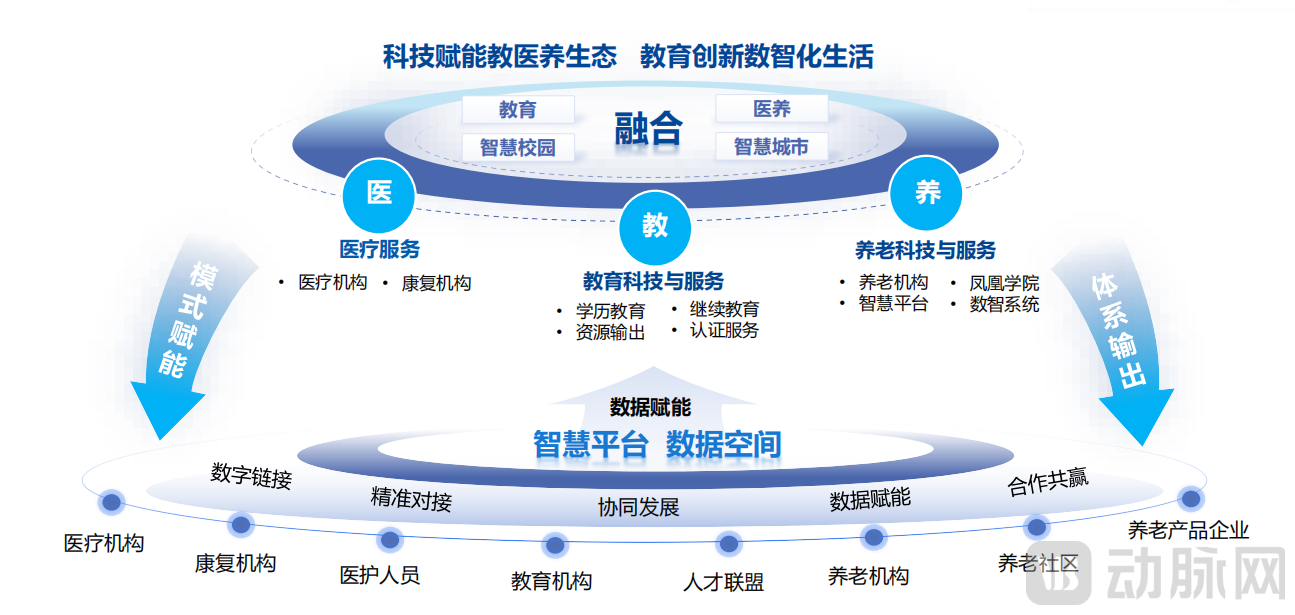
Wen Tao stated clearly: "Our three universities are the talent supply end, the research end, and the education-technology output end; the hospitals are the clinical data end, the medical service end, and the professional standards end; and the nursing homes and wellness facilities are the scenario end, the service end, and the model-validation end. Once the three are integrated, talent has a place to practice, clinical data accumulate, elderly care has professional support, and healing has a scenario in which to be validated. This is not simply 1+1+1=3 — it creates a 'multiplier effect' where 1+1+1 is far greater than 3."
For example, Ruikang Home Nursing Home has opened the "Ruikang Yizhi Experimental Class" for students majoring in "Geriatric Health Care and Management" at the three universities, converting the operational standards, service processes, and job-competency models of a Grade 5 elderly care institution directly into university curriculum, bringing frontline managers to the lectern and the scenarios into the classroom — achieving linkage across the "education, medicine, and elderly care" ecosystem. This is what distinguishes Neutech Group from other companies: a SaaS company can export systems, but it cannot export talent with hands-on experience. Neutech Group, leveraging its educational strengths, can produce in batches the talent and standards the industry needs.
According to its prospectus, degree-granting higher education services, Neutech Group's core business, generated revenue of RMB 796 million in the first half. To better serve its integrated "education, medicine, and elderly care" strategy, Neutech Group is also stepping up the development of HT (health technology) disciplines, offering programs such as intelligent medical engineering, medical informatics, medical imaging technology, health services and management, and geriatric health care and management. In education technology and services, Neutech Group continues to export educational resources by integrating technologies such as AI. Its online education platform "Neusoft Education Online" has accumulated 2.361 million registered users, continuously consolidating the cultivation of health talent.
According to LeadLeo, China's silver economy is expected to reach RMB 30 trillion by 2035. In a silver economy measured in trillions, city-level smart elderly care platforms are undoubtedly an infrastructure-level opportunity. Currently, Neutech Group's related business is just getting started, and its growth space has yet to be fully unlocked. But judging by the momentum of 10 cities live and 23 cities covered, this growth curve has already begun to turn upward.
When "elderly care" moves onto a city-level platform, the industry's rules of the game will undoubtedly change as well —
For government, the shift is expected to be from "experience-based management" to "data-driven decision-making." With real-time supply-demand heat maps on the platform, governments can distribute subsidies precisely to beneficiaries and respond to emergencies with one-click dispatch.
For institutions, the shift is from "going it alone" to "ecosystem empowerment." In the past, many institutions groped their way through management, operations, and training on their own experience — a slow and inefficient process. By connecting to the platform, they can tap into the best resources on it, improve their own capabilities, and devote more energy to services themselves.
For service providers, the shift is from "small, scattered, and chaotic" to "standardized." The platform itself sets service standards and an evaluation system, so high-quality providers can expect more resources and orders, encouraging them to raise their service quality and standards.
For seniors and their families, the shift is from "being unable to find quality services" to "one-touch access to services" — a single entry point that addresses diverse needs in education, medicine, and elderly care, with services that can be traced and evaluated.
In its financial report, Neutech Group said it will accelerate the nationwide rollout of city-level smart elderly care platforms and systematically build a standardized business system of "one platform, two centers" — focusing online on improving platform transactions and operations, and building offline training and senior education centers. Through a standardized, replicable operating model, it aims to make each platform the "digital foundation" of a city's elderly care service system, covering more cities and serving as a "booster" for the high-quality development of China's silver economy. In addition, it plans to combine technologies including "AI + big data + cloud computing + IoT + mobile internet" to develop smart elderly care solutions, driving the transformation and upgrading of the elderly care industry through intelligence, digitalization, and technology.
Objectively speaking, city-level smart elderly care platforms are still in their early stages, and the competitive landscape remains undecided. Many industry players are entering the field. Neutech Group's differentiating advantage lies in its integrated "education, medicine, and elderly care" business model. In the future, as more companies with different resource endowments join in, we look forward to seeing more players blaze innovative paths and provide smart elderly care solutions to China's silver-aging challenge.