

Reimagining Health AI: SENVIV Builds a Digital Twin Foundation with 12 Million Hours of Physiological Time-Series Data

SENVIV
Health Management Service Provider
Over the past two years, the most surprising capability of artificial intelligence has been its increasing resemblance to a “human-savvy” assistant. It can interpret medical records, answer health-related questions, and provide well-structured lifestyle recommendations based on publicly available knowledge.
But does it truly understand a specific individual?
It knows what you said, but may not know how your heart rate and breathing changed last night; it can summarize knowledge about menopause, but cannot see the subtle fluctuations of the autonomic nervous system before a hot flash; it can generate an anti-aging plan, but does not know how your body will respond after three months of implementing this plan.
This marks a watershed moment for current health AI: while models have amassed extensive knowledge about humans, they still lack data derived directly from the human body.
Looking back at the evolution of artificial intelligence, every leap in capability has been driven by an expansion of data boundaries.
Traditional deep learning identifies patterns from human digital footprints; large language models enter the mental world composed of text and symbols; embodied intelligence understands the physical environment through cameras, radar, and robots. One step further, what AI needs to understand is not merely “what a person says,” nor simply “the environment in which the person is situated,” but rather the current physiological state of the individual’s body and the direction in which it is changing.
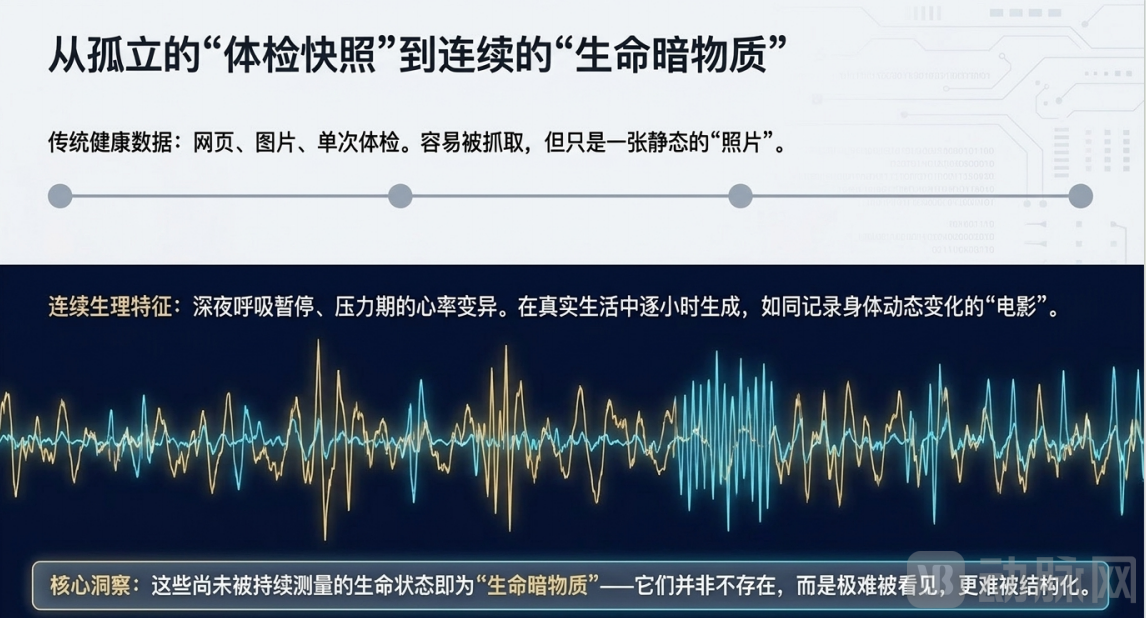
This type of data is fundamentally different from internet-based data. Web pages, images, and videos can be crawled, copied, and used repeatedly for training, whereas continuous vital signs are generated hour by hour only in real-life settings. A single health checkup is like a snapshot, while long-term physiological signals are more akin to a movie. Sleep apnea in the dead of night, heart rate variability under stress, and the slowly accumulating anomalies preceding disease exacerbation are all hidden within the dimension of time.
If the public internet is a continent already illuminated by AI, then these life states that have yet to be continuously measured can be understood as “biological dark matter.” They are not nonexistent; rather, they are difficult to observe and even harder to structure.
SENVIV opts for a non-contact, minimally intrusive approach to continuously monitor these data. During the day, the ring records daily activities and physiological changes; at night, a non-contact device placed under the pillow collects signals such as heart rate, respiration, and ballistocardiography. The less perceptible the device is, the more likely users are to use it long-term. Only by spanning a sufficiently long period can a model have the opportunity to truly understand an individual, rather than merely capturing a single measurement.
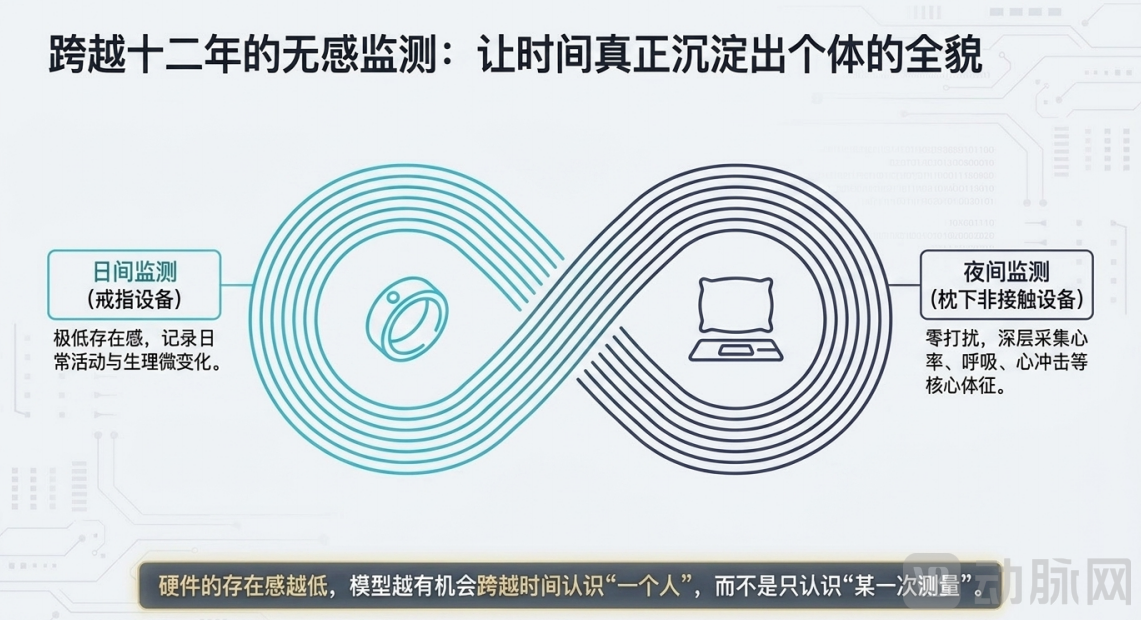
Leveraging this low-burden data acquisition framework, twelve years of continuous implementation across consumer and clinical settings have enabled the systematic aggregation of fragmented physiological time-series signals, ultimately culminating in a large-scale vital signs dataset.
Several sets of core figures vividly illustrate the depth of this accumulated expertise.
According to disclosures by SENVIV, To date, a cumulative total of 12 million hours of continuous vital signs data has been accumulated, with 3.6 million hours derived from medical settings, accounting for approximately 30%; and A total of 1,240 customer tags have been developed across dimensions such as health status, core needs, lifestyle, and consumption preferences.
These three figures point to the three most challenging pieces of the puzzle for health AI to complete: temporal duration, medical scenarios, and individual context.
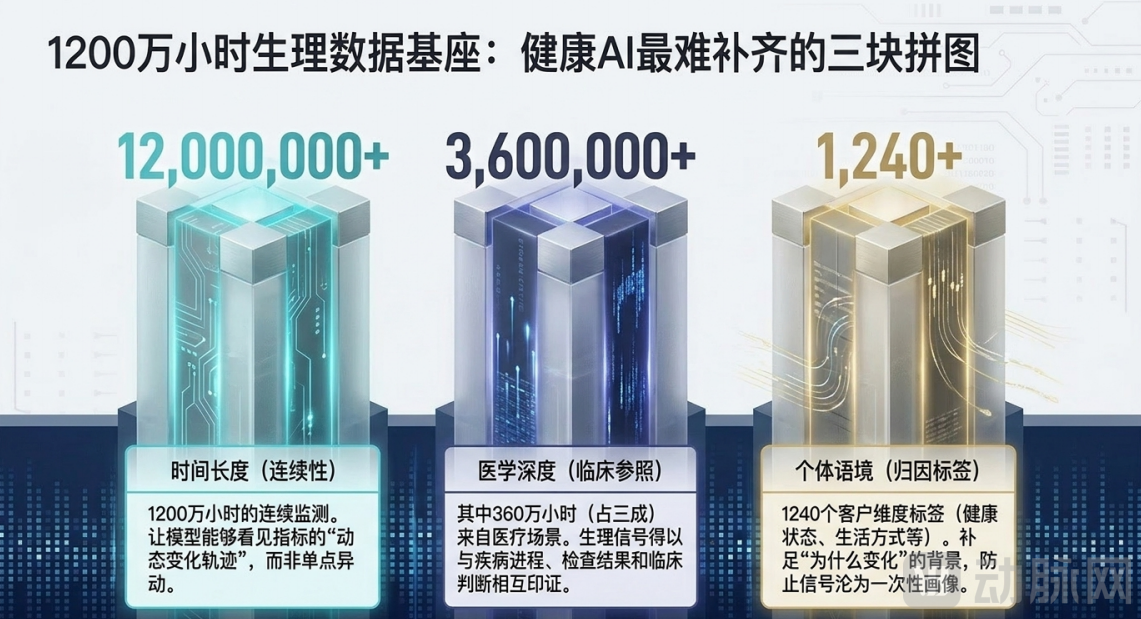
Continuous data allows the model to observe changes. Medical scenario data enables certain signals to be cross-referenced with disease progression, test results, and clinical judgments. Customer tags address the "why behind the changes"—for instance, a similar increase in heart rate could stem from exercise, anxiety, or sleep deprivation, or it may be associated with disease risk. Without context, signals are merely curves; without continuity, tags risk becoming one-off user profiles.
More importantly, Continuous data has changed the reference frame for health assessment. Traditional health management tends to categorize everyone into the same population segments, whereas Long-term monitoring enables the establishment of an individual baseline, allowing for the observation of deviations relative to one’s own data. In line with SENVIV’s current product logic, during the first seven days of use, the system combines population reference data to establish an initial baseline; thereafter, the weight of personal historical data gradually increases, and the baseline is continuously calibrated in response to changes in the user’s status.
For single-disease studies, this temporal dimension is particularly important. Many chronic diseases do not occur suddenly in a single abnormal event but rather leave behind slowly accumulating signals before onset.
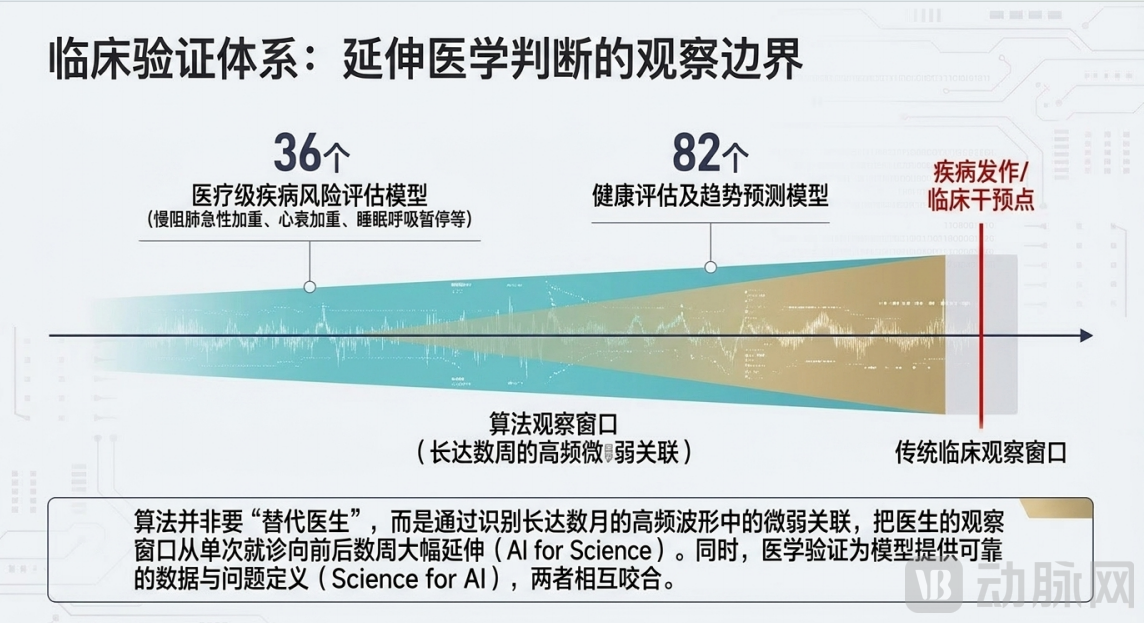
Focusing on areas such as acute exacerbations of chronic obstructive pulmonary disease (AECOPD), worsening heart failure, and sleep apnea, SENVIV has collaborated with medical institutions on research efforts. Leveraging existing data, the company has developed 36 medical-grade disease risk assessment models and 82 health assessment and trend prediction models.
A more accurate understanding of these models’ capabilities is not that they “replace physicians,” but rather that they extend the physician’s observational window from a single visit to weeks or even longer periods before and after. The specific predictive performance and applicable boundaries still need to be addressed through corresponding study designs and clinical validation.
From the perspective of SENVIV, this is precisely where AI for Science delivers genuine value in the health sector. While the human eye struggles to discern subtle correlations within high-frequency waveforms spanning months, algorithms can iteratively compare data, identify patterns, and uncover clues that were previously difficult to detect. This approach expands the boundaries of human observation rather than replacing medical judgment. Conversely, Science for AI is equally critical: medical measurements, accurate annotations, and foundational theories provide models with reliable data, well-defined problems, and validation standards. Only through this mutual reinforcement can health AI avoid drifting further away based on unverified correlations.
When data is no longer organized around a single examination or a specific disease, another possibility emerges: creating a continuously updated digital twin for an individual.
"Digital Twin" here is neither a virtual avatar nor a conversational digital human. It is more Closer to a personalized life model: continuously monitoring and receiving core vital signs such as heart rate and respiration, while synchronously recording daily health data like sleep and activity. By integrating physical examination reports, laboratory results, past health records, lifestyle habits, personal health goals, and post-intervention feedback, it gradually generates a physiological baseline and trajectory of changes unique to the individual.
The single-disease model addresses the question, “Is the risk of a specific condition currently increasing?” Personal digital twins must also address three more challenging questions: What does this change mean for you? What might trigger it? And which intervention is truly effective for you?
This shifts health management from “providing recommendations” to “conducting validation.” Interventions targeting sleep, nutrition, exercise, emotional well-being, or products are no longer one-off prescriptions that end upon delivery; instead, they become traceable actions: assessing baseline status before intervention, identifying which indicators change afterward, determining whether these changes are sustainable, and evaluating whether the regimen requires adjustment. Each round of feedback is fed back into the model, serving as the basis for subsequent decision-making. Therefore, True precision is not about getting it right in a single instance, but rather about continuously reducing errors over the course of long-term interaction.
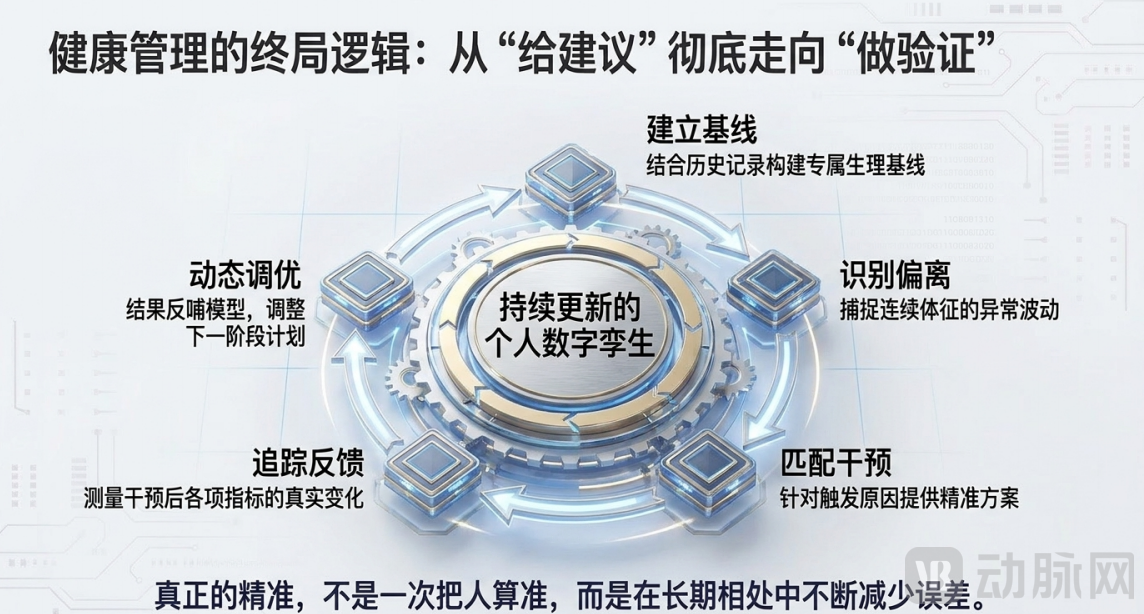
Moreover, this complete logic of “establishing a baseline – identifying deviations – providing interventions – tracking physiological feedback – dynamically optimizing the plan” is not only applicable to early warning of chronic disease risks, but also offers a new developmental approach to addressing the challenges of precision anti-aging.
High-cognition, high-investment elite women do not lack products, nor do they lack health advice. What they truly lack is a system capable of explaining individual differences, recording authentic responses, and adjusting accordingly as life stages evolve. Sleep, stress, exercise recovery, metabolic status, and perimenopausal changes are often intertwined; relying solely on age, skin type, or a questionnaire makes it difficult to explain why an individual feels fatigued or experiences slower recovery, and challenging to determine whether an anti-aging intervention has truly been effective.
Continuous vital sign monitoring offers a new window into observing these changes, but clear boundaries must be established: signals such as heart rate variability can reflect alterations in autonomic nervous system activity and stress responses, yet they cannot be simply equated with hormone levels or used as standalone diagnostic markers for specific diseases. To provide meaningful clinical insights, these data must be integrated with multidimensional information within an individual’s digital twin model. Only by synthesizing continuous physiological signals with symptoms, menstrual cycle phases, laboratory test results, and intervention feedback can precision anti-aging medicine evolve from marketing rhetoric into a measurable, reviewable, long-term healthcare service.
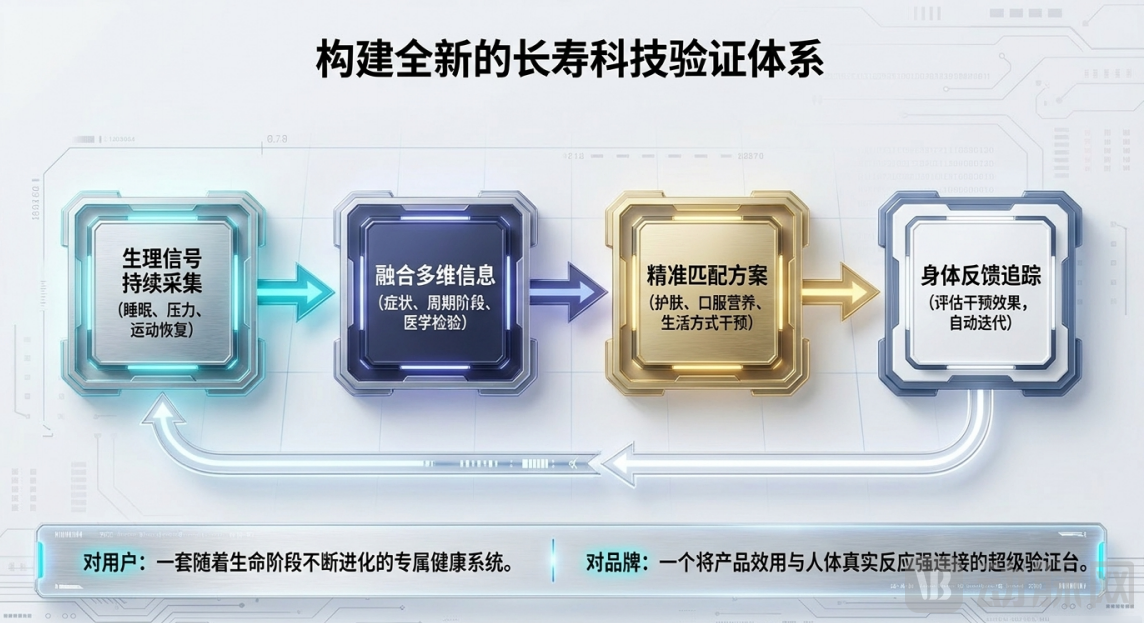
Thus, A new longevity technology pathway is taking shape: first establish a personal health baseline, then identify deviations; match skincare, oral nutrition, and lifestyle protocols to individual goals; continuously monitor physiological responses to adjust the next phase of the plan. For users, it is a health service that fosters an increasingly deeper understanding of their own well-being; for brands and service providers, it is a validation system that connects products and services with real-world responses.
The past growth logic of health consumption often relied on new products, traffic, and one-time conversions. However, this creates a new problem: when users cannot determine whether a product suits them, and brands fail to explain long-term effects, repurchases become more dependent on subjective experience and marketing efforts.
Personalized services based on continuous data collection are driving change. They connect previously fragmented steps into a closed loop: measuring physiological parameters, understanding needs, proposing interventions, tracking responses, calibrating plans, and then proceeding to the next cycle of service.For medical institutions, it can extend post-discharge observation; for health management organizations, it can enhance the continuity of services; for anti-aging brands, it can help identify suitable target populations, accumulate feedback, and foster longer-term customer relationships.
From this perspective, SENVIV aims not to replace all health products, but to serve as the underlying infrastructure.If we view high-end health consumption as a growth flywheel, continuous life data is not the flywheel itself, but rather the lubrication system that ensures the seamless interplay of measurement, intervention, validation, and repurchase. Without this system, so-called personalization risks remaining at the level of mere recommendations; with it, products and services can become increasingly precise through iterative real-world feedback.
Of course, 12 million hours do not automatically become a barrier. Data quality, effective annotation, model generalization, clinical validation, privacy protection, and whether users are willing to use it long-term will all determine how much value these data can ultimately generate. But it at least raises a question that belongs to the present: As large language models become capable of speaking like humans, will the next round of competition belong to companies that can enable machines to truly understand people?
Internet data can be replicated, whereas life data can only be generated over time. What SENVIV aims to do is transform this data, which accumulates night after night, into the foundational infrastructure for next-generation health AI.