Precision in Surgery, Synergy in Action: Consensus Medical Robotics Showcases Sentire® Surgical Robot at the 27th Annual Meeting of Urology Branch of Anhui Medical Association

Cornerstone Robotics
Innovative Surgical Robot Developer

From August 21 to 22, coinciding with the 80th anniversary of the establishment of the Anhui Medical Association, the 27th Academic Annual Conference of the Urology Branch—a series of academic activities commemorating the 80th anniversary of the Anhui Medical Association—was held in Hefei. The event was hosted by the Anhui Medical Association and its Urology Branch, and jointly organized by the First Affiliated Hospital of Wannan Medical College (Yijishan Hospital) and the First Affiliated Hospital of Anhui Medical University.Urology experts from across China and the province gathered in the Jianghuai region to jointly explore new directions for innovation in urological diagnosis and treatment, as well as for discipline development, through the exchange of ideas and mutual learning from experience.
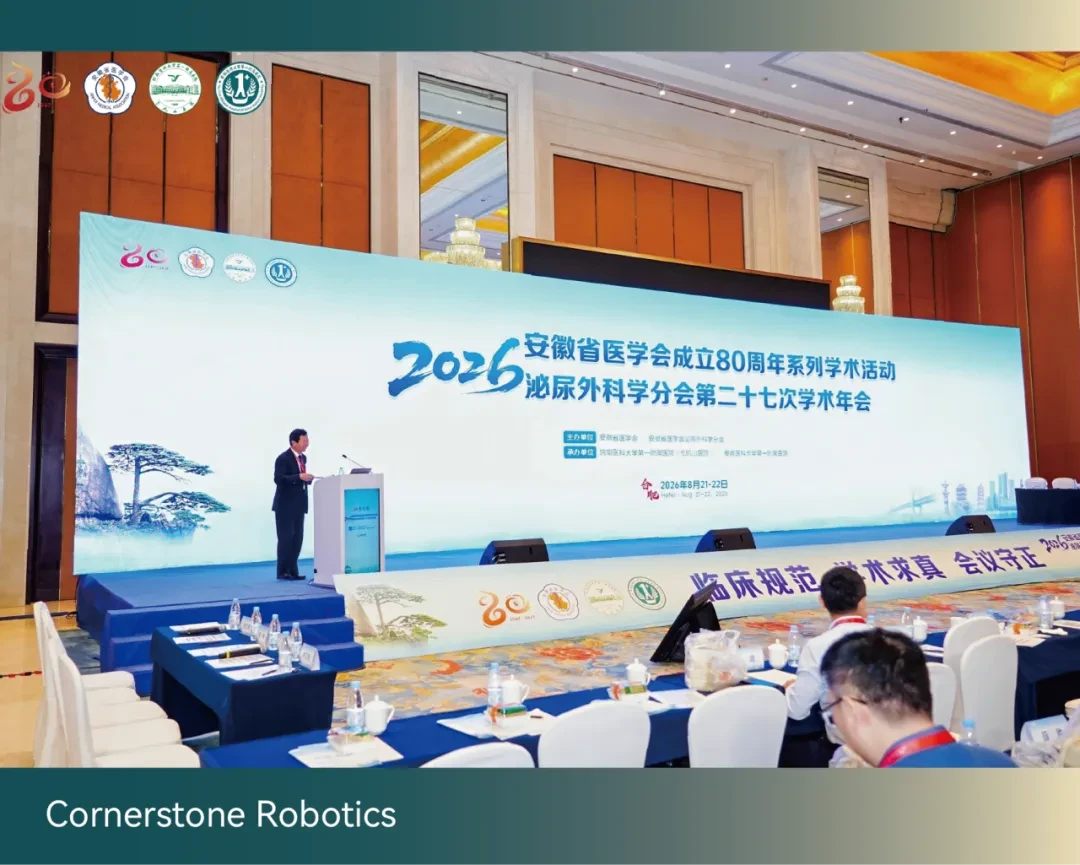
Twenty-Seven Years of Legacy and Progress: For twenty-seven years, the Annual Academic Conference of the Urology Branch of the Anhui Medical Association has remained firmly rooted in clinical practice while embracing cutting-edge advancements, playing a pivotal role in standardizing diagnosis and treatment, promoting technical innovations, cultivating talent, and fostering regional collaboration. Currently, as precision medicine, artificial intelligence, and minimally invasive surgical technologies are increasingly integrated into clinical practice, urological care is evolving from a sole focus on lesion management to a new phase that equally emphasizes trauma control, organ preservation, functional recovery, and comprehensive whole-course management. This transformation places more refined and diverse demands on clinical techniques and medical equipment.
The conference established an integrated academic exchange framework linking the main venue with seven specialized satellite sessions. The agenda covered a wide range of topics, including urologic oncology, stone disease, infection and inflammation, pediatric urology, minimally invasive techniques, voiding dysfunction and female urology, andrology, innovation and translational medicine, and specialized nursing care. Participating experts shared clinical experiences on key issues such as hilar renal tumors, urothelial carcinoma, prostate cancer, complex renal calculi, urinary tract infections, and pelvic floor dysfunction. Furthermore, in-depth discussions were held on artificial intelligence-assisted research, endoscopic surgical data processing, quality control model development, and perioperative management, thereby providing multidimensional insights to drive the high-quality development of the discipline.
The agenda of the conference clearly demonstrates that robot-assisted surgery has progressed from exploring technical feasibility to a new stage characterized by the parallel advancement of procedural refinement and value verification. Topics such as robot-assisted partial nephrectomy, ureterectomy, and cystectomy; retroperitoneal robot-assisted radical prostatectomy; and robot-assisted management of pelvic organ prolapse were frequently featured. Expert discussions further focused on key aspects including surgical approaches, tissue handling, instrument coordination, functional preservation, and postoperative recovery, reflecting the clinical community’s ongoing pursuit of precision, standardization, and reproducibility in robotic surgery. Participating experts generally agreed that technological transformations centered on robot-assisted surgery are increasingly becoming a crucial key to addressing the challenges in diagnosing and treating complex urological diseases.
During the conference, the Sentire® laparoscopic surgical robot system, independently developed by Cornerstone Robotics, attracted widespread attention from on-site experts. Guided by real clinical needs, the Sentire® system delivers synergistic advantages in visual presentation, control responsiveness, and instrument design. Its integrated dual-optical-path endoscope provides surgeons with a clear and natural three-dimensional surgical field, while the “Smart Direct Drive” system enhances motion response and control follow-through. The 5-mm flexible wristed instruments allow ample space for multi-angle manipulation within confined areas. Through the seamless coordination of these components, the system offers robust support for dissection, cutting, suturing, and reconstruction in complex anatomical environments, enabling surgeons to perform delicate procedures with greater ease and precision.
The vitality of a technology stems from its routine clinical refinement. Currently, Sentire® has demonstrated high clinical stability and safety in the field of urology. In daily clinical practice at renowned medical institutions such as the Chinese University of Hong Kong Hospital and Nanjing Drum Tower Hospital, Sentire® has assisted in a significant proportion of highly complex and challenging urological surgeries, highlighting its strong clinical utility and broad prospects for expanded application.
While continuously advancing clinical applications, Cornerstone Robotics has always placed great emphasis on in-depth exchanges with clinical experts. At the conference, the Cornerstone Robotics team engaged in discussions with urology specialists and clinical peers from Anhui Province and across China, focusing on topics such as the practical application of robotic surgery, procedural optimization, and standardized training. Guided by clinical needs, they jointly explored how surgical robot technology can be further integrated into daily diagnosis and treatment, providing more precise and flexible technical support for a wider range of complex urological procedures.
Eight Decades of Medical Heritage, Twenty-Seven Editions of Collaborative Renewal. This grand event not only showcased the dynamic progress of urology in Anhui Province but also established a vital platform for bidirectional exchange between clinical experience and innovative technologies. Moving forward, Cornerstone Robotics will remain deeply rooted in clinical settings, working hand in hand with experts and peers to expand the boundaries of precise minimally invasive surgery. By leveraging continuously evolving Chinese innovations, we aim to enhance the quality and upgrade the standards of urological diagnosis and treatment, delivering tangible benefits from high-quality medical technological advancements to more patients.