

¥7‑Billion Deal for a US Firm: Why Are Chinese Peers in the Same Track Worth Only ¥1‑Billion?

Landing Med
Developer of Cervical Cancer Diagnostic Robots

Dipath
AI-Assisted Diagnostic Tool Developer
In May 2026, Roche Diagnostics acquired the U.S. pathology AI company PathAI in a full buyout for $1.05 billion (approximately RMB 7 billion). This transaction is not only the largest M&A deal in the global pathology AI sector to date but also serves as a mirror, reflecting the valuation gap between Chinese and foreign pathology AI companies: Valuations of leading domestic pathological AI companies mostly range from RMB 1 billion to RMB 3 billion, several times lower than that of PathAI.(1-7x)Distance.
Where Does the Gap Stem From? Should Chinese Companies Replicate PathAI’s Pharmaceutical Service Model? Following Roche’s Acquisition of PathAI, How Can Chinese Pathology AI Firms Accelerating Their Global Expansion Challenge Roche in the International Market?
Judged solely by technical indicators, there is no generational gap between Chinese and foreign pathological AI; in fact, domestic companies hold advantages in the scale of training data and the number of model parameters. Taking CELLSVISION as an example, multiple studies published in The Lancet and the Nature series have demonstrated that its product performance is at a world-leading level. This signifies that, from a technological perspective, domestic pathological AI enterprises represented by CELLSVISION have established their own voice on the international stage.
The crux of valuation divergence lies in the maturity of business models.
PathAI has successfully established a scalable, monetizable business loop. Its core products are deeply integrated with multinational pharmaceutical giants such as Roche, GSK, and BMS, with over 60% of its revenue derived from pharmaceutical companies. The remaining income comes from diversified business lines, including software licensing, SaaS services, laboratory testing, and algorithm licensing for hospitals.
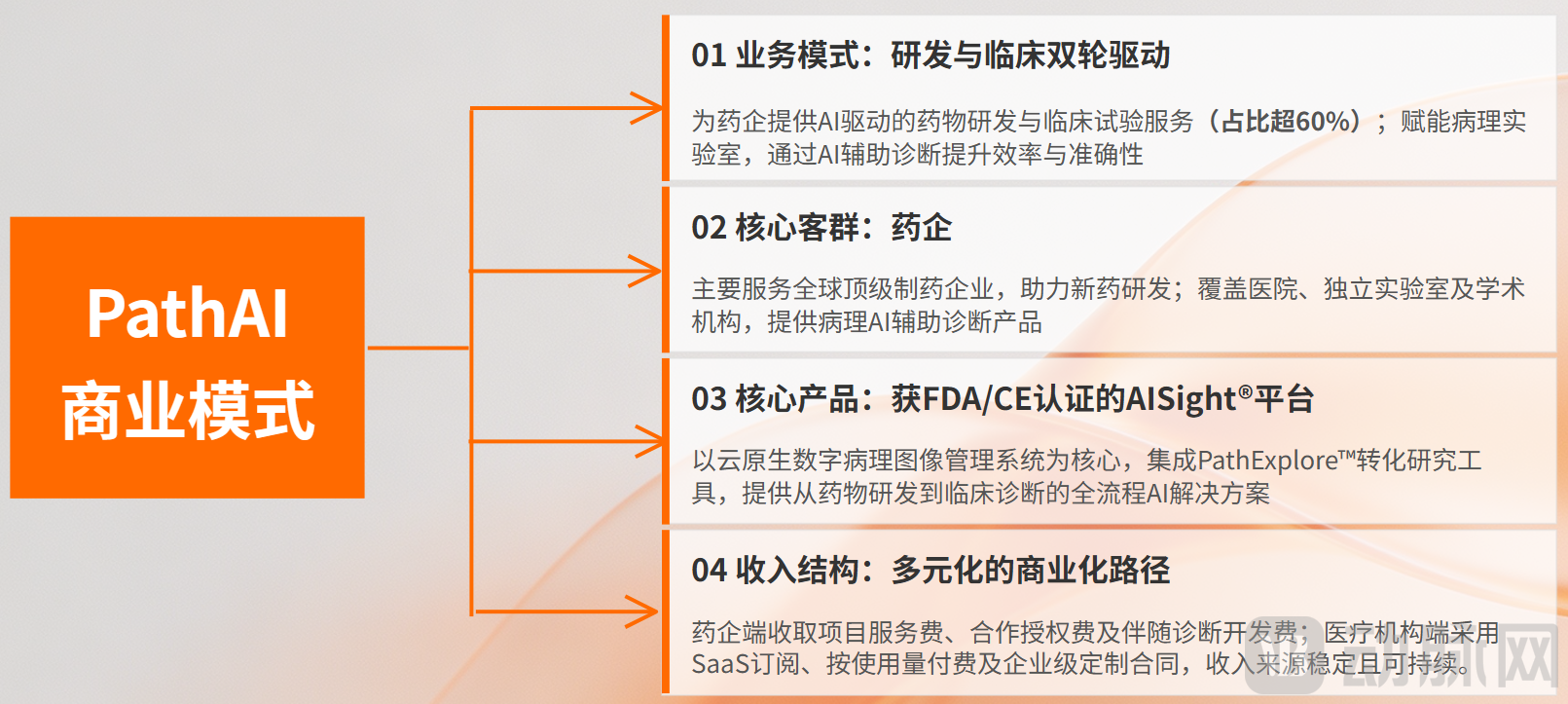
(PathAI Business Model Structure Diagram)
High-ticket, high-retention, and high-margin pharmaceutical clients have underpinned PathAI’s scaled revenue. Third-party estimates place its total 2025 revenue at approximately $100 million to $250 million, with growth rates maintained in the 30%–40% range. The higher the business certainty, the more substantial the valuation premium awarded by capital markets.
Looking Back, The AI Pathology Sector in China, Pathology AI Products' Commercialization is still in the exploratory stage.
Lin Zhencheng, a partner at Dalton Venture, pointed out: “For a long period in the past, AI-assisted pathological diagnosis lacked a basis for charging fees, making it difficult to charge directly. At the end of 2025, the National Healthcare Security Administration issued the ‘Guidelines for Establishing Price Items for Pathology-related Medical Services (Trial),’ which filled the policy gap for compliant fee collection. However, in the detailed pricing rules implemented by various provinces and cities, AI-based pathology is mostly treated as an extended diagnostic service without a separate fee item, with related costs directly included in the original diagnostic fees, thus preventing separate charges.”
To address this issue, CountryMultiple policy measures have been implemented to support and promote the charging for pathology AI services. As guided by the “Guidelines for Establishing Price Items for Pathology-related Medical Services (Trial)” issued by the National Healthcare Security Administration, provinces and municipalities are advised to account for the resource input costs associated with AI-assisted diagnosis when setting prices, implement overall price-level adjustments and guidance, and streamline the reimbursement pathways for the application of AI-assisted diagnostic technologies. Medical institutions may independently decide whether to adopt AI-assisted diagnostic technologies and which company’s products to use, with specific revenue-sharing arrangements determined through negotiation between the medical institutions and the enterprises.
Given the annual volume of over 100 million pathology examinations in China and a shortage of more than 100,000 pathologists, the domestic market has an extremely urgent demand for AI-powered pathology solutions. Furthermore, the country’s vast population and high examination volume are poised to cultivate a pathology AI services market exceeding RMB 10 billion, indicating substantial growth potential.
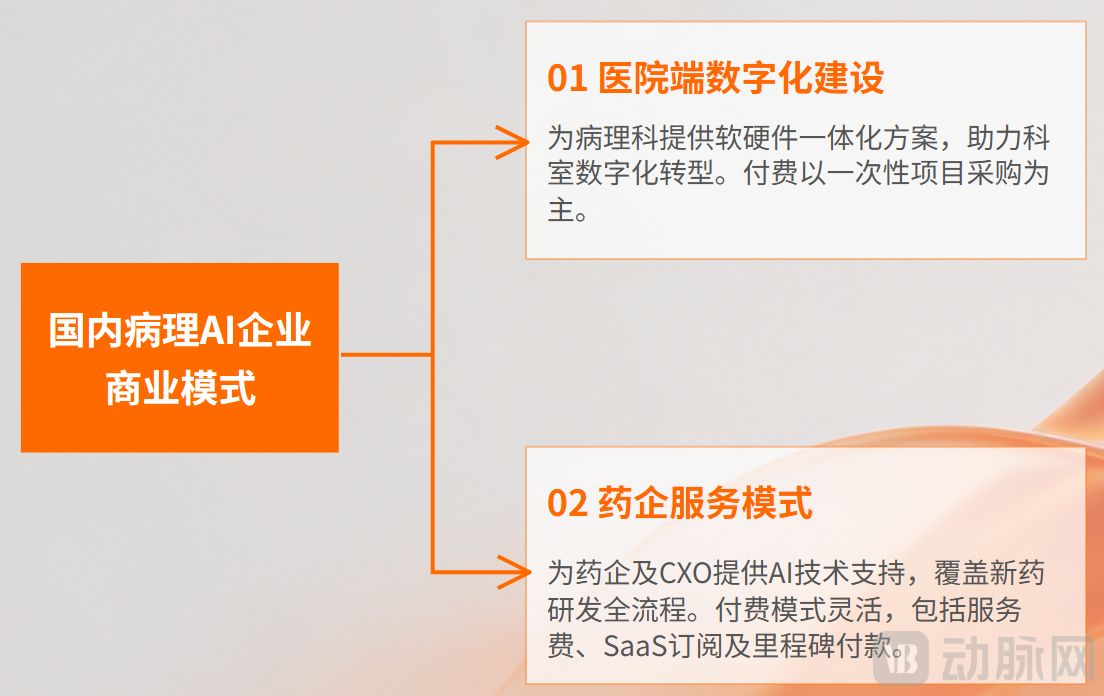
(Current Business Models of Domestic Pathology AI Enterprises)
Currently, pathology AI companies in China have explored another commercialization path. It is reported that the revenue growth rates of several leading domestic pathology AI companies have exceeded 100% for several consecutive years, with their Revenue Mainly coming SelfHospital Department of Pathology of Digitalization Project.
In the digitalization of pathology, one-off projects such as the sales of hardware and software equipment and the establishment of pathology information systems account for the majority. This revenue structure, heavily skewed toward one-time, equipment-driven income, constrains the valuation levels of domestic enterprises.
However, Digitalization ConstructionIt is inherently a high-growth sector. The policy issued by the National Healthcare Security Administration explicitly states: For hospitals that fail to provide "digital pathological slide images," a fee reduction of 5 yuan per slide will be applied, with a maximum reduction of 15 yuan per encounter.
Yang Lin, founder of Dipath, stated, “The introduction of national policies is not only compelling hospitals to accelerate the digital transformation of pathology but also providing clear direction for the industry. Building a digitally intelligent pathology department is far more than simply acquiring a few scanners, software modules, or upgrading the pathology information system. Instead, it requires forward-looking top-level planning with large AI models serving as the central ‘brain’ over the next three to five years. We are committed to constructing a comprehensive, scenario-based intelligent platform that covers clinical diagnosis, remote consultation, teaching and research, and data translation, thereby bringing the vast amounts of accumulated pathological data truly ‘to life’ and ultimately helping pathology departments significantly enhance their overall competitiveness in industry, academia, and research.”
As the digitalization of pathology accelerates, the volume of digital pathology slide image data is expected to surge, providing massive datasets for the optimization, upgrading, and large-scale training of AI-assisted diagnostic models in pathology, thereby paving the way for their commercial application.
By the end of 2024, there were approximately 38,700 hospitals in China, among which about 16,400 were secondary-level or above hospitals required to establish pathology departments. These hospitals constitute the core demand drivers for the digitalization of pathology AI. However, the overall penetration rate of pathology digitalization remains below 10%. Against this backdrop, the dividends from the digital transformation of pathology departments are expected to persist for at least another 3–4 years.
Additionally, Some domestic pathology AI companies are also attempting to enter the pharmaceutical services sector. However, innovative enterprises in the United States inherently enjoy a valuation premium. Moreover, the overseas innovative drug industry is highly mature, with unit prices for pathology-related service orders from pharmaceutical companies significantly higher than those in China. Although China’s innovative drug industry is rising rapidly, the scale of pharmaceutical companies’ procurement of pathology AI remains limited, and order unit prices are relatively low, further widening the valuation gap between Chinese and foreign enterprises.
Overall, the divergence in revenue structures and business models between domestic pathological AI companies and PathAI stems from differences in industrial foundations, market demands, and the maturity of innovative drug R&D between China and the United States. Underlying these differences are the distinct industrial pain points that each side seeks to address.
At its inception, although the United States also faced a structural shortage of pathologists and there was genuine demand from healthcare institutions for pathology tools that improve efficiency, the highly concentrated overseas innovative drug industry, characterized by substantial R&D investment by pharmaceutical companies, created even greater demand for pathological AI to shorten clinical trial cycles, reduce R&D costs, and conduct drug efficacy assessments, along with a stronger willingness to pay. This market environment naturally positioned PathAI to target the high-margin, high-retention sector of pharmaceutical company services.
At their inception, domestic pathology AI companies faced a reality characterized by a vast number of hospitals, a significant shortage of pathology professionals, strong demand for disease diagnosis across the population, and weak digital infrastructure in pathology departments. The core industry demands were to address deficiencies in clinical diagnosis and treatment, improve the efficiency of pathological diagnosis, and complete the digital transformation of pathology departments. This has led the vast majority of domestic companies to focus on the clinical market.
Given this industrial backdrop, the industry should not view clinical diagnostics and pharmaceutical services as a relay race between the “first half” and the “second half”, nor should it conclude that the clinical sector holds lesser value. These are not two sequential stages but rather two parallel, symbiotic value strands—while their pacing may differ, their value is equally significant.
CELLSVISION CEO Chen Rui stated, “The pathology AI sector in China has its own unique ceiling logic—the vast population base and the rigid demand for screening and diagnosis involving over 100 million people annually determine a highly certain fundamental market, which also serves as a real-world data pool unparalleled globally. Therefore, our strategy is clear: deepen and solidify our presence in clinical settings to secure our core business, while leveraging AI innovative services and globalization to open up a second growth curve. The current refinement and iteration of our business model is merely an inevitable stage preceding the industry’s explosion; the long-term value of this sector is beyond question.”
Therefore, domestic pathology AI companies need not wholly replicate PathAI’s pharmaceutical service model. The success of Roche and PathAI is rooted in the U.S. industrial ecosystem and is not entirely suited to the Chinese market. However, Chinese practitioners can draw valuable lessons from overseas enterprises’ global expansion strategies, premium client service systems, and professional delivery capabilities for pharmaceutical projects.
Multiple interviewees also recommended: Chinese Pathology AI Companies Should Pursue a Dual Strategy of “Clinical Diagnosis + Pharmaceutical Services” Clinical diagnosis is the core source of data and an essential element for optimizing and iterating AI, which cannot be abandoned; pharmaceutical enterprise services are key businesses for boosting revenue and profits, as well as enhancing corporate service capabilities and competitiveness.
Of greater note, a cohort of Chinese pathology AI companies has accelerated its global expansion and is poised to engage in direct competition with the “Roche + PathAI” alliance in the global market.
Following the acquisition, Roche will leverage its global channel resources to further enhance PathAI’s competitiveness in overseas markets. Meanwhile, Chinese pathology AI companies are also accelerating their international expansion:
CELLSVISION has implemented its “AI+SaaS” model in Italy, while actively expanding into markets such as South Korea, Vietnam, Russia, Mexico, Turkey, the Philippines, Bangladesh, Thailand, and Indonesia;
Wuhan Landing Med exports Chinese screening solutions, with its fully automated, intelligent cervical cancer screening system implemented in 16 countries, including Pakistan, Brazil, and Cambodia;
Dipath’s intelligent digital pathology solutions have expanded to over ten countries worldwide, with its AI-assisted diagnostic tools and large pathology models operating stably 24/7 in more than 1,500 hospitals.
A head-to-head confrontation in the global market is inevitable. “Roche + PathAI” and domestic pathology AI companies each have their own competitive trump cards.
As a benchmark in the global field of AI-powered pathology, the advantages of “Roche + PathAI” are concentrated on three levels:
In terms of brand ecosystem, PathAI has secured a place among the supplier rosters of top-tier global pharmaceutical companies, enjoying high recognition from multinational pharma firms; consequently, its customer base is not easily poached in the short term.
In terms of compliance qualifications, it holds core European and American certifications such as FDA clearance and CE-IVD, possesses the necessary access qualifications for pharmaceutical R&D scenarios, and secures the entry ticket to the pharmaceutical services market;
In terms of channel resources, Roche’s industrial network will continue to empower PathAI, helping it expand its pharmaceutical company client base, deepen its understanding of their needs, and enhance its overall service capabilities.
However, this combination is not impregnable.
Backed by Roche, PathAI’s independence is inherently constrained: Competing pharmaceutical companies of Roche harbor concerns, and the lack of neutrality creates room for substitution by domestic third-party enterprises.
In terms of product offerings, PathAI’s business is concentrated on AI-powered pathology software services, lacking a comprehensive suite of products that includes hardware, consumables, and in-hospital information systems. This makes it difficult to meet the integrated deployment needs of healthcare institutions. Furthermore, with persistently high labor costs in North America, PathAI’s project pricing is significantly higher than that of Chinese companies.
Addressing PathAI’s Strengths and Weaknesses, Chinese Pathology AI CompaniesLaunch offensives on two fronts: the global primary care market and the pharmaceutical enterprise services market.
This is the niche market segment where PathAI has the lowest willingness to invest, yet it is where Chinese companies hold the most prominent competitive advantages.
Taking Landing Med as an example, the starting point of its product development is to address common pain points such as the global shortage of pathology professionals, manual slide reading errors, and insufficient testing efficiency.
Landing Med has developed an integrated hardware and software solution, covering a full spectrum of pathology diagnostic products, including scanners, compatible consumables, AI vertical large models, and digital information management platforms. Meanwhile, it has established a comprehensive cervical cancer screening system for the global market, featuring "primary-level sampling, intelligent slide preparation, cloud-based diagnosis, and end-to-end traceability."
As of the end of July 2026, Landing Med’s products had reached over 2,000 medical institutions across 30 provinces in China, cumulatively completing cervical cancer screenings for more than 13 million women. In global markets, its operations have been established in 16 countries, including Pakistan, Brazil, and Cambodia, with clinical certifications obtained in multiple nations.
Data speaks most convincingly to international clients: In Landing Med’s project in Pakistan, clinical validation demonstrated 100% sensitivity for positive cases; data from Brazil showed that the AI system increased the positive detection rate by 5.9% compared to manual review and reduced slide reading time by 45%.
In the past two years, Landing Med has frequently appeared at international conferences, participating in more than ten industry events such as the United States and Canada Pathology Annual Meeting and the European Cytology Conference. Through technical roadshows, online matchmaking, and equipment trials, it has customized digital pathology solutions for different countries. "Try Before You Buy”model, which has reduced the decision-making concerns of overseas customers and gradually opened up the market.
Unlike domestic pathology AI companies, PathAI places greater emphasis on high-margin orders from pharmaceutical companies and shows limited interest in pursuing screening projects characterized by low unit prices, heavy implementation requirements, and long cycles.
Therefore, Chinese enterprises are poised to capture a significant share of the markets in developing countries and at the primary healthcare level globally, leveraging their comprehensive hardware and software product portfolios, cost-effectiveness, and proven implementation experience. This will enable them to accumulate cash flow, clinical data, and overseas brand reputation, thereby building momentum to penetrate the pharmaceutical service market.
Pharmaceutical companies have raised the bar for pathology AI, demanding higher standards in international delivery, regulatory compliance, and quality stability. With a mature commercial loop and the backing of the Roche ecosystem, PathAI holds a competitive edge in customer trust and project service capabilities.
Yet, the product capabilities of Chinese companies are by no means inferior. The scale of training data for domestic pathology AI can reach ten times that of overseas counterparts, with model parameters five times larger. A study by Dipath, soon to be published in Nature, shows that in over 20 tasks involving pathology-assisted diagnosis and gene phenotype prediction, domestic pathology models outperform mainstream US vertical large models by 2% to 3%.
Beyond product offerings, pharmaceutical companies also value the comprehensive capabilities of pathology AI firms, including their professional service expertise and international delivery capacity. In this regard, Domestic enterprises are also accelerating the commercial implementation of pharmaceutical services:Dipath has established deep strategic partnerships with the majority of the global Top 50 multinational pharmaceutical and medical device companies—including AstraZeneca, Zeiss, Roche Diagnostics, Takeda China, Hologic, Astellas, and Betta Pharmaceuticals—as well as leading domestic pharmaceutical firms and top-tier CXO providers. Xellar Biosystems’s AI-based pathology recognition system has been integrated into Pfizer’s global R&D pipeline. Medigenpro has built a comprehensive digital and intelligent pathology CRO platform covering study design, AI analysis, and regulatory compliance filings, serving numerous domestic pharmaceutical companies.
Currently, Chinese pharmaceutical companies lag behind PathAI in terms of order volume and unit price per project. If they can achieve regulatory compliance for entry into European and American markets, domestic enterprises are poised to capture a significant market share by leveraging superior model performance, lower costs, and higher delivery efficiency. However, Chinese companies face inherent data regulatory barriers when expanding into European and American markets, just as Western companies encounter similar challenges when entering the Chinese market.
Overall, Southeast Asia, the Middle East, Latin America, etc. Market In markets characterized by scarce pathology resources, high screening demand, and weak medical infrastructure—conditions that align closely with the domestic market environment in China—Chinese enterprises offering integrated hardware-software solutions that are low-cost and easy to implement will gain a competitive edge.
European and American Markets: PathAI will rely on its brand, credentials, and customer barriers to maintain its competitive advantage. Domestic companies will continue to face challenges such as data regulation, resulting in a relatively slow pace of penetration and substitution, and they still need to explore overseas expansion models suited to their specific circumstances.
China's Domestic Market: This sector possesses unique characteristics: on one hand, there is robust demand for clinical diagnosis, resulting in an exceptionally high market ceiling; on the other hand, the rapid development of innovative drugs in China has propelled the number of clinical trials to the top globally. Consequently, the demand for pathology services among pharmaceutical companies is poised for growth, driven by the demonstration effect of PathAI.
In the Chinese market, domestic enterprises are expected to firmly maintain their dominant position in the local primary care screening sector, while overseas companies may enter the pharmaceutical services segment. However, they are likely to face data regulatory constraints and lack significant advantages in product performance and delivery efficiency. In contrast, leveraging established service cases and continuously strengthened international delivery capabilities, domestic enterprises are poised to capture a larger share of the local pharmaceutical services market.
Considering the multiple dimensions of technological iteration, commercialization, and global competition, we predict that in the next 3-5 years, it will be difficult for a single dominant player like “Roche + PathAI” to emerge in the global pathology AI market. Instead, the industry is more likely to evolve into a new landscape characterized by dual-polar parallel development, localized competition, and the breakthrough of Chinese forces.
In the high-end pharmaceutical markets of Europe and the United States, Roche and PathAI will continue to maintain their traditional advantages, while Chinese enterprises are steadily penetrating these markets and gradually capturing share in niche segments. In emerging global markets, Chinese companies have taken the lead, capitalizing on incremental growth opportunities and achieving business iteration and upgrading. In the domestic Chinese market, local firms are safeguarding their core base and engaging in direct competition with overseas giants in the pharmaceutical services sector.
The Path to Development for AI in Pathology in China: Not by Copying the Success Models of Overseas Giants, but Through the Accumulation of Millions of Domestic Pathology Data Cases, Continuously Iterated Technological Products, and Ongoing Global Implementation Practices.
The next three to five years will be a critical window for Chinese pathology AI companies to reshape the global industry landscape.
Note: We extend our gratitude to Chen Rui, CEO of CELLSVISION; Lin Zhencheng, Partner at Dalton Venture; and Yang Lin, Founder of Dipath, for their support of this article.