

Improved Functional Scores in ALS Patients: How Was This China‑Originated Innovative Drug Developed?
For the development of new drugs for amyotrophic lateral sclerosis (ALS), "slowing the decline" has long been a key objective.
Therefore, when in a randomized, double-blind, placebo-controlled clinical trial, the functional scores of patients in the treatment group not only failed to continue declining along the disease progression but instead showed an overall upward trend, the first thing these data changed was people's perspective on evaluating an ALS candidate drug.
On August 15, at a sub‑forum of the Tiantan Conference on Clinical Care and Translational Research for Rare Neurological Diseases, Darwin‑ALT001 (referred to as "Darwin‑001"), a China‑originated central‑nervous‑system candidate drug, presented results from two Phase I clinical studies. The registrational Phase I ALS trial was led by Professor Wang Yilong from Beijing Tiantan Hospital as Principal Investigator (PI). During the release session, Li Shuya, Director of the Clinical Trial Center and Ward Head for Phase‑I Studies at Beijing Tiantan Hospital, presented the single‑ and multiple‑dose Phase‑I data from healthy volunteers. Chen Weiqi from the Department of Neurology, Beijing Tiantan Hospital, unveiled data from the dose‑escalation Phase‑I study in ALS patients.
These two studies address two fundamental questions for this novel‑class biologic after human administration: whether it can establish safety and dosing foundations in registrational clinical trials, and whether the patient signals previously observed in investigator‑initiated studies can be reproduced in registrational settings.
The answer has not yet reached its conclusion, but it has taken a step worth tracking.
The most closely watched data came from a randomized, double-blind, placebo-controlled, dose-escalating Phase I study involving 36 patients with amyotrophic lateral sclerosis (ALS).
The study utilized the Revised Amyotrophic Lateral Sclerosis Functional Rating Scale (ALSFRS-R) to monitor changes in patient function. This scale comprises 12 items, with a total possible score of 48, covering abilities directly related to activities of daily living, including speech, swallowing, fine motor skills of the hands, dressing and self-care, turning over in bed, walking, climbing stairs, and respiratory function. Higher scores indicate greater preservation of function; as the disease progresses, scores typically decline gradually.
On Day 31 post-dosing, the ALSFRS-R scores in the three Darwin-001 dose groups (1.0, 2.0, and 4.0 μg/kg) increased by 1.22, 0.78, and 0.44 points, respectively, compared to baseline; during the same period, the placebo group showed a decrease of 0.78 points from baseline. After adjustment using a statistical model, the between-group differences relative to placebo were +2.00, +1.56, and +1.22 points, respectively.
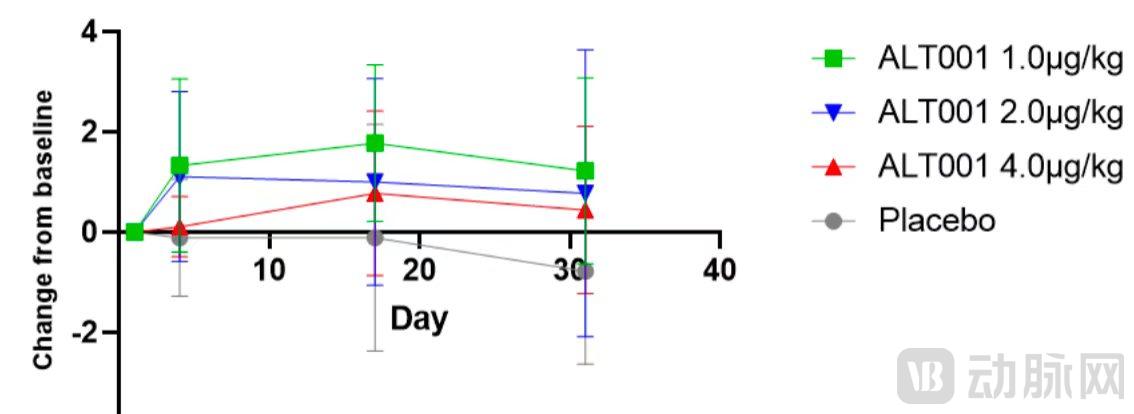
Change from Baseline in ALSFRS-R Scores by Dose Group (Source: Darwin Biotech)
In other words, within the early observation window of the same randomized controlled trial, the placebo group continued the downward trend in scores, whereas all three treatment groups exhibited an upward shift in scores.
In the course of ALS, a disease characterized by progressive motor neuron damage and declining physical function, functional improvements that deviate from the natural trajectory of deterioration are rarely observed in global clinical studies. This randomized controlled trial captured this highly valuable clinical phenomenon, suggesting that the candidate drug demonstrates considerable potential for neurorepair and functional recovery. Subsequent randomized controlled trials with longer treatment durations and larger sample sizes will be conducted to further validate the long-term sustainability and reproducibility of this reparative effect, confirming whether it can consistently translate into tangible, perceptible clinical functional benefits for patients.
Notably, in the same study, functional metrics and objective biomarkers of neurological injury exhibited concordant changes.
Neurofilament light chain (NfL) is a crucial component of the neuronal axonal cytoskeleton. Upon axonal injury, NfL is released into the cerebrospinal fluid and bloodstream, making it a commonly used biomarker to reflect the extent of axonal damage. On day 31, plasma NfL levels in the Darwin-001 2.0 μg/kg and 4.0 μg/kg groups decreased by 17.2% and 17.1%, respectively, from baseline, compared to a 2.7% decrease in the placebo group.
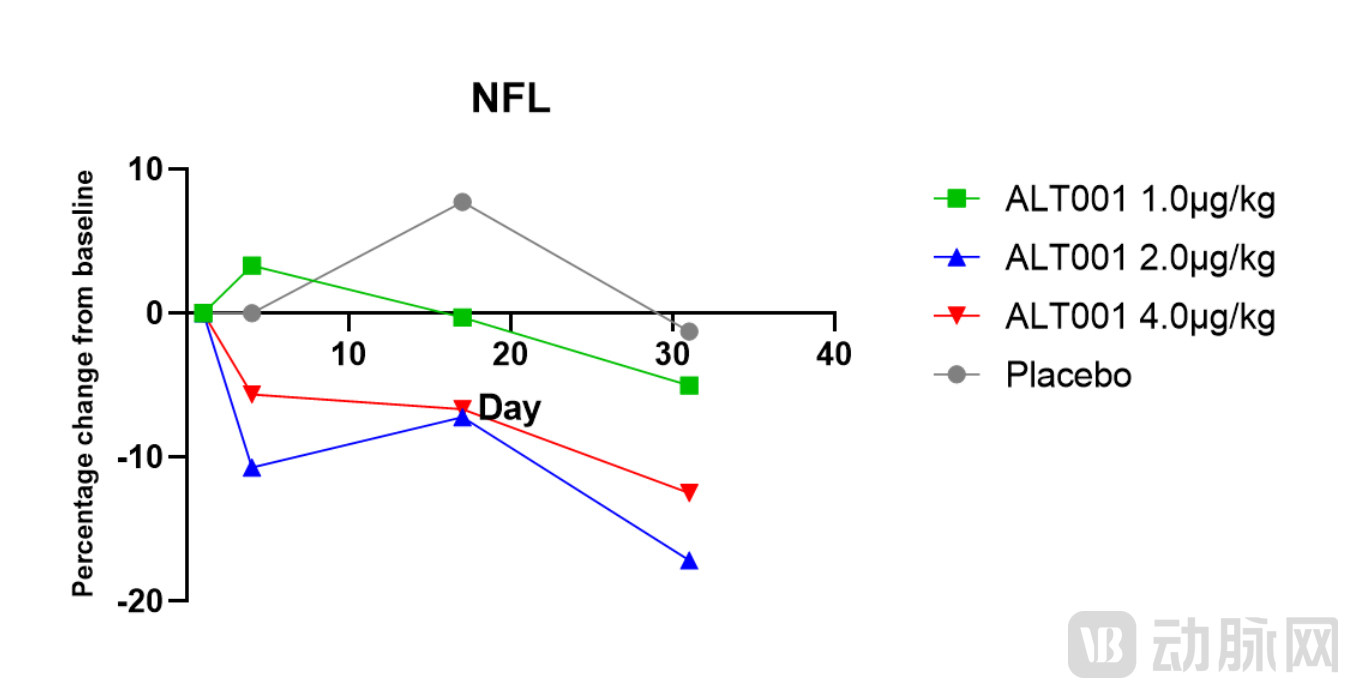
Change from Baseline in NfL by Dose Group (Source: Darwin Biotech)
At one end is a comprehensive functional score covering dimensions such as eating, turning over, walking, fine motor skills, and respiration; at the other are objective biomarkers reflecting axonal injury. The concurrent positive changes observed in these two distinct types of metrics within the same randomized controlled trial constitute the core finding of this Phase I data set that has garnered the most industry attention.
Looking solely at the "1.56-point" difference, non-specialist readers would find it difficult to assess its significance in ALS drug development. A relevant industry benchmark comes from edaravone, an approved ALS therapy. The pivotal Phase III trial supporting its approval enrolled 137 patients with early-stage ALS who met stringent inclusion criteria. At 24 weeks, the ALSFRS-R score declined by 5.01 points from baseline in the edaravone group versus 7.50 points in the placebo group, yielding a between-group difference of 2.49 points. In other words, the demonstrated value of this approved drug lies in attenuating functional decline; scores in the treatment group still decreased.
Darwin-001's Phase I and Phase III studies differ in sample size, patient composition, treatment duration, and statistical methods; therefore, efficacy cannot be directly compared based on these data alone. However, examining only the timing, direction, and magnitude of the observed signal, Darwin-001 demonstrated a corrected between-group difference of 1.22 – 2.00 points by Day 31, with the 2.0 μg/kg group showing a difference of 1.56 points. More importantly, this difference arose not because the treatment group declined more slowly, but because the treatment group increased by 0.78 points from baseline while the placebo group decreased by 0.78 points over the same period. For a Phase I study primarily aimed at assessing safety and exploring dosage, this signal holds significant industry interest.
Another global reference case is tofersen, a therapeutic for SOD1‑ALS. Public FDA documents show that tofersen failed to meet its pre‑specified primary clinical endpoint with no statistically significant difference, yet it delivered robust, consistent and substantial reductions in plasma NfL. The FDA recognized NfL as a reasonably likely surrogate endpoint predictive of clinical benefit and approved tofersen under the Accelerated Approval pathway. This places NfL within the core evidence framework for global ALS regulatory evaluation. While Darwin‑001 differs from tofersen in mechanism and target population and cannot adopt an identical regulatory path, Day‑31 observations revealed more than isolated biomarker shifts: the 2.0 μg/kg cohort achieved a 17.2% reduction in plasma NfL alongside a 0.78‑point rise in ALSFRS‑R from baseline. The concurrent, concordant changes in functional outcomes and objective biomarkers within one randomized controlled trial make this dataset particularly noteworthy.
From an industrial and project‑value perspective, these Phase‑I findings do not constitute proof of therapeutic efficacy. Instead, the program has crossed a critical value milestone: a novel‑moiety agent has generated measurable, controlled signals in randomized human studies, which can be echoed by a separate independent patient trial. From the perspective of national innovation systems, this demonstrates that China‑originated programs are advancing from mechanistic discovery toward registrational clinical development and global regulatory validation. Should follow‑up studies confirm the durability and reproducibility of such signals, the significance would extend beyond the success of a single ALS candidate drug; it may validate an innovative drug‑technology pathway for complex central‑nervous‑system disorders.
Note: The above data are provided for industry-level reference only and do not constitute head-to-head comparisons. Differences exist across studies in terms of trial phase, inclusion criteria, sample size, treatment duration, and statistical methods. Data on edaravone are sourced from the key Phase III study published in 2017 and publicly available FDA documents; regulatory information on tofersen is derived from publicly available FDA case files.
ALS is one of the most challenging areas for drug development among neurodegenerative diseases. As the disease progresses, patients gradually lose motor, speech, swallowing, and respiratory functions. The long-standing reality in drug development is that even if it is impossible to restore already declined functions, slowing down the rate of decline may still buy patients more time to retain their remaining functions.
This dictates that the narrative of ALS clinical research typically revolves around "how much less decline" rather than "how much improvement." The prominence of upward trends in functional scores stems precisely from their deviation from the most common direction of change in this field.
But for researchers, a conspicuous direction is only the first layer. Truly valuable questions have three more layers.
First, whether this change stems from reproducible inter-group differences under randomized controlled conditions, rather than fluctuations in the status of individual patients. Second, whether changes in functional scales can be supported by biomarkers or other objective indicators. Third, whether early changes can extend over a longer period and remain consistent across a broader patient population.
Darwin‑001 offers preliminary answers to the first‑two core questions: functional scores trended differently across its three dose groups versus placebo, with more pronounced NfL reductions observed in the two higher‑dose cohorts. The primary objective of this Phase‑I study was to assess safety and tolerability across multiple dose levels. While fulfilling its safety assessment goal, the trial also captured exploratory signals of improved ALSFRS‑R functional scores and decreased plasma NfL. Though these signals remain to be further validated in larger‑scale clinical trials, this set of mutually consistent data provides practical evidence for dose selection, clinical‑endpoint design and scientific‑hypothesis formulation in the program's subsequent development stage.
Within the global landscape of ALS R&D, NfL is growing in importance. Though it cannot replace patient‑level functional and survival outcomes, it enables researchers to detect changes in neuro‑axonal injury at an earlier stage. For Darwin‑001, the concurrent positive shifts in both functional scores and NfL suggest that follow‑up studies need not rely solely on a single rating scale. Instead, there is an opportunity to build a mutually‑validating evidence chain linking "patient function‑neural injury‑mechanism‑of‑action".
If a dataset is observed in only one trial at a single time point, the uncertainty in its interpretation remains high. Another reason why Darwin-001 warrants continued observation is the concordance in both magnitude and direction of change between the registered Phase I study and a prior investigator-initiated trial (IIT).
The previous investigator-initiated trial (IIT) enrolled a total of 24 ALS patients and also employed a randomized, double-blind, placebo-controlled design. At the dose of 2.0 μg/kg, the ALSFRS-R score in the treatment group increased by 0.76 points from baseline on Day 30 post-administration; in the current Phase I registration trial, the same dose group showed an increase of 0.78 points on Day 31. The early results generated by these two distinct study protocols were comparable in terms of dosage, time point, and magnitude of change, while the concurrent placebo groups in both studies exhibited a decline.
Extended‑duration IIT observations reveal additional insights: by Day‑120 follow‑up, driven by inherent disease progression, functional scores in the treatment arm began to decline, yet the magnitude of drop remained smaller than that of the parallel placebo group. In short‑term windows, elevated functional scores were captured, whereas mid‑term data demonstrated divergence in rates of decline. Though these represent distinct phenomena, they collectively point to a key question to be addressed in the next‑phase program: whether Darwin‑001 can exert sustained effects on functional preservation across different stages of disease progression.
Some participants also exhibited changes in daily living skills during the study period, such as fine grasping, rolling over, and verbal expression. These individual observations cannot replace predefined endpoints, nor do they imply that all patients will exhibit similar responses; however, they lend more concrete clinical meaning to the scale scores and suggest that future studies should further identify which patient subgroups and functional domains may be more sensitive.
The resonance between the two studies lies not only in their conclusions but also in transforming a phenomenon observed at an isolated time point into a signal that can be repeatedly validated. For a candidate neurological drug based on a novel material form, this consistency represents the first threshold in progressing from "phenomenon discovery" to "evidence establishment."
Viewing Darwin-001 merely as an ALS candidate drug developed by a company would overlook a more noteworthy aspect for industry observation: it does not follow the traditional linear model of "corporate R&D followed by hospital-conducted clinical trials." Instead, it continuously iterates among clinical questions, basic research, and drug development, with its core focus remaining on defining clinical problems, validating mechanisms, and advancing drug development itself.
Observing effects in the laboratory and developing a product is still a long way from becoming a true pharmaceutical drug. Laboratory experiments answer the question of "whether there is potential efficacy," while candidate drugs must further address what the active ingredient is, how the dosage is determined, whether batch consistency can be achieved, how safety can be controlled, and whether safety and potential benefits can be demonstrated in accordance with regulatory registration requirements. It is for this reason that collaborative development with national-level clinical platforms truly drives the transformation of an experimental sample into a candidate drug eligible for registration and clinical validation, which enterprises then advance toward process scale-up and industrialization.
Relevant teams from Beijing Tiantan Hospital and the National Center for Neurological Disorders were engaged long before the drug entered human trials. Clinical experts first identified real‑world challenges for ALS patients: what changes are clinically meaningful to patients, which functions deserve priority preservation, how to distinguish disease fluctuations from drug‑derived signals, and which biomarkers can help interpret patient outcomes. Basic‑research teams then translated these clinical challenges into testable scientific questions. The enterprise further converted research findings into a manufacturable, quality‑controllable, dose‑definable candidate drug eligible for registrational pathways. For Darwin‑001, this collaboration model avoids hospital involvement only at late‑stage clinical phases. Instead, the experimental candidate acquires pharmaceutical properties under joint requirements of clinical unmet needs, mechanistic evidence, pharmaceutical quality and registration standards, before proceeding to process scale‑up and industrial validation.
Professor Wang Yilong serves as the Principal Investigator (PI) for this registrational Phase‑I ALS trial, as well as Lead Principal Investigator and Chief Scientist of the Joint Laboratory for ALS and Nerve‑Repair Technology Translation. This dual role means clinical research and the joint laboratory do not operate as two separate tracks: novel observations generated from human studies can flow back to the laboratory for mechanistic interpretation, while new hypotheses derived from basic research must in turn be tested against patient‑derived clinical data.
Focused on ALS and nerve‑repair technology translation, Beijing Tiantan Hospital, the National Center for Neurological Disorders and Darwin Bio have carried out ongoing joint research. Following three‑year collaborative efforts, more than one‑hundred researchers covering clinical medicine, neuroscience, basic research, bioinformatics, imaging, pharmacy and translational medicine have generated evidence for neural injury and repair. An evidence network spanning product composition, cellular function, animal models and human clinical settings has thus been gradually established.
The key to this pathway lies not in the number of participants, but in how questions flow. Clinical frontline practitioners raise questions, basic research deconstructs them, drug development transforms answers into verifiable products, and patient studies feed the results back to the front end. R&D is no longer a one-way relay, but a closed loop that continuously refines judgments.
In the past, hospitals' role in innovative drug development was largely confined to the clinical trial phase: with the drug candidate already finalized and the protocol essentially set, clinical teams were responsible for patient recruitment, study execution, and outcome documentation. This division of labor has been suitable for many well-established targets and mature product formats. However, for truly original neuroscience therapeutics, if clinical experts engage only at the "last mile," many critical issues may no longer be amenable to adjustment.
This is particularly true for ALS. Given the disease's high heterogeneity and wide variability in progression rates, a single laboratory biomarker may not adequately capture the functional outcomes that matter most to patients. Clinical science must be involved at the early stages of drug development to determine which endpoints best reflect meaningful patient changes, which enrollment populations are most appropriate for testing the research hypothesis, and which companion biomarkers can help elucidate the drug's mechanism of action.
The Darwin-001 project demonstrates the three-tiered role that a national-level clinical platform can undertake.
The first layer involves translating patient needs into R&D questions. Rather than broadly proposing to "develop an ALS drug," the clinical team defines what is worth measuring and validating, focusing on motor function, swallowing, respiration, disease progression, and patient stratification.
The second layer involves organizing dispersed research capabilities into a coherent chain of evidence. Clinical samples, patient phenotypes, imaging data, biomarkers, animal models, and mechanistic studies can only mutually inform one another when situated within the same problem framework, rather than existing as isolated datasets.
The third layer is to align research with drug‑development and registration requirements at an early stage. A mechanistic discovery can hardly move forward if it cannot be translated into pharmacodynamic endpoints; likewise, a clinical observation will struggle to progress if it cannot be converted into actionable endpoints. The value of national‑level platforms lies in integrating clinical judgment, research expertise and systematic research organization, so that original discoveries can be subjected to the early‑stage test of "whether it can be developed into a drug".
In this process, Beijing Tiantan Hospital and the National Center for Neurological Disorders are not merely showcases for the project, but integral components of the R&D ecosystem. The hospital addresses "what patients truly need and which changes are trustworthy"; basic scientific research explains "why certain outcomes are possible"; and enterprises determine "how to stably transform complex biological substances into pharmaceutical products." Through continuous mutual calibration among these three parties, clinical practice has evolved from the terminal end of R&D into one of the starting points for innovation.
From VCBeat's industry perspective, this collaboration also demands that the entire innovation ecosystem maintain the capacity to understand novel products "without existing precedents". Public data shows that Darwin‑001 is the world's first cell‑free, non‑exosome cell‑derived biological product to enter clinical development. It obtained clinical trial approval in China first, followed by US IND clearance. The "approval" here refers to permission for clinical trials and does not mean the product is a therapeutically available drug. For a product modality with no established classification, quality standards or prior regulatory experience, clinical sites, research teams, regulatory communications, manufacturing systems and industry stakeholders must build a shared common language.
This does not mean lowering standards. Instead, it establishes verifiable pathways for truly‑original products while keeping unchanged the requirements for safety, quality and evidence. Without sustained support from the national innovation system for major‑disease therapies and ground‑breaking innovations, plus the openness, comprehension and iterative adjustment capacity of cross‑industry collaborative stakeholders toward novel concepts, such projects can hardly evolve from lab‑scale phenomena understood only by a handful of experts to cross multiple thresholds of druggability, registration and industrialization. Genuine systemic support is not to provide ready‑made answers for projects, but to grant them opportunities for continuous scrutiny and validation under high‑barrier criteria.
Darwin-001 itself also dictates that this R&D path cannot simply replicate traditional templates.
It is an allogeneic human umbilical cord mesenchymal stem cell-derived protein complex. The product contains no live cells, is not a cell therapy, nor is it an exosome product; furthermore, nucleic acids are not its active ingredients. Instead, it is a complex biologic developed from a set of bioactive soluble proteins of cellular origin, designed for standardized research and production.
Traditional small-molecule or antibody drugs typically establish a "component – action – dose" relationship centered on a relatively well-defined target. Darwin-001 follows a different product logic: in addressing complex neurological disorders such as ALS, which involve multifactorial interactions, it aims to simultaneously target multiple pathological and reparative processes following neural injury through a multi-component protein network.
Over the past three years, joint research efforts have categorized the relevant mechanisms into multiple dimensions, including neuroinflammation and immune homeostasis, oxidative stress and metabolic regulation, mitochondrial energy homeostasis, lysosomal function and proteostasis, axon guidance and the neurovascular unit, as well as the neural microenvironment and reconstruction of brain functional networks. These directions constitute an action network that requires ongoing validation, rather than a definitive mechanism fully explained by a single pathway.
This "multi-mechanism" approach theoretically aligns with the complexity of ALS, but multi-component formulations do not inherently equate to greater efficacy. On the contrary, the more complex the product, the higher the demands on the R&D system: it is necessary to define component boundaries, identify critical quality attributes associated with function, establish potency assays that reflect biological activity, and demonstrate batch-to-batch consistency within acceptable limits.
Therefore, the true challenge for Darwin-001 extends beyond merely demonstrating "biological activity" to ensuring that "this activity can be consistently replicated." Only by transforming complex biological systems into a quality and manufacturing framework that is measurable, controllable, and scalable can multi-component protein complexes transition from laboratory materials to industrialized pharmaceuticals.
This is also the core work undertaken by enterprises within the entire collaborative system.
For Darwin-001, druggability considerations are integrated from the outset. How cell sources and states are controlled, how protein composition is characterized, which parameters constitute critical quality attributes (CQAs), how in vitro potency is correlated with potential mechanisms of action, how lyophilization and storage conditions impact stability, and whether batch-to-batch consistency can be maintained after scale-up — any unanswered question in these areas would become an obstacle to further clinical development.
Over the past few years, Darwin Biotech has continuously advanced CMC, quality control and industrial‑scale system development to address these challenges, and engaged with domestic and international regulatory authorities regarding this entirely novel product modality. For complex biological products, industrialization is not a manufacturing concern to be addressed only after clinical success. Instead, it constitutes a core R&D thread that runs in parallel with mechanism studies, dose selection and clinical protocol design starting from candidate identification.
The Phase I study in healthy subjects delivered foundational proof‑of‑concept for this R&D thread in humans. A total of 64 healthy volunteers were enrolled to receive single‑dose administration and repeated intravenous infusions over 14 consecutive days, generating evidence supporting the safety, tolerability and dose‑selection for repeated dosing. Meanwhile, the registered Phase I trial involving 36 ALS patients advanced safety and dose‑finding investigations in the target patient population, yielding early signals of concordant changes between functional outcomes and NfL levels.
To date, Darwin‑001 has completed the registered Phase I trial in Chinese ALS patients as well as a Phase I study in healthy subjects for ischemic stroke. Its US IND for the ALS indication has also been cleared. The candidate drug has progressed through target discovery, mechanistic research, animal studies, investigator‑initiated trials and registered Phase I testing, and now enters a stage where larger‑scale clinical evidence is required to address key questions.
From a product perspective, this represents the evolution of complex protein complexes from "observable biological phenomena" to "drugs that are eligible for regulatory submission, manufacturable, and verifiable." From an organizational standpoint, it constitutes a systematic translation achieved through the joint efforts of national-level clinical platforms, interdisciplinary scientific research forces, and enterprise industrialization capabilities.
For Darwin-001, the data release on August 15 was not the endpoint, but rather the starting point for research and development issues to become more specific.
In the next phase, larger‑scale randomized controlled ALS studies will seek to verify four key points: whether the upward trend in functional scores can be reproduced, how long such improvements can be sustained, whether NfL changes can establish a stable correlation with patients' long‑term function and disease progression, and how varying doses, disease stages and patient profiles may influence outcomes. Follow‑up domestic studies and US‑based clinical development will test these questions across more rigorous and broader patient populations.
The value of Phase I trials lies not in providing all answers in advance, but in determining whether a candidate merits further validation and what should be investigated next. In randomized, double‑blind, placebo‑controlled human studies, Darwin‑001 has demonstrated concurrent positive shifts in functional endpoints and objective neuro‑damage biomarkers. Prior IITs further corroborated these functional improvements. Going forward, the clinical value of Darwin‑001 will hinge on the stability and reproducibility of evidence from longer‑term, larger‑scale trials.
However, this release has clearly highlighted another equally important development: the research and development of original Chinese neurological drugs is evolving from isolated technological breakthroughs toward a systematic synergy encompassing clinical practice, scientific research, pharmaceutical sciences, regulatory communication, and industrialization capabilities.
It can start from the most urgent clinical needs of Chinese patients. National medical centers bring forward problem‑setting, clinical scientists define patient‑centric value and validation pathways, basic‑research teams address mechanistic questions, and enterprises deliver druggability development, quality control and large‑scale manufacturing. Finally, data from registrational clinical trials are used to test the initial scientific hypotheses.
The value chain — from clinical challenges to mechanistic insights, then to manufacturing processes and quality standards, and from candidate therapeutics back to patients — has completed its first closed‑loop iteration. Whether Darwin‑001 can translate early‑stage signals into definitive patient benefits remains to be determined by upcoming studies. For the industry, evaluating such projects should not merely focus on how closely they resemble existing drugs. Instead, assessments should center on four verifiable questions: can human‑derived signals be reproduced, can patient benefits be sustained, can complex products be manufactured consistently, and can registration and industrialization progress sustainably.
Neurological diseases represent vast unmet clinical needs yet pose formidable challenges for drug development. Whether Darwin‑001 can emerge as a Chinese project that exceeds early‑stage industry expectations hinges on clinical outcomes from larger‑sample, long‑term trials, alongside batch‑to‑batch consistency, scalable manufacturing and cost control. Should these critical questions receive clear answers step‑by‑step, its potential may extend beyond the single ALS indication: ischemic stroke is already under clinical validation, and a product platform and industrial capabilities built around nerve injury and repair could unlock further development opportunities.
Many truly original innovations are poorly understood at their inception due to the absence of established benchmarks. The value of an innovation‑supporting system lies not in presupposing success, but in reserving room for validation under rigorous standards, helping shape regulatory frameworks, and allowing data to continuously refine judgements. Whether Darwin‑001 can exert broader impact within neurological drug discovery remains to be determined by clinical data. Nevertheless, this rarely‑trodden path merits close industry attention, with significance stretching far beyond that of a single innovative drug.