

Exclusive: Chin‑Win Health Breaks Through DSA's Luminal Blind Spot, Secures Tens‑of‑Millions‑RMB Financing to Take an Early Lead in Cerebrovascular Imaging
CHIN-WIN Health
Vascular Interventional Device R&D Developer
As neurointerventional medicine advances into a phase of refined development, the capabilities and boundaries of imaging technology are becoming key to the further upgrading of interventional therapies.
According to VCBeat's exclusive information, CHIN-WIN Health has recently completed a tens‑of‑millions‑yuan angel‑round investment from Yifeng‑Zhuohua Fund.
The proceeds will be mainly used to advance multi‑center clinical trials for Neuro‑IVUS, the world's first intravascular ultrasound diagnostic system for cerebral vessels, complete NMPA Class‑III medical device registration filing, as well as support early‑stage technical layout and R&D of the ultrasound‑driven neuroscience application matrix.
Founded in March 2025, CHIN-WIN Health is located in BioBAY, Suzhou Industrial Park Biomedical Industrial Park. The company is committed to building a new matrix of digital‑AI‑empowered vascular interventional devices and intelligent equipment applications. It has established two deeply‑integrated closed‑loop systems: "Clinical‑R&D‑Product" and "AI‑Equipment‑Device". Backed by top‑tier clinical resources from Peking Union Medical College, Chinese Academy of Medical Sciences, and cutting‑edge R&D capabilities of its Institute of Biomedical Engineering, the company targets core clinical pain points in the cerebrovascular intervention track. It drives the rapid industrialization of high‑barrier hard‑tech innovations.
In neurointerventional procedures, digital subtraction angiography (DSA) has long played a critical role in angiography and intraoperative navigation; however, it essentially provides two-dimensional projections of the vascular lumen and cannot directly visualize the vessel wall structure.
This means that when physicians handle high‑complexity scenarios including intracranial atherosclerotic stenosis (ICAS), flow‑diverter (FD) implantation, and thrombectomy for complex acute ischemic stroke (AIS), relying solely on luminal imaging cannot adequately assess plaque characteristics, stent apposition, vascular dissection and other risks. Such blind spot of "seeing only the lumen, not the vessel wall" constitutes a core pain point driving high rates of post‑procedural restenosis and recurrence.
Although intravascular ultrasound (IVUS) has received Class I Level‑A recommendations for PCI of anatomically complex lesions in coronary practice per the "2024 ESC Guidelines for the Management of Chronic Coronary Syndromes" and "2025 Guidelines for Percutaneous Coronary Intervention", there are no mature cerebrovascular‑specific IVUS products available for neurointervention.
The cerebrovascular interventional ultrasound diagnostic system (Neuro‑IVUS) is CHIN-WIN Health's product developed to fill this gap. Its core concept is to deploy miniaturized intravascular ultrasound technology into intracranial vessels. Beyond conventional luminal imaging, it further acquires vessel‑wall information to deliver more quantifiable imaging evidence for plaque identification, stent apposition assessment, and complex interventional procedures.
To truly apply IVUS to cerebrovascular intervention, the primary challenge that must be addressed is device miniaturization.
Compared with coronary vessels, intracranial vessels are thinner and more tortuous, imposing stricter requirements on the size and crossability of interventional devices. Breaking through physical‑size barriers, CHIN-WIN Health has developed an ultra‑miniature single‑crystal piezoelectric composite transducer measuring 0.42 mm × 0.53 mm. It delivers a central frequency of 50 MHz and an axial resolution exceeding 50 μm. Paired with an ultra‑small‑lumen catheter, the system can navigate the Circle of Willis and major intracranial trunk vessels including M1/A1/P1 segments.
Building on this foundation, the company has further established an AI algorithm system covering image acquisition, intelligent analysis and clinical decision‑support. It enables automatic plaque classification, automatic stenosis‑rate measurement, and real‑time alerts for poor stent apposition. The system allows physicians to not only visualize cerebrovascular anatomy but also interpret lesion features, generating quantifiable diagnostic evidence. It lowers the procedural learning curve and improves surgical safety and consistency.
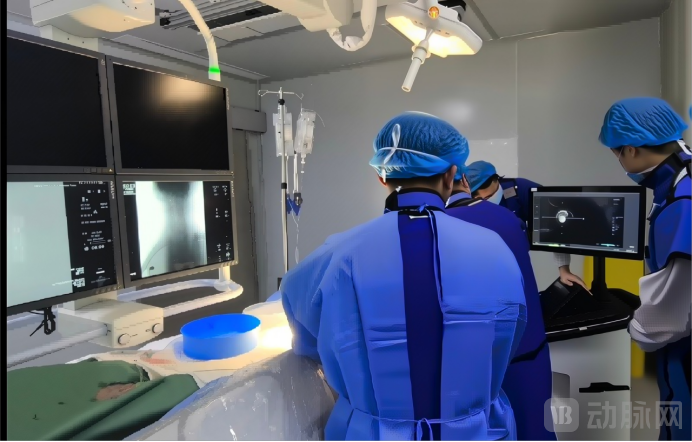
Technical breakthroughs have laid the foundation for clinical applications. Nevertheless, as an entirely‑new device category, Neuro‑IVUS still faces rigorous regulatory review barriers prior to registration and commercial launch. Founded less than one year ago, CHIN-WIN Health has completed Neuro‑IVUS's development from design finalization to animal studies. The company projects that its registration timeline will be roughly two years ahead of comparable international pipeline products. It is expected to capture certain first‑mover market advantages between 2028 and 2030.
From micro-transducers and catheter design to AI algorithms, and further to clinical trials and regulatory submissions, the final commercialization of the product requires precise coordination across multiple stages, posing extremely high demands on the team's industrialization capabilities.
Zhao Jun, Founder of the company, boasts nearly 20 years of industrial experience in cardiovascular and cerebrovascular intervention. He previously worked at leading enterprises including Wego Group, Sinomed, and Heartware Medical, with profound insights into clinical needs and commercialization pathways. The core team under his leadership comprises full‑value‑chain specialists covering precision device R&D, AI algorithms, quality‑management systems, clinical registration and other domains. Highly aligned with the company's "dual‑closed‑loop" strategy, the team enables efficient and robust translation of cutting‑edge technological achievements into clinically‑ready products.
Coronary IVUS has fully validated the clinical and commercial value of intravascular imaging technology, with its usage rate in PCI procedures in China exceeding 30%.[1], it exceeds 90% in developed countries such as Japan and the United States. [2][3]This mature pathway also demonstrates the clinical value of IVUS in the assessment of vascular lesions, interventional decision-making, and post-procedural optimization. In contrast, the application of IVUS in the field of cerebrovascular intervention remains unexplored. As the first intravascular imaging product specifically designed for cerebrovascular use, Neuro-IVUS targets this untapped blue-ocean market.
Beneath this market potential lies the continuously‑expanding neurointerventional devices market and the growing demand for precise imaging. According to Guosen Securities' forecast, China's neurointerventional devices market will reach RMB 12.8 billion in 2025. Frost & Sullivan projects that the market will grow to RMB 44.226 billion by 2030.
With the sustained growth in neurointerventional procedures, complex interventional scenarios including ICAS, FD implantation and complicated AIS thrombectomy call for higher‑precision evaluation of vascular anatomy, lesions and device status. Following the penetration path of coronary IVUS, Neuro‑IVUS holds substantial incremental market opportunities within the cerebrovascular segment.
In terms of business model, IVUS represents a typical "device‑plus‑consumable" solution. As a single‑procedure consumable, the catheter constitutes a key component for product commercialization. According to estimates by Xinyun Life Science, within the three‑year first‑mover window, Neuro‑IVUS catheter consumables alone (with an average consumption of 1.5 catheters per procedure) are projected to generate a market size ranging from RMB 4 billion to RMB 6 billion.
For CHIN-WIN Health, opportunities lie not only in replicating the penetration curve of coronary IVUS, but also in new‑found demands brought by the precision‑driven evolution of neurointervention. With the continuous advancement of Neuro‑IVUS, the company is poised to further accumulate clinical data, foster the formulation of application standards, and leverage its first‑mover advantage to capture both clinical and commercial entry points for cerebrovascular interventional ultrasound.
It is worth noting that this round of financing is not focused merely on a single product. Taking Neuro‑IVUS as its strategic anchor, CHIN-WIN Health is building a more comprehensive new matrix of ultrasonic neuroscience applications following the path of "intra‑operative imaging — adjuvant therapy — functional assessment".
In the short term, the company will advance the development of Neuro-IVUS AI-assisted diagnostic software and submit applications for Class III medical device certification. Additionally, it will develop intraoperative real-time 3D reconstruction and surgical navigation modules to provide surgeons with a surgical field of view approximating "virtual endoscopy."
In the medium term, the company will deploy dual-frequency, multi-element miniature therapeutic transducers and explore therapeutic applications such as ultrasound thrombolysis and ultrasound neuromodulation, thereby extending its product portfolio from diagnosis to therapy.
In the long‑term perspective, the company will also explore ultrasound‑photoacoustic fusion imaging technology to enable precise assessment of cerebrovascular function and metabolism. It will gradually build an ultrasonic neuroscience solution covering the full workflow of "diagnosis — treatment — rehabilitation".
"What we aim to build is not a standalone device, but an intelligent platform that truly understands clinicians' needs and supports clinical‑decision‑making," commented Zhao Jun, Founder of CHIN-WIN Health. Neuro‑IVUS serves as the company's core product for ongoing clinical translation and regulatory registration filings, as well as the starting point for building its "AI + equipment + medical device" product matrix. Within the multi‑billion‑yuan neurointervention track, CHIN-WIN Health pursues not only import substitution, but also global value originating from China through original innovation.
"We keep our eyes on neuroscience projects that address unmet clinical needs and possess global competitiveness," said Zhang Chao, Principal of Yifeng Zhuohua Fund. "CHIN-WIN Health has achieved systematic breakthroughs in ultra‑miniature ultrasonic transducers, steerable catheters and AI anti‑interference algorithms, securing a rare "first‑mover position" in the global neurointerventional imaging track. The company has built a neuroscience application matrix spanning diagnosis to therapy based on ultrasound technology. Its founder previously led three listed neurointervention‑focused medical‑device companies to deliver substantial sales growth. Backed by top‑tier clinical resources plus medical‑engineering‑institute technical support, we expect CHIN-WIN Health to accelerate the commercialization of its multiple neuroscience product lines."
References:
[1] LifeCore Biomedical, "Record of Investor Relations Activities," May 7, 2026
[2] Northcore Life, "Record of Investor Relations Activities," May 7, 2026
[3] <Rates of Intracoronary Imaging Optimization in Contemporary Percutaneous Coronary Intervention: A Report From the BMC2 Registry>