

Global AI Healthcare Race: A Major Reshuffle—Who Will Lead the Next Leg?
Diagens
Medical Imaging AI and High-End Medical Equipment Developer
The evolution of the AI industry is repeatedly shattering the boundaries of human imagination—and at an accelerating pace. From 2022, the inaugural year of generative AI, to the successive breakthroughs in large language models and multimodal AI, technological iteration has been advancing by leaps and bounds nearly every year.
As of 2026, the competitive landscape of the global AI industry has undergone a clear shift: OpenAI is expanding from a “model company” into an AI agent ecosystem; Google is deeply integrating Gemini into Workspace and Search; Microsoft is leveraging Azure AI to build an enterprise-grade platform; and Meta is constructing an open-source ecosystem centered around Llama.
The transformation paths of the four tech giants may appear distinct, yet they have quietly reached a consensus: companies with true long-term competitiveness no longer rely solely on a single model, but instead master a complete system that is scalable, reusable, and capable of supporting an ecosystem.
This consensus is particularly pronounced in the field of AI healthcare.
AI in healthcare is one of the largest-scale application scenarios for AI implementation. Characterized by both high data intensity and high-stakes clinical decision-making, it demands far greater technical reliability and systemic robustness than most other AI sectors. According to data jointly released by Wind Information and Rime LaiMi, medical imaging data accounts for 90% of the entire healthcare data ecosystem, with this data pool continuing to expand at an annual rate exceeding 30%. As the fervor around model competition subsides, the global AI healthcare industry, with medical imaging as its primary battlefield, is reaching a critical turning point: the core focus of the new round of competition, Shifting from the debate over "single-point accuracy" to building comprehensive, end-to-end capabilities centered on a "data supply system."
In this rewriting of the rules, China has joined the global first tier. Local innovators are redefining the value coordinates of the industry's future.
Rewinding the clock a few years, Class III medical device registration certificates for AI were a scarce resource. “Whoever secured certification first gained hospital access first” was the dominant industry narrative at that stage. Following this value logic, medical imaging AI companies, which initially occupied a core position in AI healthcare, diverged into two distinct technological and commercialization paths.
The first path is the “hardware value-added” model. It is grounded in the sales of imaging equipment, bringing AI to market as a functional module bundled with hardware. Its advantage lies in the natural reuse of existing channels and customers; however, its shortcomings are equally prominent: AI serves merely as an ancillary feature attached to the equipment rather than as a standalone product, meaning its value realization is entirely tied to hardware sales volume. Once healthcare institutions tighten their budgets, AI spending becomes a priority for cuts.
The second path is the "single-disease vertical" model. Companies focus on deepening their expertise in a single disease type, achieving commercialization through disease-specific R&D, registration, and sales, which allows for rapid implementation and early results. However, the bottlenecks are equally apparent: each expansion into a new disease category requires restarting data collection, annotation, model training, and regulatory approval almost from scratch. As a result, marginal costs fail to converge, and the ceiling for scalability is clearly visible. More critically, this approach cannot match the breadth of clinical demand in terms of speed. Over ten years, domestically approved medical imaging AI products have covered only about 35 disease types, whereas the real-world clinical demand for imaging diagnostics in China exceeds 3,200 items. The benefits of precision at individual points are rapidly diluted by the vast scope of demand.
Nowadays, the number of approved Class III AI medical device certifications continues to grow, exceeding 200, meaning that a single algorithm no longer constitutes a scarce barrier. The core of industry competition is shifting from competing on “single-point model accuracy” to full-chain platform capabilities encompassing compliant data operations, industrialized model production, and clinical scenario delivery.
It is precisely at this crowded juncture that Diagens has forged a third path.
This path demands heavy upfront investment and involves complex foundational infrastructure, yet the marginal cost continues to decline with each additional task, creating an ever-growing scale effect. While competitors are busy securing certifications for hospital entry, Diagens is not only obtaining certifications but also “building its foundation.” And while others use single-disease models to capture specific departments, Diagens is not only achieving breakthroughs in individual areas but also “constructing a platform.”
What underpins this path are two things: Scalable and reusable engineering capabilities built on the hundred-billion-parameter medical imaging foundation model iMedImage®; as well as the end-to-end linkage of data governance, model training, evaluation, deployment, and feedback iteration-iMedLoop™ Medical Imaging Data Platform.
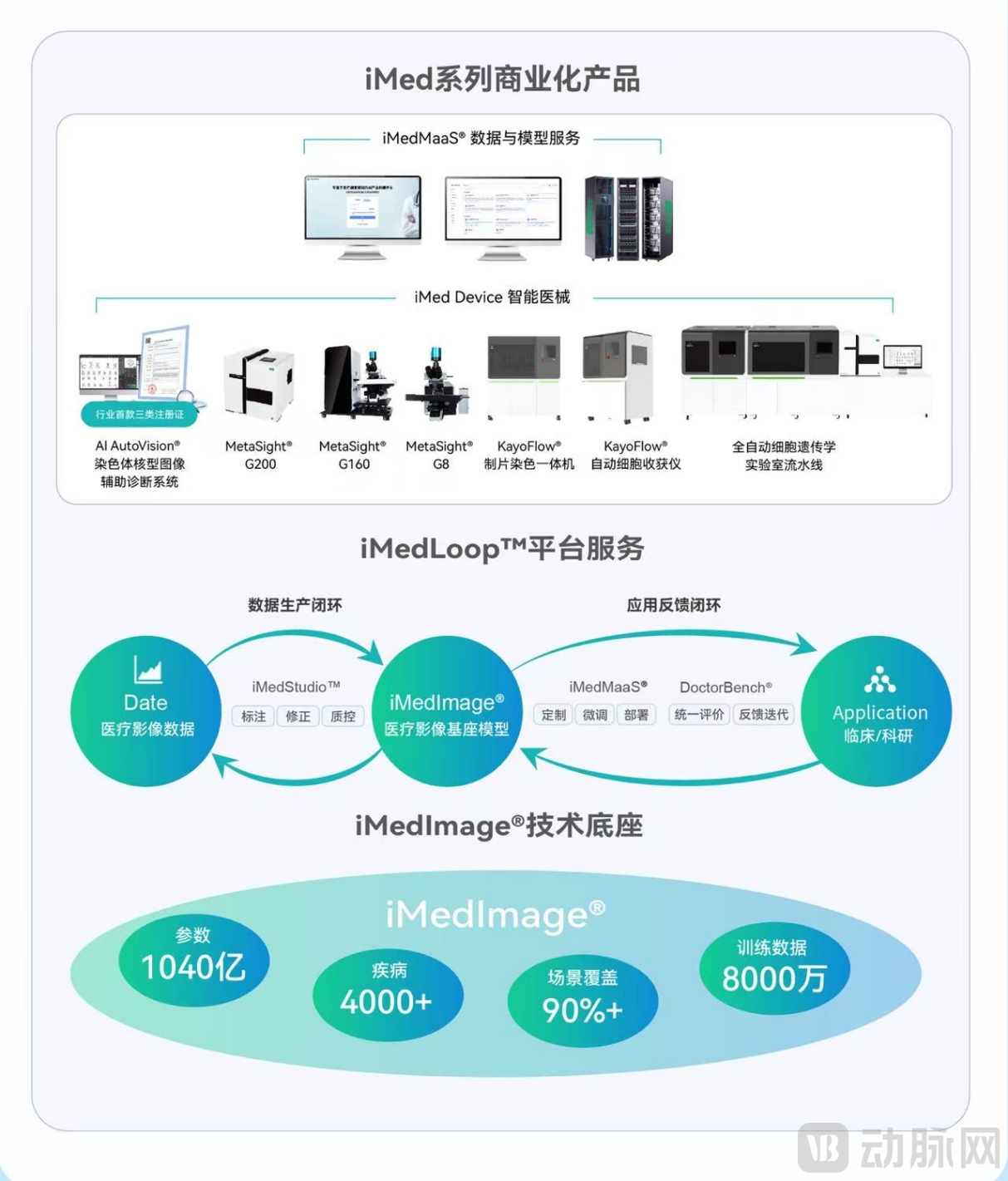
The data has validated this judgment. As of the first half of 2026, Diagens had cumulatively undertaken 158 model projects and established collaborations with 99 hospitals (including 65 Grade A tertiary hospitals), covering 43 human organs and 61 disease areas. Revenue from model services reached RMB 94.54 million, representing a year-on-year increase of 101.1% and accounting for 86.9% of total revenue.
This can no longer be summarized by the term “first-mover advantage.” While a first-mover advantage can be caught up with, a structural system that is already operational and continuously generating value is difficult to replicate. This marks the watershed moment for Diagens’s transition from an industry participant to a definer of “system-based competition.”
Placing Diagens within the global coordinate system clarifies its position.
In the previous round of competition centered on “single-point model accuracy,” players represented by the United States and Israel built significant first-mover advantages through superior models and earlier strategic positioning. This phase fostered a global boom in single-disease vertical models and solidified the leading position of overseas players—a fact, but one that now belongs to the past.
Now, the rules of the game and the track have both changed.
The core of competition in AI healthcare has shifted from “model accuracy” to “data as a key factor.” The leaders of the previous phase have not been absent—top institutions such as Stanford and Microsoft continue to achieve fruitful results in their exploration of multimodal foundation models. However, most of these achievements remain at the “laboratory” stage: while models have been open-sourced and papers published, scalable clinical application and sustainable commercial closed loops are far from being realized. The entire industry is still in its early exploratory stage.
Diagens as The World’s First Innovator to Complete “End-to-End Platform Development + Commercial Implementation”, has taken the lead in representing China in achieving a new phase of breakthroughs—the world’s first Class III medical device certification for a foundational large model in medical imaging, 1,734-case multicenter clinical trials, 28.95 million annotated samples, and over 3,000 professional data governance specialists. Behind these figures lies an industrial ecosystem that is already self-sustaining and continuously generating value.
More strategically significant, Deshi Technology did not confine this capability as a private asset, but instead transformed it into Industry-Shareable Ecological Resources.
As an industrial infrastructure, the iMedLoop™ Medical Imaging Data Platform is open to healthcare institutions, research institutes, and industry partners. It activates the full value chain of data elements, jointly lowering the barriers and costs of AI-driven medical innovation, thereby fostering the growth of the domestic industry while contributing to the evolution of the global AI healthcare sector.
Looking back from the perspective of a longer industrial cycle, the medical imaging data platform is not just a product of Deshi Technology, but also a microcosm of Chinese innovators rising by leveraging the local industrial ecosystem and giving back to industry development.
China boasts the world’s largest single-payer health database, covering over 1.3 billion insured individuals; the special review procedure for innovative medical devices has established a priority review pathway for AI medical products with clinical value; and the vast patient population combined with diverse clinical scenarios provides ample resources for large-scale, multicenter clinical trials. The interplay of these three advantages not only fosters fertile ground for the rapid industrialization of AI healthcare innovations in China but also gives rise to companies like Deshi Technology, which are leading the global healthcare industry into an era of systematic intelligence.
Diagens’s leadership lies not in digging a moat, but in building an open, collaboratively constructed industrial fortress.
As founder Song Ning stated, Diagens aims to “leverage artificial intelligence to promote inclusive healthcare and achieve true medical equity.”— Leveraging the efficient circulation and value realization of medical data elements as a fulcrum to accelerate the transition of medical AI from innovation to industrial application. Every brick and tile of this castle is paving the way for this goal.
How Does This System Operate?
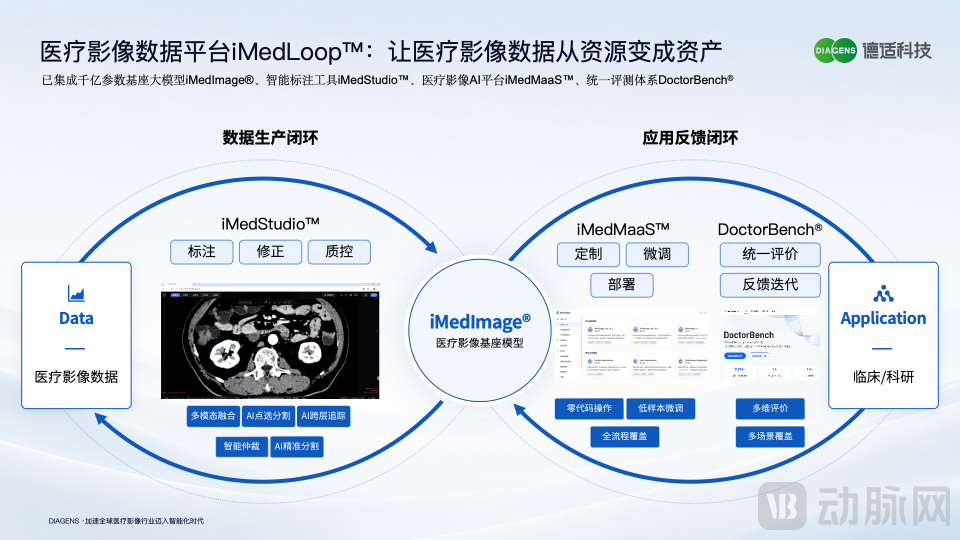
From the perspective of product architecture, iMedLoop™ with the foundational large model iMedImage®as the core, establishing a dual closed-loop system of "data production" and "application feedback."
At the data production end, iMedStudio™ Intelligent Annotation Tool works through multimodal fusion, AI-assisted point-and-click segmentation, cross-layer tracking, and intelligent arbitration, efficient annotation, correction, and quality control of imaging data are achieved; on the application side, iMedMaaS™ Platform supports zero-code operation, low-sample fine-tuning, and end-to-end coverage, enabling rapid customization, deployment, and iteration of models in clinical and research settings; DoctorBench®Unified Evaluation System provides multi-dimensional evaluation and multi-scenario coverage, ensuring continuous optimization of model performance. The two major closed loops drive each other, enabling the continuous accumulation and amplification of data value throughout the entire chain of “annotation—training—application—feedback.”
How much has been invested in this system?
The deepening of platform capabilities is inseparable from continuous R&D investment. The 2026 semi-annual report shows that Diagens' R&D investment reached RMB 64.118 million in the first half of the year, a year-on-year increase of 67.4%, Primarily directed toward upgrading foundational large models, professional workflows and high-quality data governance, building model evaluation systems, full lifecycle management of core products, and advancing the R&D pipeline.
How Is This System Validated and Strengthened?
From a regulatory perspective, in May 2026, Diagens secured "The World's First Class III Certification for a Foundation Large Model in Medical Imaging", which not only validates the compliant transformation pathway from foundational models to large-model products, but also sets a new global record for the fastest approval of a pioneering product in the field of medical imaging AI. Meanwhile, Diagens has signed strategic cooperation agreements with entities such as the Hangzhou Data Exchange and the Hangzhou Data Element Innovation Center, further strengthening the industrial foundation in terms of compliant circulation of data elements.
What Has This System Brought?
From the perspective of ecosystem building, leveraging iMedLoop™ has reduced the volume of annotated data required for disease-specific model training to 1/200 of the original level, compressed the overall development cycle to 1/12 of its previous duration, and significantly lowered the combined costs of capital and computing power by 90%. As disclosed in the semi-annual report, iMedLoop™ has established collaborations with 99 hospitals, implemented 158 model projects, engaged over 3,000 professionals in co-development efforts, and accumulated approximately 28.95 million annotated samples.
A self-reinforcing value flywheel has taken shape—more terminal access brings more data input, driving iterative enhancements in model capabilities, which in turn spurs the development of richer applications and attracts more partners to join, thereby expanding the ecosystem.
This flywheel’s momentum points toward a broader vision. As a leader in the AI healthcare industry, Song Ning possesses an interdisciplinary background in computer science, medical genetics, and clinical medicine. Regarding the trajectory of industry development, he believes that the global evolution of medical imaging AI will unfold in three stages, with the third stage expected to accelerate toward maturity within the next four to six years. At that time, the deep integration of large imaging models and large language models will drive a systematic upgrade of public health management systems, making resident health management more efficient, precise, and inclusive.
Over decades, China’s medical device industry has traversed a long journey from imitation to surpassing, and from low-end substitution to high-end breakthroughs. Yet on the new track of AI in healthcare, everything is accelerating.
From generative AI to multimodal large models, from algorithmic breakthroughs to closed-loop industrial ecosystems, Chinese innovators have hit the right notes at nearly every critical juncture. Leveraging vast clinical datasets, diverse application scenarios, and an efficient industry-academia-research collaboration system, China is no longer merely a follower but has begun to define the rules.
The “China Moment” of AI Healthcare Has Arrived. This time, it is no longer about overtaking on the bend, but rather about proactively leading the way on a global scale.
References:
1. "AI Imaging Diagnosis: Technology Empowerment and Capital Frenzy" Wind, Rime
2."Prospects and Challenges: When Medical Imaging Meets Artificial Intelligence" Peking Union Medical College Journal
3. “Current Status of Development and Research Applications of Lung Cancer Imaging Datasets,” Chinese Journal of Radiology
4. “Song Ning: AI Era Boosts Inclusive Healthcare,” Zheshang Magazine
5. [Infographic] Desheng Technology’s 2026 Interim Results: Entering a New Phase as a “Medical Imaging AI Research and Production Acceleration Platform” – Desheng Technology
Recommended Reading:
1. "The Next Decade of AI in Medical Imaging" https://www.vbdata.cn/1519090350
2. The Golden Window for the Data Factor Industry: “White Paper on the Construction of China’s Medical Imaging Data Platform” Begins Compilation, Jointly Building a Standardized Path for Medical Imaging Data Platforms https://www.vbdata.cn/1519088201