China's First Force-Feedback Laparoscopic Surgical Robot with Aerospace-Originated Technology Achieves Clinical Breakthrough in a $5.7B Market

Tuodao Medical
Surgical Robot Developer
Source: Medical Device Business Review
Author: Qiuqiu
Robotic surgery has long had a hidden shortcoming:Clear vision and precise execution, yet “no tactile feedback” from the tissue.
Recently, Tuodao Medical’s Tuoling® endoscopic surgical robot, equipped with fully self-developed force-feedback instruments, successfully performed three complex urological surgeries by remotely controlling the surgical terminal in Xinjiang, 2,400 kilometers away, from Zhengzhou.
According to the company's official release, this isThe First Domestically Developed Force Feedback Technology for Laparoscopic Robots to Achieve Clinical Application in China.
This breakthrough marks the first time in China to achieve autonomous three-dimensional force feedback,Enabling physicians, even when separated by 2,400 kilometers, to perceive in real time the forces exerted by instruments during tissue grasping and traction.Elevating remote surgery from “visual-guided operation” to “haptic-enabled operation.”
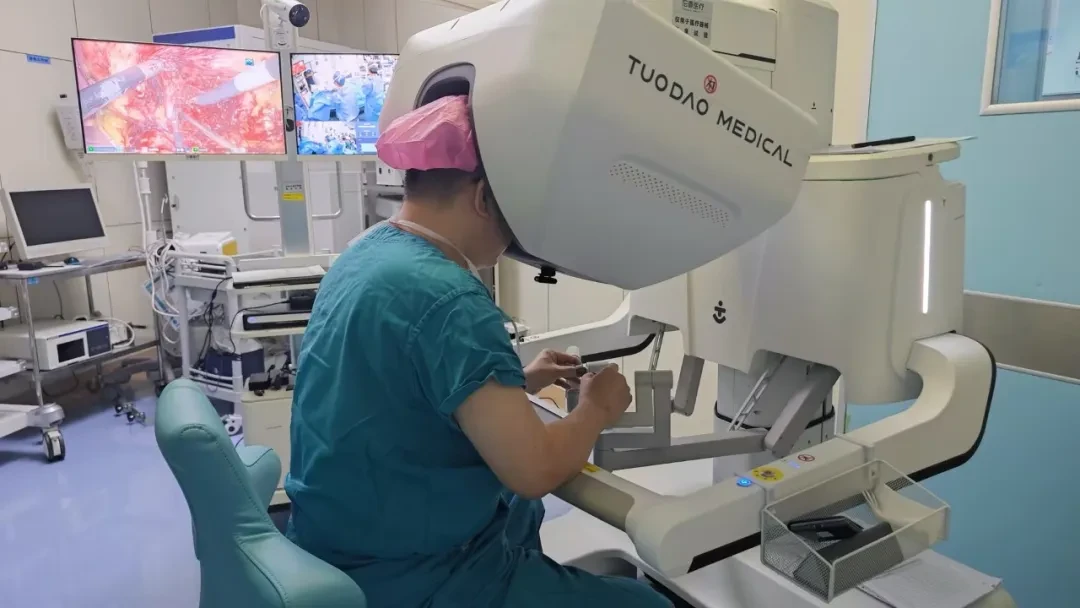
Dr. Duan from Zhengzhou performs remote surgery via the Tuoling® console. Image source: Tuodao Medical

Transmitting “tactile feedback” from 2,400 kilometers away,
Domestic Force Feedback Clears Clinical Hurdle
Laparoscopic robots provide surgeons with magnified vision, yet they sever the direct tactile contact between the surgeon’s hands and the patient’s tissues.
How fragile the blood vessels are, the extent to which tissues are stretched, and whether the instruments are clamped too heavily—doctors often have to judge these factors solely based on visual changes and clinical experience.
This is not merely a matter of operational experience.
In procedures such as partial nephrectomy and radical prostatectomy, surgical instruments are required to repeatedly dissect, retract, and suture among blood vessels, nerves, and organs.
Excessive force may cause tissue damage, while insufficient force may result in unstable grasping. The greater the surgical distance, the higher the reliance on precise feedback.
The challenge lies within an instrument shaft with a diameter of less than 9 millimeters.
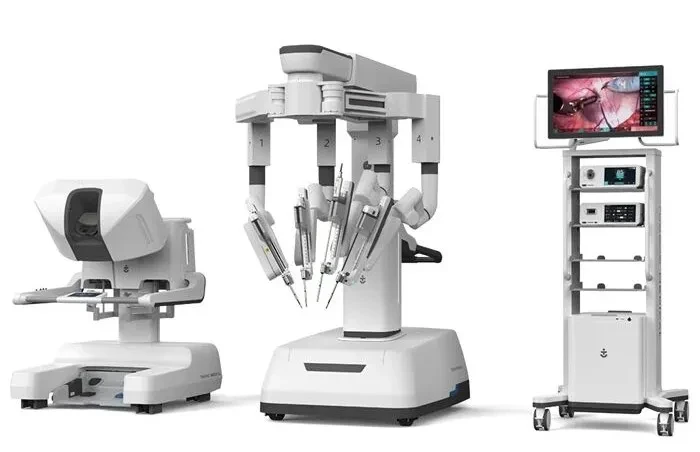
Tuoling® integrates 3D traction and grasping force sensors, enabling the forces experienced by the patient-side instrument to be fed back to the physician’s control console.By integrating 3D 4K fluorescence imaging, surgeons can clearly visualize tissues while also perceiving changes in instrument force.
Robots were previously responsible for transmitting movements.
Now, it begins to transmit power.
This trial successfully completed two partial nephrectomies and one radical prostatectomy, covering key procedures such as lesion dissection, tissue cutting, wound suturing, and urethral reconstruction. The radical prostatectomy was performed in 1 hour and 9 minutes.
During surgery, 3D 4K fluorescence imaging can magnify tissue textures by 10 to 20 times. The company states that end-to-end signal latency is consistently maintained within predefined clinical safety thresholds.
The value of the three surgical cases lies not in having reached final conclusions on therapeutic efficacy, but in demonstrating that haptic feedback has crossed the threshold from the laboratory to human surgery.
The clinical foundation of the entire Tuoling® system is derived from the earlier YC100. In 2024, the YC100 wasJiangsu Province People's Hospital, the First Affiliated Hospital of Nanchang University, and the First Affiliated Hospital of Zhengzhou University completed multicenter pre-market clinical trials, covering a variety of surgical procedures in urology, gynecology, and general surgery.
According to the company's disclosure, none of the cases required conversion to open surgery; most cases had an estimated blood loss of approximately 20 mL, with an average operative time of about 2 hours. In July 2025, YC100 received NMPA approval as a “Laparoscopic Endoscopic Surgical System.”
The previous registration-based clinical study addressed whether Tuoling® could perform complex multi-departmental surgeries. This trial further answers:When the Doctor and Patient Are 2,400 Kilometers Apart, Can Haptic Feedback Be Applied to Real Human Procedures?
This marks a leap in product capabilities.

R&D investment over five years totaled RMB 521 million,
Aerospace Force-Sensing Technology Enters the Operating Room
Force feedback is not as simple as adding a sensor.
Subtle forces at the tissue level must be accurately measured, rapidly transmitted, and converted into haptic feedback for the surgeon.Sensors, device structure, control algorithms, and communication systems are all indispensable.
According to Tuodao Medical,The YC100 comprises over 30,000 components, with core parts such as the robot controller, drive servo, and precision joint modules all independently developed by the team.
Publicly available information discloses that from 2020 to 2024,Tuodao Medical's cumulative R&D expenses amounted to approximately RMB 521 million,Investments cover product areas including orthopedics, endoscopy, percutaneous puncture, natural orifice surgery, and medical imaging.
This indicates that haptic feedback is not a temporary product selling point. It is built upon long-term investments in the complete system, instruments, and control platform.
Behind the Tuoling® haptic feedback technology lies the extensive accumulation of teleoperation research by Professor Song Aiguo’s team at Southeast University.
The related project spanned 12 years and was awarded the Second Prize of the National Technological Invention Award in 2017.The team’s achievements have provided key technical support for the teleoperation of the Chang’e-3 lunar rover, and completed ground verification of human-machine interactive teleoperation for the large external robotic arm of the Chinese Space Station.
Space Teleoperation and Remote Surgery: Seemingly Worlds Apart, Yet Addressing Similar ChallengesThe operator is physically separated from the object being manipulated; the system must not only transmit motion to the remote end but also relay haptic feedback forces back to the operator.
In 2024, the “Force Sensing and Force Feedback Technology for Surgical Robots” was approved as a National Key R&D Program; the project was officially launched in 2025, with Tuodao Medical undertaking the sub-project titled “Force-Interactive Laparoscopic Surgical Robot and Clinical Trials.”
Universities address key technologies, enterprises complete the engineering of complete machines, and hospitals promote clinical validation in humans.
Three R&D pipelines ultimately converge on the operating table.
The value of haptic feedback extends beyond physicians.
In the past, robots primarily recorded surgical footage and the motion trajectories of instruments.With the integration of haptic feedback, the forces generated during each clamping, traction, and suturing maneuver can also be quantified.
This is a new data stream.
On another automated R&D line, Tuodao Medical and the team from the University of Science and Technology of China have completed dual-instrument collaborative electrosurgical cholecystectomy in live animal experiments, further advancing visual, control, and instrument coordination capabilities toward surgical automation.
Robots are no longer just learning how to move.
It must also understand when to apply force and when to withdraw.

The da Vinci 5 takes the lead.
Tech Giants Vie for the Robotic “Tactile Gateway”
After more than two decades of development, high-definition visualization and flexible robotic arms have gradually become standard features in surgical robots.Whether physicians can perceive the forces between instruments and tissues begins to determine the upper limit of next-generation platforms.
In 2024, Intuitive Surgical introduced force-feedback instruments on the da Vinci 5 system, transmitting push-pull forces measured at the end-effector back to the surgeon’s console controls.
Preclinical studies show that,With force feedback enabled, the force applied by the operator to the tissue is reduced by up to 43%.
As of May 2026,The da Vinci 5 system has been installed in over 1,400 units globally, with a cumulative total of more than 380,000 surgeries performed.
Haptic feedback has moved beyond the laboratory and entered large-scale application.
More significant changes have occurred on the data front. Once force is quantified, it can be utilized for intraoperative alerts, postoperative review, and physician training, while also supplementing data for risk warning and automated control.
Haptic feedback is evolving from a mere operational function into an intelligent interface for surgical robots.
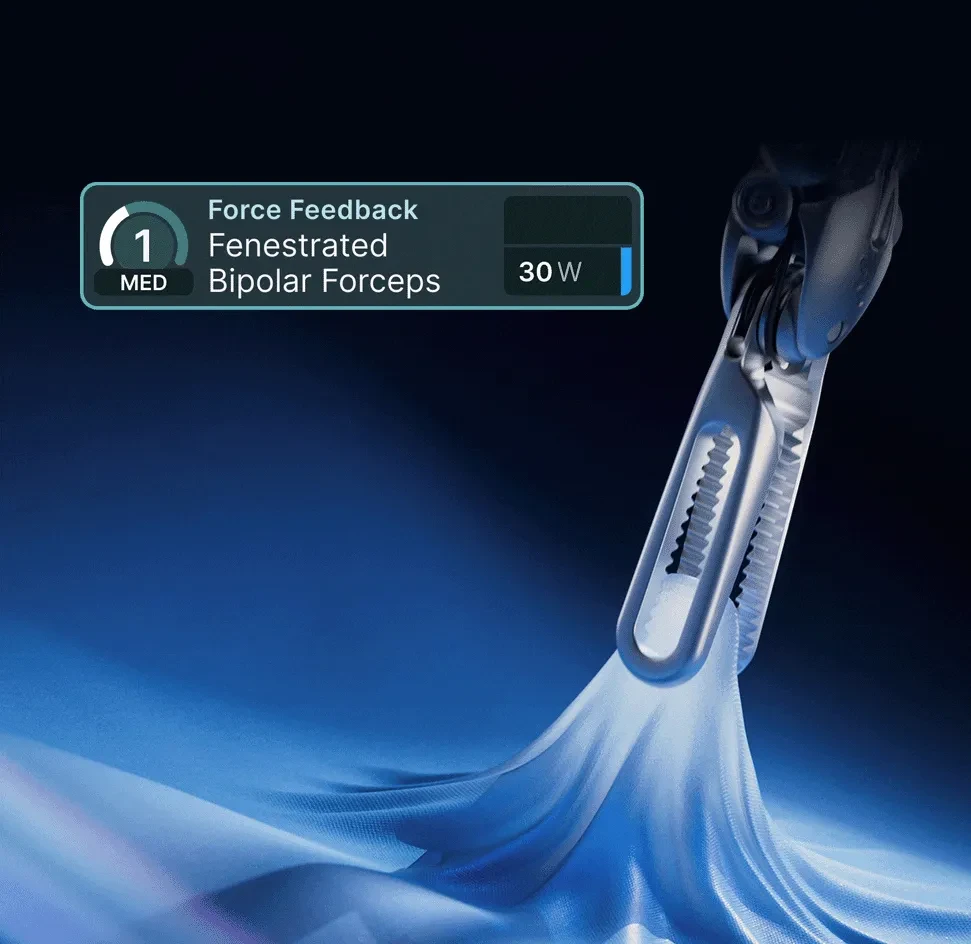
The da Vinci 5 Force Gauge can display instrument force information in real time. Image source: Intuitive Surgical
Competitors have taken different paths.
Japan SaroaAerodynamic force feedback has been applied in clinical practice;SenhanceHaving pioneered haptic feedback earlier, it will cease sales after being acquired by Karl Storz.
Medtronic Hugo and Johnson & Johnson OTTAVAThe focus is heavily placed on modular robotic arms, operating room efficiency, and AI platforms; currently, no public materials list direct force feedback at the instrument tip as a core feature.
One approach aims to equip robots with direct haptic feedback, while the other enhances physicians’ clinical judgment through vision, audio, and AI.
Tactile sensation is gaining momentum, but it is not yet the sole determinant of success.
Tuodao Medical established a distinct brand identity for haptic feedback through a 2,400-kilometer remote robotic surgery on the human body.The subsequent competition hinges on the accuracy of force measurement, the stability of remote transmission, and the ability to consolidate data into clinical evidence and intelligent capabilities.
Only those who can close the loop of “perception–feedback–data–decision” will be in a position to define the next generation of surgical robots.

Domestic sales account for nearly half of the market share,
The Next Battle Turns to "Touch"
China's laparoscopic surgical robots have moved beyond the stage where only imported products were available.
In 2024, domestic sales of laparoscopic robots exceeded 100 units.The market share of domestic brands has approached nearly half.The number of robot-assisted laparoscopic surgeries in China reached 143,200 cases, and the domestic installed base increased from 134 units in 2019 to 511 units in 2024.
The market is expanding rapidly, with domestic players also carving out distinct paths.
Tuomai is vying for scale and access to the remote surgery market. Its remote capabilities have already received NMPA approval,In June 2026, global commercial orders exceeded 300 units.and enhances the physician's perception of operational force through the "force presentation" feature.
Jingfeng has adopted a platform-based strategy, integratingIntegrating multi-port, single-port, and remote surgery into a unified system to expand departmental coverage and surgical procedures.
ShuRui leverages its snake-like arm to access single-port surgery, focusing on addressing instrument flexibility in confined spaces.
Each company separately addressed how to enable robots to operate at greater distances, with smaller incisions, and across a broader range of surgical procedures. However, as remote operation, single-port access, and three-dimensional imaging gradually become common capabilities among domestically produced products,A more fundamental question has come to the forefront: What can next-generation robots still rely on to gain a competitive edge?
UIH Smart Fusion chooses to integrate preoperative CT and MRI with intraoperative imaging, while simultaneously deploying master-slave force sensing.
Tuodao Medical further introduces three-dimensional force feedback into ultra-long-distance telesurgery, enabling the grasping and traction forces at the tissue site to traverse the communication network and be faithfully transmitted back to the surgeon’s hands.
Different companies have chosen different technological paths, yet they all point to the same trend.
Can remote interventional physicians transcend spatial barriers, and can imaging-guided physicians clearly visualize tissues?Haptic feedback informs the physician about what the instrument has contacted, the clamping force applied, and the magnitude of force exerted on the tissue.
Tuodao Medical has thereby secured a competitive entry point distinct from that of scale leaders.It is vying not only for the remote surgery market but also for the authority to define how next-generation robots understand tissue and assist surgeons in controlling operational boundaries.
Commercial competition is also accelerating.
In the first half of 2026, among publicly disclosed winning bids for public hospitals, the average winning bid price for laparoscopic surgical robots decreased from approximately RMB 17.69 million to RMB 13.32 million. As console prices continue to decline, it is becoming increasingly difficult for companies to establish long-term competitive advantages solely through low pricing and basic performance capabilities.
Haptic feedback provides a new bargaining chip beyond price.
Once it can be translated into more stable operations, a shorter learning curve, and haptic data that can be used for training, risk warning, and surgical AI, it may upgrade from a feature to an important reason for hospitals to choose the product.
The First Half of the Competition Among Domestic Robots: A Contest of Installations, Surgical Procedures, and Remote Capabilities.
The second half will be about who can enable robots to truly perceive tissue.
The key step taken by Tuodao Medical is precisely the transition of “haptic feedback” from a technical concept to clinical application and market competition.