Hansoh Pharma's CDH17-Targeted ADC HS-20110 Secures $1.53 Billion Global Licensing Deal with Roche
Hansoh Pharma
Pharmaceutical Research, Production, and Sales

On October 17, 2025, Hansoh Pharma (03692.HK) announced that it had entered into a licensing agreement with Roche to grant Roche the exclusive global rights for the development, manufacturing, and commercialization of its investigational CDH17-targeted antibody-drug conjugate (ADC) HS-20110.
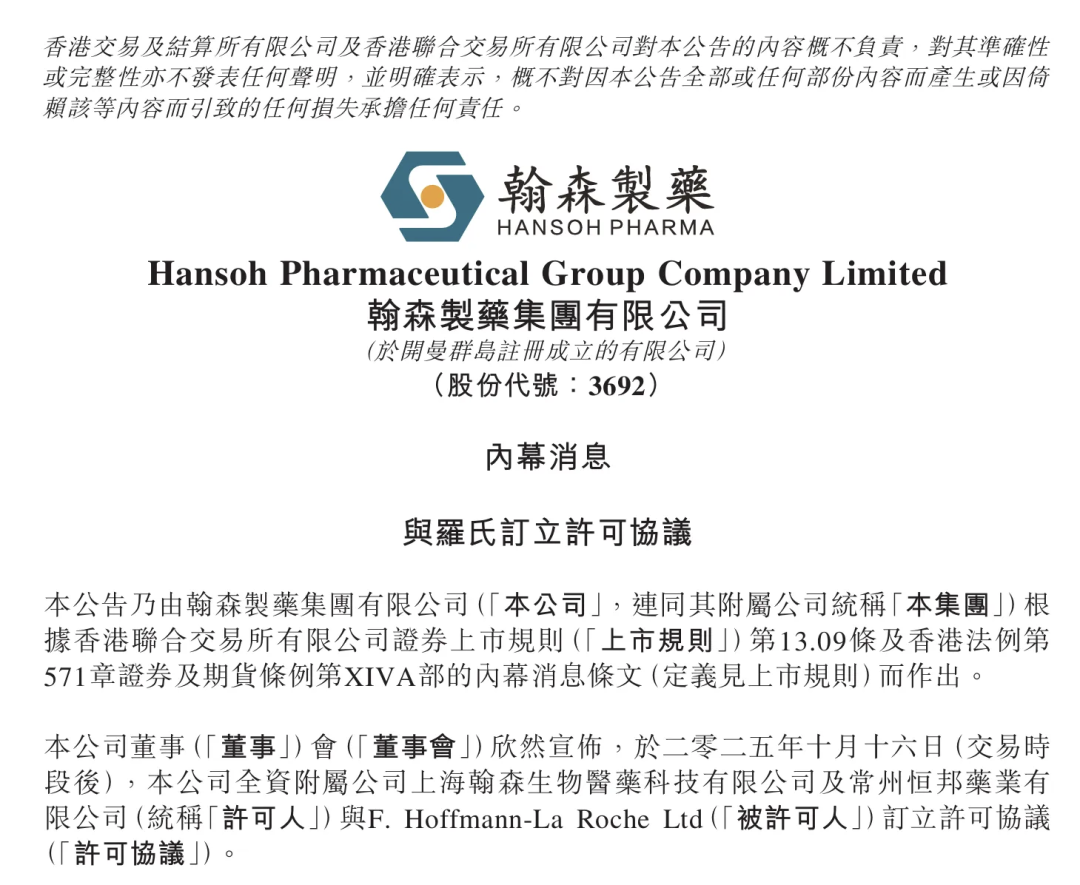
According to the agreement, Hansoh Pharma will receive an upfront payment of $80 million and is eligible to receive up to $1.45 billion in milestone payments based on development, regulatory, and commercialization progress, as well as tiered royalties on future sales. The product is currently undergoing global Phase I clinical trials in China and the United States for the treatment of colorectal cancer and other solid tumors.
CDH17 ADC: A Breakthrough Target for Colorectal Cancer Treatment
CDH17 (Liver-Intestine Cadherin) is a member of the cadherin family, primarily expressed in intestinal epithelial cells in healthy adults. It is abnormally highly expressed in over 90% of colorectal cancers, 50% of gastric cancers, and pancreatic cancers, and is closely associated with tumor metastasis and poor prognosis. Its high specificity makes it an ideal target for the treatment of gastrointestinal tumors.
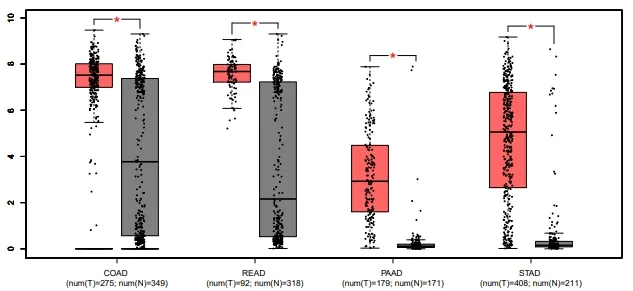
Source: Gepia Database
Colorectal cancer is the third most common cancer globally, with about 569,000 new cases and approximately 293,000 deaths in China in 2022, accounting for more than 37% of global related cases. The five-year survival rate for advanced patients is less than 15%, and existing therapies (such as chemotherapy, targeted drugs, and PD-1 inhibitors) have limited efficacy for metastatic patients, highlighting an urgent need for more precise and effective treatment options.
EGFR inhibitors (such as cetuximab) are only applicable to patients with RAS wild-type, and the drug resistance rate is high. PD-1 inhibitors are ineffective for microsatellite-stable (MSS) colorectal cancer, which accounts for 85% of patients. The ORR for metastatic colorectal cancer beyond third-line treatment is only 1-5%, indicating a significant unmet clinical need.
Preclinical studies show that CDH17 ADC can precisely penetrate the tumor stroma barrier and significantly inhibit tumor growth in colorectal cancer liver metastasis models. Its potential lies in covering difficult-to-treat patient populations such as those with MSS type; combination with chemotherapy or immunotherapy may enhance efficacy.
Global CDH17 ADC Competitive Landscape: Chinese Pharmaceutical Companies Take the Lead
Currently, there are five CDH17 ADCs globally in clinical stages, four of which are developed by Chinese companies, with Hansoh Pharma's HS-20110 being among the frontrunners.
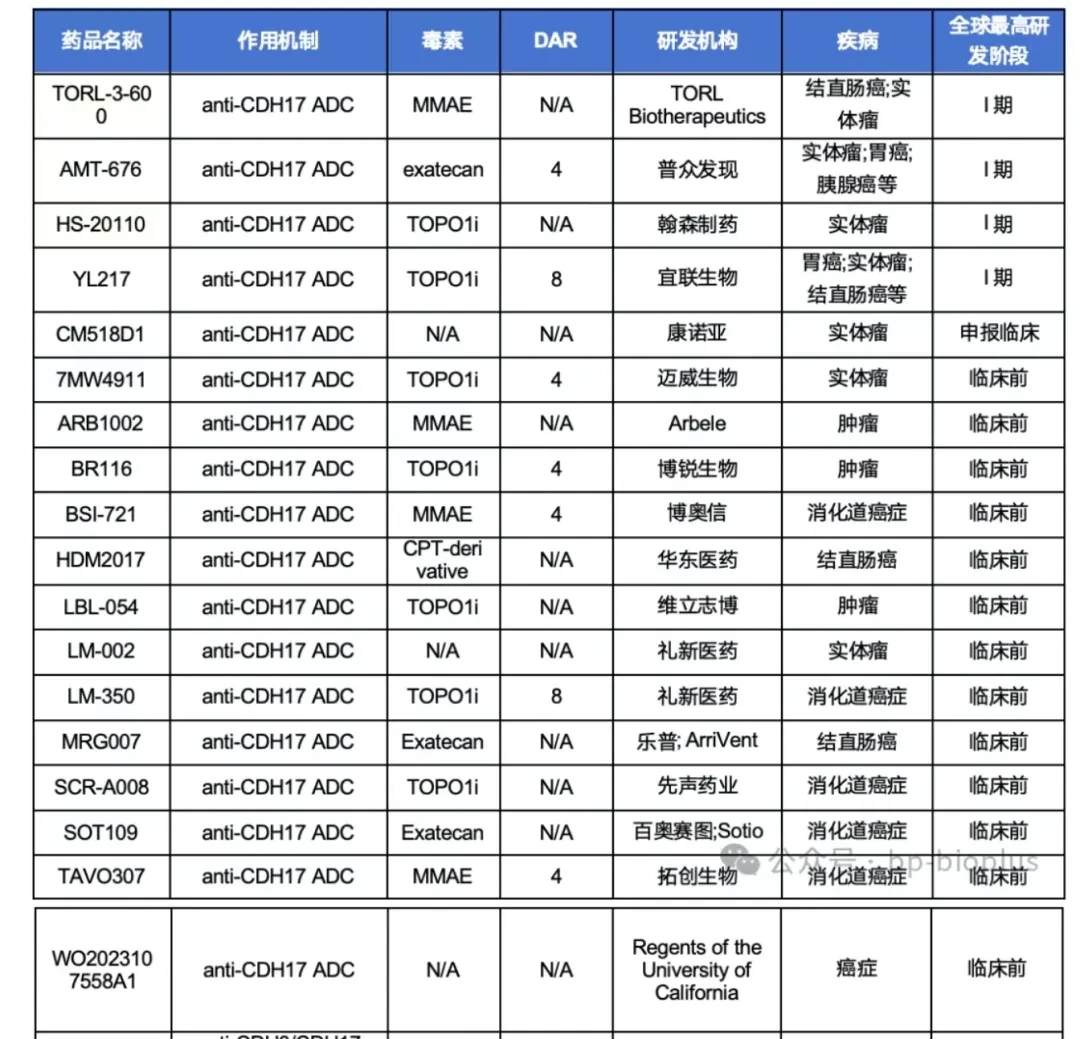
Data Source: bp-bioplus
The following is a detailed analysis of the core features and R&D progress of five CDH17-targeted ADC drugs currently in clinical stages, covering antibody design, linker technology, toxin payload, and preclinical/clinical data:
1. Hansoh Pharma HS-20110 (Licensed by Roche)
- Antibody and Affinity: Utilizes a highly specific anti-CDH17 monoclonal antibody with nanomolar (nM) affinity (KD), preferentially targeting the basement membrane of tumor tissues.
- Linker and Payload: Optimized cleavable linker (GGFG structure) paired with proprietary topoisomerase I inhibitor SHR-9265, DAR value ≈ 4, enhancing plasma stability and boosting the "bystander effect."
- Preclinical data: Achieved >90% tumor inhibition rate (TGI) in colorectal cancer PDX models, effective for RAS/BRAF mutations and liver metastasis models; Cynomolgus monkey toxicology studies showed a therapeutic window >10 with no significant hepatotoxicity.
- Clinical Progress: Phase I trials (NCT0623XXXX) ongoing simultaneously in China and the U.S., exploring dose escalation for advanced solid tumors.
2. Mabwell Bio 7MW4911
- Antibody and Affinity: Humanized monoclonal antibody Mab0727, with moderate cross-species (human/monkey) affinity (KD=1.2 nM) and rapid internalization properties.
- Linker and Payload: Site-specific conjugation based on the IDDC™ platform, utilizing a cleavable linker + proprietary topoisomerase I inhibitor MF-6, with DAR=4 and homogeneity >95%.
- Preclinical data:
- TGI reached 71%-99% in 15 PDX models, covering CMS1-4 classified colorectal cancer;
- Overcoming ABC Transporter Resistance: TGI (82%) significantly outperformed MMAE-ADC (52%) in the LS513 resistance model;
- Cynomolgus monkeys HNSTD > 20 mg/kg, no hematological toxicity.
- Clinical Progress: IND approved in both China and the U.S. in August 2025, Phase I trial ongoing (solid tumor indication).
3. HDM2017 by Huadong Medicine
- Antibody and Affinity: High-endocytosis anti-CDH17 monoclonal antibody, affinity not disclosed, preferentially binds to tumor cell membrane antigens.
- Linker and Payload: Cleavable linker + Topoisomerase I inhibitor (CPT derivative), DAR=4.
- Preclinical data:
- Colorectal cancer CDX model TGI reached 97%, pancreatic cancer model TGI > 85%;
- Significantly inhibits microsatellite-stable (MSS) tumor growth, synergistic effect when combined with PD-1 inhibitors.
- Clinical Progress: Obtained FDA clinical approval in September 2025, China IND approved in October, Phase I trials in the U.S. and China advancing simultaneously.
4. Keymed Biosciences/Lepu Biopharma CM518D1
- Antibody and Affinity: High-specificity antibody, binds to the CDH17 EC1 domain, rapid internalization (<30 minutes).
- Linker and Payload: Cleavable linker + Ecteinascidin derivative (Topoisomerase I inhibitor).
- Preclinical data:
- Colorectal cancer PDX model TGI > 80%, overcoming oxaliplatin/irinotecan resistance;
- Effective for gastric cancer with moderate to low CDH17 expression (TGI=65% when H-score=100).
- Clinical Progress: The world's first CDH17 ADC to enter clinical trials, with a Phase I/II trial initiated in June 2025 (NCT0618XXXX).
5. YL217 by Yilian Biologics
- Antibody and Affinity: Specific antibody not disclosed, but high tumor/normal tissue distribution ratio emphasized.
- Linker and Payload: Designed based on the TMALIN® platform, tumor microenvironment-activated linker + camptothecin-class toxin (presumed to be a topoisomerase I inhibitor).
- Preclinical data:
- Gastric cancer model achieved 100% complete response (CR), covering CDH17/CLDN18.2 dual-target heterogeneous tumors;
- The linker is cleaved only in tumor tissues, reducing systemic toxicity.
- Clinical Progress: First patient dosed globally in Phase I trial in July 2025 (NCT0620XXXX).
? Technology Trends and Challenges
1. Toxin Homogenization: All five drugs utilize topoisomerase I inhibitors to kill tumors by disrupting DNA replication, but the proprietary toxins of Hansoh Pharma (SHR-9265) and Maiwei (MF-6) show superior breakthroughs in drug resistance.
2. Innovation in Linkers: Yilian (TMALIN®), Mabwell (IDDC™) reduce off-target toxicity through controlled release or site-specific conjugation.
3. Clinical Validation Focus:
- Can the immunotherapy resistance of MSS-type colorectal cancer be overcome?
- Balance between hepatic metastasis lesion penetration efficiency and hepatotoxicity?
- Potential for combination therapy (e.g., PD-1 inhibitors, EGFR-targeted drugs).
Conclusion:
Roche's heavy investment in Hansoh Pharma's pipeline this time not only recognizes the potential of HS-20110 but also confirms the upgrade of Chinese innovative pharmaceutical companies' global influence in the ADC field. In the future, new technologies such as bispecific ADCs and dual-payload ADCs will further drive paradigm shifts in colorectal cancer treatment.
Data Source:AACR 2025, PharmCube Data, ClinicalTrials.gov, Corporate Announcements. Corporate Announcements, Cell Reports Medicine (2025), ClinicalTrials.gov.