

Moderna’s Phase III Breakthrough Sends Everest Medicines Soaring 89% Intraday: mRNA Strategy Receives “Strategic Validation”
Everest Medicines
Developer of Innovative Therapies
On August 19, Merck & Co. and Moderna Announced that the Phase III study of personalized mRNA cancer therapy reached key endpoints, causing Moderna’s stock price to surge by approximately 177% on the day. This development has once again made mRNA oncology treatments a focal point in the capital markets, and also allowed those who had previously positioned themselves in this direction Everest Medicines Gaining attention.
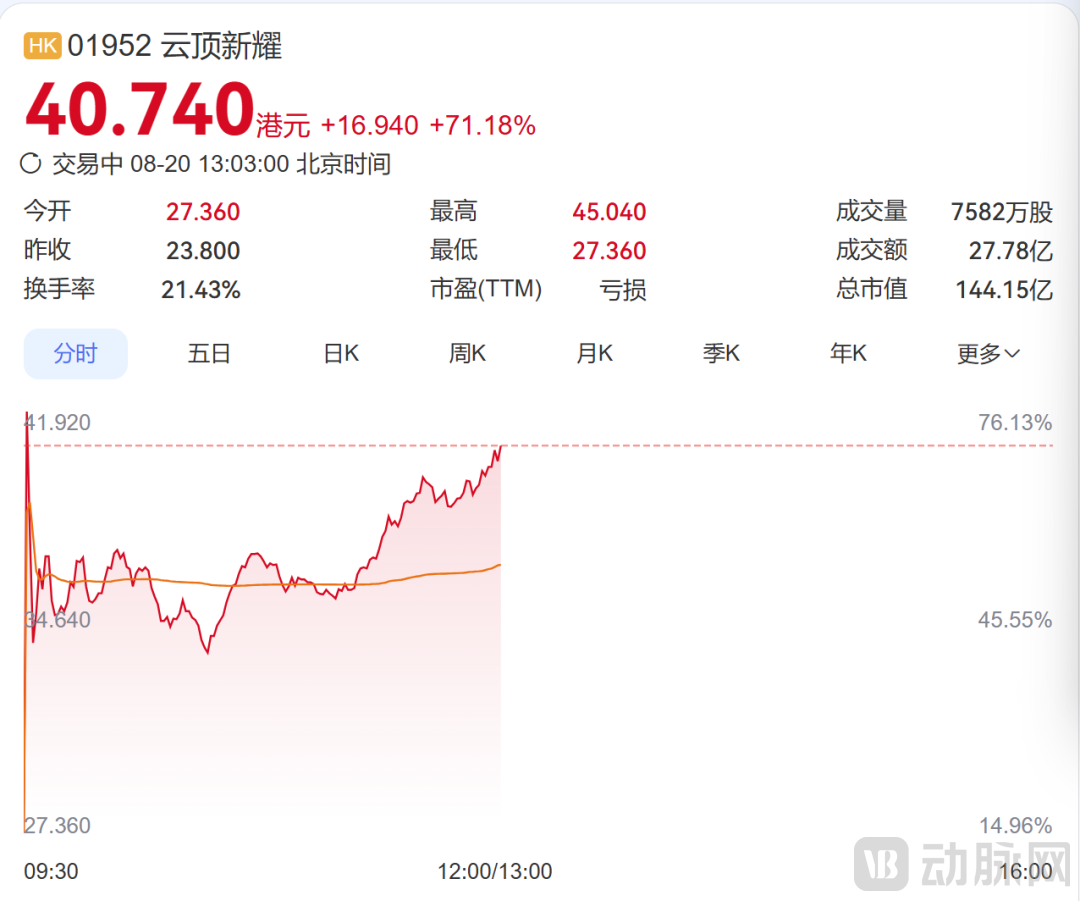
On August 20, the share price of Everest Medicines touched HK$45 during intraday trading, representing an increase of approximately 89% compared to the previous trading day’s closing price. In fact, the mRNA cancer vaccine is not a temporary move by Everest Medicines to follow industry trends, but rather a forward-looking strategic layout within its independent R&D portfolio, marking a significant strategic validation for the company.
It is understood that Everest Medicines has established an AI+mRNA platform, with a pipeline encompassing personalized therapeutic cancer vaccines (EVM16), off-the-shelf tumor-associated antigen (TAA) vaccines (EVM14), off-the-shelf immunomodulatory cancer vaccines (EVM15), and mRNA Autologous CAR-Tand other projects. Among them, EVM16 and Moderna’s Intismeran both follow the personalized neoantigen vaccine pathway. The first-in-human clinical data readout has been completed, with partial Phase Ia investigator-initiated trial (IIT) data released at the 2026 AACR Annual Meeting, demonstrating dose-dependent immunogenicity and positive preliminary efficacy signals, along with a favorable safety and tolerability profile in patients with heavily pretreated, end-stage tumors. Moderna’s Phase III breakthrough also provides a direct industry benchmark for Everest Medicines’ strategic layout in this area.
Furthermore, Everest Medicines’ mRNA pipeline extends beyond these assets. EVM14 has received Investigational New Drug (IND) approval in both China and the United States; the first patient has been enrolled in the Phase I trial in the U.S., while clinical development in China is proceeding concurrently. EVM15 completed preclinical proof-of-concept studies and identified its clinical candidate molecule in 2025. Additionally, the mRNA-based in vivo CAR-T project EVM18 and the dual-target in vivo CAR-T project EVM20 are also advancing through clinical development.
More importantly, this also serves as a concentrated demonstration of Everest Medicines’ in-house R&D capabilities. In the past, the market largely viewed Everest as a commercialization platform; however, the company is actually building a “dual-engine” capability structure driven by both commercialization and business development (BD) on one hand, and independent R&D on the other. The progress made with its mRNA cancer vaccine further brings this self-developed capability into sharper focus.
However, mRNA is merely one facet of Everest Medicines’ long-term strategic layout. Upon entering the “3.0 phase,” the company is transitioning fromNefeconThis core flagship product is expanding into multiple therapeutic areas, various product development stages, and the Asia-Pacific market. “In the first half of 2026, Everest Medicines officially entered its 3.0 phase, becoming an innovation-driven, integrated biopharmaceutical company,” said Wu Yifang, Chairman of the Board, Executive Director, and CEO of Everest Medicines. The company will continue to enhance its capabilities in integrating innovative resources, commercial operations, and global development, accelerating the realization of innovative value.
And this is precisely the key to understanding this interim report: The 157% revenue growth is the result of unleashing past commercialization capabilities; the transition from single-product to multi-product matrix determines Everest Medicines Growth Potential for the Next Phase.
Update on Everest Medicines' Growth Structure
In the past few years, Nefecon has been the most important commercial pillar for Everest Medicines. In the first half of 2026, the company achieved revenue of RMB 1.148 billion, a year-on-year increase of 157%; Non-IFRS net profit reached RMB 97.23 million, marking a turnaround from loss to profit. During the reporting period, the company’s gross margin, excluding non-cash items, reached 73.7%, and the proportion of operating expenses to revenue decreased by 64.0 percentage points year-on-year, further improving operational efficiency.
Therefore, the 157% revenue growth primarily stems from the unleashing of commercialization capabilities. However, for an innovative pharmaceutical company, rapid sales ramp-up of a single product represents only the first phase; what truly determines the sustainability of growth is whether the next pipeline of products can be launched in a timely manner to maintain momentum.
And this is precisely the change underway at Everest Medicines.
Everest Medicines has continuously enriched its product portfolio around nephrology, cardiovascular/metabolic diseases, acute and critical care, ophthalmology, autoimmune diseases, and oncology, while extending into cutting-edge fields such as mRNA cancer vaccines and in vivo CAR-T therapies through independent research and development. The company has established a "3+3+1" product matrix, expects to complete the construction of multi-track product pipelines by 2028, and plans to steadily introduce 2–3 innovative drugs annually to enrich its pipeline.
The “3+3+1” strategy here is not simply about adding a few more products; rather, it reflects Everest Medicines’ effort to build a tiered portfolio across different product stages, creating a relay among mature commercialized products, mid-to-late-stage pipeline assets, and early-stage innovative projects.
In other words, what Everest Medicines is truly transforming is its growth cycle. In the past, the launch of a core product meant rapid revenue realization, but also necessitated the continuous search for the next growth driver. Now, the company aims to create a relay among its mature products, mid-to-late-stage pipeline, and early-stage innovative technologies: mature products contribute current revenue, mid-to-late-stage assets sustain growth over the next few years, while cutting-edge platforms such as mRNA cancer vaccines and in vivo CAR-T therapies preserve options for longer-term growth.
This is precisely why the Moderna case warrants inclusion in Everest Medicines’ analytical framework. While the recent Phase III results do not directly confirm the clinical success of Everest Medicines’ related programs, they further underscore that the value of mRNA technology is expanding from preventive vaccines into therapeutic areas, with oncology treatment emerging as a key commercialization direction for this platform. For Everest Medicines, which has proactively positioned itself in this space, this development provides a new industry benchmark.
This also explains why the company, in its “Phase 3.0,” simultaneously emphasizes commercialization, business development (BD), independent R&D, and globalization, rather than focusing on any single business line in isolation.
Everest Medicines CEO Luo Yongqing stated that in the first half of 2026, the company accelerated the translation of innovative achievements around its established strategy, with coordinated advancement in commercialization, business development (BD), independent R&D, and global layout. Leveraging the “A2MS” commercial operation system and lean management system, Everest Medicines drove synergistic growth of both innovative and mature products.
A 157% revenue growth is the result of unleashing past commercialization capabilities; while the continuously expanding product pipeline is answering the question: How long can Everest Medicines‘growth continue?
Multi-Matrix Enters the Globalization Phase
As the product portfolio expands, the next natural question is: Where do these products realize their commercial value?
This represents another noteworthy shift in Everest Medicines’ “Phase 3.0” strategy. The company is positioning the Asia-Pacific region as a key foothold for its globalization efforts, a move whose significance extends beyond merely boosting overseas revenue.
In the past, Chinese innovative drug companies expanding overseas primarily relied on license-out deals for international commercialization, with overseas partners assuming responsibility for subsequent development and marketing. However, as Chinese innovators gradually build their own commercial capabilities, the logic of global expansion is evolving: shifting from merely exporting products to exporting both products and commercialization expertise.
Luo Yongqing stated that with the establishment of the Pan-Asia commercialization platform, the company is further replicating its China-proven commercialization capabilities to the Asian market, thereby driving the expansion of both existing and future products into Asia.
Currently, Everest Medicines has established an emerging market platform in Southeast Asia, with a self-operated team of over 120 people and sales exceeding $80 million. The company has further strengthened its commercialization capabilities in the Asia-Pacific region by acquiring Haisen Biopharmaceuticals (Singapore). Meanwhile, the company continues to enrich its Asia-Pacific product portfolio through business development (BD), with some products already securing market rights in Southeast Asia, South Korea, Australia, and the Hong Kong, Macau, and Taiwan regions of China. For instance, MT1013 has obtained rights for China and parts of the Asia-Pacific region; Vicagrel covers Southeast Asia, South Korea, Australia, and the Hong Kong, Macau, and Taiwan regions of China; and Beijiexin also spans multiple Asia-Pacific markets.
Therefore, for Everest Medicines, the Asia-Pacific region is not merely a new revenue market, but a crucial platform for implementing its multi-matrix strategy.
The industry shifts behind this are actually more noteworthy than the term “going global.”
In the past, the globalization of Chinese innovative pharmaceutical companies was largely characterized by “asset export”: R&D conducted in China and overseas licensing, with companies generating upfront payments and milestone revenues through License-out deals. However, as companies began establishing their own regional commercialization teams and market access capabilities, globalization has shifted from overseas licensing of individual products to the regional replication of commercialization capabilities.
This means that the product itself is no longer the sole asset for global expansion; the commercialization platform itself has also begun to emerge as a strategic capability asset. A sales, market access, medical promotion, and patient education system that has already proven successful in the Chinese market can be replicated across Asian markets, enabling it to support multiple products simultaneously, rather than requiring the reconstruction of an entire commercialization framework for each new drug launch.
This is particularly important for Everest Medicines, which is transitioning from a single-product focus to a diversified portfolio. After expanding its product matrix, if all products rely solely on the Chinese market, the company will still be constrained by the limitations of a single market. However, as its Asia-Pacific platform gradually matures, the same commercialization capabilities can support more products and cover more markets, potentially creating a positive feedback loop between the product portfolio and the regional platform.
From an industry perspective, this also marks the next phase that Chinese innovative drugs are entering in their globalization journey: from “Sell the drugs”, toward“Replicate commercialization capabilities”.
Therefore, the significance of the Asia-Pacific region to Everest Medicines lies not merely in contributing a portion of its overseas revenue, but in providing new commercialization opportunities for its increasingly expansive product portfolio. Product Matrix Determination “What is available for sale?”, the Asia-Pacific commercialization platform has decided “Where else can it be sold?”
Bidirectional BD Emerges as a New Growth Driver
If the multi-matrix strategy addresses “where growth comes from,” and the Asia-Pacific layout determines “where growth occurs,” then business development (BD) tackles another long-term question: How can an innovative pharmaceutical company continuously secure innovation resources that align with its capabilities?
In recent years, business development (BD) activities among Chinese innovative pharmaceutical companies have largely focused on addressing the fundamental question of “whether they have any products.” This was typically achieved by licensing in mid-to-late-stage assets and then leveraging their own R&D or commercialization capabilities to bring these products to market. However, as an increasing number of companies enter the commercialization phase, the significance of BD is evolving. The challenge is no longer merely about the quantity of products, but rather how to more effectively integrate R&D, product portfolios, commercialization efforts, and global market resources around each company’s core strengths.
This change is clearly reflected in Everest Medicines’ “two-way business development (BD)” strategy.
Wu Yifang stated that the company is strengthening its “bidirectional” business development (BD) capabilities. On one hand, it is actively promoting global collaborations and value realization for innovative assets, successfully completing the out-licensing of its first product with global rights, Xibutinib (EVER001). On the other hand, it is focusing on core therapeutic areas and continuously introducing mid-to-late stage innovative assets with high commercial certainty and best-in-class potential.
Amid the ebb and flow of in-licensing and out-licensing deals, Everest Medicines’ business development (BD) strategy is undergoing a transformation.
Internally, Everest Medicines has introduced mid-to-late stage innovative assets in core therapeutic areas, including nephrology, autoimmunity, cardiovascular disease, and ophthalmology. Externally, the company has begun to drive the global monetization of its independently developed innovative assets. EVER001 has become the company’s first product with global rights to be out-licensed. In July, the company received a RMB 770 million upfront payment from this transaction, further bolstering its cash reserves.
More importantly, Everest Medicines has begun to integrate business development with R&D, commercialization, and cash flow.
In accordance with the “dual positive feedback” model proposed by the company, early-stage assets are incubated and out-licensed to generate cash that feeds back into R&D; meanwhile, commercially stage products are in-licensed to enhance commercialization capabilities, with sales proceeds and cash flow supporting the next round of pipeline development.
From this perspective, Everest Medicines' BD is transitioning from a purely “Supplementary Pipeline”, shifting focus to enhancing overall efficiency through product portfolio optimization and innovative resource allocation.
This is, in fact, a common challenge faced by the innovative drug industry as it enters the commercialization phase. In the past, whether a biotech company could gain market recognition largely depended on its ability to possess a promising product. However, as companies transition into a multi-product stage, the dimensions of competition expand accordingly. Factors such as synergy among products, allocation of R&D resources, reuse of commercialization platforms, and leveraging global partnerships to unlock product value all begin to influence corporate growth efficiency.
For Everest Medicines, “bidirectional business development” is essentially establishing a new cycle: inwardly introducing mid-to-late stage assets to support the continuous expansion of its commercialization platform; outwardly promoting the licensing of self-developed assets to convert product value into new R&D and business resources. Therefore, Everest Medicines' BD has become more than just “Supplementary Pipeline”, but rather reconfiguring innovation resources around a multi-matrix framework.
Everest Medicines has set a goal to achieve annual revenue of RMB 15 billion by 2030, becoming a leading integrated innovative biopharmaceutical company in Asia, and establishing an “N+X” product portfolio across five core therapeutic areas.
The gap between a semi-annual revenue of RMB 1.148 billion and RMB 15 billion is evidently significant. However, at least based on this interim report, Everest Medicines is attempting to move away from the reliance of a biotech company on a single blockbuster product, and is instead building the capabilities required of a comprehensive innovative biopharmaceutical enterprise.
From “A Drug” To “A Chess Game”,for Everest Medicines, The key challenge is no longer proving whether a drug can succeed, but rather ensuring that product development, commercialization, business development (BD), and globalization achieve sustained synergy to continuously unlock growth opportunities for the next stage.