

Your Medical Records Are Up for Sale
Four years into medical data’s status as a production factor, medical‑data transactions are finally picking up steam.
A review of publicly listed medical‑data products on major domestic data exchanges including Beijing, Shanghai and Guizhou shows a growing roster of data suppliers, expanding product diversity, and manifold growth in both deal counts and total transaction value.
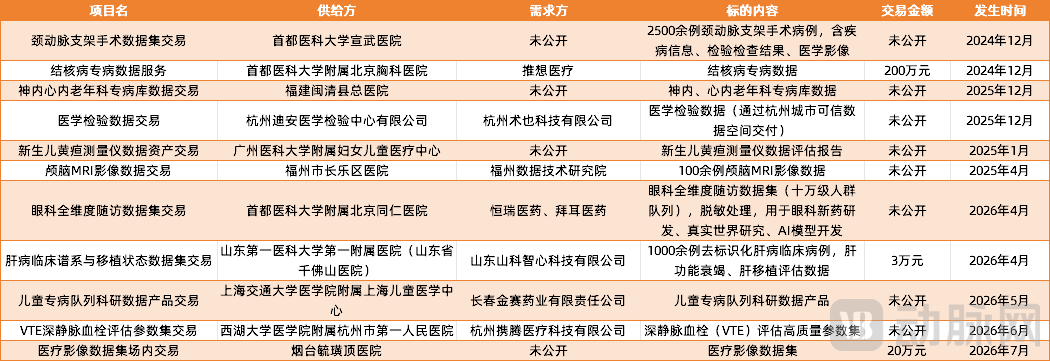
Publicly Disclosed Healthcare Data Trading Projects (Partial)
The rise stems largely from broad adoption of general‑purpose AI and scaled deployment of vertical healthcare AI applications, which have fueled natural expansion of medical‑data trading.
Meanwhile, local big‑data bureaus and their affiliates have stepped up industry engagement. By striking corporate partnerships to develop new data businesses, they are attracting more buyers and sellers into the marketplace.
Over the past year, Beijing Data Pilot Zone has partnered with RIMAG to build a high‑quality medical‑image database. Hangzhou Data Exchange Co., Ltd. and Hangzhou Data Factor Innovation Center have sealed strategic cooperation with Hangzhou Diagens Biotechnology Co., Ltd. Shaanxi Silk Road Data Trading Center has joined hands with Yangtze River Pharmaceutical Group, Digital Xi'an Technology Operation (Group) Co., Ltd. and other entities to establish a medical‑data integration and innovation research platform.
A new co‑construction‑centered data supply‑demand ecosystem is taking shape.
Even so, unresolved ownership of medical data keeps overall market volume far below the threshold for high‑velocity data circulation.
Whether the sector can seize global AI tailwinds to evolve into a hundred‑billion‑yuan medical‑data circulation market hinges on coordinated efforts among exchanges, market players and regulators to make trading operate efficiently.
High‑quality medical data never lacks buyers.
In an ideal scenario, AI trained on premium datasets can replicate top‑tier physicians’ capabilities and ease clinician shortages across healthcare systems. It could also cut average drug‑development cycles from 10 years to four, expanding affordable treatment access for more patients.
In practice, healthcare‑sector demand remains highly fragmented. Pharmaceutical firms need R&D datasets, medical‑device developers require training data, and insurers seek actuarial datasets. One single data product can only satisfy narrow use‑cases.
Supply‑demand matching is therefore far more complex than in other industries.
Exchanges’ primary bottleneck lies in limited supply. Concerns over data‑security liability deter many medical institutions from trading data, leaving large volumes of high‑quality datasets unused.
Chinese regions have piloted multiple approaches to tackle this gap.
One model is full‑range services operated by data exchanges.
Shanghai Data Exchange exemplifies this approach. To source premium clinical datasets, it engages key Grade‑A tertiary hospitals including Huashan Hospital and Ruijin Hospital with one‑on‑one support covering data confirmation, compliance assessment and listing. Image and special‑disease datasets from these institutions have been listed for trading.
Beyond on‑site transactions, Shanghai has built trusted data spaces for designated disease types.
These spaces enable secure storage, governance and circulation to maximize data utility. They deliver end‑to‑end technical and security safeguards, and deploy three core components: data connectors, data‑space operation platforms and dedicated portals for convenient authorized access to internal resources.
The H. pylori trusted‑data space is a well‑regarded implementation. Its architectural framework realizes “data available without being visible”, resolving privacy and compliance risks via technical means.
A second path features government‑led trusted‑data spaces. Under this framework, raw data never leaves local jurisdictions. Transactions are completed inside government‑hosted trusted environments, where pharma and med‑tech firms only receive computed outputs rather than source datasets.
In July 2024, Guangzhou Municipal Health Commission together with Guangzhou Radio Group Co.,Ltd. launched the Guangzhou health‑industry trusted‑data space, following the principle of “raw data stays on‑site; data is usable without being visible” to advance hospital‑enterprise collaboration.
To date, over 40 hospitals have joined the platform, facilitating more than 10 million medical‑data transactions.
Guangzhou Women and Children's Medical Center completed the platform’s inaugural deal: a neonatal‑jaundice medical‑device company wanted equipment‑test evaluation reports. Working with space operators, the hospital delivered analytical outputs via data sandboxes, with raw data retained within the trusted environment.
Other localized models have also emerged.
Fujian adopts a government‑led framework combining public‑data authorized operation and scenario incubation. Acting both as a “data customs authority” and incubator, the local exchange centrally manages public medical‑data authorization, supervises data exports and designs use‑case products to draw in processing enterprises. This model yields authoritative, highly standardized data sources and supports rapid scale‑up.
Yet heavy exchange involvement may distort dataset design by suppliers and filter out some market‑oriented datasets.
Xi’an prioritizes regional specialty disciplines and traditional Chinese medicine, adopting a special‑disease‑driven industry‑university‑research integration model.
Local exchanges function as technical brokers, matchmaking hospitals and pharmaceutical firms via contractual transfers and joint laboratories for research‑oriented data collaboration.
Xi’an Data Bureau has recently partnered with Yangtze River Pharmaceutical Group. Supported by compliance frameworks and matchmaking services from the exchange, the two sides explore data‑driven TCM new‑drug R&D focusing on classical TCM formula research and real‑world‑evidence applications. Local leading hospitals supply desensitized diagnosis‑and‑treatment real‑world datasets for orthopedic conditions, which Yangtze River Pharmaceutical Group leverages for secondary development and efficacy evaluation of TCM products.
Divergent operational models are natural market evolution. Despite geographic differences, competition persists amid scarce high‑quality data assets.
Consequently, modern data exchanges must go beyond basic display and circulation functions. They need to deliver value‑added data‑processing services and proactively match buyers with sellers.
For now, the industry broadly agrees to set ownership questions aside, to be revisited once medical‑data trading matures.
For medical institutions holding datasets, data trading represents a fresh revenue stream, amplified by active support from exchanges and local authorities.
RIMAG serves as a telling example. Leveraging policy‑driven opportunities in Beijing Data Pilot Zone, RIMAG has closed multiple anonymized and assessed data transactions, generating tangible returns in the data‑trading market.
Benefiting from its in‑house healthcare‑AI portfolio, RIMAG trades datasets cleaned during internal model training, whose costs have already been absorbed in R&D. Data products thus deliver substantial marginal profits.
According to White Paper on the Development of Global Digital Intelligence Medical Imaging Ecosystem Industry in the 2026 AGI Era by Frost & Sullivan, RIMAG has built systematic medical‑image data service capabilities. It hosts more than 28.53 million cumulative imaging cases with roughly 20 000 new entries daily, supporting 12 imaging modalities and covering over 300 diseases plus 500 disease subtypes, forming an initial‑stage data flywheel.
Moreover, once built, a single dataset product can be resold repeatedly, spreading construction costs across successive deals.
Still, RIMAG’s playbook cannot be easily replicated across the industry.
Building datasets carries substantial costs. Reselling legacy datasets generated from prior model training can deliver gross margins above 90%. By contrast, end‑to‑end development of new datasets — including data collection, governance, legal assessment, asset formalization and platform listing — costs suppliers a minimum of RMB 100 000.
Fragmented healthcare demand also prevents breakout “hit” datasets. Few full‑time specialized data‑supply teams exist, and weak supply constrains exchange growth.
RIMAG’s approach is mostly replicable for medical institutions: repackaging existing datasets as tradable assets for exchange relisting. Such repackaged assets constitute most listed products on current exchanges.
Suppliers face risks from blind capacity expansion.
Today many communications take place on exchange platforms, while raw data is physically copied off‑site via external hard drives, creating data‑leakage risks. Trusted‑data‑space infrastructure mitigates these risks and enables more controlled asset delivery.
Cost trade‑offs remain, however. Trusted‑data spaces require considerable encryption‑computing computing resources, much of which sits idle during non‑trading hours and creates resource waste. Only higher transaction frequency can drive utilization higher and bring down average unit costs.
Significant obstacles remain before large‑scale medical‑data‑asset trading, yet the trend is irreversible.
Historically, AI developers building healthcare applications were limited by datasets from a small number of partner hospitals. Resulting models often carried regional bias and lacked generalizability.
Scaled medical‑data trading would free developers from over‑reliance on individual hospitals. By drawing on multi‑source cross‑regional datasets at the R&D stage, teams can build more robust AI models. Separately commercialized AI products will also reduce intellectual‑property disputes with hospitals.
Medical institutions likewise stand to benefit. For decades, hospitals invested heavily in big‑data infrastructure mainly as cost centers. Data‑trading maturation may turn data governance from a cost burden into a new revenue source.
Medical‑data assets carry highly elastic value. When deployed to accelerate pharmaceutical and device R&D or improve hospital operations, derivative value will far exceed direct trading proceeds.
Like other industries, viable medical‑data business models require an investment‑intensive growth phase before marginal‑cost declines materialize. Large‑scale capital inflows have not yet arrived, yet positive signals are accumulating.
A RMB 100‑billion‑plus market may emerge within three years. Its significance extends well beyond adding one new trading category: it will reshape value creation logic for digital healthcare and drive industrial‑wide iteration.