

Kicking off with $1 Billion: Nearly All Players in This Sector Have Secured Financing This Year

Xaira Therapeutics
Comprehensive Biotechnology Developer

GENESIGHT
Developer of AI Virtual Cell (AIVC) Technology
"The Spring Festival has just passed, and the sector seems to have suddenly heated up, with several projects officially announcing financing news." Wang Yixuan, who just earned her Ph.D. in July, also serves as the Chief Technology Officer of GENESIGHT.
The virtual cell company, established in August 2025, completed a seed funding round of tens of millions one month ago.
In China, the current funding environment for virtual cell companies is exceptionally loose. As long as a company possesses decent virtual cell technology, regardless of how new the enterprise is or how young the entrepreneurs are, they can almost effortlessly secure substantial seed-round or angel-round financing.
For Wang Yixuan and GENESIGHT, this external environment has brought about a clear change: they can now access investors beyond their vertical sector and see opportunities that were previously out of reach.
VCBeat attempted to contact an investor who had recently invested in a virtual cell company, seeking a different perspective on this emerging trend. The response received was that it was inconvenient to comment at the moment, as the investor had just backed another virtual cell startup, though the deal has not yet been officially announced.
The virtual‑cell investment wave is fast approaching. The boundless potential of AI‑driven drug discovery may thus get a fresh new start.
Can All Virtual Cell Companies Secure Funding?
The rise of virtual cells to prominence dates back to 2024.
In that year, backed by top‑tier venture firms ARCH Venture Partners and Foresite Labs, Xaira Therapeutics was founded, bringing together Stanford scholars and former senior executives from MNCs including Roche and Pfizer, and secured $1 billion in financing immediately upon its establishment.
This funding amount is uncommon in early-stage biotech financing. What sets Xaira apart is its intention to reshape AI-driven drug discovery with a novel technological paradigm: the AI virtual cell.
Shortly after the 2026 Spring Festival, Xaira officially launched X-Cell, a virtual cell model with 4.9 billion parameters. The concurrently released preprint paper explicitly disclosed that on the Tahoe-100M drug dataset, X-Cell achieved a Pearson correlation coefficient of 0.31, significantly outperforming the STATE model's 0.22, with its core performance showing up to a five-fold improvement over the STATE model.
The Pearson metric, namely the Pearson correlation coefficient, is a core performance metric specifically used in the AI virtual‑cell field to measure a model's "perturbation" prediction performance. A Pearson correlation coefficient value closer to 1 indicates that the perturbation trend and magnitude predicted by the model are highly consistent with real experimental results.
It is worth noting that the Pearson correlation coefficient of the STATE model 0.22 had already become the industry's mainstream benchmark for performance. Yet X-Cell achieved this industry-level performance breakthrough in less than a year. This signifies that the development of virtual cell models has entered a fast lane, attracting capital inflows in its wake.
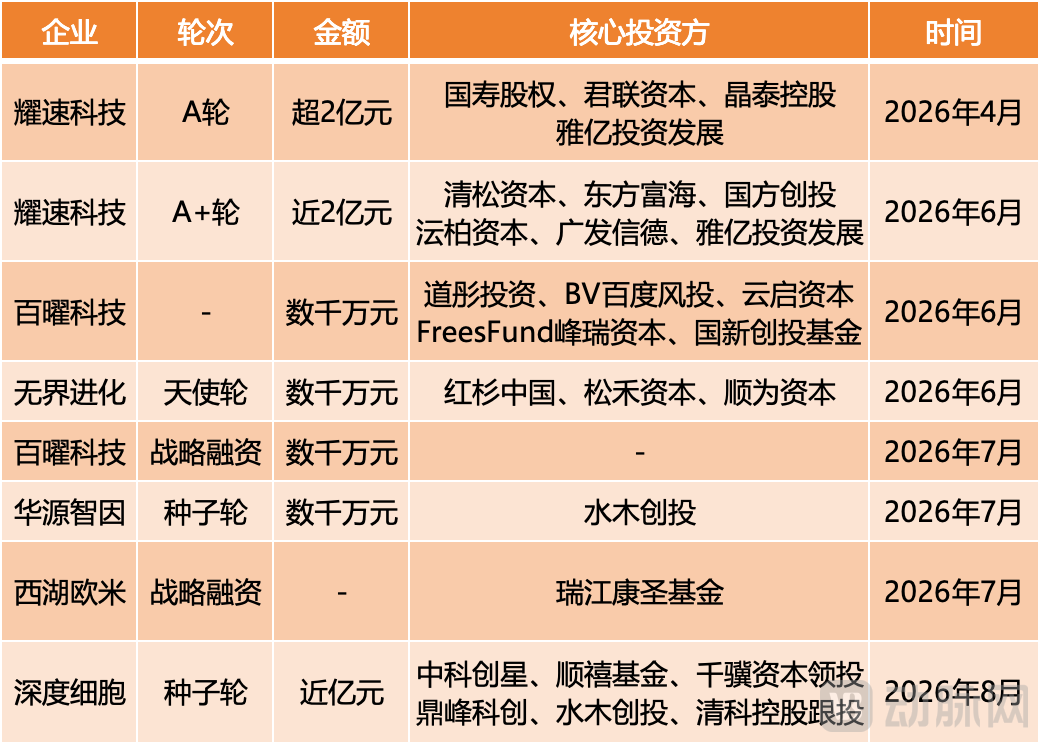
Domestic AI Virtual Cell Projects That Completed Financing Since 2026 | Data Source: VBInsight
According to VBInsight, since April 2026, nearly 10 financing events have taken place in China's virtual‑cell track. Top‑tier professional and state‑backed investment institutions including Sequoia Capital, Legend Capital, Baidu Ventures (BV), and Guoxin Venture Capital Fund have all entered the sector, with hundreds of millions of capital pouring into the industrialization wave of this emerging technology.
Among them, except for Xellar Biosystems and Westlake Omics, other virtual‑cell enterprises that have completed successive financing rounds are all at relatively early startup stages.
It is worth noting that these virtual cell companies have each chosen differentiated application scenarios and technical pathways.
For instance, Vitaura has adopted a platform-based strategy centered on "large-scale databases + general-purpose foundation models," attempting to establish a presence in target discovery, drug screening, and iPSC-differentiation-based cell therapies. INFevo focuses on full-stack large-model-driven virtual cells, covering multi-scale simulations from molecules to cells, with a unique strategic layout in the design of chassis cells for synthetic biology. GENESIGHT, meanwhile, avoids the highly competitive areas of target screening and molecule generation, instead focusing on preclinical efficacy evaluation. DeepCell, which has just completed a financing round, builds virtual cells starting from the fundamental level of molecular interactions, with a technical path more oriented toward basic research-driven innovation.
In a sense, at this juncture when the industry is just gaining momentum, early-stage virtual cell projects across various directions can almost all successfully secure early-stage financing.
Deconstructing China's AI Virtual Cell Landscape: The New Battleground for BAT
So-called virtual cells refer to the simulation of partial or even complete biological behaviors of cells on a computer.
"With the advancement of multi-omics technologies, we have accumulated vast amounts of cellular data; however, these data remain largely fragmented and static," said Guo Tianxiang, Professor at Westlake University and Founder of Westlake Omics, in an interview with VCBeat, describing the original motivation behind virtual cell research. "Can we integrate genomics, transcriptomics, proteomics, as well as spatial, temporal, and perturbation data to build a model that describes cellular states, predicts cellular changes, and is continuously validated and refined through experimentation?"
In short, current virtual cells need to perform two tasks: describing the state of the cell and predicting the impact of external perturbations on the cellular state.
Shifting our focus back to the United States, in the same year that Xaira was founded, another virtual cell company quietly emerged in the San Francisco Bay Area, just dozens of kilometers away. By the end of that year, it released version 1.0 of its virtual cell model, AIDO.Cell-100M.
GenBio AI, a company founded by Song Le, a leading expert in China's large-scale biological model technology. Not long ago, Song Le stepped down as Chief AI Scientist at Baitu Life Sciences, where he was one of the founders of its AI capabilities.
During his tenure at Biotope, Le Song spearheaded the development of the xTrimo foundational large model system for life sciences, starting with protein pre-training and gradually expanding to unified modeling of multi-scale biological data, including DNA, RNA, and cellular data. Prior to this, Le Song worked at Ant Group and Alibaba DAMO Academy.
In China, from biological large models to virtual cells, BioMap and its backer Baidu are names that cannot be overlooked.
Previously, BioMap's independently developed foundational large model for life sciences, xTrimo, has been iterated to version V4, with 268 billion parameters, making it one of the largest-scale multimodal foundational large models for life sciences globally.
Not to be outdone in the leap from large biological models to virtual cells, BioMap has also made significant strides. In 2025, BioMap secured first place globally at the inaugural Global Virtual Cell Challenge, defeating over 1,200 teams worldwide with its self-developed xTrimo SCPerturb single-cell perturbation computational model. Interestingly, Wang Yixuan, CTO of GENESIGHT mentioned earlier, was previously employed at BioMap.
In October 2023, the team led by Li Xin from the Institute of Zoology, Chinese Academy of Sciences, first announced the research findings related to GeneCompass. This biological model, pre-trained on more than 120 million single-cell transcriptomic data points from humans and mice, is one of the earliest cross-species foundational models for gene regulation worldwide.
In October 2025, the open‑source code repository of the GeneCompass model was officially launched on GitHub, open to global researchers. In the same month, Vitaura, a virtual‑cell‑model‑focused company with the GeneCompass model as its core technology, closed a multi‑million‑yuan angel‑round financing. In June 2026, Baidu Ventures (BV) invested in Vitaura.
From developing models to supplying industry talent, and then investing substantial capital, the established internet giant Baidu has already firmly rooted itself in the virtual cell sector before the industry truly sees the dawn of its breakthrough.
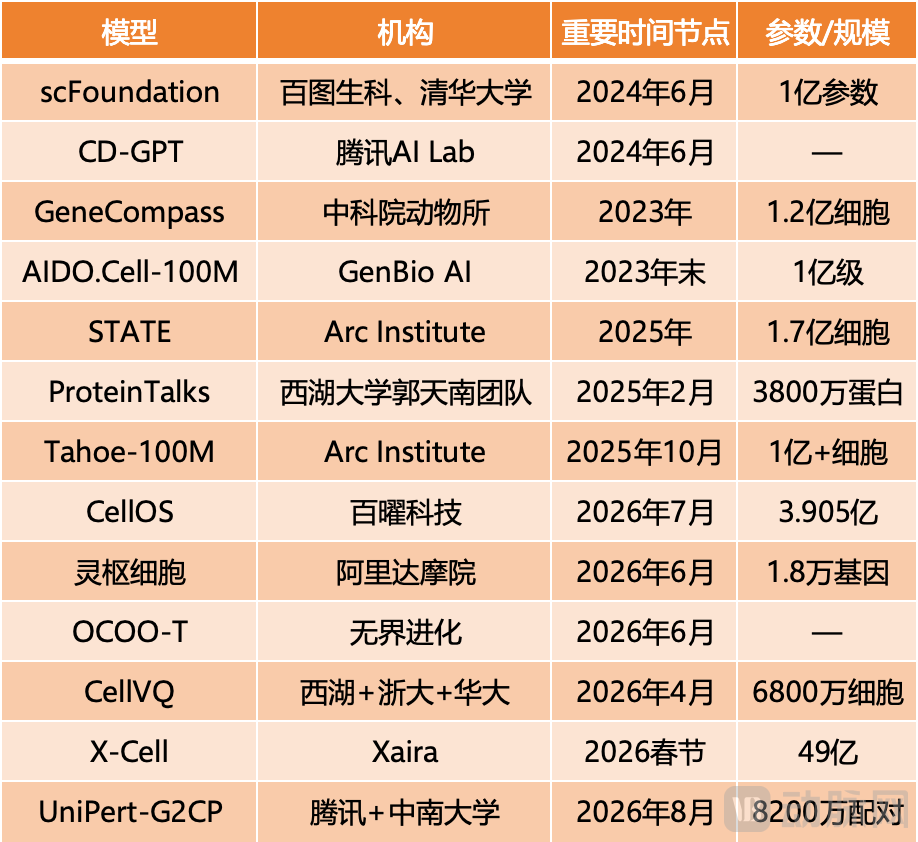
Key Models Related to Virtual CellsData Source: Compiled by VCBeat based on public information
Meanwhile, in Shenzhen, southern China, Tencent has also ventured into the field of virtual cells.
In June 2024, Tencent AI Lab officially released the open-source code repository for CD-GPT on GitHub. This is China's first innovative foundational biological large language model based on modeling the central dogma of biology.
In August 2026, the joint research conducted by Yao Jianhua's team at Tencent Life Sciences Laboratory and Professor Li Min's team at Central South University was published in "Cell". They proposed UniPert-G2CP, a unified framework for cellular perturbation modeling, establishing a new paradigm that bridges multimodal molecular representations with cross-domain phenotypic transfer.
However, Tencent's strategic layout in virtual cells goes far beyond this.
In 2015, Tencent participated in XtalPi's Series‑A financing. Over the following decade, Tencent increased its shareholding on multiple occasions. Prior to XtalPi's IPO, Tencent had become its largest external institutional shareholder. XtalPi stands as a key player among domestic Chinese enterprises working on AI‑driven virtual‑cell technologies.
In November 2025, under deep incubation by XtalPi, Zhao Yalong, who headed AI algorithms at XtalPi Innovation Center, founded virtual‑cell enterprise INFevo. In June 2026, the paper on OCOO‑T, a self‑developed virtual‑cell model by INFevo, was officially published and made open on arXiv.
According to INFevo, the OCOO‑T model has achieved state‑of‑the‑art (SOTA) performance across three major perturbation benchmarks. In the same month, INFevo closed a multi‑million‑yuan angel‑round financing, with top‑tier investors including Shunwei Capital, HongShan and Green Pine Capital Partners participating in the deal.
Back in April 2026, XtalPi made a strategic investment in Xellar Biosystems. Founded in Boston at the end of 2021, the company explores the integration of organ‑on‑a‑chip devices, high‑content 3D cellular imaging, computer vision and AI technologies.
Through this investment, XtalPi has extended its reach into the realm of experimental validation for virtual cells. The greatest challenge currently facing the commercialization of AI-driven virtual cells is establishing a closed loop that seamlessly integrates prediction, validation, and subsequent prediction refinement.
The Third Pole of China's Virtual Cell Sector Lies in the Yangtze River Delta.
Here are Alibaba's DAMO Academy and Westlake University. Another interesting point is that Huang Buwei, the youngest co-founder of Xaira mentioned earlier, is a graduate of Zhejiang University in Hangzhou.
In June 2026, Alibaba DAMO Academy officially released the Lingshu Cell Model and demonstrated gene perturbation prediction on-site. In the gene perturbation benchmark of the Virtual Cell Challenge, which involved 25 top-tier teams, the Lingshu Cell Model ranked first overall, with core metrics outperforming traditional models such as STATE.
It is reported that the model has been integrated into the "Damo Lingshu" scientific research agent platform and is now open for public testing. Previously, it assisted research teams in predicting 68,000 potential superconducting materials and can be directly applied to the preliminary screening stage of drug development in the life sciences field.
Of course, Alibaba DAMO Academy is not the only hub for virtual cell innovation in the Yangtze River Delta.
On June 17, 2026, the team led by Guo Tiannan at Westlake University, in collaboration with Shanghai Jiao Tong University School of Medicine, Harbin Medical University, and other institutions, systematically mapped the highest-resolution and most comprehensive spatial atlas of the human proteome to date in "Nature".
In July 2026, Professor Guo Tiannan's team, in collaboration with multiple domestic and international research institutions, published a forward-looking review article titled "Towards the construction of a virtual yeast" in Nature. The article proposes a systematic framework for constructing virtual cells that is verifiable, iterative, and transferable. Using Saccharomyces cerevisiae as a model organism, the study presents an approach to integrating prior biological knowledge, cellular spatial architecture, and dynamic perturbation data to build cell-level AI agents that incorporate both biological constraints and predictive capabilities. This methodology is not limited to yeast but can be transferred to various cellular systems, including those of humans, animals, plants, and microorganisms.
Professor Guo Tiannan once stated that he hopes to integrate this static protein "map" with dynamic changes across the time dimension, leveraging AI to construct a predictable and interactive "virtual cell" model.
In February 2025, Professor Guo Tiannan's team released ProteinTalks, the first foundation model for building virtual cells based on dynamic proteomics, featuring large-scale proteome modeling derived from 38 million perturbation data points. In July 2026, Westlake Omics, founded by Professor Guo Tiannan, received strategic investment from the Ruijiang Kangsheng Fund.
Furthermore, in April 2026, Professor Li Ziqing's team from the School of Engineering at Westlake University, in collaboration with Zhejiang University and the BGI Research Institute, published a landmark study in Nature Communications introducing CellVQ, a single-cell foundation model that combines comprehensiveness with interpretability. Alongside this, they released CellVQ-Graph, a lightweight plugin tool designed to address key industry challenges, namely the poor generalizability and limited interpretability of existing AI models for single-cell analysis.
Virtual Cells in the Course of History
The initial concept of the virtual cell emerged during the rise of systems biology. Researchers had a singular goal: to formulate all intracellular biochemical reactions and gene regulatory relationships into mathematical equations, thereby fully replicating the complete behavior of a living cell in silico.
In 1999, Japanese scientists launched the renowned E-Cell project, constructing the first virtual cell prototype in human history. To reduce complexity, the team selected a hypothetical minimal bacterium with only 127 genes. By manually writing extensive differential equations and inputting parameters for each metabolic pathway, they ultimately enabled the virtual cell to complete its division cycle at the digital level.
However, this model inherently suffers from a critical limitation: every additional gene or reaction pathway requires researchers to manually calibrate parameters. Consequently, E-Cell remains confined to minimalist hypothetical life forms, falling far short of applications in human cells or drug development.
In 2012, the Covert team at Stanford University delivered a landmark achievement in traditional mechanistic modeling: the whole‑cell model of Mycoplasma genitalium. As one of the bacteria with the smallest known gene set in nature, Mycoplasma genitalium has a total of 482 genes. Integrating genomic, metabolic and gene‑knockout experimental data, the research team built a complete simulation system capable of simulating bacterial growth and division, as well as predicting cellular phenotypic changes following gene knockout. This work was regarded as a milestone in computational biology at that time.
However, the model can only operate on the simplest bacteria and cannot be transferred to human cells, which are several orders of magnitude more complex. A large number of biochemical reaction parameters have not yet been accurately measured by experimental methods, and it is difficult to validate simulation results through large-scale wet lab experiments. The entire project has remained within university laboratory research and has not spawned any commercial spin-offs.
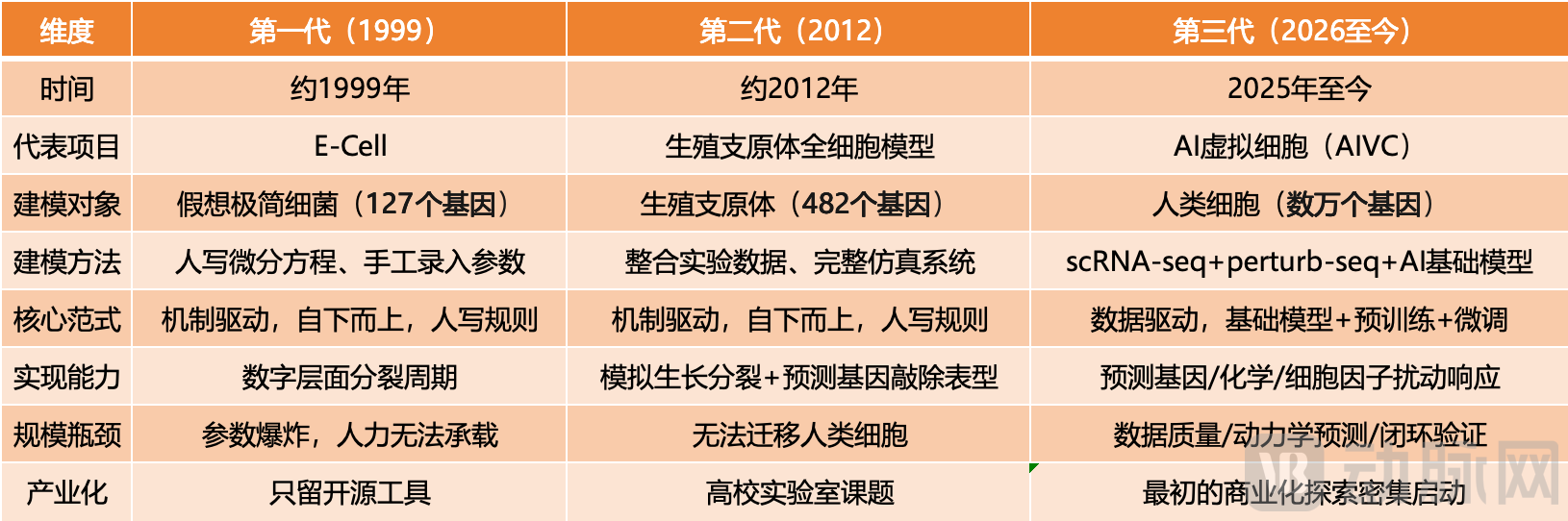
Virtual Cells in the Course of History Data Source: Compiled by VCBeat based on public information
"In fact, around 2023, large biological models were already widely used in computational biology research, but these models had limited generalization capabilities across different cell types," pointed out Wang Yixuan.
The true paradigm shift occurred after the maturation of single-cell sequencing, large-scale perturbation experiments, and AI algorithms. Coupled with the pharmaceutical industry's growing demand for and capacity to leverage AI technologies to enhance drug development efficiency, these factors collectively ignited the current surge in interest in AI virtual cells.
However, between realistic virtual cell models and the ideal of AI-driven drug discovery lies a vast gulf requiring countless iterations of model optimization and dataset refinement.
"If we use the standard of truly simulating a living cell in silico, we are still far from achieving it," Professor Guo Tiannan told VCBeat. He noted that many so-called virtual cell models currently address relatively specific problems, such as predicting how a cell will change following gene knockout or drug treatment based on its current state.
In his view, the biggest challenges facing AI virtual cells currently lie in data and biology. "Among publicly available datasets, static data are abundant, while high-quality spatial, dynamic, and perturbation data remain scarce, stated Professor Guo Tiannan."
Dr. Pei Hao, Founder of MobiDrop, also points out that despite the large volume of available public data, prominent structural issues persist. These include significant batch effects originating from different laboratories, equipment, reagents and workflows. Most datasets are static observational data, with incomplete contextual records regarding sample origins, experimental procedures and quality control.
"On the other hand, many models primarily focus on data correlations, with insufficient consideration of the true biological mechanisms within cells. The next step requires both improved models and new experimental techniques and data systems," added Professor Guo Tiannan.
Wang Yixuan also emphasized that AI virtual cell models must be validated in real-world scenarios and trials. Collaborating with physicians, scholars, and influential pharmaceutical companies to evaluate their capabilities in real-world settings is far more valuable than merely obsessing over parameter tuning to maximize performance metrics.
It is still too early to tell whether the third wave of virtual cells will ultimately stir up profound changes in the industry. At the very least, a new chapter in the history of AI-driven drug discovery has inevitably been opened.