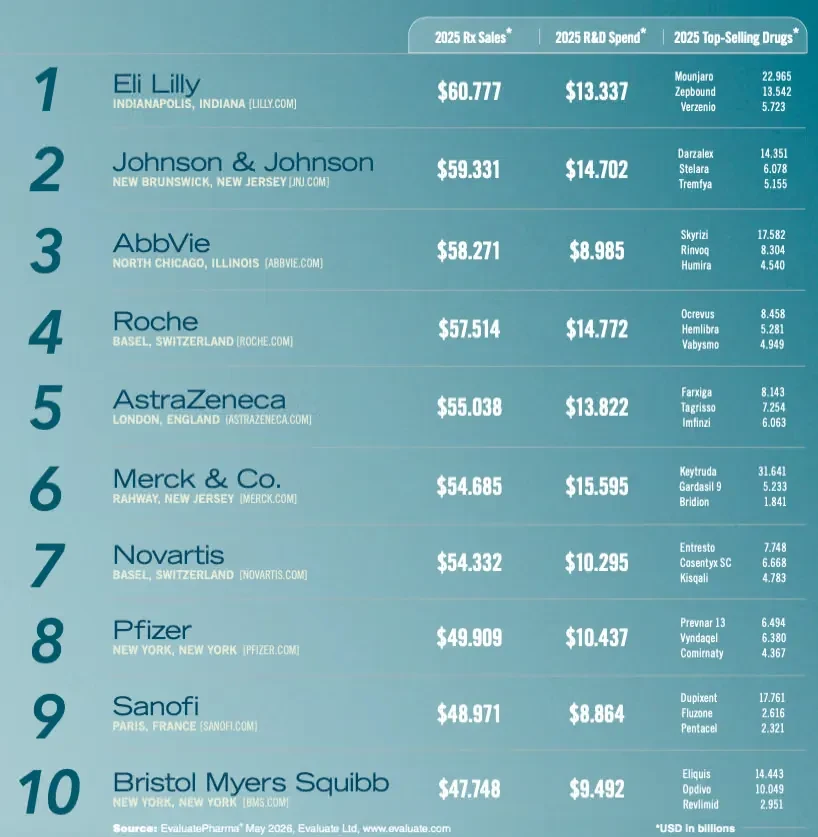
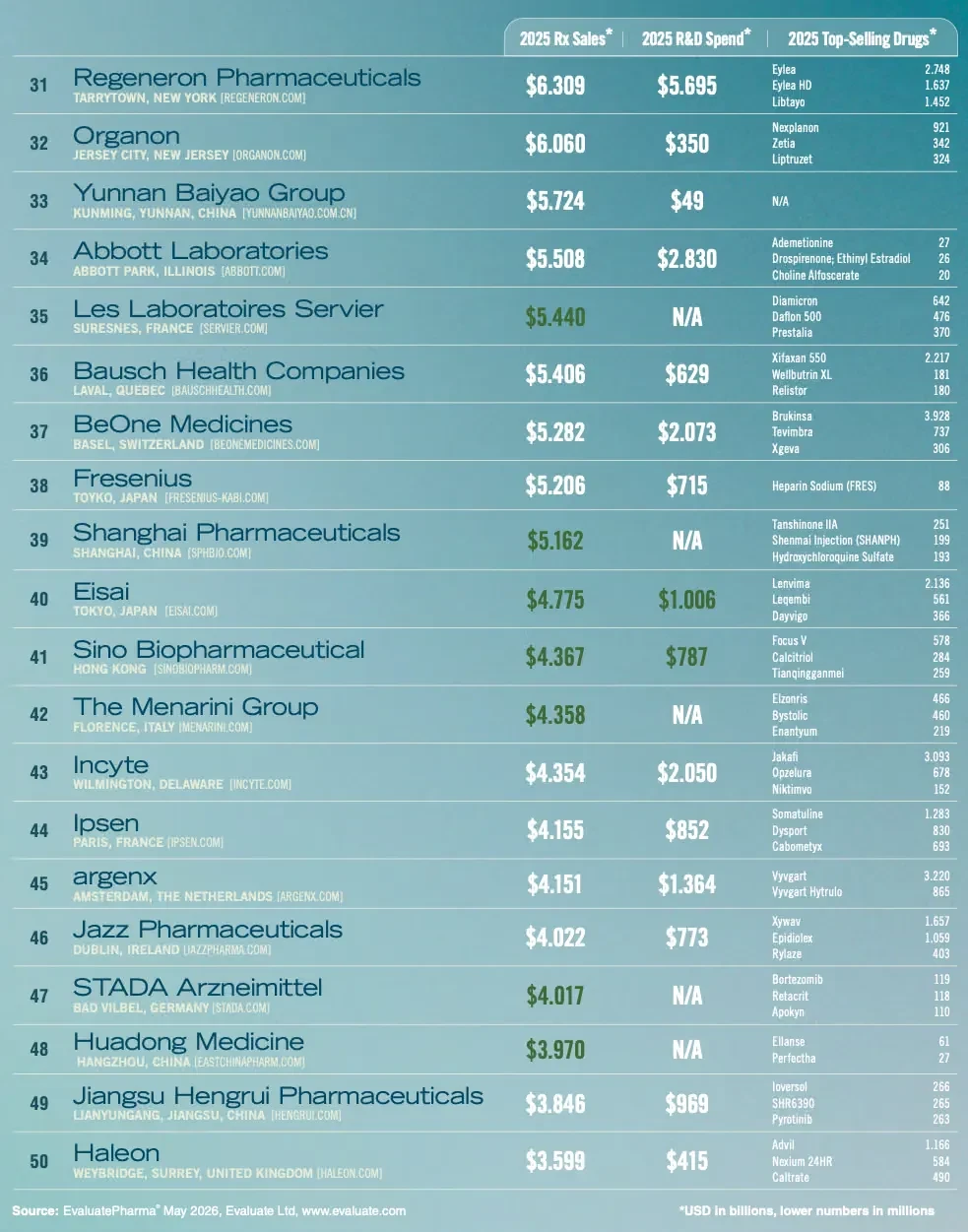
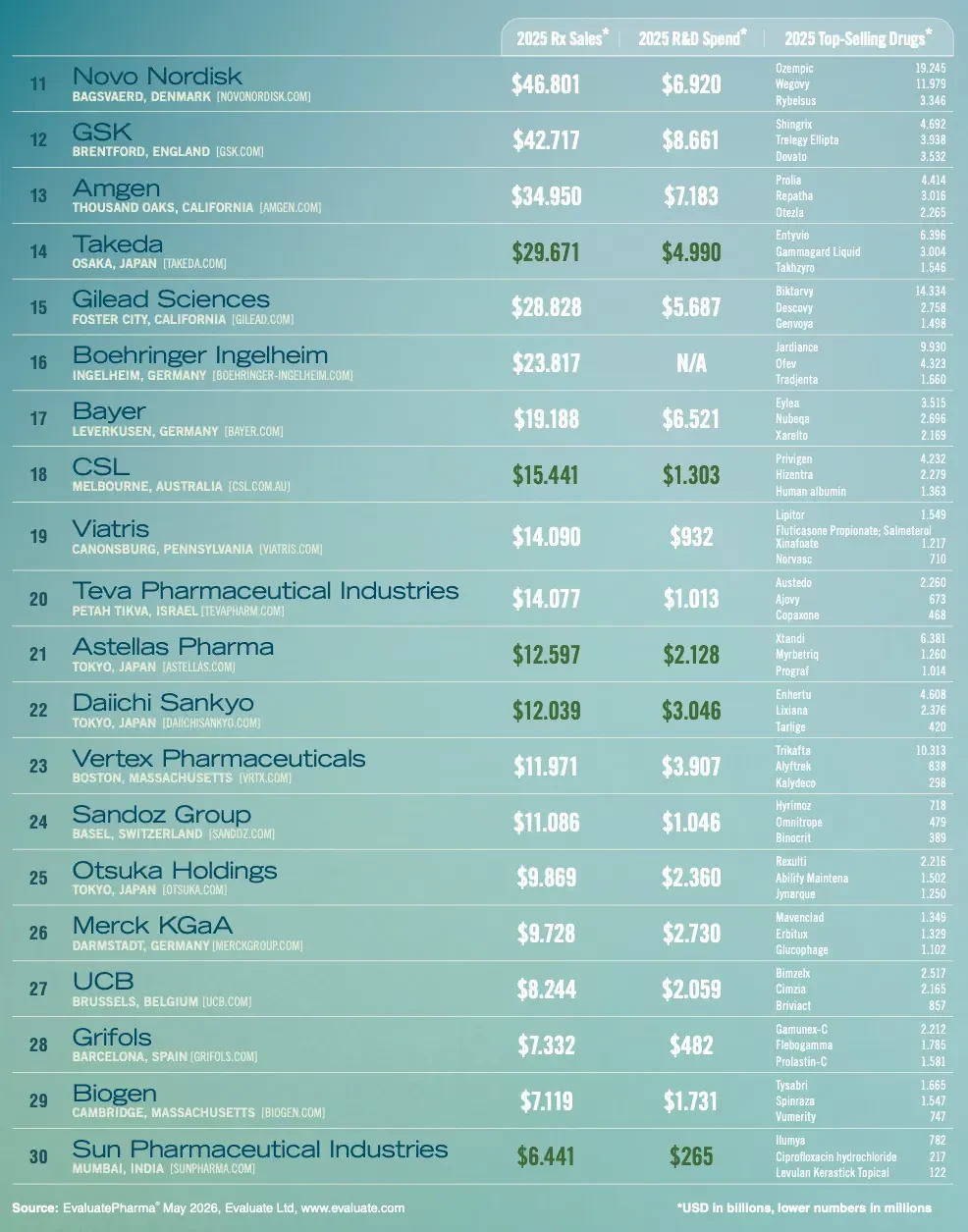
On August 14, Pharmaceutical Executive released the 2026 Top 50 Global Pharmaceutical Companies list.The magazine commented that the ranking changes in this year’s list amounted to an earthquake-level reshuffling of the industry landscape.In 2025, Eli Lilly, which was ranked 11th, surpassed ten companies in just one year, claiming the top global spot with $60.777 billion in prescription drug sales; Johnson & Johnson, which had held the number one position for two consecutive years, fell to second place, while AbbVie took third.The ranking changes among listed domestic pharmaceutical companies are more pronounced: Yunnan Baiyao remains at 33rd place, BeOne rises significantly from 44th to 37th, and SPH returns to the list at 39th. On the other hand, Sino Biopharm drops from 39th to 41st, Huadong Medicine falls from 41st to 48th, and Hengrui Pharma declines from 46th to 49th.However, it is worth noting that a decline in ranking does not equate to a regression in innovation. On the contrary, the most valuable signal conveyed by this list is:Domestic innovative drugs are accelerating their commercial scale-up, yet the growth momentum of global leading pharmaceutical companies is even more robust. Chinese pharmaceutical enterprises have now entered a new stage of competing in the global market.The most prominent is undoubtedly BeOne.Last year, it ranked 44th with prescription drug sales of $3.789 billion,It has risen to the 37th position this year, becoming the domestic innovative pharmaceutical company with the largest increase in ranking.These seven rankings correspond almost directly to the global volume ramp-up of zanubrutinib: In 2025, BeOne’s product revenue reached $5.3 billion, a year-on-year increase of 40%; among this, the global sales of zanubrutinib reached $3.9 billion, a year-on-year increase of 49%, with the U.S. market alone contributing $2.8 billion. The global sales of tislelizumab also reached $737 million.However, BeOne’s rise in ranking stands in stark contrast to that of others.Hengrui Pharma’s innovative drug sales revenue reached RMB 16.342 billion in 2025, a year-on-year increase of 26.09%, accounting for 58.34% of its total pharmaceutical sales revenue; among these, revenue from non-oncology innovative drugs surged by 73.36%.From the perspective of innovation-driven transformation, this is clearly a quite impressive performance report. However, in the "Pharmaceutical Executive" rankings, Hengrui Pharma’s prescription drug sales increased only from $3.632 billion in the previous year to $3.846 billion, with its ranking dropping by three positions.Sino Biopharm tells the same story. In 2025, revenue from innovative products reached RMB 15.22 billion, a year-on-year increase of 26.2%, accounting for 47.8% of total revenue;Over the past three years, 16 innovative products have been approved, including seven Class 1 innovative drugs.In 2025, the company saw the market launch of additional products, including zongaitinib, a first-line oral therapy for lung cancer; cumosilide, a CDK inhibitor; and recombinant human coagulation factor VIIa. However, its global ranking declined from 39th to 41st place.This precisely reveals another layer of reality behind the list:The innovative transformation of China's leading pharmaceutical companies has begun to yield results, but has not yet fully translated into an advantage in global rankings.Huadong Medicine presents a more typical case. Its ranking slipped directly from 41st to 48th, with prescription drug sales recorded in the leaderboard showing almost no significant growth. In recent years, the ramp-up speed of Huadong’s innovative products has not been slow; however, compared to its substantial base of mature products, new drugs are still in the transition phase from “high growth on a small base” to “contributing at scale.” This reflects a collective challenge facing China’s leading innovative pharmaceutical companies: determining when the volume of innovative product sales will become large enough to alter the overall revenue trajectory of a major pharma company.SPH has emerged as this year’s “comeback company.” After ranking 42nd on the 2024 list and falling out of the Top 50 in 2025, it has surged back to 39th place this year, with prescription drug sales reaching $5.162 billion.Global Landscape Undergoes Dramatic Shift: Mega Blockbuster Drugs Reshape Top RankingsIn the 2025 rankings, the top ten remained Johnson & Johnson, AbbVie, Merck & Co., Roche, Pfizer, AstraZeneca, Novartis, BMS, Sanofi, and Novo Nordisk, with Eli Lilly ranking only 11th. At that time, it had already achieved a 27.8% growth in prescription drug sales driven by tirzepatide.By 2026,Eli Lilly Surpasses Ten Companies to Claim Top Spot with $60.777 Billion, “Pharmaceutical Executive” also described it as one of the most significant and sudden ranking jumps in the history of the 2026 list.Johnson & Johnson, formerly in first place, dropped to second; AbbVie fell from second to third; Roche remained stable at fourth; and AstraZeneca rose from sixth to fifth.However, a group of “former kings” from the past decade have slipped: Merck & Co. fell from third to sixth, Pfizer from fifth to eighth, and Bristol Myers Squibb (BMS) from eighth to tenth. Novo Nordisk, which broke into the TOP 10 last year on the strength of semaglutide, was pushed down to 11th place this year.This shift mirrors the logic facing domestic pharmaceutical companies:The growth rate has failed to keep pace with the new industry leaders.Merck & Co. remains heavily reliant on Keytruda, Bristol Myers Squibb continues to confront the patent cliff for its mature blockbuster drugs, and Pfizer is still grappling with the growth gap left by the waning COVID-19 business. Although Novo Nordisk still commands a massive GLP-1 market, it has lost its dominant market position in direct competition with Eli Lilly.In contrast, Eli Lilly’s tirzepatide, AbbVie’s Skyrizi and Rinvoq, and AstraZeneca’s continuously expanding oncology and specialty care portfolio are all driving new incremental growth.New players are also emerging in overseas markets.The most notable example is argenx, which entered the TOP 50 for the first time, ranking 45th with $4.151 billion in prescription drug sales. The rise of argenx has been driven almost entirely by a single product—the FcRn-targeted therapy efgartigimod. In 2025, the global net sales of efgartigimod surged from $2.2 billion the previous year to $4.2 billion, nearly doubling. As its indications expanded from generalized myasthenia gravis to other autoimmune diseases such as chronic inflammatory demyelinating polyneuropathy, and with the launch of new formulations including subcutaneous injection and pre-filled syringes, this single drug has rapidly propelled argenx from a biotech company into the top 50 global pharmaceutical companies.From this perspective, the 2026 Global Top 50 Pharmaceutical Companies ranking is more akin to a leaderboard of commercialization efficiency for innovative drugs.First Review | Shi WanjiaSecond Review | Li Fangchen
Third Review | Li Jingzhi