

We-LINKING Medical Secures Over RMB 100 Million in Funding to Advance Implantable Brain-Computer Interface for Neurological Restoration

WE-LINKING
Developer of Medical-Grade Fully Implantable Wireless Brain-Computer Interface Systems
Text | Liu Lingguo, Hu Xiangyun
Edited by Hai Ruojing
36Kr Exclusive: Medical Brain-Computer Interface Company WE-LINKING Completes Over RMB 100 Million in Financing36Kr has exclusively learned that WE-LINKING, a medical brain-computer interface (BCI) company, recently completed a financing round exceeding RMB 100 million. The round was led by Junzhong Capital, with Innuovate (688253.SH) serving as the core industrial investor in the fund. The raised capital will be primarily used to advance clinical validation of its core implantable BCI products, accelerate the medical device registration and approval process, enhance its manufacturing system, and continuously expand its clinical application layout in the field of neural function restoration. Previously, WE-LINKING had secured investment from several top-tier institutions, including Gaorong Capital, Life Science Park Venture Capital, CDH Investments, and Lihexingchuang.
WE-LINKING, founded in 2019, is a brain-computer interface (BCI) company continuously tracked by 36Kr. “Let there be no incurable brain diseases in the world.” This sentence is posted on the wall of WE-LINKING’s headquarters. In the currently overheated BCI sector, this vision focused on serious medical applications seems less “sexy” than “human-computer interaction.”
The dedication to treating brain diseases is closely tied to the academic background and scientific training of founder Li Xiaojian. Over the past two decades, Li Xiaojian’s research has consistently focused on deciphering brain function and developing interventions and treatments for brain disorders.
After earning his Ph.D. from the Institute of Biophysics, Chinese Academy of Sciences, Li Xiaojian worked for nearly a decade at the Medical College of Georgia and Northwestern University’s Feinberg School of Medicine in the United States. Upon returning to China, he joined the Shenzhen Institutes of Advanced Technology, Chinese Academy of Sciences, to conduct research and development on brain–computer interface technologies. He currently holds dual appointments as a professor at the Greater Bay Area Center for Brain Science and Brain-Inspired Intelligence and at Zhujiang Hospital, both affiliated with Southern Medical University.
Recently, Li Xiaojian sparked heated discussion within the industry due to his bold remarks about investors. In his view, it is understandable that people have different interpretations of the market prospects for brain-computer interfaces. "Some are optimistic about the imaginative potential of human-machine interaction, while others focus on the potential of consumer-grade applications." However, what needs to be guarded against is "focusing only on the distant future while ignoring the immediate risks and challenges."
Fifty years since the advent of brain-computer interfaces, genuine advancement in clinical research has only occurred in recent years. “Solidly establishing a foundation in rigorous medical applications first” to build robust technological expertise is, in Li Xiaojian’s view, the preferable approach.
From this perspective, the viable approach he identified is to prioritize brain repair, given that the injury is located in the brain. “Patients with brain injuries often lose partial or complete control over their limbs due to nerve damage and the resulting inability of neural signals to conduct effectively. However, if the patient’s brain can still generate normal motor intentions, we can leverage brain-computer interface (BCI) technology to repair damaged neural pathways and achieve remodeling of the brain network.”
In Li Xiaojian’s view, the “brain” is the unshakable core of brain-computer interface technology, while the “machine” serves the brain. By guiding the remodeling process of brain networks, it can not only repair brain injuries but also unlock and enhance the brain’s potential.
For instance, for patients with impaired motor function due to brain injuries such as stroke or traumatic brain injury, “regaining control over their native limbs can provide more direct benefits”; for patients with severe nerve damage and limited potential for restoration, a collaborative approach combining partial functional restoration with partial functional substitution may be considered.
WE-LINKING’s technological framework, which covers the entire process of neural function restoration, was summarized by Li Xiaojian as “diagnosis before treatment, integrating repair and replacement.” “Several international teams have built the ‘gun’ of brain-computer interfaces; the key question now is: where is the target?”
Precise diagnosis and treatment of brain diseases, along with the protection and repair of cranial nerves, are considered by him to be the most urgent clinical needs at present, as well as the starting point for brain-computer interfaces to demonstrate their definitive clinical value.
Repair nerves,
A Systematic Engineering Project on “Reshaping”
“Repairing Nerves” may sound somewhat mystical at first, but its underlying scientific basis is the brain’s neuroplasticity. It should be clarified that “repair” here does not mean “reviving” necrotic neural tissue; rather, it involves using implantable brain-computer interfaces (BCIs) for BCI-based training to help patients’ remaining neural circuits reorganize and achieve functional compensation.
Li Xiaojian summarizes this process as “network reorganization, circuit remodeling, and functional reconstruction” of the nervous system: Following brain injury, the original neural networks undergo reorganization; brain-computer interface (BCI) training can guide the compensatory remodeling of damaged circuits, ultimately enabling new circuits to reconstruct native functions. In this process, the BCI serves as the “coach,” while the neurons within the circuits act as the “athletes.” BCI training helps residual neurons learn to compensate for damaged ones, thereby re-establishing interrupted neural circuits.
WE-LINKING’s systematic capabilities in fully implantable brain-computer interfaces are not merely reflected in a specific medical device targeting particular indications, but are further extended into a comprehensive clinical platform for implantable brain-computer interfaces.
Its hardware components consist of an electronic implant, an external controller and neural stimulator, and exoskeletons and other effectors/assistive devices, with wireless power supply and transmission of cortical electroencephalogram (EEG) signals.
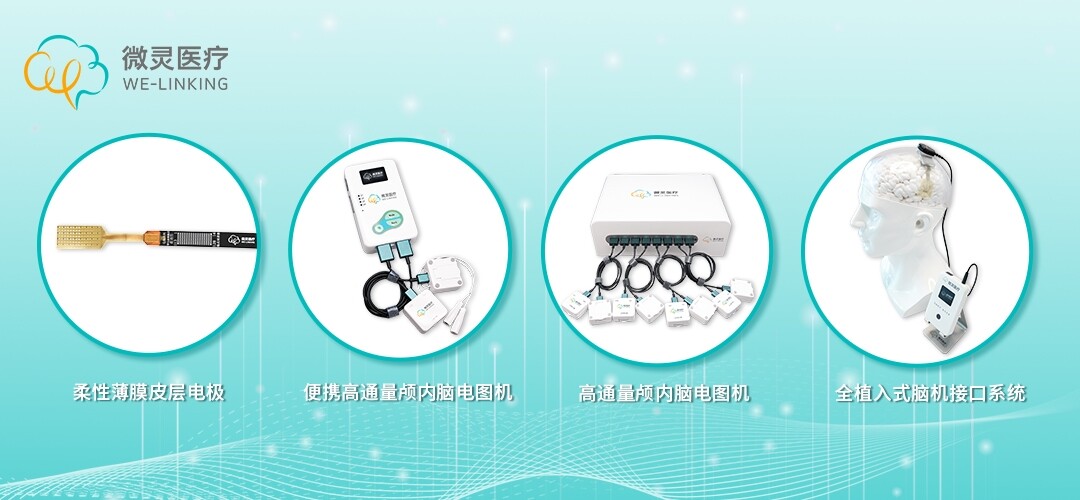
WE-LINKING Product Portfolio Overview
Among these, the flexible thin-film cortical electrodes serve as the “tentacles” of this system that interface closely with the brain. According to reports, WE-LINKING’s flexible electrodes are approximately 10 micrometers thick, with each sheet covering an area several centimeters in length and width. The electrodes are placed on the surface of the cerebral cortex without penetrating the brain tissue, enabling the acquisition of neural activity from different brain regions over a relatively large area. Li Xiaojian stated that technical parameters such as the morphology of the electrode sheets, the spacing and size of the contacts, as well as the implantation location and duration, are all determined by the specific clinical issues to be addressed.
Thus, the brain-computer interface (BCI) customization platform provides flexibility for adjusting BCI therapies across different indications, enabling treatment plans to be “tailored to specific diseases.” “The devices may look similar externally, but the targeted intracranial neural circuits differ, as do the electrode configurations; furthermore, chip functionalities and the channel setups for signal acquisition and stimulation also vary,” said Li Xiaojian.
It is reported that the customized version of the implantable brain-computer interface system for neural repair in patients with severe brain injury has initiated an IIT (Investigator-Initiated Trial) study. In mid-June this year, a hospital in Guangdong Province completed the implantation surgery using this brain-computer interface device.
Li Xiaojian introduced that the patient had fallen into a coma due to a brainstem hemorrhage one and a half years ago. Although the patient gradually regained consciousness after emergency treatment, brainstem damage resulted in "locked-in syndrome," which has since deteriorated to a minimally conscious state. Patients with locked-in syndrome are often described as "prisoners of consciousness"; they remain fully aware but suffer from total paralysis, unable to speak or move, with only minimal eye movements possible. "Perhaps only a brain-computer interface can help him."
Following brain-computer interface (BCI) implantation surgery, the patient underwent approximately one week of arduous BCI training and regained a conscious "locked-in" state. After an additional four weeks of implanted BCI therapy, the patient's left upper limb improved from complete flaccid paralysis to being able to perform multiple gestures, including independently lifting the forearm, easily extending the wrist, and grasping light, small objects. In the next phase, the patient is expected to engage in mild interaction with the external environment using a remote-control joystick.
“From the perspective of patient benefit, we must first create a breakthrough in the locked-in state, enabling the patient to engage in simple communication with family members. Restoring motor function in one hand is critical to the patient’s well-being, and deactivating the brain-computer interface system does not hinder continued use, as hand movement remains under the patient’s own control,” stated Li Xiaojian.
The primary rationale for initiating our work with the highly challenging “in situ functional reconstruction via brain-computer interface” lies in the following consideration: “With our robust theoretical foundation and technical support, we first aim to verify safety and efficacy in severe cases characterized by the most urgent needs and the most difficult treatment conditions. This approach will allow us to proceed with greater confidence when addressing indications involving less severe injuries.” In particular, critically ill patients have a more pressing need for novel therapies, and from an ethical standpoint, it is easier to garner support for conducting clinical trials in this population.
Based on this, WE-LINKING will continue to focus its resources on more clearly defined central nervous system diseases and patient populations at the current stage. It is understood that the company plans to further expand its clinical trials to cover a broader range of brain disorders.
Read out the boundaries of brain function,
Assist Physicians in Making Precise Decisions
If repair is about rebuilding signal pathways after neural injury, is it possible to locate and preserve neural function before it is lost to disease?
Currently, another key research focus at WE-LINKING is “how to identify and protect critical brain functional regions before neurological impairment occurs.” In response to this clinical need, the company has launched a series of auxiliary diagnostic products for brain function protection, comprising flexible thin-film cortical electrodes, high-throughput intracranial electroencephalography (iEEG) systems, and intelligent decoding software.
Among these, the flexible thin-film cortical electrode array can be attached to the patient's brain cortex surface to collect high-throughput neurophysiological signals, with a spatial resolution reaching sub-millimeter level. It has been validated through hundreds of clinical trials and is now in the registration phase for Class III medical devices.
The accompanying high-throughput intracranial electroencephalography (iEEG) system, specifically designed for neurosurgery, can be used in conjunction with analysis software to assist in diagnostic scenarios.
For neurological disorders such as epilepsy, Parkinson’s disease, depression, and disorders of consciousness, this system can effectively compensate for the limitations of conventional imaging modalities like CT and MRI. “Imaging examines brain structure, whereas brain-computer interface technology localizes functional brain areas,” said Li Xiaojian.
Taking epilepsy as an example, the abnormal discharges from the epileptogenic zone exhibit dynamic characteristics. Traditional imaging methods often fail to fully capture the origin of these abnormal discharges and their signal propagation pathways. In contrast, brain-computer interface technology can continuously acquire and analyze neural electrical signals from different brain regions, providing a basis for the precise localization of the epileptogenic zone.
For organic lesions such as brain tumors and cerebral hemorrhage, WE-LINKING’s products assist physicians in delineating the spatial relationship between the lesion and critical functional brain areas, thereby mitigating the clinical dilemma between maximizing lesion resection and preserving neurological function to the greatest extent possible.
Li Xiaojian explained that tumor infiltration may encroach upon existing functional areas. Due to compensatory mechanisms, brain functions such as language and motor control may shift to adjacent regions, resulting in an intermingling of the lesion with critical functional areas. This increases the risk of inadvertent injury to key functional zones during surgical resection, thereby elevating the likelihood of postoperative functional deficits such as aphasia and paralysis.
To address this, WE-LINKING’s solution involves adhering flexible thin-film electrodes to the cortical surface to acquire and decode electroencephalographic (EEG) signals in real time. This enables millimeter-level spatial resolution mapping of functional brain areas, providing functional navigation guidance for surgical procedures and assisting physicians in performing precise operations.
Simply put, this technology directly reads neural activity within the patient’s brain to “map” functional areas. During awake craniotomy, the patient performs tasks such as limb movements and language exercises according to instructions, while the system analyzes and visualizes the functional areas in real time, assisting surgeons in performing precise operations.
The decision to place electrodes on the cortical surface is also aimed at creating as complete a functional map as possible. In assisted diagnostic scenarios, the primary task is to clearly delineate the distribution of multifunctional areas such as language and motor regions, where millimeter-level spatial resolution is sufficient to meet clinical needs. The approach of adhering to the cortical surface not only minimizes tissue damage but also enables signal coverage over a larger area.
In terms of commercialization, WE-LINKING’s intracranial high-throughput electroencephalography (EEG) system and its配套 multiple cortical thin-film electrode arrays are currently in the registration phase for auxiliary diagnosis aimed at brain protection, with expected phased approvals and market launch within the next 1–2 years. In the direction of brain injury repair and neurological disease treatment, WE-LINKING’s fully implantable brain-computer interface (BCI) system will continue to advance multi-center clinical trials and initiate clinical exploration for a broad range of indications.