AstraZeneca and Amgen's Tezspire Receives FDA Approval for Chronic Rhinosinusitis with Nasal Polyps

AstraZeneca
Biopharmaceutical Manufacturer

Amgen
Developer of Treatment Drugs for Serious Diseases

On October 17 local time, AstraZeneca and Amgen jointly announced that the US FDA had approved Tezspire.(Tezepelumab Subcutaneous Injection)'s supplemental new drug application for the treatment of inadequately controlled adult and pediatric patients aged 12 years and older.Chronic Rhinosinusitis with Nasal Polyps(CRSwNP)Additional maintenance treatment.
CRSwNP is a complex chronic inflammatory disease characterized by persistent inflammatory responses in the nasal mucosa and benign nasal polyp proliferation. Currently, clinical treatments for CRSwNP mainly include intranasal or systemic corticosteroids, nasal polypectomy, and biologics, but some patients still face issues such as limited treatment efficacy and high recurrence rates, indicating unmet therapeutic needs.
TezepelumabIt is a targeted thymic stromal lymphopoietin.(TSLP)Monoclonal antibody. By precisely blocking TSLP,TezepelumabCan suppress the activation of related inflammatory pathways from the source, thereby alleviating disease symptoms.Previously,TezepelumabApproved for treatmentAsthma, isWorld’s First Approved TSLP-Targeted Drug。
This timeTezepelumabThe approval of the CRSwNP indication is mainly based on the positive results of the Phase III WAYPOINT clinical trial. This is a parallel-group study with a double-blind, multi-center, randomized, placebo-controlled design, aimed at comprehensively evaluatingTezepelumabTreatment of Severe Chronic Rhinosinusitis with Nasal Polyps in AdultsThe efficacy and safety. Subjects were randomly assigned toTezepelumabTreatment group or placebo group, receiving subcutaneous injection treatment. For subjects who completed the 52-week treatment period, the study also included an additional 12-24 week post-treatment follow-up phase.
Phase III WAYPOINTResults:
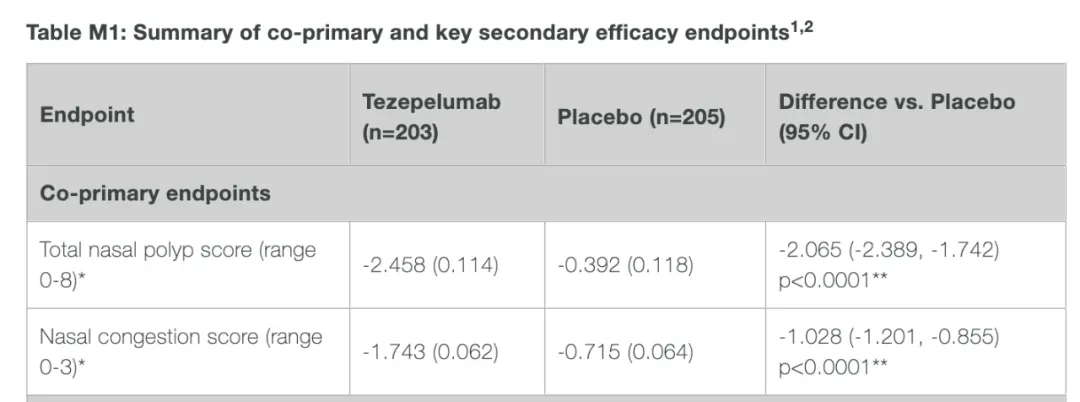
At Week 52 of treatment, compared with the placebo group,TezepelumabTreatment Group Nasal Polyp Score(NPS)Decrease by 2.065 points (95% CI: -2.389, -1.742; p<0.0001), and this improvement began to show as early as the 4th week of treatment;
Patient-Reported Nasal Congestion Score(NCS)Decrease by 1.208 points (95% CI: -1.201, -0.855; p<0.0001) , and improvement in NCS was observed as early as Week 2 of treatment, continuing through Week 52.
Screenshot source: AstraZeneca official website
For all key secondary endpoints,TezepelumabThe treatment group achieved statistically significant and clinically meaningful improvements. Notably, compared with the placebo group,TezepelumabCan reduce the proportion of patients requiring subsequent nasal polyp surgery by 98%.(p<0.0001), the proportion requiring systemic corticosteroid treatment decreased by 88%.(p<0.0001)。
In terms of safety,TezepelumabIn the CRSwNP patient population, it was generally well-tolerated, with a safety profile consistent with the approved indication for severe asthma. In the WAYPOINT trial, the most commonly reported adverse event in the treatment group was COVID-19 infection.(COVID-19), nasopharyngitis and upper respiratory tract infections.
From the market performance,TezepelumabDemonstrating strong growth potential. 2024,The global sales revenue of the drug reached $1.22 billion, with a year-on-year increase of 87%.。
In addition to the already approved indications for severe asthma and CRSwNP, AstraZeneca and Amgen are still continuously expanding.TezepelumabThe therapeutic potential is currently being targeted at chronic obstructive pulmonary disease(COPD)、Eosinophilic Esophagitis(EoE), etc.Clinical trials for other inflammatory diseases.
Subcutaneous injection has become one of the major trends in antibody drug development. According to the Insight database, more than 60 subcutaneous antibody new drugs (excluding biosimilars and modified versions) have been approved for marketing in the United States, including monoclonal antibodies, bispecific antibodies, antibody fusion proteins, and more.
With the development of new drugs and new dosage forms, combined with the new trend of large-volume subcutaneous injection, the selection of packaging solutions for subcutaneous injection drugs has also become an important part of drug development. It is related to the stability and safety of the drug, as well as the patient's comfort during injection. Therefore, the selection and quality evaluation of packaging materials are factors that pharmaceutical companies need to consider comprehensively.

Cover Source:Corporate logo
Disclaimer:This article is for information sharing only,不代表 Insight 立场和观点,也不作治疗方案推荐和介绍。如有需求,请咨询和联系正规医疗机构。
Editor: Xinyao
PR Article Coordination: WeChat insightxb
SubmissionWeChat: insightxb; Email: insight@dxy.cn