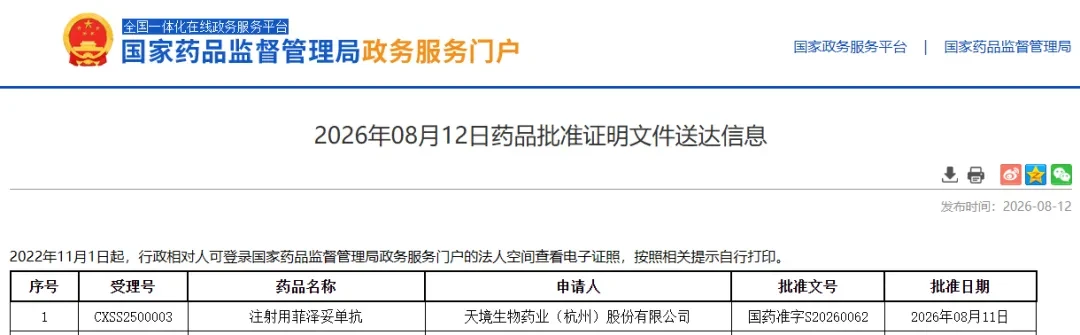
Felzartamab (MOR202), a CD38-Targeting Monoclonal Antibody, Approved in China for Multiple Myeloma Following $2.6 Billion Global Licensing Journey

TJ Biopharma
Biopharmaceutical R&D and Manufacturer

Biogen
Neuroscience Drug Developer

Johnson & Johnson
Medical Device R&D and Manufacturer

01)
@PharmaSpace
30-Minute Infusion, Non-Immunogenic: Differentiating Signals in Clinical Data
In a Phase I-IIa clinical trial involving 91 patients with relapsed/refractory multiple myeloma, fezertamab demonstrated noteworthy characteristics.
Most notably, its infusion time allows for safe completion of intravenous administration within 30 minutes.
In the monotherapy group without corticosteroid premedication, 14 out of 35 patients (40%) experienced infusion-related reactions; whereas with the addition of dexamethasone, only 4 out of 56 patients (7%) experienced such reactions.
The maximum tolerated dose was not reached; the recommended dose can be up to 16 mg/kg.
In terms of safety, the most common grade ≥3 adverse events were lymphopenia (38%), neutropenia (33%), and leukopenia (30%).
51 patients (56%) reported serious adverse events, but no deaths were related to MOR202.
Notably, no anti-MOR202 antibodies were detected in patients; this finding of "no immunogenicity" is uncommon among monoclonal antibody therapies.
02)
@PharmaSpace
A Nine-Year "Puzzle" of Rights and Interests
Fesoteromab was initially developed by MorphoSys AG of Germany.In November 2017, TJ Biopharma entered into a licensing agreement with MorphoSys, securing exclusive rights for all indications in the Greater China region.
In June 2022, HI-Bio secured global rights outside Greater China from MorphoSys.
In May 2024, Biogen acquired HI-Bio for $1.8 billion.
April 2026,Biogen Acquires Greater China Rights from TJ Biopharma for $100 Million Upfront Payment Plus Up to $750 Million in Milestones, Totaling $850 Million
With this, the global rights to this CD38 monoclonal antibody have finally been “unified” under Biogen.
TJ Biopharma retained the commercial supply rights for its Hangzhou GMP manufacturing facility, charting a path of “retaining production while divesting rights.”
03)
@Pharma Space-Time
Hematologic Malignancies Are the Starting Point; Autoimmune Diseases Are the True Battlefield
Fizerotumab has entered a crowded competitive landscape.
Johnson & Johnson’s daratumumab achieved global sales exceeding $11.67 billion in 2024, capturing a substantial 43.3% share of the global multiple myeloma drug market.
In such a landscape, if the battlefield is limited to multiple myeloma alone, it would be difficult for latecomers to challenge the dominant position of the market leader.
The true strategic intent lies in indication expansion.
Biogen has initiated global Phase III clinical trials of fezokizumab for autoimmune diseases, including IgA nephropathy, primary membranous nephropathy, and antibody-mediated rejection in kidney transplantation.
China is one of the countries with the largest number of IgAN and PMN patients globally.
Fraser Hall, President of Biogen’s International Region, described it as having the potential of a “pipeline-in-a-product”:One Product, Multiple Indications in Bloom.
# Concluding Remarks
From Multiple Myeloma to Autoimmune Diseases, the Approval and Launch of Felzertamab Is Not Merely the Debut of a New Drug, but Also a Footnote on Strategic Choices.
In the multi-billion-dollar CD38 arena, true differentiation lies not in engaging in cutthroat competition on the same battlefield, but in redefining the battlefield itself.