


Source: Lieyun Network
On August 10, Aureka Biotechnologies announced the completion of a $100 million Series B financing round. With this, the AI-native TechBio company, founded in 2023, has raised nearly $200 million in cumulative funding.
This financing round was completed in stages. The initial tranche was exclusively invested by Granite Asia, while subsequent tranches were led by prominent industrial investors, with co-investment from Hui Capital. Existing shareholders, including Qiming Venture Partners, Matrix Partners China, and New Enterprise Associates (NEA) Capital, continued their investment.
Aureka Biotechnologies, Inc. stated that the funds from this round will be primarily invested in the research and development and large-scale training of next-generation biological foundation models, continuously enhancing the models’ capabilities in core tasks such as de novo molecular design, biological structure modeling, and functional prediction. Meanwhile, the company will further upgrade its Lab-in-the-Loop system, which centers on experimental feedback, to foster a deep closed-loop integration between the foundation models and its proprietary single-cell functional screening, high-throughput experimental validation, and drug development platforms. According to Aureka’s roadmap, the biological foundation model, serving as the “intelligent core” of its closed-loop AI-native infrastructure, will not only address individual drug discovery tasks but also continuously learn biological principles, enabling it to understand, generate, predict, and intervene in complex biological systems.
As foundation models increasingly integrate with automated R&D infrastructure, Aureka Biotechnologies, Inc. will evolve from “enhancing drug discovery efficiency with AI” to “modeling life systems with AI,” continuously expanding the technological boundaries and industrial potential of AI-driven drug discovery.
Investment Trends in the Industry Shift Annually, with the Generative Antibody Sector Emerging as the Main Theme
In 2024, investment and financing in the AI-driven drug discovery sector experienced a rebound. According to data from Zhiyaoju, global AI drug discovery financing totaled $3.601 billion across 104 deals in 2023. In 2024, the total global financing amount climbed to $5.795 billion, representing a year-over-year increase of over 60%, with the number of financing events rising to 128, signaling a significant recovery in capital market sentiment. In 2025, the total annual financing in the global AI drug discovery field reached as high as $7.553 billion (Source: Ping An Securities, “2026 In-Depth Report on the AI Drug Discovery Industry”). The AI biologics segment became a key focus for capital inflows, with the generative antibody/protein track emerging as one of the most active areas for large-scale financing. This shift is driven by multiple factors: traditional antibody development heavily relies on random library screening, making it difficult to achieve de novo design targeting specific epitopes. With the maturation of high-throughput wet-lab antibody technologies and the continued implementation of industrial business models, generative AI has emerged to provide novel solutions, facilitating the establishment of a closed-loop R&D process encompassing “AI molecular design – wet-lab functional validation – data feedback for iterative improvement.”
Aureka Biotechnologies, Inc. believes that the financing performance in the generative antibody/multifunctional protein sector validates an important trend: AI-driven molecular design is becoming the infrastructure for next-generation drug development, demonstrating the significant industrial value of upstream models and design capabilities.
Competitiveness Requires Systematization: Lab-in-the-Loop is Key
Kuang Yinghui of Granite Asia stated, “AI-driven drug discovery is transitioning from competition centered on single-point model capabilities to a new stage characterized by the synergistic evolution of data, models, and experimental closed loops.” Aureka Biotechnologies is precisely such an AI-native TechBio company. It is dedicated to developing next-generation biological foundation models and building a closed-loop, AI-native infrastructure composed of AI models, agents, digital biotechnology, and experimental platforms, thereby reengineering the entire drug discovery process. The company treats Lab-in-the-Loop as primary infrastructure for model development, deeply integrating AI agents, high-throughput digital biotechnology, proprietary single-cell functional screening, and its self-built experimental platform to form a closed-loop system encompassing molecular generation, experimental design, functional validation, data feedback, model post-training, and candidate molecule development.
This system transforms Aureka Biotechnologies’ laboratory from a mere validation step following model generation into a core component directly involved in model learning and capability evolution. The models propose experimentally verifiable molecular designs and scientific hypotheses, while the experimental platform generates high-quality functional data. This data is then fed back into both the foundation models and project-specific models, driving continuous model iteration and initiating the next round of design and validation. In contrast to model development approaches that primarily rely on public, static datasets, Aureka’s models continuously receive experimental feedback from real-world drug discovery projects. They evolve iteratively within a design–validation–learning loop, thereby creating a closed-loop flywheel in which data, models, experiments, and drug assets mutually reinforce one another.
Industry insiders believe that the core bottleneck in the next phase of the generative antibody sector will shift from “whether molecules with binding capabilities can be generated” to “whether the biological functions of molecules in real-life systems can be predicted and validated.” What Aureka Biotechnologies, Inc. has built is precisely the core infrastructure to overcome this industry bottleneck. By training biological foundation models with proprietary data, continuously conducting post-training of models and project-level iterations through self-generated experimental data, and evolving towards a biological world model capable of predicting responses in living systems, the company has pursued a differentiated path of “integrated and synergistic development of data and models.”
From Biological Foundation Models to World Models: Building Technological Barriers to Shape Future Commercial Value
Dr. Zhao Wei’an, Founder and CEO of Aureka Biotechnologies, Inc., stated, “When leading biological foundation models are truly integrated with scalable R&D infrastructure, we are no longer merely improving the efficiency of a single step in drug discovery; rather, we are building a next-generation drug discovery engine capable of understanding, generating, and predicting biological systems. This marks a critical step for Aureka Biotechnologies toward realizing a biological world model.”
Leveraging a comprehensive technical foundation, Aureka Biotechnologies, Inc. has achieved authoritative validation of its underlying model capabilities: the open-source version of its self-developed biological molecular foundation model, AuraIDE, known as OpenDDE, has been independently evaluated by third parties and ranks among the top tier of global open-source biological molecular models.
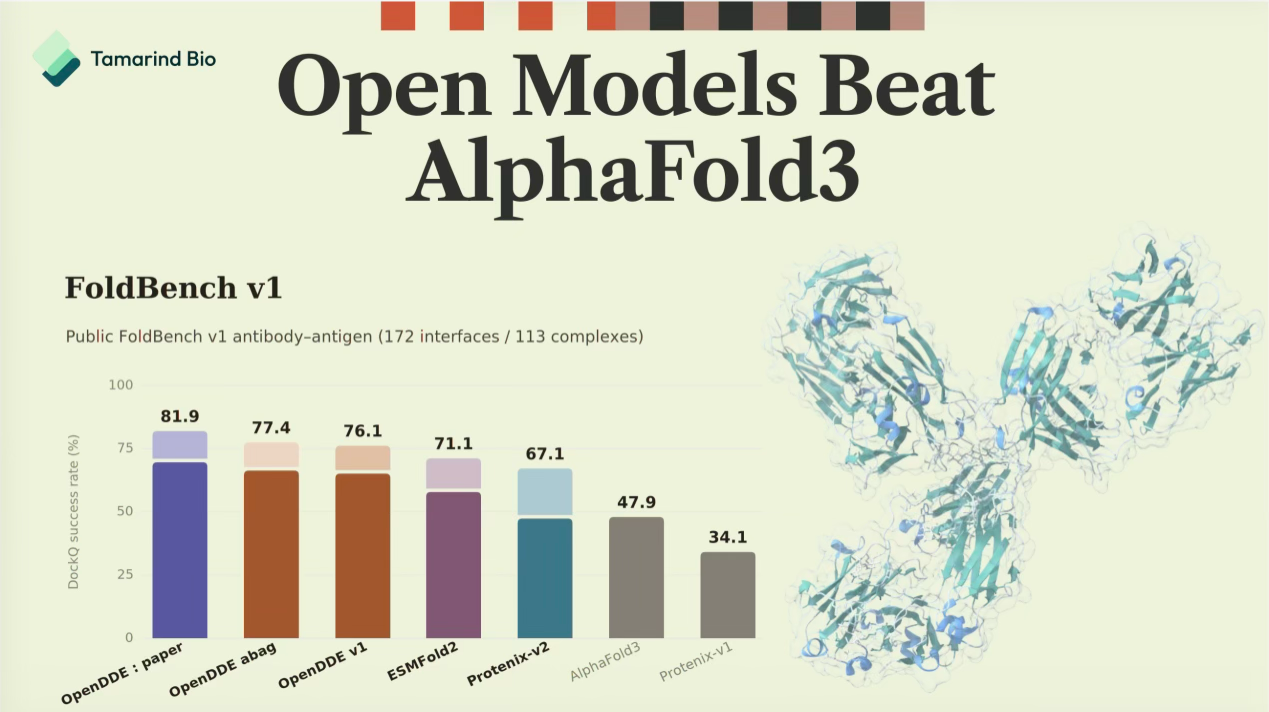
OpenDDE’s Performance in Third-Party Evaluation on the Public Antibody–Antigen Structure Prediction Benchmark FoldBench v1. Source: Tamarind Bio, “Open Models Beat AlphaFold3,” FoldBench v1 benchmark.
Aureka Biotechnologies, Inc. stated that the significant advances achieved by existing biological foundation models in protein structure prediction and biomolecular interaction modeling have provided a key technological basis for the development of biological world models; however, biological world models capable of bridging molecular, complex, and cellular scales, and performing dynamic, multi-scale deductions of life processes under intervention conditions, remain in the early stages of exploration. The company will continue to invest in this direction.
# TranslationWhile keeping an eye on the future, we must also live in the present. Aureka Biotechnologies’ end-to-end agentic R&D infrastructure integrates molecular generation, druggability assessment, experimental validation, result feedback, and candidate molecule development, rapidly translating scientific hypotheses, model capabilities, and experimental capacities into developable drug assets, while continuously supporting the advancement of internal pipelines and external collaborative projects.
In terms of commercializing technology, Aureka Biotechnologies, Inc. has achieved scaled production of high-value, differentiated antibodies in projects that are traditionally difficult to tackle with conventional methods, such as GPCR and bispecific monoclonal antibodies. The company has established strategic collaborations with several leading global pharmaceutical companies to jointly advance the development of differentiated antibody drugs. Over the past two years, it has generated tens of millions of dollars in commercial revenue, validating its AI platform’s delivery capability, scalability, and commercial potential in real-world drug discovery projects.
Looking ahead, as the capabilities of biological world models continue to mature, the Company will further compress R&D cycles and improve the success rates of pipelines targeting difficult-to-drug targets, thereby continuously unlocking the long-term industrial and capital value of its AI-native TechBio platform.