Galapagos NV Exits Cell Therapy with Global Layoffs Including Shanghai Team
Galapagos
Small Molecule and Antibody Therapeutics Developer

Gilead Sciences
Antiviral Drug Developer
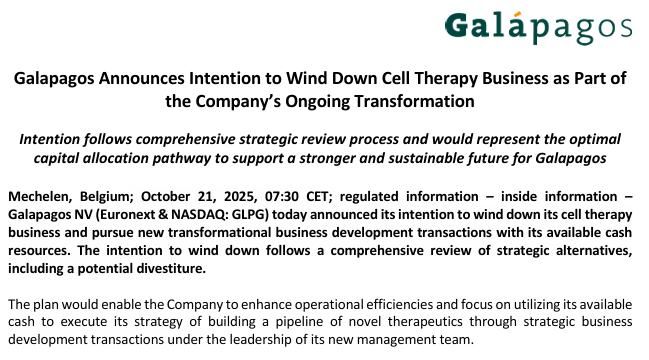
According to the company's announcement, this decision was made following a comprehensive review of strategic alternatives.
CEO Henry Gosebruch stated that the company had conducted an in-depth sales and investor engagement process but only received limited, non-binding offers with terms insufficient to support long-term viable development. In light of the ongoing investment requirements and changes in the dynamics of the global cell therapy market, the board ultimately unanimously decided to terminate operations (with the two directors appointed by Gilead abstaining from the vote).
If the termination plan receives final approval, the company will close relevant facilities located in Leiden (the Netherlands), Basel (Switzerland), and Shanghai. The restructuring is expected to result in operating expenses of 100 to 125 million euros and one-time restructuring costs of 150 to 200 million euros. Galapagos plans to retain its headquarters in Mechelen (Belgium) and establish the remaining small molecule drugs and immune-related projects as the core of the company’s future growth.
As of June 30, 2025,Galapagos holds cash and financial investments totaling 3.1 billion euros, providing a solid financial foundation for future strategic transformation.The company stated that it would utilize existing financial resources to seek new business partnerships and transformative deals to achieve long-term stable growth.
Notably, Galapagos has already accumulated a certain amount of scientific research achievements in the field of cell therapy. Its main candidate drugCD19 CAR-T(GLPG5101)In the ATALANTA-1 Phase 1/2 study targeting relapsed/refractory indolent non-Hodgkin lymphoma (iNHL), a high complete response rate (up to 97%) was demonstrated. Additionally, the company has also made strategic advancements.BCMA CAR-T(GLPG5301, used for multiple myeloma) andMAGE-A4 TCR-T(In collaboration with Adaptimmune for head and neck cancer) project.
However, faced with industry challenges such as stricter regulation, high production costs, and commercialization uncertainties, Galapagos opted for a "stop-loss" exit.
This adjustment also means thatGalapagos Reorganizes Relationship with Long-Term Partner Gilead SciencesSince signing the global R&D collaboration agreement in 2019, Gilead has invested approximately $5 billion in financial support to Galapagos and secured the priority rights for projects outside Europe. In July 2025, the two parties signed a new royalty and waiver agreement, allowing Galapagos to regain global development and commercialization rights for its cell therapy business, while paying royalties to Gilead based on a certain percentage of future net sales or divestiture proceeds.
Analysts believe that while this move brings short-term layoffs and a contraction in R&D, it also signals that Galapagos is adjusting its direction to focus on sustainable pipelines. In the future, the company will increasingly concentrate on co-development and licensing opportunities in small molecule innovative drugs, immunology, and oncology, includingTYK2 Inhibitor GLPG3667 in Systemic Lupus Erythematosus and Dermatomyositis IndicationsThe advancement.
Against the backdrop of European biotech companies generally facing capital tightening and the increasing complexity of commercialization pathways for cell therapies, Galapagos' decision may become a landmark case of industry adjustment. The termination of its operations in Shanghai, China, also once again reflects that international biopharmaceutical companies are undergoing a new round of structural adjustments in their layout in China.
Reference Source:





Previous Review
Review of Innovative Drugs Mid-Game: A New Starting Point After the Bubble Burst
BD Decade in Review: Trends and Logic Insights of Cross-Border Pharmaceutical Deals
Industry Watch: Why Are Layoffs Still Sweeping the Biopharmaceutical Sector?