

Vecverse Completes Pre-A Round Financing, Building Autonomous Driving Labs with Physical AI

VECVERSE
Cloud-Based AI Solutions Provider
"We do not predict the future; we provide the physical-world productivity to enable its discovery."
These remarks were made by Li Su, Founder of Vecverse. As he led the team to complete the Pre-A round of financing, the revolution of Physical AI is entering the life science industry with unprecedented impact. AI is shifting from "understanding research papers" to "performing hands-on experiments". Laboratory "tools" are evolving from traditional machinery toward "embodied intelligence" endowed with perception, decision-making and self-evolution capabilities.
Early in 2026, Jensen Huang, Founder of NVIDIA, declared in his keynote speech at CES: "The ChatGPT moment for Physical AI has arrived." In his view, AI models capable of understanding the physical world, reasoning, and planning actions are quietly transforming numerous industries. Today, Vecverse, deeply rooted in the physical AI domain, is progressively realizing the concept of "Physical AI for life science laboratories."
Vecverse has recently completed the closing of its Pre-A round of financing. The round was led by Taipu Life Science Investment, with Wanyuan Dian Fund participating as a follow-on investor. The proceeds will be mainly used for core technology research and development, market expansion, team building and supplementing working capital, to accelerate the commercial rollout of self-driving laboratory robots and agents.
The investors in this round boast profound industrial accumulation and professional insights in the life sciences sector. Lead investor Taipu Life Science Investment is an investment institution focusing on life sciences. Its management team mainly comes from large domestic investment institutions and well-known pharmaceutical industrial companies, equipped with professional academic backgrounds and years of investment experience in specialized fields. Built on in-depth industrial research, Taipu Life Science Investment integrates industrial and financial resources. It strives to identify technologies and enterprises that can advance human health and well-being, and empowers them to accelerate technical productization, scaled production and industrialization. Its key areas of intensive research and focus include AI-enabled medical devices, AI-driven life sciences, innovative drugs and medical devices, as well as animal health.
Follow-on investor Wanyuan Dian Fund is a private equity fund with profound experience in the healthcare industry. It focuses on growth investment opportunities within the healthcare sector. Guided by its mission of "focusing on innovation, accompanying entrepreneurs, and maximizing the integration of industry and capital", the fund leverages its long-established industrial resources and sharp scientific insights to identify high-quality innovative startups. It aims to serve as the foundational catalyst for innovation in China's in vitro diagnostics industry.
Taipu Life Science Investment and Wanyuan Dian Fund have formed a joint force in this round of financing. The former brings interdisciplinary, full-chain industrial empowerment vision, while the latter contributes in-depth clinical and channel resources within the healthcare sector. Their joint investment not only provides Vecverse with capital support, but will also deliver critical assistance in application scenario implementation, clinical verification and industrial ecosystem development.
Physical AI Must "Grow" in the Laboratory
Physical AI Agents, in Jensen Huang's view, are AI models capable of understanding and interacting with the real world, enabling autonomous machines to perceive, comprehend, and execute complex operations in the physical realm.
Unlike AI agents in the digital world, Physical AI places greater emphasis on intelligence that emerges and evolves through interaction with the physical realm. Just as the capabilities of autonomous driving are ingrained in the roads, and robotic capabilities are embedded in motion, the capabilities of Physical AI in life sciences are cultivated through real-world experimental operations.
Traditional life science analysis tools are predominantly designed with a "human-centric" approach, relying on closed graphical user interfaces (GUIs) and physical buttons for interaction; their hardware structures are tailored to human operational habits; each device stores results independently in inconsistent formats; and the equipment lacks edge intelligence capabilities such as perception, reasoning, decision-making, and self-correction. Wet and dry lab data are inherently siloed, preventing the formation of an autonomous closed loop of "design–execute–detect–learn." Vecverse's core assertion is that the legacy research hardware infrastructure from the 20th century cannot support the full potential of AI-driven autonomous experimentation. We cannot expect robots to be extensively trained to operate manual instruments "like humans." All "tools" in the AI era need to be reimagined and rebuilt. Tools in the AI era must evolve from mere "execution instruments" into "embodied intelligence carriers." This is precisely what Vecverse is undertaking: Redefine and redesign across the hardware mechanical layer, model and multi-agent layer, control logic layer, software and interface layer, and business and industrial value layer, making every device a carrier of embodied intelligence and transforming every experimental action into data that can be understood and optimized by AI.
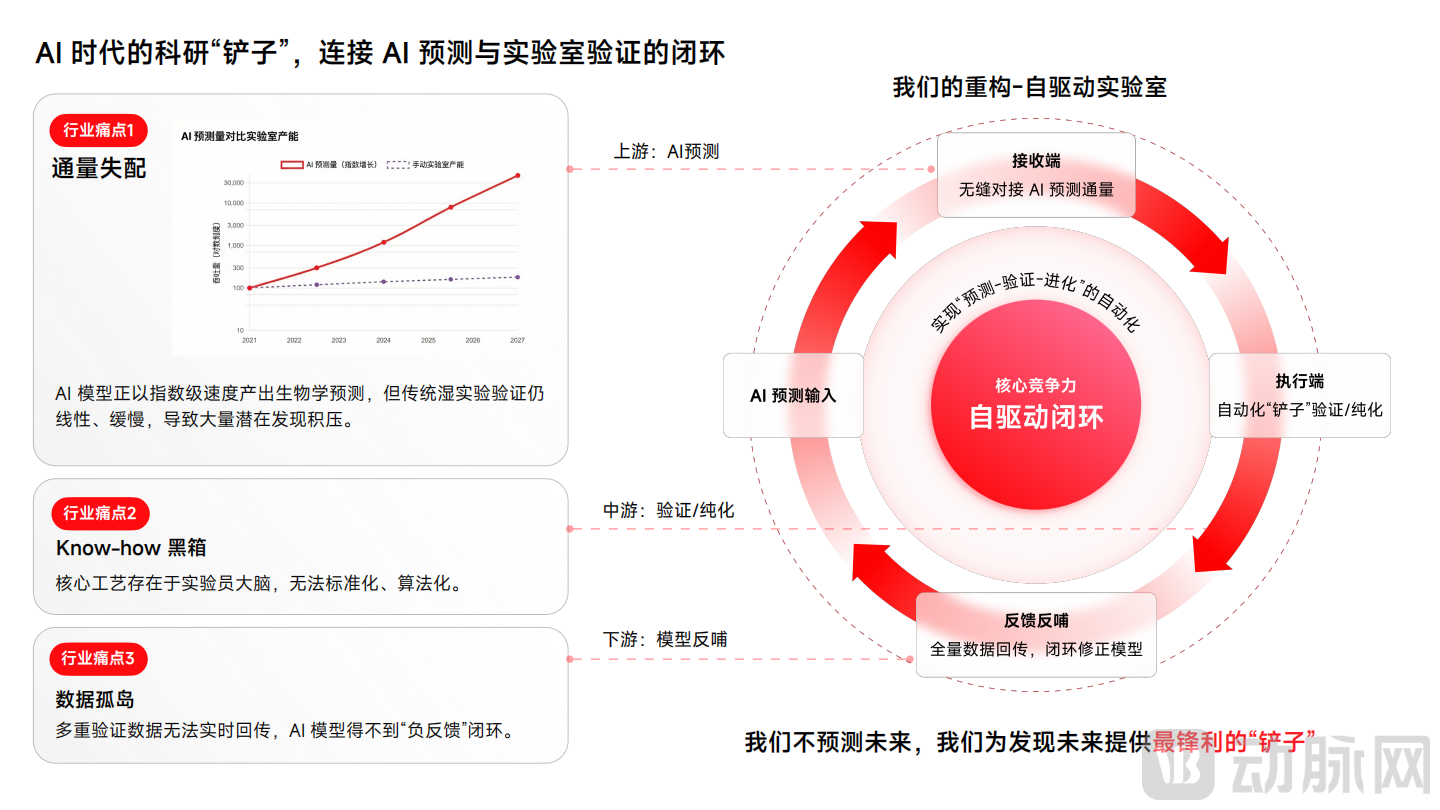
Strategic Path: The Four-Tier Engine from Tools to Ecosystem
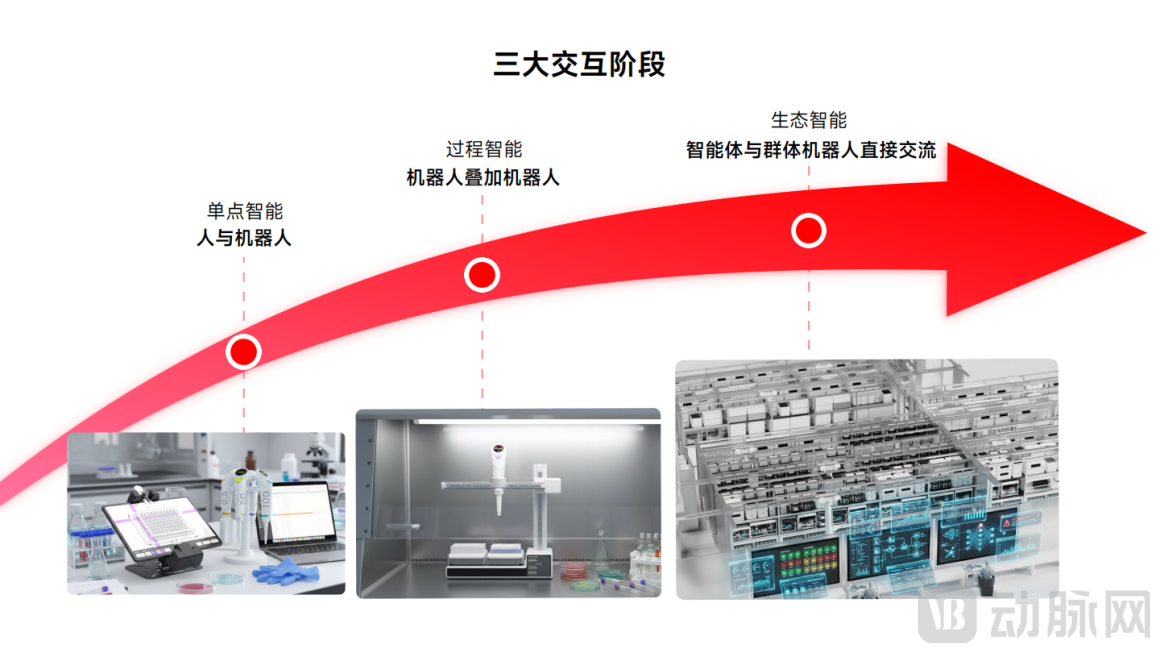
Vecverse's ultimate vision is to empower every scientist with tens or even hundreds of tireless "collaborators," turning the blueprint of fully autonomous, end-to-end self-driving laboratories into reality. On the path toward this ultimate goal, Vecverse continues to unlock value through four progressive tiers:
Level 1: IntelligenceHardwareLayer. Starting with pipetting, the most frequent operation in life sciences, Vecverse has redefined traditional manual pipettes into intelligent tools equipped with multi-sensor fusion perception, AI-driven algorithms, and smart interactive capabilities. Features include automatic cloud calibration upon startup, natural language control, an built-in operating system that synchronously records every step, and real-time uploading of experimental data to the cloud. By leveraging this single-point tool, Vecverse rapidly reaches global research and industrial customers, establishing brand recognition and a distribution network.
Level 2: Autonomous Agents + Liquid Handling Layer. Vecverse also further built Workstations with Edge Intelligence, it allows operators to flexibly integrate smart pipettes of varying capacities (nanoliters to milliliters) along the X-axis, and combine them with functional modules such as magnetic separation, incubation, detection, and purification along the Y-axis, enabling intelligent, LEGO-style configurations tailored to experimental objectives. Meanwhile, Vecverse has also innovatively created VLA Physical Multi-Agent Swarm with Independent Intellectual Property Rights (VLA Operon) From multi-level coverage spanning interaction, multi-agent systems, consensus and protocols, and atomic service capabilities to data and objects, it establishes a security audit mechanism that is observable, hallucination-resistant, and equipped with endogenous risk control. This "Transformer"-style multifunctional workstation integrates hardware and software, features layered intelligence, and supports customizable scenarios. It covers more than ten application scenarios, including PCR, ELISA, pre-sequencing sample preparation, and pre-mass spectrometry sample preparation. Offering plug-and-play convenience with code-free and layout-free operation, it represents an upgrade from "tool creation" to "intelligent solutions for autonomous experimentation."
Level 3: Self-Driven Laboratory Layer. Equipped with autonomous intelligent agents (VLA Operon), proprietary intelligent hardware manufacturing, mobile robotic arms, robots and software engineering capabilities, this layer integrates hardware, software, IoT and AI technologies tailored to real-life application scenarios in life sciences. Upward, it supports the development and deployment of life science foundation models, scientific intelligent agents, and Meinverse, the Molecular Biology AI Agent. Downward, it coordinates experimental intelligent agents, the VLA Operon multi-agent cluster and a full suite of intelligent hardware. The equipment cluster can understand experimental goals expressed in natural language, autonomously break them down into executable procedures, automatically allocate resources to run experiments, conduct real-time error correction and iteratively optimize subsequent protocols. This establishes a complete wet-dry closed loop of "Design – Execute – Detect – Learn", enabling AI and robots to act as intelligent collaborators for scientists.
Level 4: Ecosystem Platform Layer. Vecverse opens its self-developed edge computing AI hardware VecChip No.1 together with underlying communication protocols to the whole industry as modular components. Custom-designed for laboratory equipment, this AI hardware supports local large model inference, edge computing and voice interaction. It enables traditional instrument manufacturers to realize intelligent equipment upgrading at extremely low costs, and fully unlocks the ecological value of Physical AI within life sciences.
Synchronous Construction and Cyclic Iteration of the Four-Tier Engine: The Intelligent Hardware Layer accumulates experimental data and application scenarios; The Autonomous Agent Layer precipitates workflows and operational capabilities for self-driven laboratories; The Platform Layer delivers underlying infrastructure and open collaboration for intelligent upgrading across the entire industry.
"China-Germany Dual-Core" Interdisciplinary Team
Vecverse's core team is an interdisciplinary group that combines the DNA of European precision engineering with the speed of Chinese industrialization.
Founder Li Su holds a doctoral degree in Engineering Realization and Robotics from Technical University of Munich, Germany. He studied under Europe's top robotics research team and previously served as a Full Chair Lecturer in Human-Machine Interaction at Bauhaus-Universität Weimar. He took an active part in cutting-edge European research on human-machine collaboration under Industry 4.0. His research spans precision mechanical transmission, AI integration, hardware infrastructure and human-machine interaction, equipping him with comprehensive interdisciplinary technical insights. Co-founder Wang Yixian graduated from Zhejiang University of Technology. She once worked as the assistant to the chairman of a large industrial group, possessing end-to-end management capabilities covering brand strategy planning and market implementation.Co-founder Xie Chutian holds dual master's degrees from Boston University. He formerly led overseas business for a leading domestic laboratory equipment enterprise, with solid foundational engineering expertise and proven capabilities in global business expansion.
Headquartered in Hangzhou, the company runs a product studio in Weimar, Germany. Its "China-Germany Dual-Core" R&D system enables Vecverse to leverage dual strengths: European precision engineering and China’s rapid iterative development. Over 50% of the company's staff are R&D personnel, and it holds more than 85 intellectual property rights. The team covers multiple disciplines including mechanics, transmission, sensing, electric control, AI algorithms and biological applications. Vecverse @Pette series intelligent pipettes have won three top international industrial design awards: Red Dot Design Award Best of the Best, Good Design Award (Japan), and London Design Gold Award.
Commercialization Accelerates as Policy Tailwinds Arrive
Vecverse's practical deployments are rapidly validating this strategic roadmap. The company has partnered with over 100 universities and research institutes including Westlake University, Zhejiang University, Fudan University and Peking University Third Hospital to explore AI concept laboratories. It also collaborates with leading enterprises such as Dian Diagnostics, QuayGene, Biostage and Kangrun to develop ecosystem-based applications. In laboratories at Zhejiang University, researchers pick up the @Pette series intelligent pipettes, tap the screen and issue voice commands. The equipment executes operations precisely, with data from every step uploaded to the cloud in real time. Within domestic pharmaceutical enterprises and university labs, Vecverse products are becoming standard equipment for a growing number of researchers.
On the international front, the company has established 14 agency and distribution channels across business lines and officially launched its overseas sales network. In 2026, Vecverse showcased its full product portfolio at SLAS Boston (Society for Laboratory Automation and Screening), attracting widespread attention from the North American and global research community. From Double First-Class universities and national key laboratories to biotech innovative drug enterprises and industrial biosynthesis platforms, Vecverse unlocks the potential of automation and intelligence across all liquid-handling scenarios.
One week prior to the closing of this financing round, Beijing issued the Implementation Plan for Accelerating AI-enabled Scientific Research (2026–2028). It is China's first medium-to-long-term AI for Science initiative covering autonomous laboratories, research agents and scientific foundation models. The document explicitly proposes building a dry-wet closed loop featuring AI hypothesis generation, robotic experiment execution, and systematic analytical optimization. Meanwhile, the global AI4S market is projected to grow from USD 45.38 billion in 2025 to USD 262.3 billion by 2032. China's life science instrument market has exceeded RMB 120 billion. Policy tailwinds and industrial momentum are converging.
Intelligent Tools and the Future
If today's AI for Science is a "gold rush" of scientific discovery, Vecverse has chosen to become the reformer focused on resolving bottlenecks in wet-lab processes such as validation and purification. By jointly developing physical AI agents and intelligent hardware, we are committed to driving laboratory innovation, providing productivity in the physical world for the life sciences sector.
When every liquid-handling motion turns into AI-interpretable data, when every device becomes an embodied intelligence carrier, and when every laboratory gains the capacity for autonomous reasoning and execution — research efficiency will no longer be measured in "person-hours", but iterated through "intelligent cycles". Scientists will be fully liberated from repetitive labor, enabling them to focus on challenges that truly demand human intellect: formulating hypotheses, designing experiments, and interpreting outputs generated by AI.
In the laboratories of the future, Physical AI will no longer be cold hardware encased in metal shells. Instead, it will serve as an intelligent collaborator working alongside scientists, "thinking and acting in tandem". Operating 24/7 without interruption, it executes experiments, carries out verifications, learns continuously and drives optimization, compressing multi-year validation cycles into months or even weeks. At that stage, humanity's pace of exploring the unknown will be thoroughly redefined.
This is precisely the destination Vecverse strives to reach — not to replace scientists, but to equip every scientist with tens or hundreds of tireless "collaborators". When the "tools" of Physical AI are placed in the hands of every explorer, the expansion of humanity's cognitive frontier will no longer be limited by how much hands can operate or eyes can observe, but only by how far thought can reach.