

Shenzhen Pregene Secures $120M Upfront in $1.64B In Vivo CAR-T Deal with Kite Pharma

Gilead Sciences
Antiviral Drug Developer
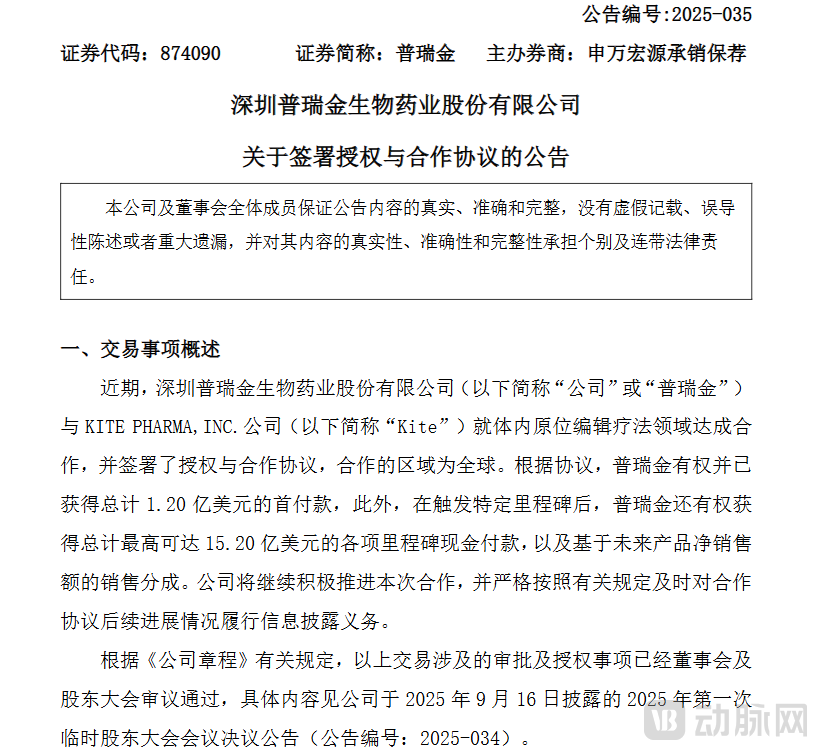
Recently, Shenzhen Purrin Biotechnology Co., Ltd.(Pregene, hereinafter referred to as "Pruigen")Announced, in collaboration with the U.S. biopharmaceutical company Gilead Sciences(Gilead Sciences, hereinafter referred to as "Gilead")Gilead Sciences' Kite Pharma reached a strategic cooperation agreementThe two parties will jointly develop in vivo CAR-T (Chimeric Antigen Receptor T-cell) therapy.
According to the statement,The total amount of this cooperation can reach up to 1.64 billion US dollars., including milestone payments during the R&D and commercialization phases, as well as subsequent sales royalties. Among these, Kite Pharma will prepay $120 million to Puruijin to support the R&D efforts of the next-generation in vivo cell therapy platform. The collaboration scope covers multiple ongoing projects targeting solid tumors and hematologic malignancies.
From Ex Vivo to In Vivo: The Technological Shift in CAR-T Therapy
The advent of CAR-T therapy represents a landmark technological breakthrough in the field of cellular immunotherapy over the past decade.Since Novartis' Kymriah® (tisagenlecleucel) was first approved by the U.S. Food and Drug Administration (FDA) in 2017, the FDA has approved six CAR-T products, including axicabtagene ciloleucel and tisagenlecleucel targeting CD19, as well as idecabtagene vicleucel targeting BCMA.
However,The production and application of traditional ex vivo CAR-T are still constrained by multiple bottlenecks.: The entire process, from collecting T cells from patients, modifying genes in vitro, amplifying, and reinfusing them, often takes 2–4 weeks. Some patients with rapidly progressing conditions may miss the treatment window due to waiting; personalized production brings high manufacturing costs (the cost of a single treatment is usually more than $400,000); at the same time, cold chain logistics and strict quality control also significantly increase supply chain complexity. These factors limit the promotion of CAR-T in more disease types and wider populations.
In this context, the concept of in vivo CAR-T has emerged. The core idea is to directly induce T cells to express CAR molecules in patients through in vivo gene delivery methods (such as mRNA, lipid nanoparticles, adeno-associated viruses, etc.), thereby achieving immune reprogramming without the need for cell reinfusion. Compared with ex vivo approaches, this model not only has the potential to shorten the manufacturing cycle and reduce costs but may also improve treatment accessibility, particularly showing promise in autoimmune diseases and solid tumor scenarios.
In recent years, early clinical data has continuously provided strong support for the feasibility of in vivo CAR-T. In July 2025, a team from Wuhan Union Hospital published a phase one study on in vivo CAR-T in The Lancet. Clinical results indicated that In Vivo CAR-T demonstrated good safety, with no grade 4 or higher adverse reactions observed apart from hematologic toxicity.Achieved 100% ORR (Objective Response Rate) in 4 patients with relapsed/refractory multiple myeloma.Among them, 2 cases reached sCR (stringent complete response). Notably, these CAR-T cells also demonstrated good efficacy in sites that are traditionally difficult for CAR-T to infiltrate, such as extramedullary lesions and cerebrospinal fluid.
Prugene's Five Major Technology Platforms Lay the Foundation + Gilead-Kite’s Commercialization Expertise Empowers
When Shenzhen-based innovative company Precigen encounters global cell therapy giant Gilead Sciences and its subsidiary Kite Pharma, this $1.64 billion collaboration is no coincidence. It represents the deep strategic and technical alignment between Precigen's hard power built on a full-chain technology platform and the industry resources accumulated through Gilead’s commercial experience.
Founded in 2012, PuriJin is one of the early platform-based innovative pharmaceutical companies in China focusing on the cell and gene therapy (CGT) field, with its headquarters located in Pingshan, Shenzhen. Relying on 13 years of technical accumulation,PRIGEN has built a core technology system covering the entire chain of "R&D - Pilot Testing - Industrialization," with five major technology platforms forming synergistic advantages.: Including a nanobody screening platform that supports the screening of antigen recognition sequences for CAR molecules, an immune cell drug discovery platform that ensures the drug-like properties of cell drugs, a plasmid/viral vector process development and production platform that achieves high yield and low-cost preparation, a cell process development and production platform that meets compliance requirements, and an iPSC reprogramming and multi-gene editing platform for next-generation cell therapy. Among these, the cell preparation platform is equipped with fully automatic and semi-automatic disposable closed systems, which can flexibly adapt to various process routes. The total laboratory area is 10,000 square meters, the R&D team consists of over 80 members, and more than 20 cell drug R&D projects have been advanced cumulatively.
At the product pipeline end,Prigen adopts a "step-by-step development" strategy to cover multiple fields: its pipeline includes CAR-T, TCR-T, CAR-NK, etc., with indications spanning hematological tumors, solid tumors, and orthopedics.Among them, the CAR-T drug PRG1801 targeting BCMA is the core breakthrough — leveraging the advantages of chimeric humanized nanobody technology, this drug for the treatment of relapsed/refractory multiple myeloma has become one of the fastest-progressing cell drugs globally in the same target category; In March 2020, PRG1801 received clinical approval from the Center for Drug Evaluation (CDE) of the National Medical Products Administration, and has now successfully advanced to Phase II clinical trials, with preliminary data showing good safety and efficacy potential.
Gilead and Kite’s $1.64 Billion Bet on Preclin: A Long-term Strategy in the In Vivo CAR-T Space. As a global biopharmaceutical giant, Gilead Sciences, founded in 1987, is renowned for its antiviral drugs (such as treatments for hepatitis C and HIV),In 2017, Gilead Sciences acquired Kite Pharma for $11.9 billion, gaining Yescarta® (Axicabtagene Ciloleucel Injection) in one fell swoop., quickly joining the ranks of industry leaders. As of 2024, the global sales of Kite's two ex vivo CAR-T products, Yescarta® and Tecartus®, have exceeded 1.9 billion US dollars in total.
In the field of CAR-T in vivo, Kite has made its second move this year.In August this year, Kite took the lead in acquiring Interius BioTherapeutics for $350 million, obtaining an in vivo platform capable of generating CAR-T cells within patients, complementing lentiviral delivery technology; this collaboration with PuriGen will further integrate the technical advantages of Chinese enterprises and accelerate clinical validation.
Capital and Giants Compete for In Vivo CAR-T
In recent years,The capital热度 in the global in vivo cell therapy track continues to climb, with frequent financing activities among in vivo CAR-T-related enterprises.Among them, Capstan Therapeutics raised $175 million in its Series B financing round, while Kyverna Therapeutics' market value surpassed $1.2 billion shortly after its listing on NASDAQ. These impressive performances vividly reflect investors' strong recognition of the commercial potential of in vivo immune therapies.
This track's popularity is not only reflected in the capital end but also drives global companies to accelerate technological exploration——Chinese companies are also actively laying out with differentiated technical paths.: Based on the development in the ex vivo CAR-T field, Legend Biotech is simultaneously advancing the in vivo CAR-T project LVIVO-TaVec100 targeting CD19/CD20 bispecificity. A Phase I sponsor-initiated trial was launched in May 2025, with the first set of clinical data expected to be released by the end of the year. Through two rounds of collaboration with Umoja, Ixozz Biotech has integrated its clinically validated CAR sequences with Umoja's VivoVec platform, accelerating the development of in vivo CAR-T candidate products. These companies' explorations are enriching the technical array of in vivo CAR-T.
The collaboration between PuriGene and Gilead Sciences is not an isolated event but a microcosm of the global in vivo CAR-T sector's rapid growth and intensifying competition among companies.Since 2025, multinational pharmaceutical companies have been intensively strengthening their positions in this field through mergers, acquisitions, and collaborations, forming a "contest of many heroes" situation.In March, AstraZeneca acquired EsoBiotec for $1 billion, bringing its engineered nanobody lentivirus ENaBL technology platform and four clinical pipelines under its wing; in June, AbbVie acquired Capstan Therapeutics for $2.1 billion, successfully obtaining the core platform of in vivo CAR-T based on LNP; in October, Bristol-Myers Squibb (BMS) acquired Orbital Therapeutics for $1.5 billion, further enhancing its CAR-T portfolio.
Behind the rapid development of the track, the support of regulatory agencies' policies plays an indispensable role.The U.S. Food and Drug Administration (FDA) released or updated several guidance documents on CAR-T and gene therapy product development during 2024–2025 (e.g., Considerations for the Development of Chimeric Antigen Receptor (CAR) T Cell Products, 2024), providing specific recommendations on long-term follow-up, Chemistry-Manufacturing-Control (CMC), and safety assessment. In 2025, the FDA also adjusted the regulatory arrangements for approved CAR-T therapies (e.g., REMS, Risk Evaluation and Mitigation Strategies). These regulatory developments to some extent provide a clearer reference framework for the clinical pathways and compliance requirements of in vivo delivery products.
Against this backdrop, the collaboration between Gilead Sciences and Puruixin represents both a natural extension of international pharmaceutical companies seeking breakthroughs in cost and efficiency, and an example of China's innovative platforms integrating into the global value chain. For China, Puruixin's expansion overseas is not an isolated case, but rather a signal: in an era of capital globalization and technological co-creation,Companies with original capabilities (such as full-chain technology platforms, PRG1801 pipelines) and engineering implementation pathways are evolving from regional participants into global innovation co-builders.This may be the most noteworthy "Chinese variable" worthy of long-term attention in the wave of in vivo cell therapy.