Transformation Capability in System Reform, Differentiation Strategy in Innovation Pathways, and Steady Progress in Global Competition. Hansoh Pharma, as a development model that rapidly evolved from Pharma to BioPharma, has outlined a more resilient long-term model for China's innovative pharmaceutical companies.
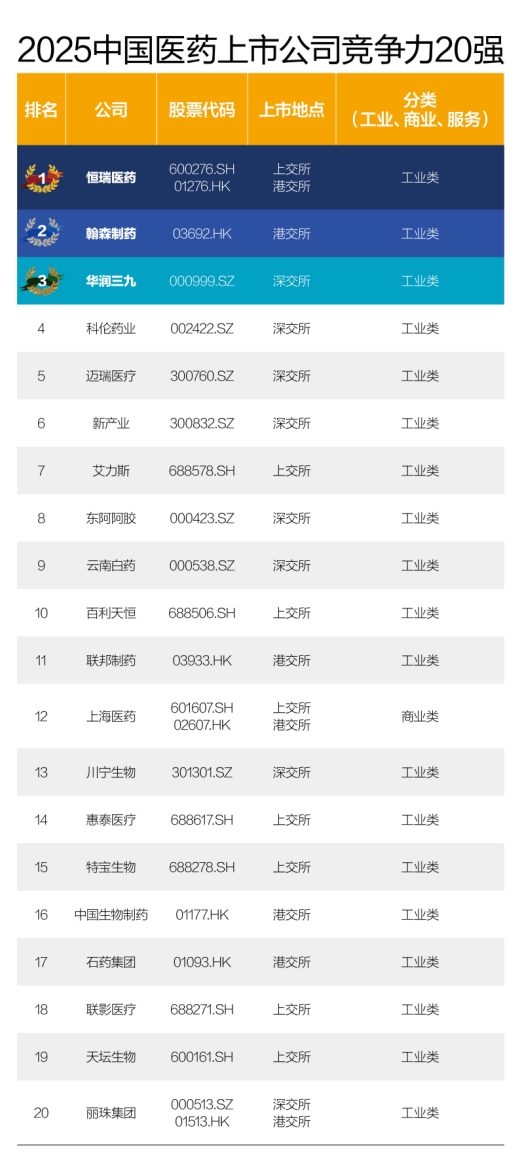
With 2015 as a new milestone for pharmaceutical innovation in China, 2025 marks the beginning of the second decade. However, the "awakening" of China's pharmaceutical industry can be traced back to the period after the reform and opening-up.From the prevalence of generic drugs to the rise of innovative proprietary drugs, and from the initial establishment of the medical insurance system to the creation of diversified payment methods, over the past three decades of the vigorous development of China's pharmaceutical industry,In China, a group of pharmaceutical enterprises that are rooted in the local area, safeguard people's livelihood, and have a global outlook have emerged.As revealed in the recently announced "Top 20 Most Competitive Pharmaceutical Listed Companies in China," in this selection aimed at identifying China's most competitive pharmaceutical listed companies, uncovering leading enterprises that will guide the future of China’s pharmaceutical industry, and discovering the most promising and investment-worthy sectors, more than half of the listed pharmaceutical companies have reached their 30th year.Notably, among the top 20 most competitive companies, 12 are appearing on the list for the first time. Among them, Hansoh Pharma ranks second despite being a newcomer.What About Hansoh Pharma?翻开翰森的成长史,你会发现,这家1995年成立于黄海之滨的药企,用了三十年时间,走出了一条"Focus on Clinical Needs, Commit to Long-term Innovation"The development path. Not only has it continuously made breakthroughs and innovations in major disease areas such as oncology, anti-infectives, metabolism, central nervous system, and autoimmune diseases, becoming the "China force" in safeguarding patient health, but also set a new benchmark for the transformation and upgrading of China's pharmaceutical industry through a series of high-value global collaborations.At this critical juncture where globalization meets innovation and the industry enters uncharted waters, looking back at Hansoh Pharma's thirty-year growth trajectory reveals not just the development history of a pharmaceutical company, but also a microcosm of China's innovative drug industry.If "moving fast" is the era's urging to startup pharmaceutical companies; then "going far" is the watershed for mature enterprises. Hansoh Pharma's 30 years have left the industry with a thought-provoking proposition:Between Noise and Anxiety: How Chinese Pharmaceutical Companies Bring Every Product to the Market, to Patients, and to the World?Construction of Innovation System: The Moat of Hansoh's Long-Term PhilosophyIn the 1990s, when China's innovative drug industry was still in its infancy, the pharmaceutical market in China was dominated by generic drugs. The industry generally relied on the survival strategy of quickly imitating and scaling up sales. However, Hansoh Pharma, founded in 1995, did not stop at the short-term goal of "rapid imitation." Instead, within less than a decade of its establishment, it began building its "second curve" oriented toward innovation.This decision was not popular at the time, and could even be considered ahead of its time.In 2002, Hansoh Pharma launched its first R&D pipeline for Class 1.1 new drugs, a milestone that even predates the industry consensus on "generic innovation integration." At that time, new drug R&D required significant investment, had long development cycles, and carried a high risk of failure, with almost no strategic or capital market support to cushion these challenges. Innovation relied solely on the financial endurance and strategic foresight of the company itself. From this perspective,Hansoh's innovative layout is a visionary long-term approach.From the perspective of the company's development pace, Hansoh's 30 years can almost be divided into three distinct phases:The first decade of its establishment was a phase of foundation-building for Hansoh Pharma.Focusing on indications such as anti-tumor and psychiatric diseases, Hansoh Pharma developed generic drugs and quickly entered the market, establishing initial profitability and a sales network. More importantly, during this period, Hansoh began to lay out high-quality formulation processes and active pharmaceutical ingredient export standards, accumulating first-hand experience for its later entry into the international compliance system.The second decade was an important period for Hansoh Pharma to build up strength and focus its efforts.At this stage, Hansoh not only initiated the early development of multiple innovative projects but also completed the transition to a modernized group governance structure. Around 2015, Hansoh gradually established a full-chain R&D platform covering target validation, lead compound optimization, IND application, CMC development, clinical registration, and commercialization preparation. The accumulation of these systematic capabilities has enabled the company to build a "systematic moat" amid subsequent industry reshuffling waves, such as centralized procurement, medical insurance cost control, and competitive innovation in new drug development.The third decade marks the coming-of-age year for Hansoh Pharma, characterized by accelerated innovation and internationalization.Taking the 2019 Hong Kong stock listing as a milestone, Hansoh Pharma has officially stepped into the spotlight of innovative drug commercialization. In this decade of vigorous development of China's pharmaceutical innovation, new products from Hansoh’s R&D pipeline have continuously gained approval in China, with some pipelines simultaneously initiating overseas clinical applications. Meanwhile, the pace of collaboration with overseas biotech firms and multinational pharmaceutical companies has been steadily accelerating. At the organizational level, Hansoh has recently embarked on a "multi-center" R&D layout: Lianyungang focuses on CMC and production process platforms, while Zhangjiang in Shanghai concentrates on preclinical development, antibody technology platforms, AI design, and clinical research, among other cutting-edge R&D directions. Additionally, overseas subsidiaries have been established, and international R&D teams have been formed, creating an organizational model that fosters synergy between domestic and international operations.Looking back at the three decades of Hansoh Pharma's development,Its understanding of "tissue evolution" goes beyond the business dimension.Over the course of 30 years of development, the company has continuously promoted internal mechanism innovations, including postdoctoral workstations, competency models for R&D personnel, and product lifecycle management systems. This emphasis on "organizational capability" has become a key factor enabling the company to undergo steady transformation in the face of intense competition and a rapidly changing market environment.Looking back on the journey from the current perspective, it is not difficult to find,Hansoh's thirty years represent not only the transformation and upgrading of its product pipeline from generics to original research, but also the leap in organizational capabilities from single projects to platformization.Currently, it has more than 40 innovative molecular entities under research and development, and by 2024, its R&D investment will account for over 22% of its revenue, making it a "steadily strong" representative among pharmaceutical companies in China.This combination of deep accumulation, cyclical thinking, and organizational patience has also enabled Hansoh Pharma to become one of the few companies in the industry that can navigate through cycles and emerge as an innovative pharmaceutical enterprise.Focus on Advantages: Hansoh's Differentiated Innovation StrategyIf the story of Hansoh Pharma in the past twenty years was a steady leap from generics to original research, then the key factor that has truly set it apart from other local pharmaceutical companies undergoing innovative transformation in the past decade is its differentiated innovation strategy of "not chasing trends, yet staying grounded in reality."In the nearly ten years since China's pharmaceutical industry entered the "innovative drug boom," a large number of pharmaceutical companies have repeatedly bet on star targets such as PD-1, hoping to replicate the success of the first batch of "blockbuster drugs."Hansoh Pharma has chosen a unique approach that combines "innovative breadth + platform depth" —— not only delving deep into target origins and mechanism differences, but also building a systematic international cooperation network.Unlike some peer-sized pharmaceutical companies that introduce pipelines through high-priced License-in deals and quickly inflate valuations, Hansoh places greater emphasis on the cornerstone of innovation capabilities: including drug design platforms, clinical development capabilities, CMC quality management, and regulatory submission systems.In the field of anti-tumor therapy, Hansoh Pharma independently developed and promoted innovative drugs such as Aumolertinib at an early stage. Aumolertinib is Hansoh's leading product in the oncology field and also China's first self-developed third-generation EGFR-TKI.From the approval of the first indication in March 2020, to the approval of the first-line indication in December 2021, and then to the approval of the third and fourth indications this year, these milestones are not only significant for Hansoh Pharma but also a testament to the rise of China-produced innovative drugs in the field of lung cancer treatment. More notably, in June this year, Ameletinib tablets were approved for marketing by the UK Medicines and Healthcare products Regulatory Agency (MHRA), becoming the first innovative drug from Hansoh Pharma to enter the overseas market and also the first China-originated EGFR-TKI to be marketed overseas.Beyond lung cancer, Hansoh Pharma has also expanded into indications such as esophageal cancer, colorectal cancer, hematological tumors, and osteosarcoma. Among these, the company's ADC portfolio has become the most prominent part of its pipeline. HS-20093 (B7-H3 ADC) and HS-20089 (B7-H4 ADC) have both entered Phase III clinical trials in China, with international development rapidly advancing, placing their progress at the forefront globally. Additionally, next-generation ADC projects, such as HS-20122 (EGFR/c-Met bispecific ADC) and HS-20110 (CDH17-ADC), have been approved to enter clinical research, demonstrating the company’s continuous iterative capabilities on its ADC technology platform.In non-oncology fields, Hansoh Pharma continues to strengthen innovative exploration in central nervous system, metabolic, and anti-infective disease areas, and systematically builds up its presence in autoimmune diseases.Such as HS-20094 (GLP-1/GIP dual receptor agonist) in the pipeline, which is currently actively advancing Phase III clinical research for obesity or overweight indications, with related studies having administered doses to over a thousand subjects. Additionally, there are other promising products such as IL-23p19 monoclonal antibody (HS-20137), TYK2 inhibitor (HS-10374), P2X3 antagonist (HS-10383), and OX2R antagonist (HS-10506). These potential products all have the possibility of becoming new blockbuster drugs in the future.This is exactly Hansoh Pharma's "anti-involution" innovation strategy:Adhere to long-term and patient investment in innovation.For core areas and core pipelines, especially, we adhere to long-term thinking, avoiding blindly chasing trends. We promote the coordinated development of pipelines, fully leveraging our comprehensive capabilities in development, registration, production, and commercialization to quickly enter the market and seize opportunities.From China to the World: Hansoh Pharma Expands International PresenceGlobalization is an unavoidable proposition for almost all Chinese innovative drug companies. However, in reality, only a handful of local pharmaceutical enterprises have truly achieved a "closed-loop globalization." Especially against the backdrop of increasingly stringent international registration standards, rising geopolitical uncertainties, and valuation adjustments in the BD market, the path to globalization for Chinese pharmaceutical companies is undergoing a cyclical shift from a "surge" to "calmness." Amidst this transition, Hansoh Pharma’s globalization strategy offers an alternative case study.While adhering to the construction of original research capabilities, Hansoh Pharma places great emphasis on the acceleration effect brought by international cooperation.If we place the "going global progress bar" of China-based pharmaceutical companies on a timeline, Hansoh Pharma clearly does not belong to the "first batch of early adopters." However, in terms of outcomes, in recent years, its collaborations with multiple global biotech firms and multinational pharmaceutical companies have been continuously deepening. Especially since 2023, its business development (BD) partnerships in areas such as oncology and metabolism have shown a trend of "improved quality and accelerated pace." In the heated ADC and GLP-1 fields, Hansoh Pharma has reached license-out collaborations totaling over $8.8 billion with GSK, MSD, Regeneron, and Roche within three years. The substantial BD revenue provides stronger momentum for innovative drug research and development.In addition to enabling early products to realize market value sooner and sharing risks, Hansoh Pharma can also learn more advanced experiences from multinational corporations (MNCs) through external cooperation in License out partnerships.When multinational corporations (MNCs) conduct research and evaluation of potential products, they pose multiple rounds of complex and meticulous questions, ranging from discovery research, clinical research, regulatory approval, project management to process manufacturing. In the process of organizing thoughts and answering these questions, Hansoh Pharma's team can also understand and learn about the cognition, control, and experience of overseas multinational pharmaceutical companies in each link. Additionally, it enables mutual support between R&D in China and international R&D, relying on the full-chain R&D capabilities such as international multi-center trials (MRCT) and data mutual recognition under the ICH alliance, achieving or promoting global synchronized R&D. Moreover, with the strong commercialization capabilities of MNCs, products can be quickly advanced to benefit patients worldwide.While License out is in full swing, in terms of License in, Hansoh Pharma's strategy for introducing products and pipelines places greater emphasis on meeting patients' clinical needs in different scenarios.On the one hand, introduce high-value, high-potential products in untapped fields,As exemplified by the introduction of Xinyue (Inebilizumab) in 2019, it was the world's first approved CD19 monoclonal antibody and, at that time, the only biologic approved for treating Neuromyelitis Optica Spectrum Disorder (NMOSD). Currently, Inebilizumab has also been approved in China for its second indication, the treatment of Immunoglobulin G4-Related Disease (IgG4-RD), marking it as the world’s first and only product for this use.On the other hand, it is a product that continuously expands indications and forms a good synergistic effect with the currently covered departments.The introduction of Quanxin Biologics' IL-23p19 monoclonal antibody (HS-20137 Injection) and the company's self-developed product HS-10374 (TYK2 inhibitor) will synergistically strengthen Hansoh Pharma's autoimmune pipeline.Looking back at Hansoh's 30 years, it has been neither aggressive nor conservative. It proactively laid out innovations during the imitation era and steadily expanded its globalization during the innovation era, maintaining its rhythm.As stable as a leading enterprise and as agile as an emerging Biotech.This may be exactly the kind of spirit that China's leading domestic pharmaceutical companies need ——Able to withstand pressure, patient, with a global perspective but not overly eager for quick success.When the industry is undergoing significant changes and capital cycles are fluctuating, maintaining a stable and powerful position like Hansoh Pharma, with full confidence, is the best posture to navigate through the cycles.Second Review | Li Fangchen
Third Review | Li Jingzhi