ESMO 2025: BioNTech Halts BNT111 Melanoma Vaccine Amid Disappointing Phase 2 Data; Moderna Reports Promising Early Results for mRNA-4359

BioNTech
Developer of Novel Biologics

Regeneron
Biopharmaceutical Manufacturer

The other day, Endpoints News reported that,BioNTechDecision to SuspendDevelopment Plan for the Melanoma mRNA Vaccine BNT111。
The main reason for making this decision is that, at the European Society for Medical Oncology(ESMO 2025)At the conference, BNT111 presented disappointing Phase 2 data.
BNT111 Phase 2 Data

About BNT111
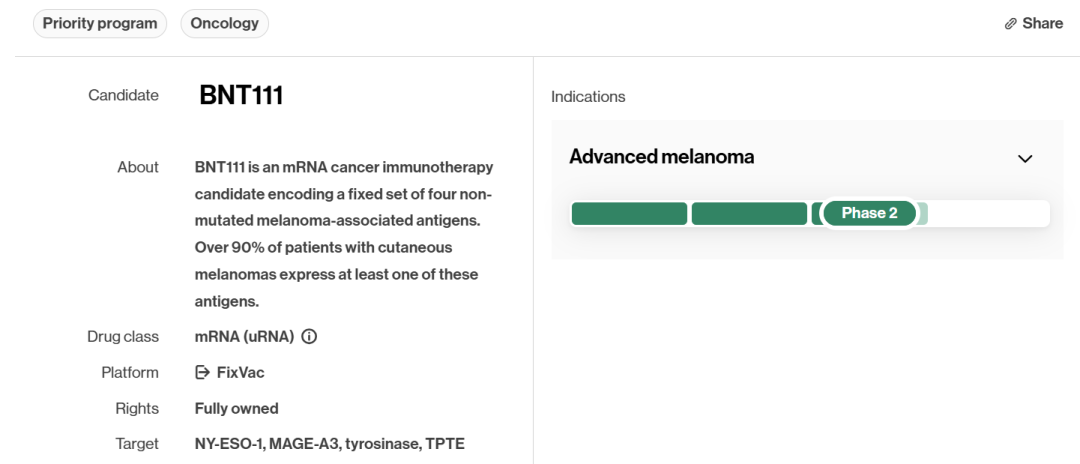
BNT111 is an mRNA cancer vaccine developed based on BioNTech's proprietary FixVac platform. It encodes a fixed set of four melanoma-associated antigens: NY-ESO-1, MAGE-A3, tyrosinase, and TPTE, aiming to induce an immune response in patients with advanced melanoma.
On July 29, 2020, the Phase 1 clinical trial results of BNT111 were“An RNA vaccine drives immunity in checkpoint-inhibitor-treated melanoma”Published in Nature, the results indicate that vaccination with BNT111 is aEffective Immunotherapy, and demonstrate the general utility of non-mutated shared tumor antigens as targets for cancer vaccination. An RNA vaccine targeting four melanoma-associated antigens induces durable objective responses in melanoma patients, accompanied by robust CD4+ and CD8+ T-cell immunity. In November 2021, BioNTech announced,The US Food and Drug Administration has granted BNT111 Fast Track designation。
Phase 2 Experimental Design
In 2020, BioNTech collaborated with Regeneron to develop BNT111 and Cemiplimab.(Cemiplimab)TheCombination therapy, and launched this Phase 2 clinical trial in 2021(NCT04526899), to evaluateBNT111 alone or in combination with cemiplimab(Libtayo)Efficacy and Safety in Treating Advanced Melanoma Patients Unresponsive to Other Forms of Therapy.
Patients were randomly assigned to Group 1 in a 2:1:1 ratio.(BNT111+cemi), 2 groups(BNT111 monotherapy)And Group 3(cemi monotherapy)The primary endpoint is the objective response rate in Group 1 as determined by blinded independent central review according to RECIST 1.1 criteria.(ORR)Compared with the hypothetical historical control group 10%(H0 Hypothesis)Comparison; Secondary endpoints include safety and progression-free survival.(PFS)And Overall Survival(OS)。
The latest updated data show that: a total of 184 patients were randomly grouped (Group 1: 94, Group 2: 46, Group 3: 44Baseline characteristics were comparable across groups.(Median age 64.5 years; range 18-91 years)As of February 14, 2025, the median follow-up time was 15.6 months.
Group 1 BNT111 in combination with cemi treatmentORR was 18.1%, including 11 cases of complete remission and 6 cases of partial remission;Disease Control Rate(DCR)55.3%`, Median Duration of Response`Not reached,Median Progression-Free Survival(PFS)The median progression-free survival was 3.1 months, and the median overall survival was 20.7 months.。
Two groups of BNT111 monotherapyORR was 17.4%, DCR was 58.7%, median PFS was 2.8 months, and median OS was 13.7 months.;
The ORR of 3 groups of cemi monotherapy is13.6%, DCR was 47.7%, median PFS was 3.2 months, and median OS was 22.3 months.。
Among the 181 patients who received treatment, the safety profile was manageable, and the BNT111 treatment group experiencedTypical CRS-related treatment-related adverse events.
In summary, BNT111 in combination with cemi demonstrated a statistically significant improvement in the primary endpoint. However, no meaningful differences were observed in the key secondary endpoints of median PFS and median OS in the BNT111+cemi combination therapy group.Inferior toCemi monotherapy group.
Based on this trial result, BioNTech decidedNo further clinical trials of BNT111 for the treatment of melanoma are planned., andLower the priority of this plan.
Notably, BNT111 is the first mRNA cancer vaccine candidate developed by BioNTech and represents one of the company’s key R&D pipelines in the field of cancer treatment. The failure of BNT111 may lead to a reevaluation of mRNA cancer vaccines within the industry.
Moderna: A Mixed Bag of Joy and Sorrow

Melanoma Vaccine mRNA-4359: DCR 60%, ORR 24%
As BioNTech abandons its melanoma mRNA vaccine, Moderna also does so at ESMO.Announced at the conferenceMelanoma Vaccine mRNA-4359Latest clinical results, announced its combination with pembrolizumab(Keytruda) The combination producedPositive treatment response。
ThisPhase 1/2 Study(NCT05533697) A total of 29 patients were enrolled, all of whom had received at least one line of checkpoint inhibitor therapy. mRNA-4359 was administered intramuscularly at a dose of 400µg or 1000µg every 3 weeks for up to 9 doses. The patients'The disease control rate also reached 60%., which means that out of every 10 patients receiving treatment, 6 achieve tumor remission or stable condition after treatment.In the subgroup of patients with evaluable treatment response and at least 1% of tumor cells expressing PD-L1,ORR was 67%, and generated antigen-specific T cell responses.
The trial is expected to be completed in February 2032.
Moderna's Head of Development and Oncology, Dr. Kyle Holen, stated in a press release: "Although still in the early stages, mRNA-4359 currently shows promise in highly...(Checkpoint Inhibitors)The data from patients with refractory metastatic melanoma is unique in the field and brings great hope for future development plans. We are encouraged by its potential to meet the significant unmet needs of many patients."
Another Preventive mRNA Vaccine Forced to Terminate
However, despite the positive results of the melanoma project, another Moderna project formRNA Vaccine Project for the Prevention of Congenital CMV Infection(mRNA-1647)But met with a Waterloo.
Congenital CMV refers to pregnant women transmitting the virus to the fetus or newborn, which may lead to serious consequences such as developmental delays and hearing loss. According to the Centers for Disease Control and Prevention(CDC)It is estimated that more than 50% of adults in the United States have been infected with CMV before the age of 40.
It is reported that the phase 3 trial of mRNA-1647 covered 13 countries and included 7,454 females aged 16 to 40. Although the safety profile was good, its efficacy in preventing primary infection...The protection rate is only between 6% and 23%.Far below the company's expectations. On October 22, Moderna announced the termination of the project.
Moderna President Stephen Hoge stated, "We are deeply disappointed by the failure to prevent primary infection, which means that despite years of effort in this area, there is still no vaccine available to prevent congenital CMV."
Notably, the uniqueness of this trial lies in,"Preventing primary infection" as the primary endpoint, rather than merely preventing symptomatic diseaseHoge pointed out in his blog that this is the only one in Moderna's pipeline.A clinical trial with this goal is even more challenging.
Despite the termination of this project, Moderna stated its financial outlook for the fiscal year 2025 and the goal of achieving breakeven by 2028.Unaffected. The company will continue to advance the vaccine inPhase 2 Trial for the Prevention of CMV Reactivation in Transplant Patients.
Mixed Results: Arcturus Cystic Fibrosis (CF) Inhalable mRNA Therapy Phase 2 Clinical Outcomes Inconsistent

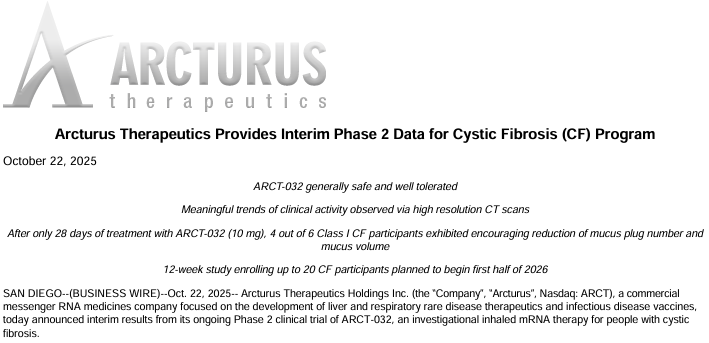
Also on October 22,Arcturus TherapeuticsPublished itsFor Cystic Fibrosis(CF)The inhaled investigational mRNA therapy ARCT-032OngoingInterim Analysis Data of Phase 2 Clinical Trial。
ARCT-032 Utilizes Arcturus' Proprietary LUNAR® Lipid-Mediated Nebulization Platform to Deliver CFTR Messenger RNA to the Lungs. Its Potential Mechanism is Expressing Functional Cystic Fibrosis Transmembrane Conductance Regulator in the Lungs of CF Patients.(CFTR)mRNA copies, which are expected to restore CFTR activity and alleviate the downstream effects that lead to progressive lung disease.
In the second cohort of the study, six patients with Grade I cystic fibrosis(CF)Adult patients inhaled a daily dose of 10 milligrams of ARCT-032 for 28 days. Four participants showed a reduction in mucus plugs and mucus volume based on high-resolution CT scans.The reduction ranges from 9.1% to 38.5%., MucusThe volume reduction ranged from 6.1% to 67.4%.. However, at the end of the 28-day treatment period, the forced expiratory volume in one second (FEV1)(FEV₁)This key indicatorFailed to show meaningful improvement。
Some professional analysts believe that the result is "Mixed Blessings”:
"At the end of the dosing period, FEV1(Predicted Percentage)Lack of significant impact, which is exactly the focus for investors before the release of mid-term data.Below the benchmark of a 3% increase in ppFEV1 for 6 patients set by management," said William Blair analyst Myles Minter. "This raises questions about whether ARCT-032 can continue to improve lung function."
Meanwhile, InvestingPro data shows that eight analysts recentlyUpregulatedThe profit forecast for the company's upcoming period indicates confidence in the company's prospects.Continuously Enhanced。
Currently, an expanded third cohort study is underway, aiming to recruit up to six subjects to determine whether a dose-escalation response exists at the 15 mg dose level and whether ARCT-032 remains generally safe and well-tolerated. The company plans to initiate a 12-week safety and preliminary efficacy study in the first half of 2026, enrolling up to 20 participants with CF.
From Peak to Turning Point: mRNA Therapy Enters a "Watershed Moment"

After the tide of the COVID-19 pandemic receded, mRNA technology is no longer in a single explosive growth phase but has entered a critical stage of "from concept to differentiation." The setback of BioNTech's BNT111 indicates that the clinical complexity of mRNA cancer vaccines far exceeds that of the infectious disease field, and immune effects are not linearly replicable. Meanwhile, Moderna’s mRNA-4359 has injected hope into similar projects, proving that precise antigen design and immune synergy remain the breakthrough points for the future. At the same time, the interim data from mRNA-1647 and ARCT-032 serve as a reminder to the industry—delivery efficiency, tissue specificity, and sustained expression are still the "last three kilometers" constraining the implementation of mRNA therapies.
In this round of "screening evolution," failure no longer means the end of the road for a technology, but rather the beginning of reorientation. mRNA technology is moving from a universal platform towards...Diverse Branches——A multi-dimensional system of therapeutic, inhaled, personalized, and combination delivery is taking shape. The future success will not depend on a single target or drug, but on the ability to build a safer, more precise, and more efficient "mRNA treatment ecosystem."
This revolution about messenger RNA is coming fromThe race for speed shifts to a race for quality.
References
1. https://mp.weixin.qq.com/s/K_7trJ1ev9YZvhgCkxRspQ
2. https://mp.weixin.qq.com/s/hKW2PqS2FKvQcS_13uqIhw
3. https://mp.weixin.qq.com/s/DDQaKCYyLTVp5SJgE7tEvw?scene=1&click_id=92