

Autonomous Biomedical Research with an AI Agent: Stanford Team Unveils Biomni, a General-Purpose Scientist AI Published in Science

Genentech
Pharmaceutical R&D Manufacturer


By Wang Cong
Editor | Wang Duoyu
Layout | Shui Chengwen
Biomedical research is increasingly constrained by repetitive and fragmented workflows, which slow the pace of discovery.
June 2025,Stanford UniversityHuang Kexin、Serena Zhang、Wang Hanchen、Qu Yuanhao、Lu Yingzhoua team led by researchers, in collaboration withGenentech、Arc Institute、University of California, San Francisco andPrinceton University, etc.Several leading research institutions have released aGeneral-Purpose Biomedical AI Agent——Biomni, this agent is capable of autonomously completing complex research tasks across multiple branches of biomedicine。
On July 9, 2026, the paper passed peer review., with:Autonomous biomedical research with an artificial intelligence agent(AI Agent-Driven Autonomous Biomedical Research)as the title, officially published in a top-tier international academic journalScience。
Systematic benchmarking demonstrates thatBiomni Demonstrates robust generalization capabilities across a variety of heterogeneous tasks—including causal gene prioritization, drug repurposing, rare disease diagnosis, microbiome analysis, and molecular cloning—without the need for task-specific tuning. Real-world case studies show that Biomni can parse multimodal datasets, optimize protein stability, coordinate wet-lab instrumentation, and generate experimentally verifiable protocols. The research team stated,Biomni’s vision is for AI to augment the capabilities of human scientists and accelerate scientific discovery.
Why Do We Need “AI Scientists”?
Biomedical research is facing an awkward dilemma: on one hand, technologies such as high-throughput sequencing and wearable devices are generating massive amounts of data; on the other hand, there is a severe shortage of experts capable of analyzing this data.
Data has piled up like mountains, yet talent is in short supply.
Much valuable data lies dormant, many complex analyses remain unfeasible, and numerous cross-disciplinary knowledge connections fail to be established—not because they are unimportant, but because there are far too few people capable of carrying out such work.
Although existing AI tools are powerful, most of them are “Specialist”: Some are only capable of analyzing single-cell data, others specialize solely in designing gene-editing experiments, and still others are limited to performing drug screening. When switching to a different domain, they must be retrained or replaced with different tools.
So, can we create a “Generalist"—one that can seamlessly switch between different biomedical fields, much like a human scientist—"AI Scientist”?
This, precisely, isBiomniThe original intention behind its inception.
How Was Biomni Forged?
Creating such an all-around “AI scientist” is by no means an easy task. The research team accomplished two key things—
Step 1: Construct the “Biomedical Action Space”
The research team selected 100 of the most recent papers from each of the 25 biomedical subfields on the bioRxiv preprint platform, totaling 2,500 papers, and had AI read them one by one to extract the tasks, tools, databases, and software involved.
Ultimately, they constructedBiomni-E1Environment, including—150 specialized biomedical tools, 105 commonly used software packages, and 59 databases.
This is equivalent to equipping AI with a completeVirtual Laboratory。
Step 2: Design a General-Purpose Intelligent Agent Architecture
Having the tools is not enough; one must also know how to use them. The research team designedBiomni-A1Architecture, with three core innovations—
Intelligent Resource Selection: In response to user queries, AI first retrieves the most relevant tools and databases, rather than utilizing all available resources.
Code-as-Action Interface: AI uses code to express and execute each step, enabling it to flexibly combine different tools and handle complex processes.
Adaptive Planning: After formulating an initial plan, the AI continuously adjusts and optimizes it during execution, much like human scientists thinking while doing.
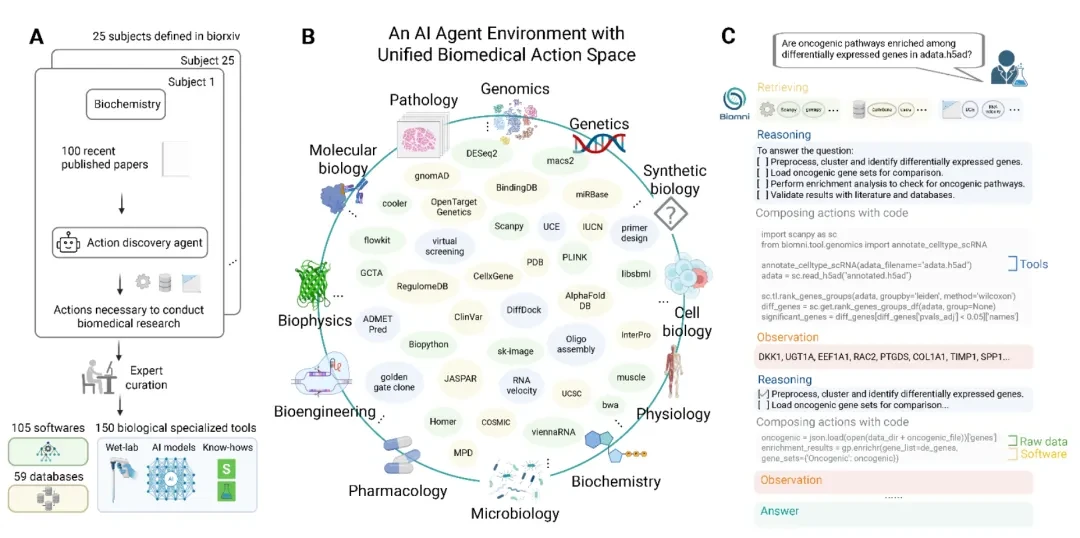
Biomni Overview
Simply put,BiomniLike a human scientist equipped with a “superbrain,” who not only possesses extensive professional expertise but also knows how to flexibly utilize various tools.
How Powerful Is Biomni, Exactly?
The research team demonstrated the powerful capabilities of Biomni in their paper through a series of rigorous tests—
Benchmarking: Comprehensive Leadership
In a comprehensive benchmark covering 443 questions, Biomni achieved an average accuracy of 57%, significantly outperforming general large language models.(LLM)30% of general tasks, 25% for specialized drug R&D agents, and even surpassing the 43% achieved by dedicated programming assistants.
In “The Final Examination of Humanity”(Biomedical Edition)In such high-difficulty reasoning tests, Biomni delivers a significant improvement of 6–12 percentage points, regardless of the underlying large language model employed—demonstrating that its advantage stems from its architectural design rather than any specific model.
Versus Human Experts: Faster and Better
The research team also pitted Biomni against senior postdoctoral fellows and professor-level human experts in a head-to-head competition, with results showing that, inSingle-cell annotation,Rare Disease Diagnosis andIn tasks such as GWAS causal gene detection,Biomni matches or exceeds human experts in accuracy, while delivering speeds that are several to tens of times faster.。
Reinforcement Learning Empowered: Stronger with Every Lesson
The research team also introduced a reinforcement learning mechanism, enabling Biomni to continuously self-optimize through interactions with its environment. After training, the performance of the Biomni-R0-32B version surged from 0.35 to 0.67, even surpassing closed-source large language models such as Claude 4 Sonnet.
This means that, Biomni Continuous improvement can be achieved through “practice,” a level of proficiency that requires human researchers to undergo years of specialized training.
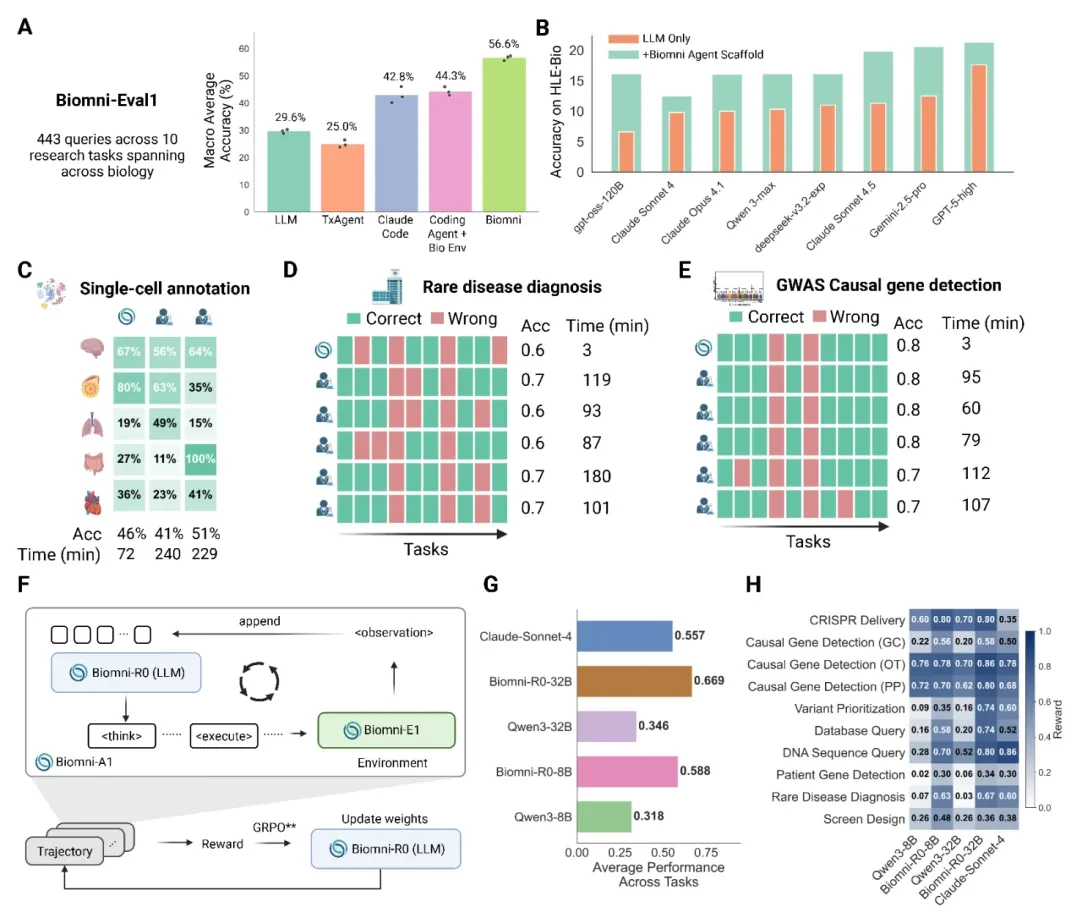
Biomni’s Performance on General Benchmarks, Expert-Level Tasks, and Reinforcement Learning
Practical Exercises: Five Real-World Cases
If benchmarking is merely “theoretical,” the following five real-world application cases truly demonstrate the value of Biomni.
Case 1: Wearable Data Analysis
The research team provided Biomni with raw heart rate and step count data from Fitbit trackers worn by 1,027 participants—comprising over 1.4 billion heart rate measurements and 37 million step records.
Biomni independently completed the entire analysis process: from data cleaning to physiological indicator extraction(resting heart rate, circadian rhythm amplitude, heart rate variability, etc.), to the construction of a multidimensional risk score(0–6 points), and then to generate publication-quality visualizations.
The final results are highly consistent with the original study, including key physiological relevance.(e.g., resting heart rate is negatively correlated with circadian rhythm amplitude), the entire analysis requires no manual intervention.
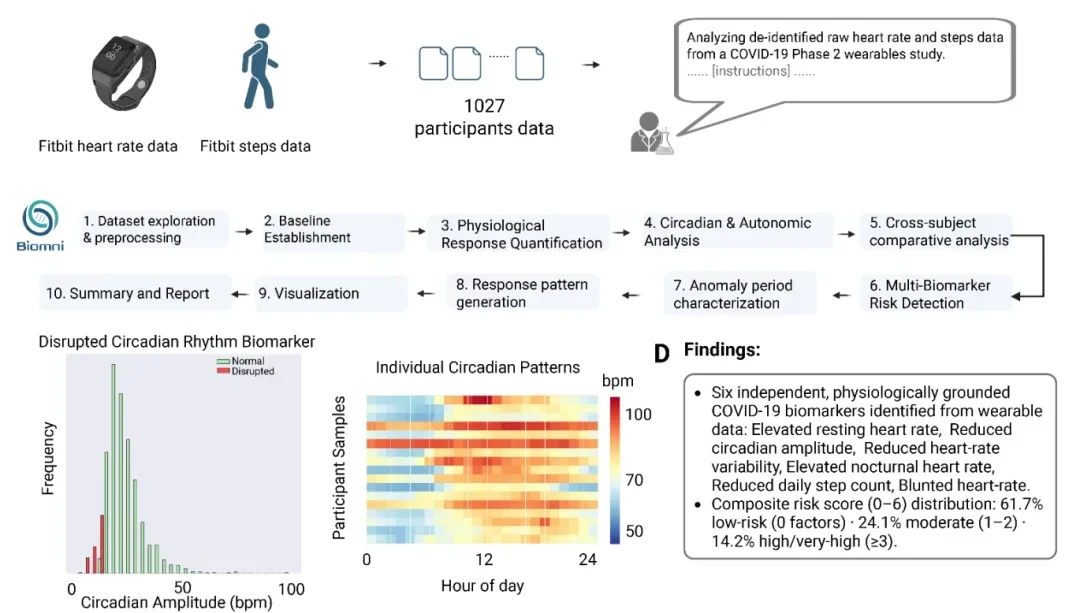
Biomni Autonomous Analysis of Wearable Data
Case 2: Multi-omics Data Analysis
This is one of the most impressive cases. Biomni was tasked with analyzing a multi-omics dataset of human embryonic skeletal development comprising 336,162 nuclei.(including both RNA-seq and ATAC-seq data)。
It autonomously planned and executed a ten-stage analytical pipeline: loading and exploring all datasets, preparing RNA-seq data, configuring transcription factor analysis tools, inferring gene regulatory networks, pruning networks, calculating regulator activity, extracting chromatin accessibility data, filtering predicted targets using ATAC-seq data, analyzing activity patterns across different cell types and developmental stages, and summarizing findings and generating reports.
The entire operation took approximately 5 hours, during which real-time errors such as variable name mismatches were automatically handled. The final results not only reproduced known regulatory relationships in bone formation but also nominated several potential regulators that had not been previously studied in depth.(e.g., AUTS2, ZFHX3, PBX1), providing new directions for subsequent research.
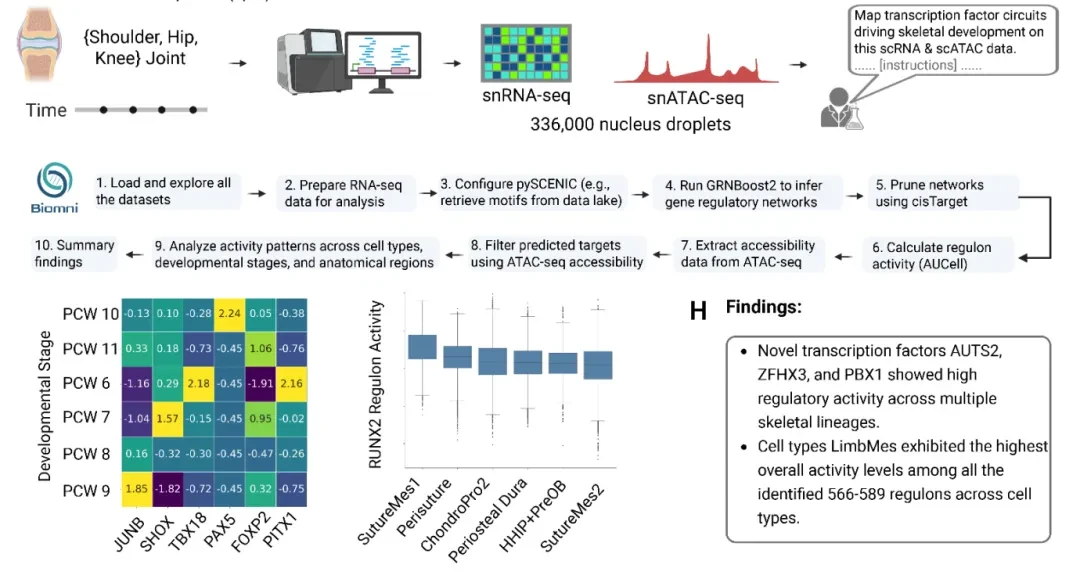
Biomni: Autonomous Analysis of Single-Cell Multi-Omics Data
Case 3: Wet Lab Experimental Design
One of the most common tasks in molecular biology is “cloning”—inserting a target gene fragment into a vector. This is routine for experienced researchers but fraught with pitfalls for novices.
Biomni was tasked with designing an sgRNA cloning strategy targeting the human B2M gene, and it autonomously completed the analysis of plasmid structure, sgRNA design, oligonucleotide sequence generation, and provision of detailed experimental protocols.(Annealing, Ligation, Transformation, Screening), design validation primers, simulate assembly, and generate the final plasmid map.
The research team strictly followed the Biomni protocol for the experiment. Colonies grew by the next day; two colonies were selected for sequencing, yielding a perfect match with no errors.
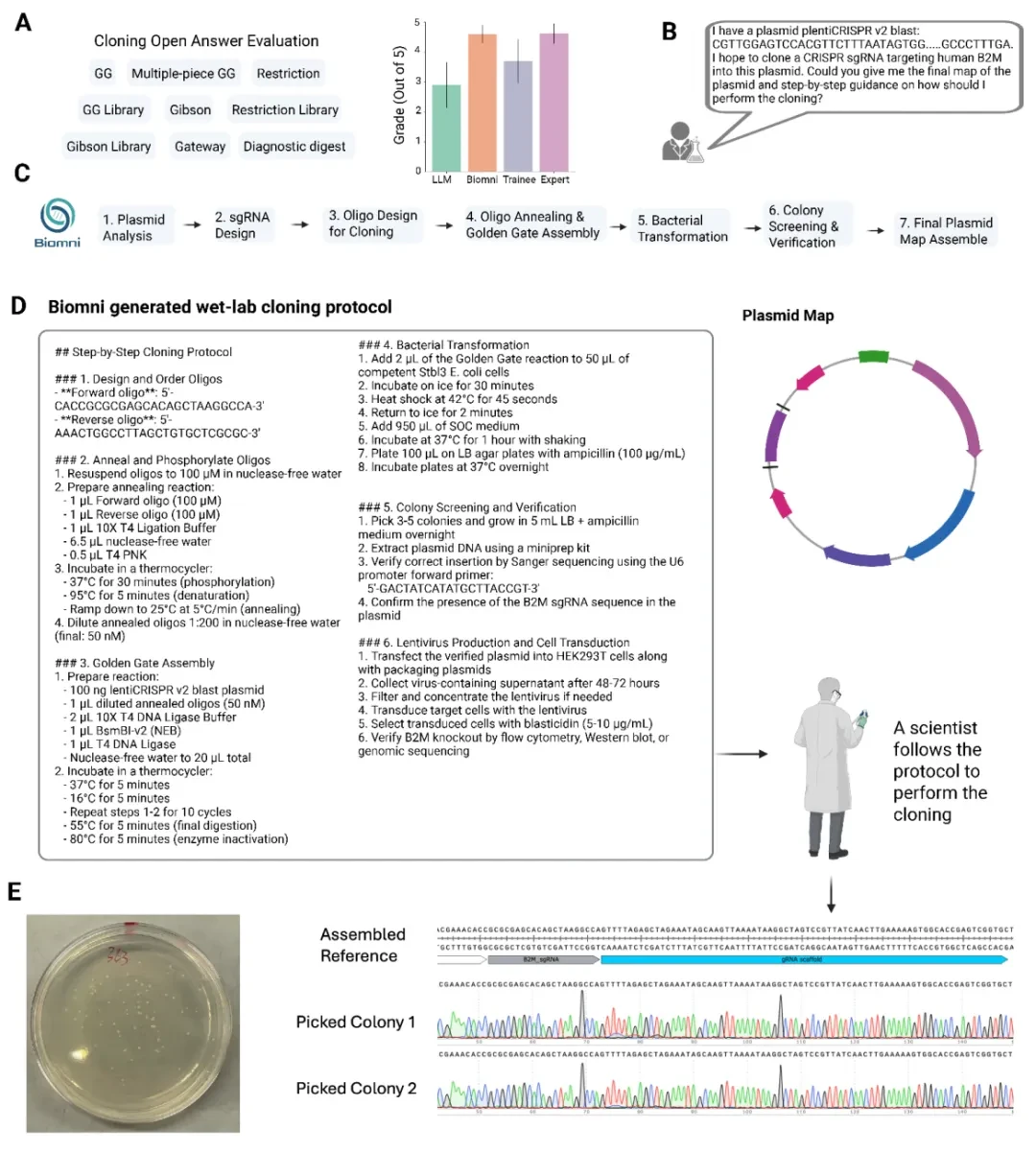
Biomni Designs Wet Lab Protocols
Case 4: Optimization of Protein Thermal Stability
Input a protein sequence with the goal of enhancing its thermal stability. Biomni autonomously invokes AlphaFold2 to predict the protein's three-dimensional structure, employs ThermoMPNN to assess baseline stability, consults the literature to identify stabilizing mutations in homologous proteins, proposes candidate mutations, and iteratively evaluates three rounds of optimization.
Ultimately, it identified three mutations(Q83I、C66F、C110F), with a cumulative predicted improvement in thermal stability of -4.108 kcal/mol, while maintaining 98% amino acid sequence identity. Each mutation is underpinned by clear physicochemical principles—a task that previously required professional computational biologists several weeks to complete.
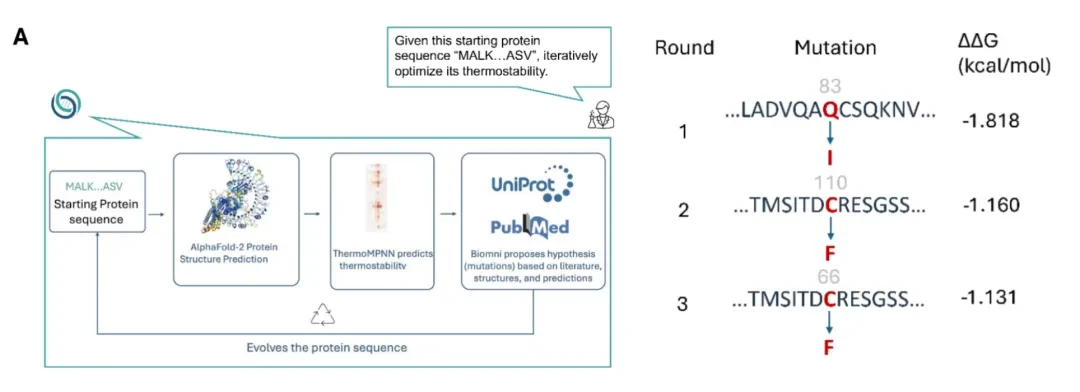
Biomni Optimizes Protein Thermal Stability
Case 5: Control of Automated Liquid Handling Workstations
Biomni can also integrate with the PyLabRobot framework to directly generate executable automation code for liquid handling workstations such as the Hamilton STAR. From a simple “liquid transfer” command to complex cell viability assay protocols involving “8 compounds, 12-point gradient dilutions, and 3 replicates,” Biomni generates production-grade code that includes correct deck configurations, error handling, and resource cleanup.
This marks Biomni's achievement in transitioning from “Dry Lab Analysis"to"Wet Lab Execution” full-chain integration.
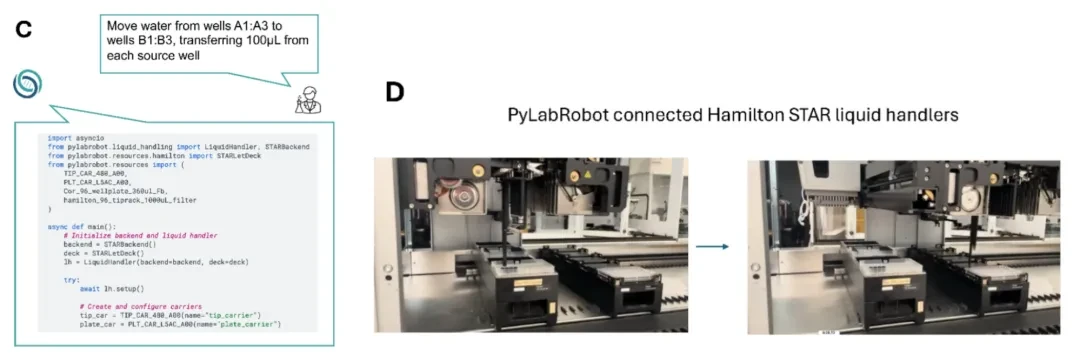
Biomni bridges computational analysis and wet-lab operations by automatically generating experimental protocols.
Conclusion
Biomni The emergence of this phenomenon heralds the formation of a new research paradigm—humans are responsible for generating ideas, setting directions, and making key decisions, while AI handles tedious analyses, integrates fragmented knowledge, and generates actionable solutions.
This “human-machine collaboration” model may profoundly alter the pace and efficiency of biomedical research, much like computer-aided drug design did in its early days. As the paper states—Biomni’s Vision: AI-Augmented Human Scientists, Accelerating Scientific Discovery(Biomni envisions artificial intelligence augmenting human scientists and accelerating discovery)。
And the arrival of this day may be sooner than we previously imagined.
https://www.science.org/doi/10.1126/science.adz4351









DotWatching, Convey Your Taste