Suzhou Ribo Life Science Files for Hong Kong IPO as a Global Pioneer in siRNA Therapeutics
Ribo Life Science
Small Nucleic Acid Drug Developer

On October 28, 2025, from Yushan Town, Kunshan City, Jiangsu Province, ChinaSuzhou Ribo Life ScienceCo., Ltd.Suzhou Ribo Life Science Co., Ltd.("Hereinafter referred to as"Ribo Life Science”)Filed a prospectus with the Hong Kong Stock Exchange, planning toHong Kong Main Board listing. This is another application following the expiration of its submission on April 25, 2025.
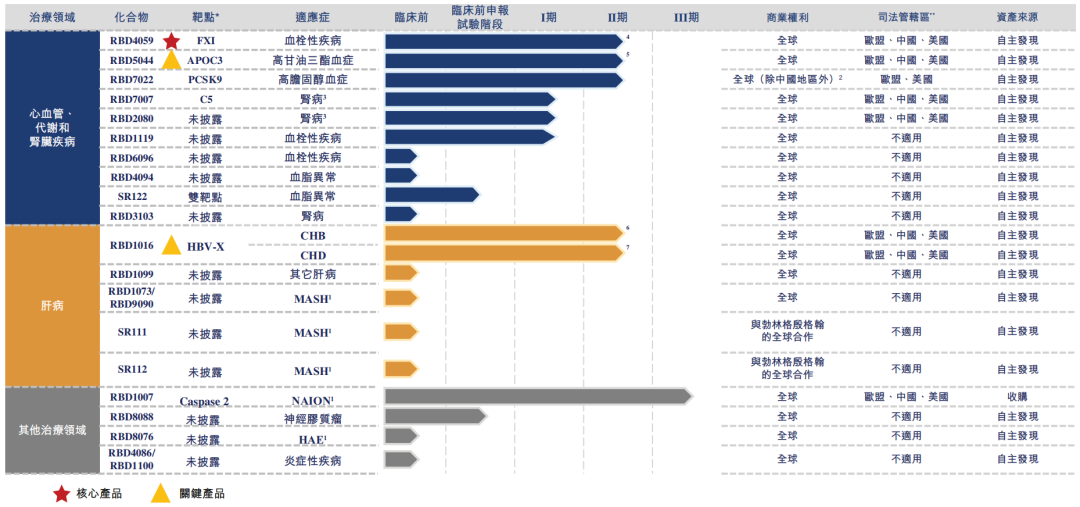
Source: Prospectus
Core Product RBD4059:
RBD4059 isThe world's first and fastest in clinical developmentSuzhou Ribo Life Science Co., Ltd.'s siRNA drug for the treatment of thrombotic diseases. As of now, the company has completed all cohort enrollments for the Phase 2a clinical trial in February 2025 and is expected to complete the trial by the end of 2025.
The current standard-of-care drugs for thrombotic diseases mainly include warfarin, heparin, and direct oral anticoagulants, which have significant limitations due to the potential risk of serious bleeding in patients.
RBD4059 combines the advantages of targeting FXI with siRNA drug technology,Demonstrates significant safety while maintaining strong efficacy.According to clinical and preclinical data, RBD4059 has demonstrated FXI inhibition levels sufficient to meet the efficacy threshold across a wide range of indications, while significantly reducing the bleeding risk associated with traditional anticoagulants.
Moreover, the long-acting characteristics of siRNA provide potential for improving patient compliance.Making RBD4059 a promising optimal treatment choice for patients with a wide range of thrombotic diseases.。
Key Product RBD5044:
RBD5044 is a targeted APOC3 treatment for hypertriglyceridemia (HTG).Potential Best-in-ClasssiRNA, also known asThe Second GloballyDrugs of this category entering clinical development.
In November 2022, the company submitted a Phase 1 Clinical Trial Notification for RBD5044 to the Australian Therapeutic Goods Administration (TGA) and completed the Phase 1 trial in Australia in October 2024. In August 2024, the company submitted a Phase 2 Clinical Trial Application (CTA) for RBD5044 to the European Medicines Agency (EMA), receiving approval in October 2024. The Phase 2 trial is currently ongoing in Sweden among patients with mixed dyslipidemia.
AOPC3 is a protein that plays a key role in lipid metabolism.
The current treatment for HTG has limitations, including limited efficacy, the need for daily dosing, and significant side effects (such as hepatotoxicity, myopathy, gastrointestinal dysfunction, and the risk of pancreatitis). APOC3-targeted therapy, as a breakthrough approach, directly inhibits lipoprotein lipase, thereby increasing the clearance rate of triglyceride-rich lipoproteins and cholesterol in the blood. Since triglyceride-rich particles and remnant particles are increasingly recognized as major contributors to atherosclerotic plaque formation and vascular damage, this approach offers advantages over standard treatments that focus solely on low-density lipoprotein.This strategy can more effectively and specifically control cardiovascular risks associated with triglycerides and residual cholesterol.。
Key Product RBD1016:
RBD1016 is an siRNA candidate drug in global clinical development for the treatment of chronic hepatitis B (CHB/HBV) and hepatitis D (CHD/HDV), and more importantly,One of the fastest-progressing drugs of its kind globally。
The company's prospectus shows that, with its potent and durable HBsAg (hepatitis B surface antigen) reduction, RBD1016 is expected to become a key pillar therapy in combination regimens for the functional cure of chronic hepatitis B. It is also a leading siRNA candidate for the treatment of chronic hepatitis D.
The company received CTA approval from the EMA in May 2023 and IND approval from the China National Medical Products Administration in October 2024 to explore the potential of RBD1016 as a next-generation treatment for CHB. In October 2025, the EMA granted orphan drug designation to RBD for the treatment of HDV infection.
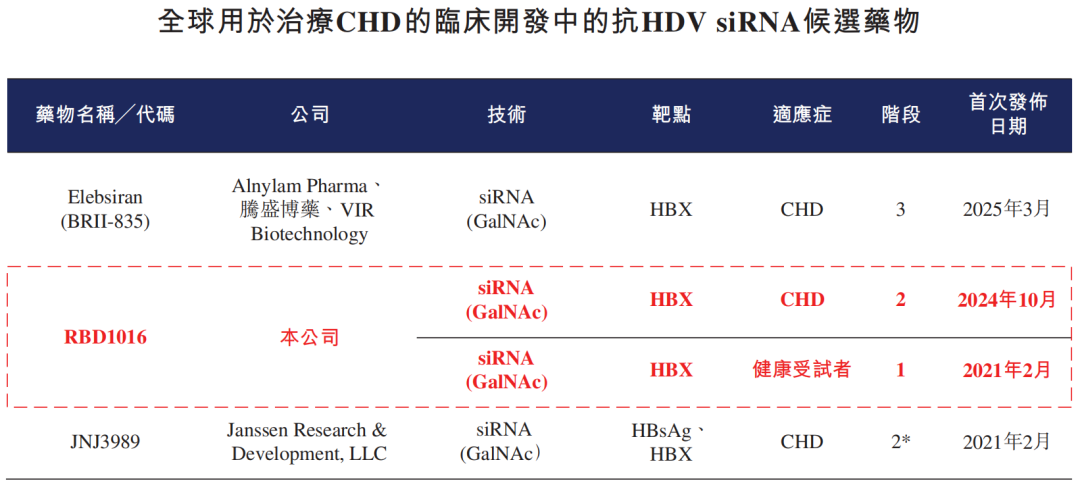
In addition, the company launched its Phase 2a trial in Sweden in August 2024 to explore the potential of RBD1016 in treating CHD, with the trial expected to be completed by the end of 2026.
As of now, there are no approved siRNA drugs globally for the treatment of CHB. Meanwhile, there are six siRNA candidate drugs for the treatment of CHB in phase II or higher clinical development stages worldwide.
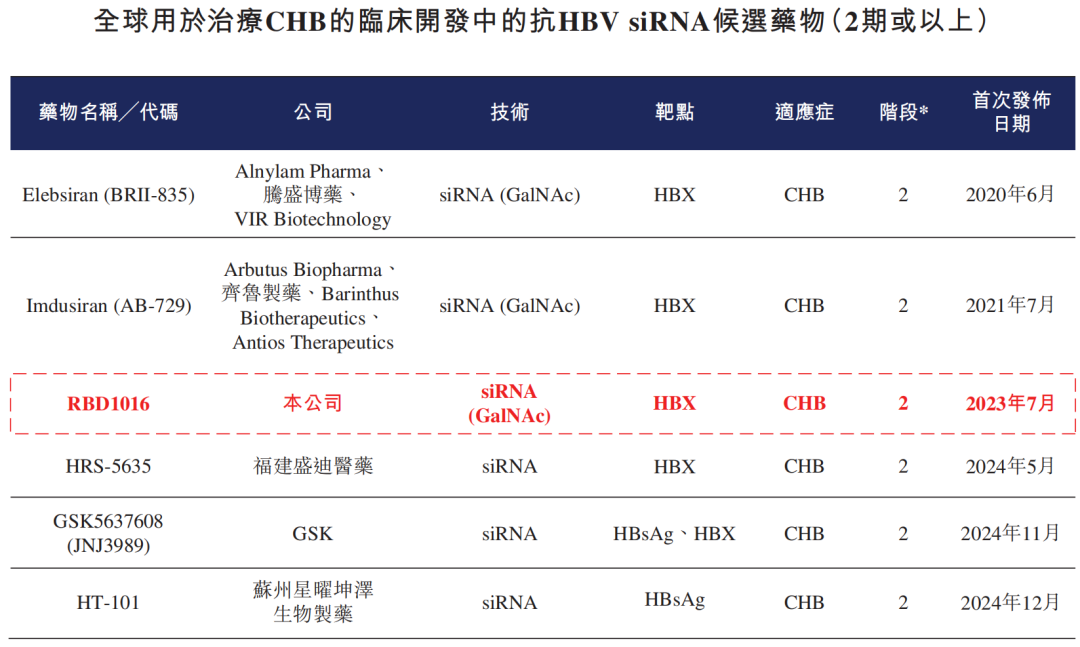
Source: Prospectus
To date, there is no global treatment method for CHD. PegIFN-α is currently the globally recommended treatment for CHD patients, but it has significant side effects, and there are no approved siRNA drugs for treating the disease yet. Currently, there are three siRNA candidate drugs for CHD treatment in clinical development worldwide.
Source: Prospectus