BioGeometry Unveils GeoFlow V3: The First Reasoning-Enabled Protein Foundation Model Achieves 15.5% Wet-Lab Hit Rate in Antibody Design

BioGeometry
Large Molecule Drug Developer
'%20fill='%23FFFFFF'%3E%3Crect%20x='249'%20y='126'%20width='1'%20height='1'%3E%3C/rect%3E%3C/g%3E%3C/g%3E%3C/svg%3E)
The Latest Breakthrough in Protein Large Models Comes from China!
Recently,BioGeometry"Quietly" released a new generationAll-Scenario Atomic-Level Protein Foundation Large ModelGeoFlow V3`, setting a new example for peers worldwide.`
Half a year ago,GeoFlow V2Release, which boasts equal or even superiorAlphaFold3、Chai-2The performance of advanced models like these has allowed the world to witness the innovative strength of Chinese teams.
Nowadays, the new model inGeoFlow V2On the basis of, there have been significant innovations in multiple aspects.
When other models are still"Scale卷"”When,GeoFlow V3Chose a different route - for the first timeMulti-step ReasoningIntroducing protein design to enable the model to possess"Self-assessment, Autonomous Evolution"The ability.
GeoFlow V3Integrated reasoning architecture, deeply integrating protein sequence and structure generation, accuracy assessment, and virtual evolutionary capabilities, moving towards more practical and autonomous solutions.AIForm.
Actually measured,GeoFlow V3The performance was stunning, achieving a comprehensive improvement in accuracy, reliability, and success rate.
The new model inAntigen-Antibody Structure PredictionHigh precision rate on (DockQ > 0.8)Compared withV2Enhanced45%, far exceedingProtenix、Boltz-2、Chai-1And other models.
In the ability to discriminate between conjugates and non-conjugates,GeoFlow V3Similarly demonstrated a leading level, with stronger self-assessment and confidence judgment capabilities.
In the practical task of antibody de novo design, targeting multiple antigens and specified epitopes,GeoFlow V3Only dozens of sequences need to be tested to findnMGradebinderMolecules, with an average wet-lab validation hit rate reaching15.5%,Compared to the previous generationAIThe method has improved nearly a hundredfold.
The new model breaks through the inefficiency of traditional library construction and screening methods, reducing the discovery cycle of lead molecules from the originalShortened from several months or even years to three weeksWithin.
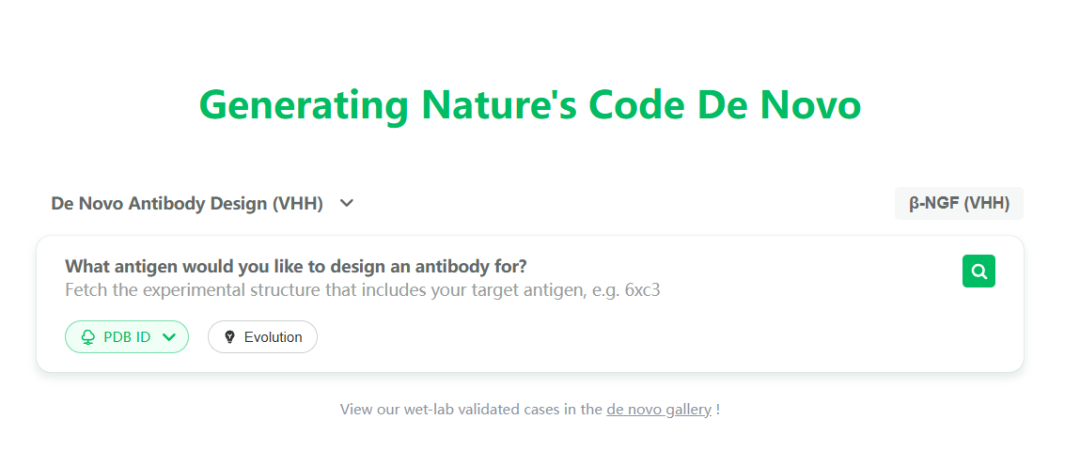
Free TrialGeoFlow V3:https://prot.design
Technical Report:https://prot.design/report
As a popular field, recentlyAIOne groundbreaking protein discovery after another, one foundational model release after another, and performance metrics that dazzle the eye.
But like BioGeometry, truly achieve"Self-developed Model+Wet Lab ValidationThere are not many closed-loop teams.
After all, the large protein model cannot just remain on paper; it needs to become a handy tool for developers."Functional, useful, and easy to use are the ultimate principles."。
All the way,GeoFlowEach upgrade brings us closer to the goal of "practicality," allowing more people to truly experience the profound transformation advanced models bring to research and development work. This is what truly matters.AIThe way it should be.
If we sayAlphaFoldPushed open the door to protein structure prediction,RFDiffusionUnleashed the potential of protein design, thenGeoFlowThe series of models are a gift from China to the world, bridging the "last mile" from theory to application.
For biopharmaceuticals and biomanufacturing,GeoFlow V3As a solid technical foundation, it reshapes humanity's ability to modify and design biomolecules, opening up unprecedented imaginative space for the industry.

AIProtein Benchmark Upgraded Again
More precise, more reliable, more intelligent!
Six months ago, BioGeometry released an all-purpose protein foundation model.GeoFlow V2, becoming the world's first atomic-level protein large model to unify structure prediction and de novo design, has demonstrated strong versatility in various protein design and modification tasks.
This time, BioGeometry has made a significant upgrade to this powerful base through deep optimization and paradigm innovation:
GeoFlow V3Not only does it possess stronger structural prediction and binding protein discrimination capabilities, but it also breaks through the traditional "generation-The linear process of "virtual screening" builds up"Generate-Evaluation-"Optimization"The multi-step reasoning capability has achieved a comprehensive improvement in accuracy, reliability, and success rate.
More Accurate Structure Prediction
As a conditional diffusion model that integrates multiple biological prior knowledge,GeoFlow-V3 The accuracy of structural prediction has achieved a qualitative leap.
In a containing104IndividualLow Homology Antibody-Antigen Complex(Strict test set simulating real-world scenarios lacking templates)GeoFlow V3The high precision rate (DockQ > 0.8)Compared toV2Upgrade45%, significantly surpassing includingAlphaFold-Multimer 2.3、Protenix、Boltz-2AndChai-1Including the existing models.
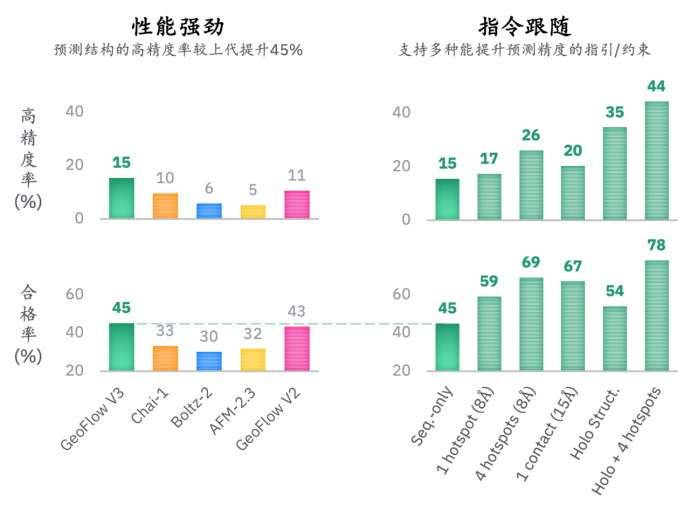
With more conditions provided, the prediction accuracy rate can soar compared to pure sequence input.1-2Times. This means that the model is able to more accurately grasp the antigen.-Antibody interactions lay a solid foundation for the design of high-quality binding antibodies.
Combined Discrimination is More Reliable
To identify truly promising candidate molecules, a reliable"Scoring Mechanism"Crucial.
GeoFlow V3 With enhanced self-assessment and confidence judgment capabilities, it can more reliably distinguish between high-precision and low-precision structures, as well as differentiate complexes from non-complexes. This provides strong support for its autonomous judgment and improvement of molecular "weak points."
ipTM (interface predicted Template Modeling score) It is one of the most accurate and robust confidence metrics. It is specifically used to measure the predicted antibody.-Accuracy of the antigen-complex interface.
ipTM > 0.8 When, its corresponding structure is "high quality" (DockQ > 0.8) The accuracy rate exceeds80%. This means a highipTMThe prediction is highly likely to be the truly correct binding mode.
On multiple challenging targets, compared with existing mainstream models,GeoFlow-V3TheipTMScore inIn most cases, it has been achieved.Reached the highestAUROCValue, demonstrating a leading level.
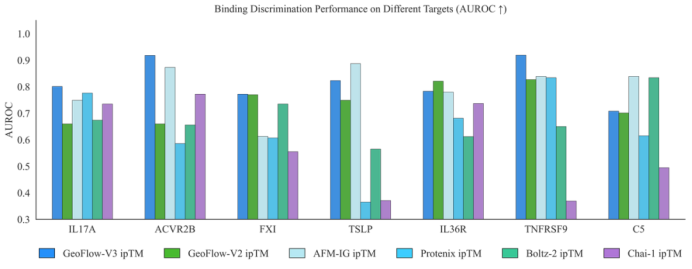
This indicates that,GeoFlow V3Providing precise guidance for subsequent optimization design through its reliable self-assessment mechanism, thereby significantly improving the efficiency of antibody development.
Multi-step Reasoning and Extended Thinking
GeoFlow V3 Introduced for the first time the multi-step reasoning capability, enabling the model to continuously mimic the affinity maturation process of antibodies in nature, guided by its own confidence scoring."Evolution"Molecules with higher binding potential.
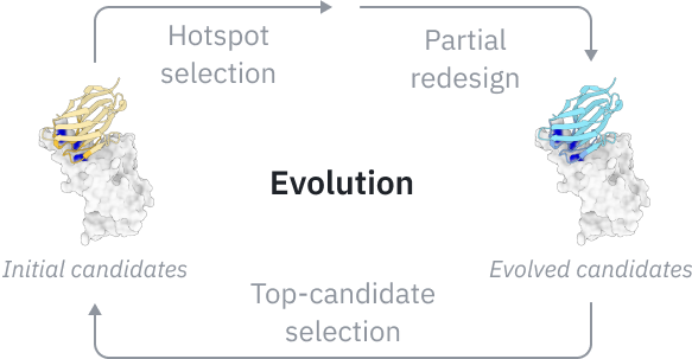
The specific process is:First, generate a batch of initial candidate antibodies,Using diffusion models to redesign its local sequence and structure, and then throughipTMetc.Score ScreeningThe Starting Molecule for the Next Round of Evolution。
This multi-round iterative process enables the model to go beyond the limitations of single-generation outputs, allowing for in-depth exploration and continuous improvement.
Computer experiments on multiple targets show that the introduction"Virtual evolution" capability, after deep thinking,GeoFlow V3 Generate Candidate MoleculesipTMThe score increased significantly, achieving the goal of using longer thinking to achieve a higher binding rate and reduce the burden of wet experiments.
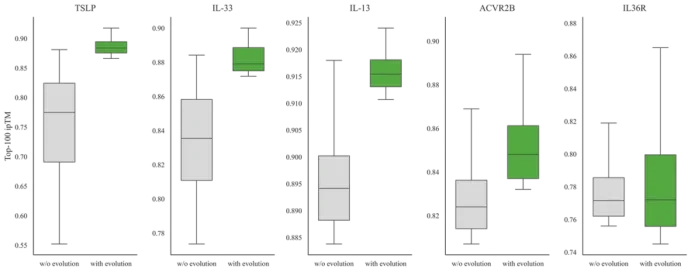
Thanks toStructure Prediction-Protein DesignUnified model architecture, the entire antibody"Generation-Evaluation-Can be used in the process of "evolution"GeoFlow V3 Independently Completed, without switching to other tools。
GeoFlow V3 As a result, it has been upgraded from a "structural design model" to a designer of "epitope-directing antibodies," capable of autonomously planning pathways, significantly enhancing its practical application value in the real world.

Fewer Experiments, Higher Success Rate
GeoFlow V3Revolutionize Antibody Development!
Self1986Since the first therapeutic antibody entered clinical trials in [Year], this field has profoundly reshaped the biopharmaceutical landscape.
2024Among the top ten global best-selling drugs in terms of annual sales, antibody drugs account for5Seat, which shows its critical significance to the pharmaceutical industry.
However, this seemingly mature field is facing deep challenges: the humanization and affinity optimization of antibody drugs are complex and full of uncertainties.——From project initiation to market entry, the average time required is10—15Years and billions of dollars invested.
Traditional R&D such as ""Looking for a needle in the ocean", needs to be in animals/In Vitro ConstructionHundreds of millionsMolecular library and developmentMonths to yearsHigh-throughput screening is characterized by lengthy processes, high costs, and limited target and molecular space exploration.
Previous GenerationAILimited by model performance and approach, it still "reliesGeneration - ScreeningThe linear process still requires a large number of experiments.The actual binding rate is often less than a single-digit percentage, or even lower.
In order to verify the model's effectiveness,GeoFlow V3De novo antibody design was performed on five therapeutic targets, includingTSLP、IL-33、IL-13、CCR8AndPD-1, these targets span multiple fields including inflammation, cancer, and more.
GeoFlow V3According to5Target points have been8An independent nanobody design activity,And fromAIThe design and wet lab validation can be completed in three weeks.
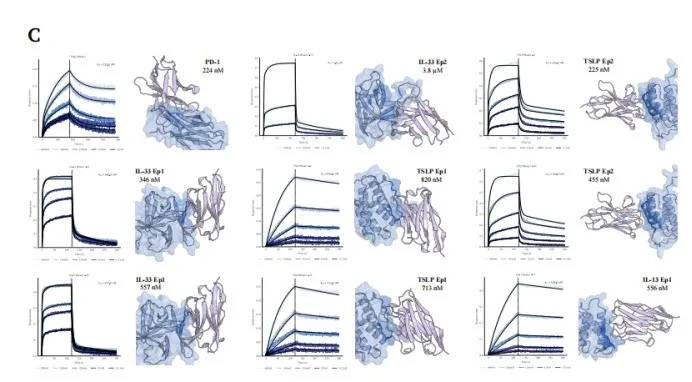
Fig: Testing only dozens of sequences designed by GeoFlow V3 can identify nM-level binder molecules.
The results showed that this8The average hit rate for each target reaches at least15.5%, compared to the previous generationAIMethod improves nearly a hundredfold!
And each therapeutic target is designedNo more than50IndividualNanobodies significantly reduce time and cost.
In other words,GeoFlow V3Truly achieved:Achieve more effective molecular output with shorter design cycles; achieve more true hits with fewer experimental inputs.

AIBottom-up Breakthrough
Accelerate Innovation in Biopharmaceuticals and Biomanufacturing
It can be said that,GeoFlow V3 marks the entry of protein design into a new intelligent phase.
It can systematically deduce the complex relationship between molecular structure and function in virtual space, and explore design spaces that are difficult to reach with traditional experiments, to achieve"Design Freedom" Opens Up New Pathways.
This breakthrough fundamentally overturns the traditional R&D paradigm, injecting strong innovative momentum into biomedicine and biomanufacturing.
For a long time, drug development has relied on resource accumulation and experience-based screening, facing the dilemma of long cycles and high costs.
Today, researchers can rationally explore through model inference and autonomous virtual optimization, bringing biopharmaceutical innovations, including antibody development, into a new era."The 'Intelligence-Driven' paradigm is expected to break the 'Double Ten Rule'."
In terms of R&D efficiency,GeoFlow V3 Shorten the discovery cycle of lead molecules from several months or even years to within three weeks;
In epitope selection,It breaks through the limitations of traditional immunization and library construction methods, overcoming what was once considered"Undruggable" complex targets.
For innovative pharmaceutical companies and research institutions,GeoFlow V3This means they can rapidly generate usable candidate molecules with extremely low experimental volumes, allowing resources to be utilized more efficiently and reshaping the value system of innovative drug development.
Not limited to biopharmaceuticals, generativeAIThe deeper impact of the protein platform lies in reshaping the entire value chain of the bioeconomy.
As Bio-manufacturing is Selected"The 15th Five-Year Plan" for Future Industries, which China regards as a key strategy to reshape the manufacturing landscape, has brought historic development opportunities for biomanufacturing.
Biomanufacturing will become one of the dominant forces in the future global economy, and it is expected that by the end of this century, it will reach up to30Trillion US dollarsThe market scale, energy, materials, healthcare, and environmental industries are welcoming a systemic industrial revolution.
The development blueprint has been proposed, but to turn the vision into reality, it is necessary to recognize the current obstacles in biomanufacturing.
The core challenge lies in:How to Precisely Design Life Systems, including chassis strains and highly efficient enzyme preparations.
Traditional bioresearch and development is inefficient, often requiring thousands of experiments to screen out an effective one.Protein, which makes it difficult to support the innovation demands of a trillion-dollar industry scale.
And generativeAIIt is precisely the key to breaking the deadlock:Directly design novel biomolecules, opening up unprecedented development opportunities for the industry.
Against this backdrop, represented by BioGeometryAI-NativeBiotechnology companies are becoming a key force in industrial development with their underlying innovations.
After years of technical沉淀, BioGeometry remains in the international first tier in terms of model capabilities and has developed applications for the entire biomanufacturing field.General Protein Design Engine。
Not only that, but BioGeometry has also built a complete dry-wet experimental platform capable of self-iteration, covering the entire process from automated construction, expression, purification, to functional verification.
With Novozan BioIVDIn the project of reagent tool enzyme modification,BioGeometry Only60Day, Through3Round "Design-Verification-The "re-design" dry-wet iteration successfully increased the product yield of industrial-grade enzymes to that of the wild type.21Times, setting an industry record.
Today, BioGeometry's universal protein design platform has been widely used in scenarios such as antibody drug development, industrial enzyme design, non-natural amino acid synthesis, and functional protein design, serving a wide range of industries from pharmaceuticals to agriculture, chemicals, and materials.
In Conclusion
Currently, we are at a historic turning point.
GenerativeAIForging a brand-new technological foundation for the entire bioeconomy, endowing humanity with the ability to "design life from scratch and autonomously evolve it."Molecule"The ability."
GeoFlow V3The advent ofAI for Life ScienceThe latest breakthrough, which introduces multi-step reasoning into protein design for the first time, makes the model more accurate, reliable, and intelligent.
And behind this, BioGeometry has conveyed a key signal this time:It not only achieves breakthroughs in underlying technology but also takes the lead in打通从理论模型、核心算法到产业交付的全链路.
There is no doubt that in the new wave of life science innovation, leading companies represented by BioGeometry are writing a global chapter for China's innovation.
—END—