

TIDES Weekly Recap | Global Peptide and Oligonucleotide Drug News (Oct 24–30, 2025)
CSPC
Innovative Drug Research and Development, Manufacturer
Ribo Life Science
Small Nucleic Acid Drug Developer
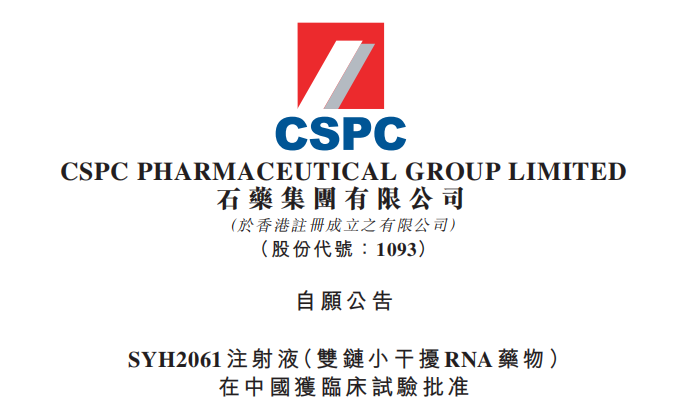
2025October 24th,CSPC (1093.HK) announced that SYH2061 Injection (a double-stranded small interfering RNA (siRNA) drug), a self-developed Class 1 chemical new drug of the Group (hereinafter referred to as "the product"), has been approved by the National Medical Products Administration of the People's Republic of China for use inClinical Trials Conducted in China.
This product is a conjugated N-acetylgalactosamine(GalNAc)Achieving Liver-Targeted DeliverysiRNADrug,Subcutaneous administrationDrug Targeting Complement ProteinsC5(hereinafter referred to as:C5),Can effectively reduceC5Level. By optimizing sequences and chemical modification strategies,This product can achieve longer-lasting gene silencing effects and is the first ultra-long-acting drug independently developed in China to enter clinical trials.ReduceC5HorizontalsiRNAMedicine, applicable for treatmentIgAKidney diseases and other complement-mediated related conditions.
Preclinical studies have shown that this product is superior to similar siRNA products in terms of drug activity and duration of efficacy, demonstrating the differentiated advantages of long-lasting drug effects, good safety, and high patient compliance, and has high clinical development value.
About CSPC
CSPC PHARMACEUTICAL GROUP LIMITED was established in 1997. Through innovative participation worldwide, CSPC continuously provides better innovative achievements for human health.。
2025October 24thSuzhou Ribo Life Science Co., Ltd. ("Ribo Life Science") and its subsidiary Ribocure Pharmaceuticals AB ("Ribocure") jointly announced that the European Medicines Agency (EMA) has granted Orphan Drug Designation (ODD) to their small interfering RNA (siRNA) candidate drug RBD1016 for the treatment of Hepatitis Delta Virus (HDV).Infection.
RiboGalSTAR independently developed by Ribo Life ScienceTMThe safety, efficacy, and long-acting properties of the liver-targeted delivery platform have been validated through multiple clinical studies, including RBD1016 for the treatment of HDV indications, which is currently advancing in global Phase II clinical trials for both hepatitis B and hepatitis D.
AboutRibocure
Ribocure, a holding subsidiary of Ribo Life Science, is located in Mölndal, Gothenburg, Sweden. As Ribo Life Science's global base for clinical development and business growth, Ribocure features a professional team with international perspectives and expertise in global clinical development. It is equipped with clinical trial sites and laboratories, leading and driving the clinical trials and business development of innovative small nucleic acid drugs worldwide.
AboutRibo Life Science
Ribo Life Science is a global leader specializing in the research and development of small nucleic acid (siRNA) drugs. Ribo Life Science aligns with the innovative frontier of international small nucleic acid technology, committing to the iterative research and development of small nucleic acid chemical modifications and drug delivery technologies. It has established an independent and controllable small nucleic acid drug R&D platform that integrates the entire technical chain, supporting various stages of research for small nucleic acid drugs from early development to industrialization.
On October 26, 2025, Novartis announced that it had reached a definitive acquisition agreement with Avidity Biosciences, a biopharmaceutical company based in San Diego, USA. Avidity focuses on developing novel therapies that deliver RNA treatments to muscle tissue. This acquisition will take place after Avidity spins off its early precision cardiology programs.
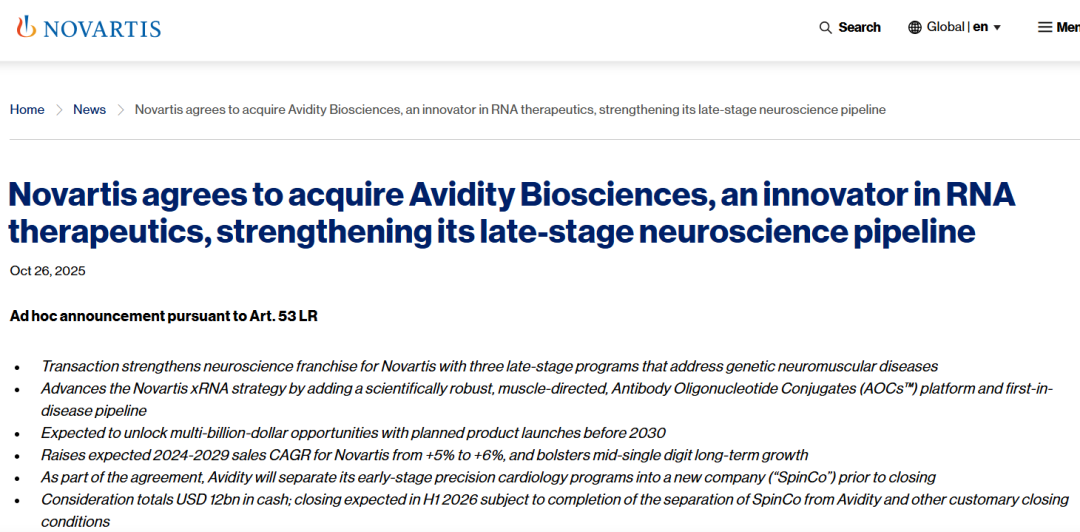
Avidity Biosciences is dedicated to developing Antibody Oligonucleotide Conjugates (AOCs™) for the treatment of serious diseases, with an initial focus on rare inherited neuromuscular disorders such as DM1, FSHD, and DMD. Avidity's proprietary platformAiming to achieve targeted delivery of RNA therapeutics to muscle tissue via TfR1 monoclonal antibodies, thereby modulating pathogenic genetic mechanisms. This acquisition will enable Novartis to obtain Avidity's muscle-targeting AOC technology platform, as well as three late-stage potential first-in-class therapies for hereditary neuromuscular diseases, further strengthening Novartis' leading position in the field of neuroscience.
According to the terms of the agreement unanimously approved by both boards, Novartis will merge with Avidity through a newly established indirect wholly-owned subsidiary, acquiring all issued shares of Avidity. Under the terms of the merger agreement, Avidity common shareholders will receive a cash consideration of $72.00 per share upon completion of the transaction, representing a 46% premium over the closing price on October 24, 2025. The total equity value is approximately $12 billion, with a fully diluted valuation of about $12 billion, and an expected enterprise value of approximately $11 billion at the time of transaction close.
Prior to the completion of the merger, Avidity will transfer its early precision cardiology programs and related collaborations to its wholly-owned subsidiary, SpinCo. Shareholders of Avidity common stock will (1) receive 1 share of SpinCo stock for every 10 shares of Avidity stock held, and/or (2) if certain SpinCo assets or SpinCo itself are sold to a third party before the merger is completed, Avidity shareholders will receive a pro rata distribution of the cash proceeds.
Novartis' acquisition of Avidity is subject to the completion of the SpinCo divestiture or other forms of separation, as well as other customary closing conditions, including obtaining regulatory approvals and the approval of Avidity's shareholders. Both parties expect the transaction to be completed in the first half of 2026.
October 27, 2025, San Francisco, USA, and Suzhou, China — Innovent Biologics, Inc. (HKEX stock code: 01801), a biopharmaceutical company dedicated to the research, development, production, and commercialization of innovative drugs in major disease areas such as oncology, autoimmune diseases, metabolic disorders, cardiovascular diseases, and ophthalmology, announced today that the fourth Phase III clinical trial (DREAMS-3) of its glucagon (GCG)/glucagon-like peptide-1 (GLP-1) dual receptor agonist, mazdutide (R&D code: IBI362), has achieved its primary endpoint. The study results demonstrated that, in Chinese subjects with type 2 diabetes and obesity, at week 32, the proportion of subjects in the mazdutide group achieving HbA1c <7.0% and ≥10% weight loss from baseline was 48.0%, superior to the semaglutide group (21.0%, P-value <0.0001). Additionally, at week 32, the mean changes in HbA1c from baseline in the mazdutide group and semaglutide group were −2.03% and −1.84%, respectively, and the mean percentage reductions in body weight from baseline were 10.29% and 6.00%, respectively (both P-values <0.05). The overall safety profile of mazdutide during the study was consistent with previous clinical trials, with no new safety signals identified. Gastrointestinal adverse reactions were the most common adverse events, mostly mild or moderate. The clinical study data is planned for presentation at future academic conferences or publication in journals.
Mashiduotide (IBI362) is a glucagon (GCG)/glucagon-like peptide-1 (GLP-1) dual receptor agonist jointly advanced by Innovent Biologics and Eli Lilly. As an analog of mammalian oxyntomodulin (OXM), Mashiduotide not only promotes insulin secretion, lowers blood glucose, and reduces weight by activating GLP-1R but also enhances weight loss efficacy by increasing energy expenditure through GCGR activation while improving hepatic fat metabolism. Mashiduotide has demonstrated excellent weight loss and glucose-lowering effects in multiple clinical studies, as well as reductions in waist circumference, blood lipids, blood pressure, serum uric acid, liver enzymes, and liver fat content, along with improved insulin sensitivity, bringing multiple metabolic benefits.
On October 27, 2025, Ascletis Pharma Inc. (HKEX code: 1672, referred to as "Ascletis") announced that it will attend the ObesityWeek 2025 held in Atlanta, Georgia, USA.yWeek®) reported multiple obesity candidate drugs in poster format, including ASC30 as well as the combination therapy of ASC31 and ASC47.
ASC30 is a small molecule GLP-1R biased agonist currently under clinical investigation, possessing unique and differentiated properties that make it possible for the same small molecule to be suitable for both oral tablets and subcutaneous injection. ASC30 is a new chemical entity (NCE) with U.S. and global compound patent protection, ensuring exclusivity until 2044 (excluding any patent term extensions).
ASC31 is a novel GLP-1R and GIPR dual-target agonist peptide independently developed by Ascletis. It has demonstrated favorable pharmacokinetic characteristics in non-human primates, along with positive in vitro activity and promising in vivo efficacy in diet-induced obese mice. ASC31 represents part of the achievements of Ascletis' proprietary Ultra-Long-Acting Platform (ULAP) for the development of novel subcutaneous injectable peptides and oral peptides.。
ASC47 is a fat-targeted, once-monthly subcutaneous injectable Thyroid Hormone Receptor β (THRβ) selective small molecule agonist independently developed by Ascletis. ASC47 has unique differentiation characteristics, enabling it to target fat, thereby producing dose-dependent high drug concentrations in adipose tissue.
AboutAscletis Pharma
Ascletis Pharma Inc. is a fully integrated biotechnology company focused on the development and commercialization of best-in-class and first-in-class drugs for the treatment of metabolic diseases.
On October 28, 2025, GlaxoSmithKline plc (LSE/NYSE:GSK) and clinical-stage biotechnology company Empirico announced a global exclusive license agreement for EMP-012, a highly selective, first-in-class and potentially best-in-class siRNA, a type of oligonucleotide. EMP-012 targets a novel therapeutic target and is currently in Phase I trials for the treatment of chronic obstructive pulmonary disease (COPD), with potential expansion into other inflammatory respiratory diseases. GSK will pay an upfront payment of $85 million, up to $660 million in success-based development, regulatory, and commercial milestones, as well as tiered royalties on global net sales.
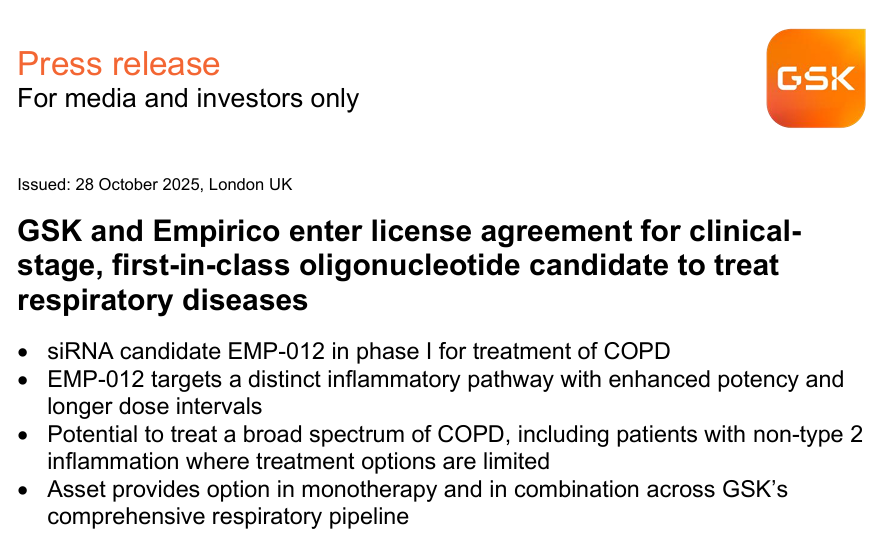
This agreement grantsGSK ObtainsEMP-012 has global rights to all development and commercialization. Empirico will continue to lead the clinical development of EMP-012 until the completion of the ongoing Phase I clinical trial.GSK will be responsible for global development, regulatory filings, and commercialization thereafter.
Empirico's newly discovered mechanism of action for EMP-012 targets a unique inflammatory pathway, offering potential for a treatment approach unrelated to baseline type 2 inflammation, smoking, or comorbidities. The target is supported by extensive genetic data and translational insights, instilling confidence in its potential. Based on this mechanism, EMP-012 can provide clinical benefits to patients with non-type 2 inflammation, a critical patient subgroup with limited treatment options. EMP-012’s enhanced activity and longer dosing intervals, enabled by Empirico’s proprietary siRNA chemistry, strategically complement GSK’s ongoing programs in chronic obstructive pulmonary disease (COPD), including long-acting biologics. In addition to its potential as a monotherapy, EMP-012 further expands GSK’s options for combinations within its COPD portfolio and pipeline.
EMP-012 is a highly selective, first-in-class siRNA with the potential to become the best-in-class siRNA and is an oligonucleotide. EMP-012 targets a completely new therapeutic target and is currently in Phase I clinical trials for the treatment of chronic obstructive pulmonary disease (COPD), with the potential to expand to other inflammatory respiratory diseases.
On October 30, 2025, Ascletis Pharma Inc. (HKEX code: 1672, "Ascletis") announced that it has selected ASC36, a potentially best-in-class once-monthly subcutaneous injectable amylin receptor agonist, as a clinical development candidate. Ascletis expects to submit an Investigational New Drug (IND) application to the U.S. Food and Drug Administration (FDA) for ASC36 in treating obesity in the second quarter of 2026.
ASC36 is a amylin receptor agonist peptide independently developed by Ascletis using its Artificial Intelligence-Assisted Structure-Based Drug Discovery (AISBDD) and Ultra-Long-Acting Platform (ULAP) technologies.The optimized design of ASC36 achieves a longer apparent half-life (measured as the time required for the blood concentration to decrease to 50% of Cmax) and higher bioavailability per milligram of peptide, thereby supporting once-monthly subcutaneous administration with an injection volume not exceeding 1 milliliter. These optimized design features provide scalability advantages in manufacturing, resulting in lower production costs.
ASC36 has superior physicochemical stability, does not form fibrillation around neutral pH, and can be developed into compound formulations with other peptide drugs, including the GLP-1R/GIPR dual-target agonist ASC35.
ASC36 has a longer apparent half-life, higher subcutaneous bioavailability, and superior weight loss effects, indicating its potential to become a best-in-class, once-monthly therapy for obesity.
AboutAscletis Pharma
Ascletis Pharma Inc. is a fully integrated biotechnology company focused on the development and commercialization of potentially best-in-class and first-in-class drugs for the treatment of metabolic diseases.
On October 30, 2025, Eli Lilly released its Q3 2025 performance, with third-quarter revenue reaching $17.601 billion, a year-on-year increase of 54%. Considering the performance of the first two quarters comprehensively,Lilly's total revenue in the first nine months of this year was $45.887 billion (+46%).
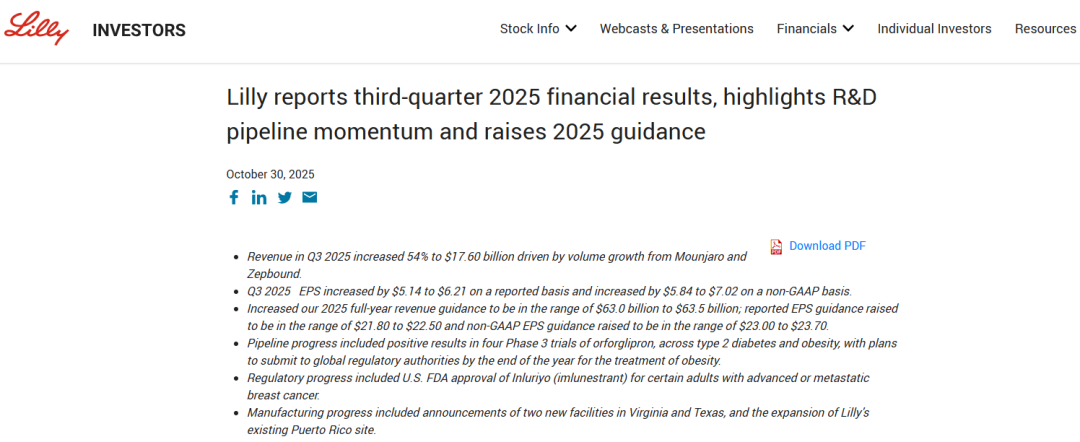
In terms of regional distribution, the U.S. market revenue reached $30.604 billion (+43%) in the first nine months of 2025, the European market revenue was $8.461 billion (+89%), the Japanese market revenue was $1.478 billion (+18%), the Chinese market revenue was $1.477 billion (+20%), and revenue from other markets was $3.867 billion (+21%).
In terms of therapeutic areas, the four major segments of Eli Lilly — cardiometabolic health, oncology, immunology, and neuroscience — generated revenues of $33.729 billion and $6.769 billion, respectively.Billion US dollars,37.06Billion USD, 9.32Billion US dollars。
Tirzepatide (Mounjaro andZepbound)and abemaciclib (Verzenio) is the main driver of revenue growth for Eli Lilly's pharmaceutical business, generating revenues of $24.837 billion (+125%) and $4.118 billion in the first three quarters, respectively.Billion USD (+10%). It is worth mentioning that,Lilly GLP-1 Products andNovo Nordisk GLP-1 ProductThe gap in prescription volume share in the U.S. market further widened in Q3 (57.9% vs 41.7%).
In terms of R&D progress, Eli Lilly has had a fruitful first nine months. Not only did the small molecule GLP-1R agonist Orforglipron successfully complete six Phase III studies (including three Q3 newly concluded studies), but the Phase III study of Tirzepatide (Mounjaro) for children and adolescents with type 2 diabetes also met its primary endpoint. In the fourth quarter, there are still significant developments worth noting in this field: Orforglipron is about to submit its marketing application, and the first Phase III study of Retatrutide, a GLP-1R/GIPR/GCGR agonist for knee osteoarthritis pain, will also be completed. Additionally, in Q3, Eli Lilly terminated two clinical programs: a Phase II study of a P2X7 inhibitor for pain treatment and a Phase III study of Abemaciclib for sequential metastatic breast cancer treatment.