Byterna Therapeutics Unveils a Universal Scarless Circular RNA Platform Based on Endogenous Stem-Loop Structures

Byterna therapeutics
CAR-T Cell Therapy Researcher
 Recently,Byterna Therapeutics(Byterna Therapeutics)Byterna Therapeutics Announces Completion of Angel Financing Round Worth Tens of Millions of RMB; Funds to Be Used for Preclinical Development and IIT Clinical Research of Circular mRNA-Based CAR-T Pipeline In Vivo. Byterna Therapeutics, a very new circular RNA company founded in 2023, had previously received little attention from the industry. Earlier this year, while searching for patent literature on cyclization technology, we unexpectedly discovered this innovative startup in China with a unique approach to cyclization technology. Recently, we plan to...A Series Report on Byterna Therapeutics' Circularization StrategyThis issue will first provide an overall overview of the cyclization strategy based on stem-loop structures developed by Byterna Therapeutics. Subsequent issues will delve deeper into sequence design. Interested friends can continue to follow.
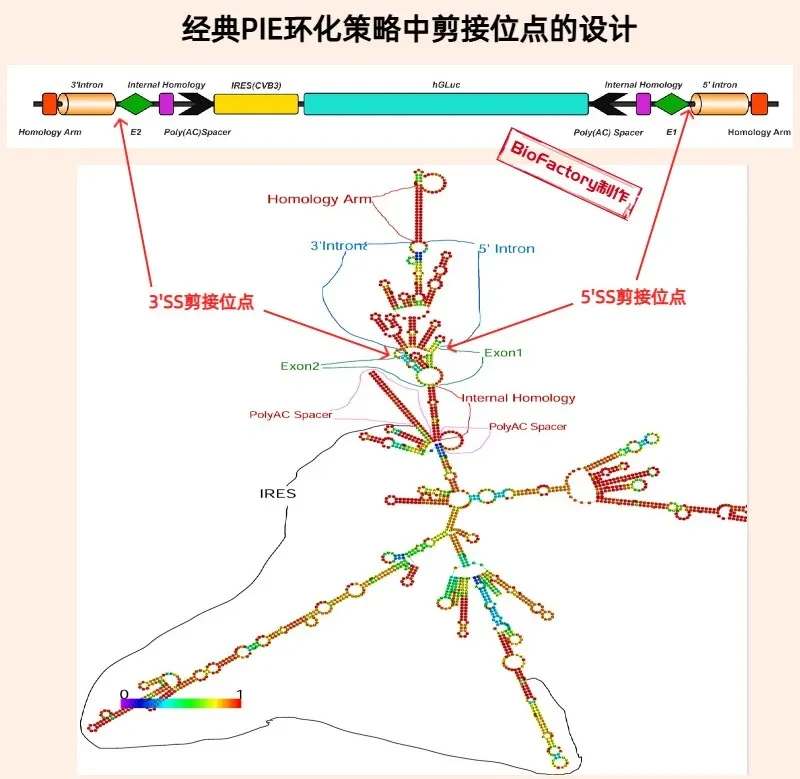
Regarding the article on circular RNA cyclization strategies, we have shared a lot before, so here we will not explain the principle of PIE in too much detail. InClassic Ana-PIE Circular RNA Precursor DesignIn, usually, the splice site(3'SS or 5'SS)Design at the 5' end and 3' end of the target sequence for cyclization. However, doing so hasA major drawback is the presence of additional sequences in the circularized circRNA sequence.:E2/E1+Internal Homology +PolyAC Spacer may trigger innate immune responses. If Internal Homology +PolyAC Spacer is removed, the classic Ana-PIE circular RNA precursorThe cyclization efficiency would become extremely low.
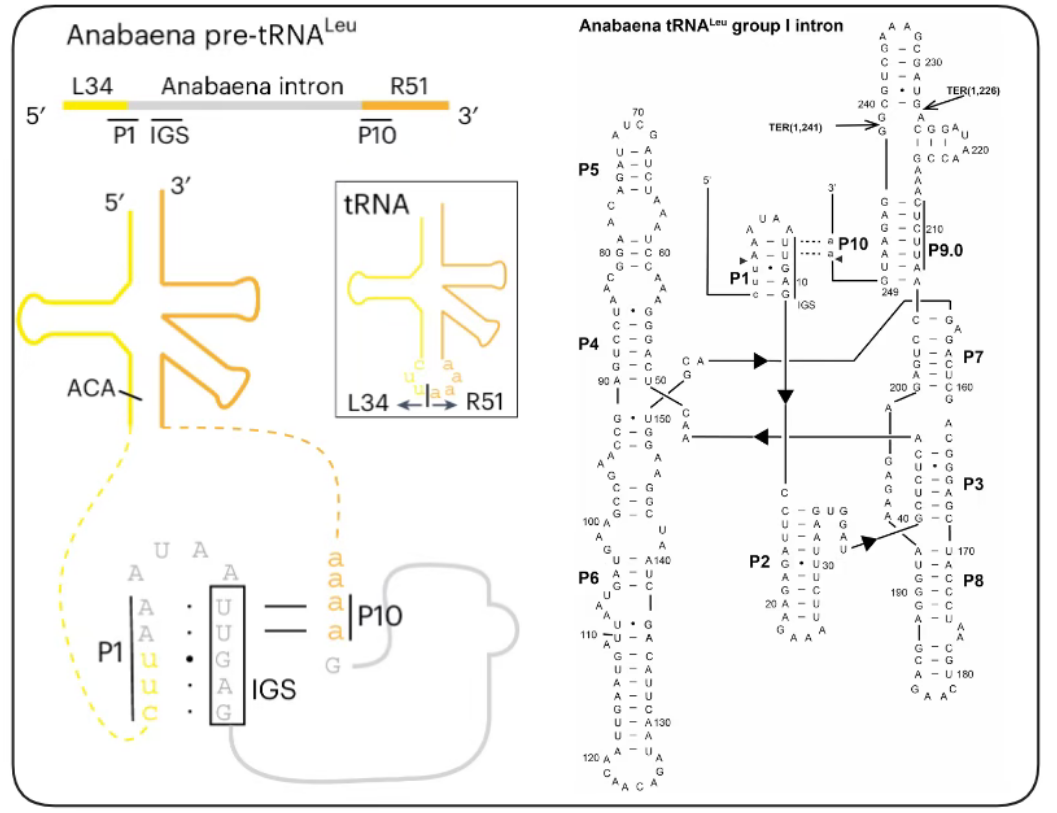
Byterna Therapeutics' research and development team focused on the secondary structure of Ana-tRNA-Leu, which, like all tRNA, features a typical cloverleaf structure with three stem-loop formations. Within the gene sequence encoding Ana-pre-tRNA-Leu, there exists a type I intron sequence with self-splicing functionality.(249bp)Interestingly, the self-splicing site of AnaⅠ intron sequence is located in the anticodon loop.(Between base 34 and 35). According to our speculation, it was precisely inspired by this that the research and development team of Byterna Therapeutics came up with a new idea regarding the cyclization strategy:Based on the secondary structure of the RNA sequence to be cyclized, can the target RNA sequence be successfully cyclized by identifying similar cloverleaf structural elements, placing the ribozyme splicing site within their stem-loop structures, and then combining them with the Ana-PIE ribozyme 3'/5' intron to form a circular RNA precursor?Fortunately, they succeeded in developing a universal traceless cyclization strategy based on the internal secondary structure of the RNA sequence to be cyclized.
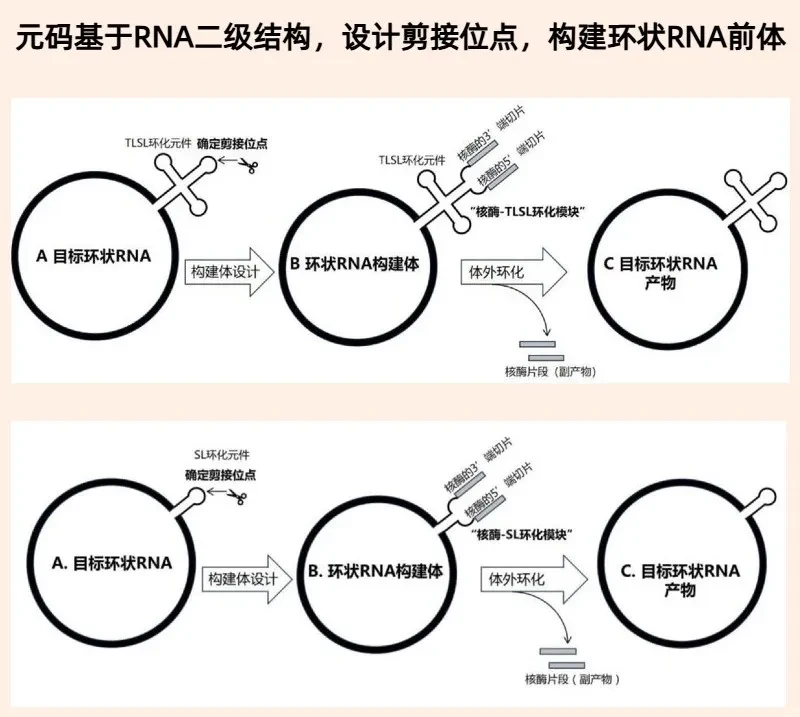
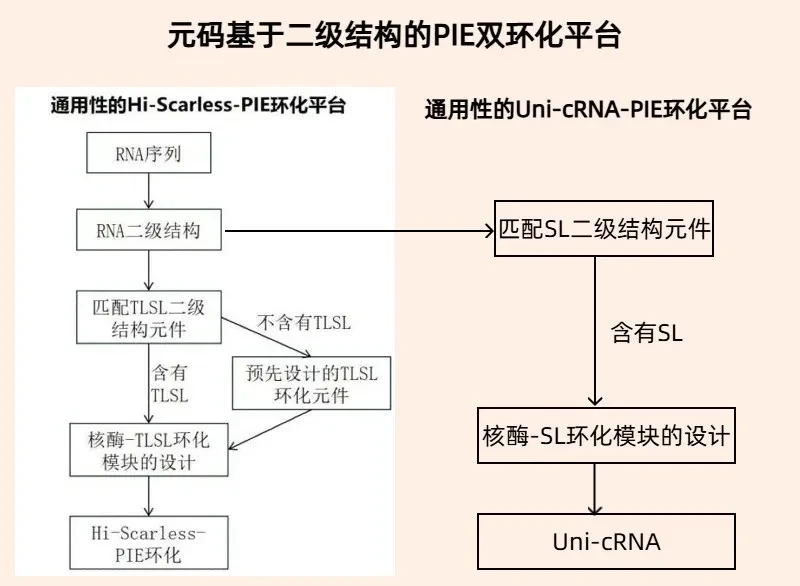
From the 5' end to the 3' end, the circular RNA precursor developed by Byterna Therapeutics can be sequentially divided into three major modules: Module Z1, Cyclization Module L, and Module Z2.Module Z1 is Homology Arm + Classic Ana-3' Intron Slice, Module Z2 is Classic Ana-5' Intron Slice + Homology ArmModule Z1 and module Z2 combine to form a ribozyme with self-splicing function. Compared with the classical Ana-PIE cyclization strategy, in the precursor RNA sequence of Byterna Therapeutics, the breaking positions of the type I intron sequence of Ana pre-tRNA-Leu gene into 5' Intron slice and 3' Intron slice are the same.The cyclization module L cyclizes to form circular RNA, with the splice site located within the stem-loop structure of the secondary structure of the cyclized RNA.(stem-loop structure)The terminal ring region(distal loop region). This stem-loop structure can be divided into two types, one of which is a multi-stem loop structure similar to the cloverleaf structure, calledTLSL Structural Elements, with 2-5 terminal loop regions; the other is a single stem-loop structure, referred to asSL Structural Elements, composed of the stem region and the terminal loop region distal to the stem.To form a stable P1 structure, it is necessary to modify the intron of the Ana pre-tRNA-Leu gene at the 10th and 11th positions of the 5' end.A mutation occurs, making it complementary to the 3' terminal base of the RNA to be cyclized.Byterna Therapeutics will develop a PIE cyclization system based on the endogenous multi-stem-loop secondary structure TLSL, called Hi-scarless-PIE; and a PIE cyclization system based on the endogenous single-stem-loop secondary structure SL, called Uni-cRNA.
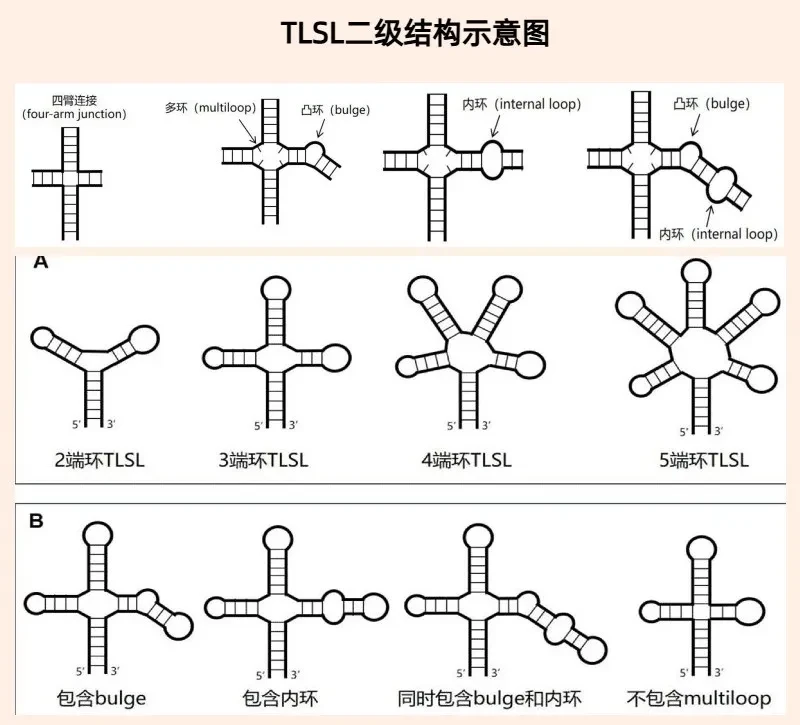
Byterna Therapeutics' Circularization StrategyThe key lies in finding the appropriate TLSL structural module or SL structural module in the secondary structure of the RNA sequence to be cyclized.。The TLSL structural module consists of a multi-arm connector.(multi-arm junction)And multiple end rings(distal loop)Connected Composition, wherein one arm of the multi-arm connector is a terminal arm, and the terminal arm is not connected to an end ring. Each of the remaining arms is respectively connected to an end ring to form a closed connection, resulting in a multi-end ring continuous structure with exposed 5' and 3' ends only on the terminal arm. Additionally, the arms of the multi-arm connector may contain bulged rings.(bluge)And Inner Ring(internal loop), The junction of multi-arm connections may contain multiple rings.(multiloop)。SL structural elements refer to the single stem-loop contained in the secondary structure of the target circular RNA molecule, which is formed by a stem region, also known as an arm, connected to a terminal loop., the stem region may contain a convex ring and/or an inner ring. The TLSL structural module or SL structural module can be located within the IRES sequence or within the CDS sequence. The TLSL structural module may naturally exist inside the IRES sequence.Exogenous pre-set TLSL structural modules can also be inserted.。
The advantages of Byterna Therapeutics' circularization strategy are twofold:
First,Universality, cyclization efficiency is not affected by the RNA sequence to be cyclized.The classical Ana-PIE cyclization strategy, while simple to operate, does not exhibit strong compatibility with the RNA sequences intended for cyclization. Some target RNA sequences show high cyclization efficiency, while others have very low efficiency. The core of the precursor circular RNA constructed using Byterna Therapeutics' cyclization strategy lies in placing the splice sites on the stem-loop structures of the secondary structure of the RNA sequence to be cyclized.Stem-loop structures are widely present in various types of RNA molecules.(IRES, CDS, UTR, non-coding RNA sequence)In China, especially the distribution of single-stem ring structures is wider.In theory, the Byterna circularization strategy can circularize any RNA sequence containing TLSL/SL structural modules. Even without the TLSL structural module, inserting a preset TLSL module into the IRES sequence can efficiently circularize any mRNA sequence.
Second,Scarless Circular RNACompared with the classical Ana-PIE circular RNA precursor, the Ana-PIE circular RNA precursor sequence designed based on the stem-loop structure does not contain a PolyAC Spacer or endogenous homologous arms. In the final product of circular RNA, no additional sequences are introduced; the linear RNA sequence to be cyclized is completely identical to the generated circular RNA sequence, eliminating the risk of triggering an innate immune response due to extraneous exogenous sequences.
Third,High cyclization efficiencyThe cyclization efficiency of Uni-cRNA based on a single stem-loop structure can reach approximately 80% or higher, while the cyclization efficiency of Hi-scareless-PIE based on multiple stem-loop structures is 90-95% or higher.
References
A General Method for Preparing Circular RNA and Its Uses, Application Publication Number 119662636 A.