Unlocking the Dual-Target siRNA Frontier: $1B Partnership and First Clinical Approval Mark a New Era in Oligonucleotide Therapeutics

Corsera Health
Developer of Cardiovascular Disease Prediction Tools and Preventive Medications

Mabwell
Innovative Biopharmaceutical Company

Frontier Biotechnologies
Innovative Biopharmaceutical Developer, Manufacturer, and Distributor

In recent years, dual-target small nucleic acid drugs have become one of the hottest fields in the global pharmaceutical industry due to their advantages such as synergistic effects and avoiding combination therapy. Despite the promising prospects of dual-target small nucleic acid drugs, their synthesis and production face multiple technical bottlenecks, which have become key obstacles in advancing pipelines.
The market is booming.
Dual-Target Small Nucleic Acids Lead a New Wave of R&D
Currently, multiple pharmaceutical companies worldwide are intensively focusing on the dual-target small nucleic acid drugs sector, advancing the clinical development of these drugs. Particularly, dual-target siRNA (small interfering RNA) drugs, with their breakthrough advantage of "simultaneously silencing multiple key disease-causing genes," have become a crucial solution to overcoming the limitations of single-target interventions.This trend has been fully confirmed in recent industry developments.:
On September 2, Corsera Health, founded by RNAi (RNA interference) pioneer John Maraganore,Announces Its Dual-Target siRNA Drug to Enter Clinical Trials by the End of 2025. This drug can simultaneously target PCSK9 and AGT, and is used to treat hyperlipidemia.
Following closely, on September 17Mabwell Successfully Expands Overseas with a Preclinical Dual-Target siRNA Pipeline through the "NewCo Model", reaching a potential total of up to 1 billion US dollars in collaboration with Kalexo.
At the same time, at the 18th International IgA Nephropathy Symposium,Frontage Bioscience Releases Preclinical Data for the First Time on a Dual-Target siRNA Drug with Global First-in-Class PotentialThe inhibition rate of the drug on the dual targets is as high as approximately 95%, and it is expected to achieve a breakthrough dosing cycle of once every 4-6 months.
On October 21,Shian Biotech's Self-Developed Dual-Target siRNA Drug SA1211 Officially Receives NMPA Clinical Trial Approval, becoming the first dual-target siRNA pipeline in the global chronic HBV (hepatitis B) treatment field to enter the clinical stage.
Behind the Heat:Breakthrough in Dual-Target siRNA Technology
With Dual Enhancement of Treatment Efficacy
The heat displayed in the above case is backed by the advantages brought by the unique drug design of dual-target siRNA. Traditional siRNA consists of complementary sense and antisense strands (Figure 1A), while dual-target siRNA uses a linker to splice two sets of siRNA together (Figure 1B), forming an independent unit. Among them, the antisense strand a and the antisense strand b can be designed to target different mRNA targets respectively, achieving dual-targeting.
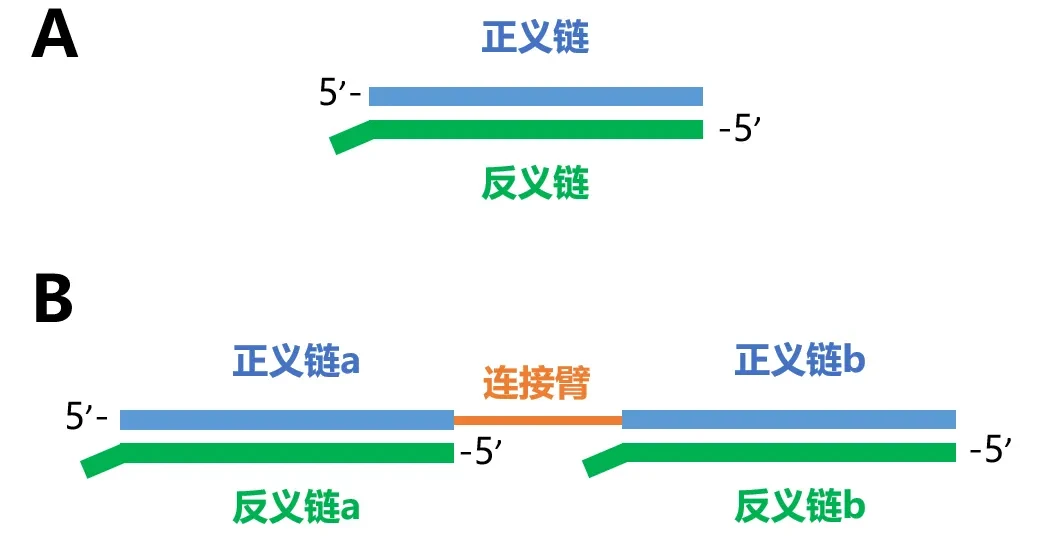
Figure 1Schematic diagram of the structure of traditional siRNA (A) and dual-target siRNA (B)
This dual-target design can bring the following treatment-related advantages.:
I.Synergistic Effect, Breaking Through Single-Target BottleneckMany diseases are not driven by a single factor. A dual-target design enables multi-pathway coordinated intervention in disease progression. Taking SA1211 from Shian Biotech as an example, this dual-target siRNA for HBV can simultaneously target the HBX gene (HBV X protein) and the PD-L1 gene (programmed death-ligand 1). These two targets can respectively inhibit HBX mRNA (messenger RNA) and PD-L1 mRNA, thereby blocking viral replication while "awakening" the immune system and reducing HBV immune escape.
2.Avoid combination therapy and reduce dose-related toxicityCompared with the combined use of two different siRNAs, dual-target siRNA requires a lower total dose, thus avoiding the toxicity associated with high doses and enhancing safety.
3.Controlled in vivo exposure, avoiding biphasic phenomenonFrom a PK (pharmacokinetic) perspective, the two siRNAs will have different absorption and clearance rates, resulting in a "double peak" in the blood concentration curves of the two drugs. However, as a single molecule, the dual-target siRNA will not exhibit this phenomenon, enabling synchronized silencing of both targets and achieving better therapeutic synergy.
Challenges under Opportunities:
The "High Threshold" of Dual-Target Small Nucleic Acid Synthesis and Production
While dual-target siRNA offers the aforementioned advantages, it also presents synthetic challenges, becoming a key obstacle hindering pipeline progress:
I.Double-Length Sense Strand。Since the sense strand of dual-target siRNA needs to complement two antisense strands, its length will reach approximately 40nt, doubling the length of the sense strand of traditional siRNA. Therefore, the number of coupling steps required for solid-phase synthesis will also increase, and the cumulative yield will significantly decrease.
2.Additional linker modificationUnlike traditional siRNA, the sense strand also requires linker modification. Taking TEG (tetraethylene glycol) linker as an example, if TEG phosphoramidite is used for synthesis, it will not only increase the number of coupling steps, but the steric hindrance it causes will further reduce the synthesis efficiency.
3.Mass ProductionCorsera Health recently announced its clinical program for a dual-target siRNA drug aimed at hyperlipidemia, marking the advancement of dual-target siRNA into the field of common metabolic diseases. This implies that dual-target siRNA will have broader user coverage and greater demand for scaled production in the future. Considering the aforementioned synthesis challenges, large-scale production of dual-target siRNA will become a significant challenge.
MegaVision Technology Dual-Platform Drive,
Cracking the Dual-Target siRNA Industrialization Challenge
As a globally renowned supplier of gene monomers, Zhaowei Technology has been deeply engaged in the nucleic acid field for nearly 30 years. While continuously enhancing our existing solid-phase synthesis platform, we have also taken the lead in providing a chemo-enzymatic synthesis platform, contributing to the industrialization of dual-target siRNA.
Solid-phase synthesis platformBased on its comprehensive advantages in the nucleic acid industry chain, Zhaowei Technology can implement complete quality control from upstream raw materials (such as phosphoramidites/GalNAc/NTP) to downstream purification and formulation, thereby providing high-quality, low-cost, and stable nucleic acid products. In addition, Zhaowei Technology's solid-phase synthesis platform is equipped with the largest-scale 1800 mmol synthesis instrument currently available in the industry, with GMP scale-up capabilities reaching kilogram-level.
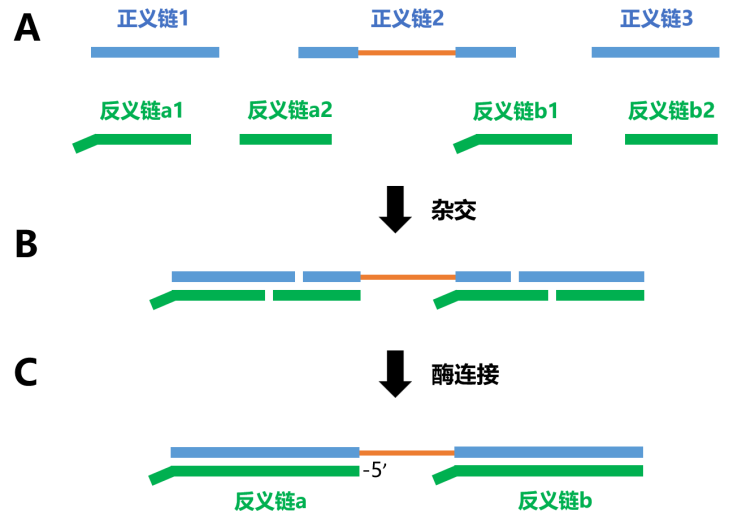
Figure 2Chemical-enzymatic ligation synthesis strategy for dual-target siRNA. (A) Shorter fragments obtained using solid-phase synthesis. (B) Hybridization of complementary fragments to generate enzymatic ligation sites. (C) Ligation of sites using ligase to form the complete dual-target siRNA.
Chemoenzymatic Synthesis Platform。Figure 2Showcases the latest chemo-enzymatic synthesis platform provided by Zhaowei Technology. This platform does not require the one-step synthesis of a complete long-chain sense strand; instead, it first uses solid-phase synthesis to obtain multiple short fragments (Figure 2A), thereby ensuring the synthesis quality and yield. Then, a ligase is used to ligate the fragments together to form a complete dual-target siRNA (Figure 2C). This synthetic strategy has the following characteristics:
I.Higher Yield。Due to the shortened length of solid-phase synthesis, the purity and yield of each short fragment can be guaranteed, especially for the sense strand 2 with linker modifications (Figure 2A). The reduction in coupling steps can also correspondingly lower reagent costs.
2.One-pot enzymatic ligationThe enzyme ligation reaction does not require step-by-step operations but instead converts each fragment into a complete double-stranded siRNA product through a one-pot method.
3.A Simpler Purification Solution. Typically, chromatographic purification is required after the synthesis of each short fragment (Figure 2A). Moreover, the chemo-enzymatic synthesis platform of Zhaowei Technology can adopt a purification scheme after enzymatic ligation, eliminating the purification step required after solid-phase synthesis, thereby reducing costs and improving yield.
Currently, the dual platforms of Zhaowei Technology have successfully assisted multiple projects in advancing to clinical stages, including助力时安生物全球首款单分子双靶siRNA药物获批临床, andDing Lexin: The World's First Enzymatic siRNA Drug Approved for Clinical Trials!
Conclusion
Dual-target small nucleic acid drugs are ushering in a new era of innovative treatment. As a leader深耕 small nucleic acid CDMO 领域,Zhaowei Technology Cracks the Core Challenges of Synthesis Efficiency, Large-Scale Production, and Purity Control with a "Chemoenzymatic + Solid-Phase" Dual-Platform Technology Matrix。
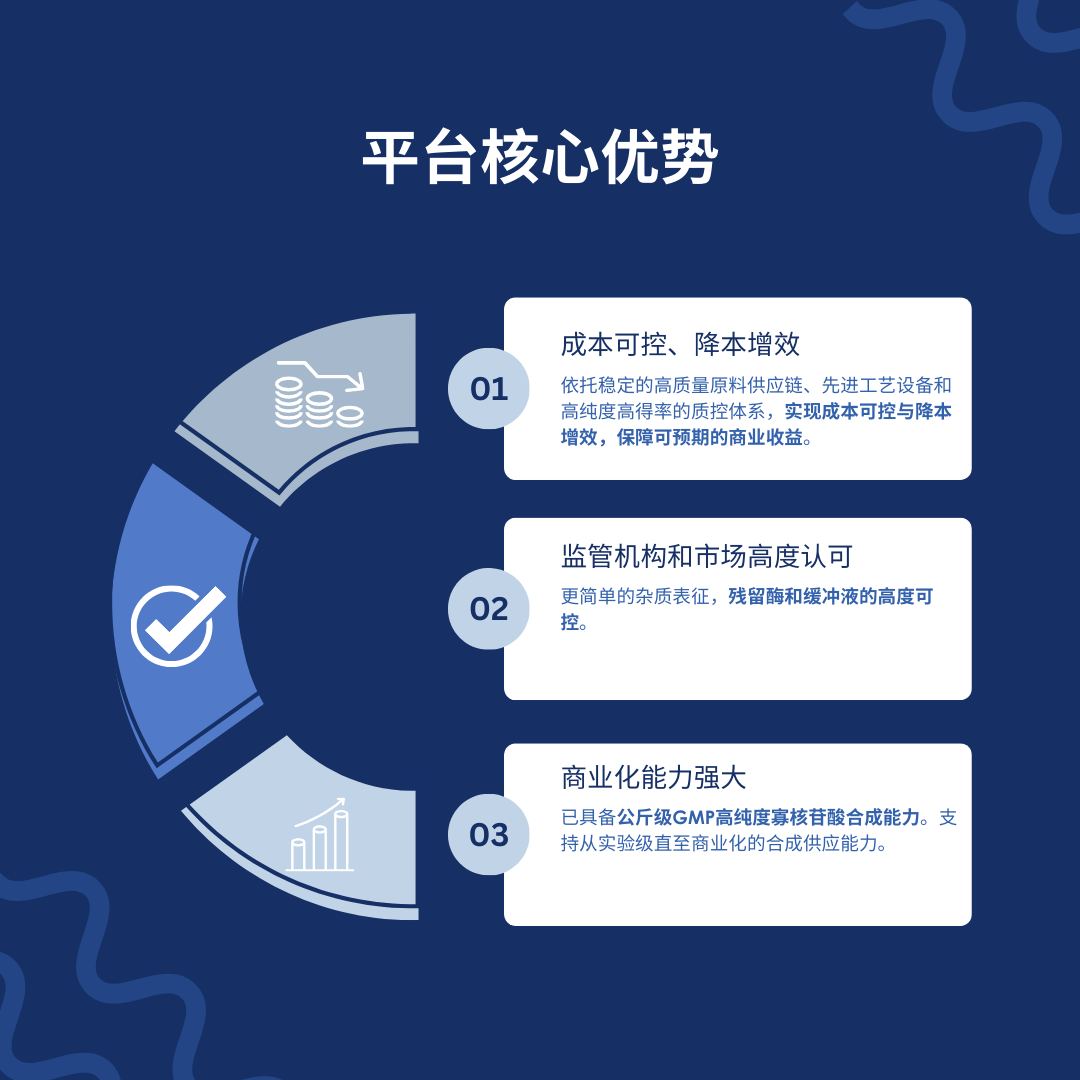
In the future, Zhaowei Technology will continue to iterate its technology platform to provide more efficient and reliable CDMO services, helping global innovative pharmaceutical companies accelerate the research and development of dual-target small nucleic acid drugs.Advance the commercialization process to bring more breakthrough therapies to patients sooner!
About Zhaowei Technology
Deeply engaged in the nucleic acid field for 27 years, Shanghai Zhaowei Technology Development Co., Ltd. is a professional nucleic acid CDMO and raw material supplier, committed to providing high-quality, high-value products and services.
The company has built a full industry chain platform for mRNA CDMO and small nucleic acid drug CDMO, providing customers with development and production services from preclinical to commercial stages. The company also has a phosphoramidite product line with an annual capacity of 58 tons, as well as raw material capacity supporting over 10.5 billion doses of mRNA vaccines.
The company not only owns a nucleic acid drug production base with an annual output of over one ton, capable of meeting production needs from pilot-scale to commercial market launch, but also independently developed technology platforms such as enzymatic ligation synthesis, providing more cost-effective and sustainably scalable manufacturing solutions for nucleic acid drugs.
The company has established long-term cooperative relationships with biotechnology and pharmaceutical companies around the world, supplying raw materials for numerous clinical-stage and commercialized nucleic acid pipelines, and successfully delivering multiple nucleic acid drug CDMO projects.For more information about Zhaowei Technology and its product services, please visit the official website.www.hongene.com And follow our official account“Shanghai Zhaowei Hongene”。