

Roche Bets $2.055 Billion on AI-Powered Brain Delivery Platform with Manifold Bio

Manifold Bio
Drug Testing Service Provider
Roche
Oncology Drug Research, Development, and Manufacturing
On November 3, Manifold Bio, an artificial intelligence (AI)-driven in vivo drug discovery platform company, announced a strategic research collaboration and licensing agreement with pharmaceutical giant Roche.This collaboration will focus on the treatment needs of neurological and neurodegenerative diseases, leveraging Manifold Bio's proprietary tissue-targeting shuttle module portfolio and its mDesign AI-driven in vivo discovery engine to jointly develop multiple next-generation blood-brain barrier (BBB) shuttles, addressing the technical challenges of drug delivery to the brain.
According to the agreement, Roche will pay Manifold Bio an upfront payment of $55 million. If the collaboration achieves milestones across the entire process including research, discovery, preclinical, clinical, and sales stages, Manifold Bio could receive milestone payments totaling over $2 billion, along with tiered royalties. Additionally, Manifold Bio retains two key rights: one is the option to co-fund the development of a specific project in exchange for a higher percentage of royalties; the other is that its BBB shuttle module technology can be applied to therapeutic payloads beyond Roche-licensed targets, reserving space for subsequent multi-scenario commercialization of the technology.
Manifold Bio: Reconstructing Drug Delivery with "AI + In Vivo Experiments"
As the core technology provider of this collaboration, Manifold Bio is not a traditional pharmaceutical company but an innovative biotechnology enterprise centered around a direct-to-vivo platform, integrating artificial intelligence (AI) with high-throughput in vivo experiments. Founded in 2019 by synthetic biology pioneer Professor George Church and others, the company is headquartered in Boston and focuses on reshaping the discovery and design logic of drug delivery molecules through a data-driven in vivo optimization process.
Traditional drug development relies on in vitro experiments to screen candidate molecules, but in vitro models cannot accurately simulate the human physiological environment. Many molecules that perform well in laboratory settings often fail in clinical trials due to their inability to reach target tissues (especially the brain). Manifold Bio was established to address this issue.Technical Route: Discover and Optimize Protein Shuttle Modules with Brain Delivery Capability through High-Throughput In Vivo Screening System, these modules can be combined and validated with monoclonal antibodies (mAbs) or other biomolecular drug modalities, featuring cross-modal scalability and platform-based application potential.
The company's core technology comprises two main pillars:mDesign AI-Driven In Vivo Discovery Engine and mShuttle Tissue-Targeting Shuttle System.Among them, mDesign adopts "in vivo-first design" as its core strategy, assigning unique molecular barcodes (mCodes) to each candidate molecule, allowing thousands of molecular variants to be tested in parallel within the same animal. By using high-throughput sequencing to track the distribution and enrichment of barcodes across different tissues, real in vivo delivery data is generated. This data is then analyzed and iterated through AI models, forming a closed-loop system of "AI + in vivo cyclic optimization." This approach shifts drug development from in vitro hypothesis to in vivo validation, completing multiple rounds of in vivo optimization within weeks, greatly improving the efficiency of molecular screening, targeting accuracy, and the clinical success rate of candidate drugs—far surpassing traditional processes reliant on cell models or structural predictions.
Manifold Bio has built its mShuttle combinatorial library, which can provide targeted shuttle modules for various tissue types such as lungs, liver, and muscles., and the brain-targeted delivery module (brain-targeted shuttle) is precisely the focus of collaboration with Roche. The BBB, as the natural barrier of the central nervous system, represents a core challenge in the development of drugs for neurological diseases, and this module was specifically developed to address this issue.
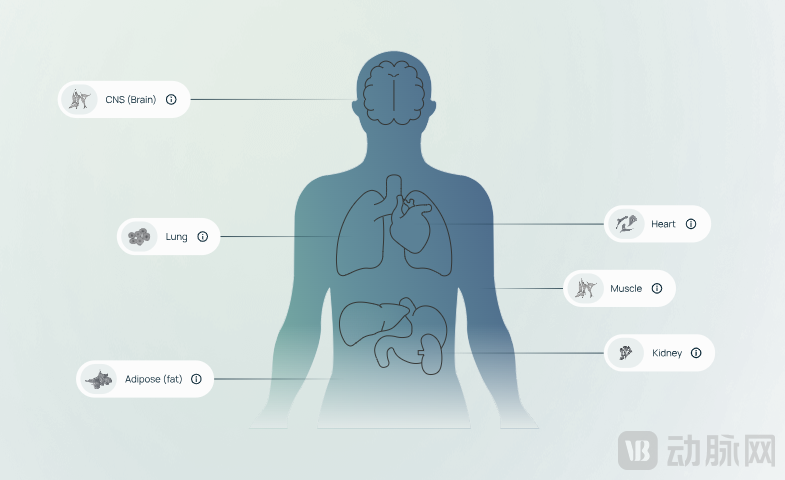
mShuttle Product Portfolio
Roche: Deep Cultivation in the BBB Field for Many Years, Leveraging AI to Enhance the Treatment of Neurological Diseases
As a global leader in the pharmaceutical industry,Roche has accumulated more than ten years of experience in the BBB delivery field., establishing its own BrainShuttle technology platform—by designing antibody modules that can bind to TfR, creating molecular channels that cross the BBB. Currently, Trontinemab (targeting β-amyloid), a representative drug based on this platform, registered and initiated Phase III clinical trials (TRONTIER-1 and TRONTIER-2) in September 2025.
However, with the development of multi-modal biologics such as antibodies, fusion proteins, and oligonucleotides, the limitations of the single TfR pathway have gradually become apparent: different molecules vary greatly in terms of BBB delivery efficiency, safety, and dose window requirements. Traditional single-target shuttle designs struggle to meet diverse needs, and this technical bottleneck requires external innovation to overcome.
Against this backdrop, the strategic cooperation between Roche and Manifold Bio reflects a strategic mindset of precisely strengthening the industrial chain. As a giant, Roche has a mature system in drug clinical development, registration, and commercialization, but its AI-driven molecular screening and high-throughput in vivo validation capabilities need to leverage emerging technologies. Meanwhile, Manifold Bio's mDesign platform can screen thousands of candidate shuttle molecules in parallel within real in vivo environments, using AI learning and feedback loops for efficient optimization, which perfectly compensates for Roche’s shortcomings in the discovery phase of delivery modules.
According to the cooperation agreement, Roche will obtain multiple AI-optimized brain shuttle candidate modules, which will be paired and validated with payloads from its own neurology pipeline. This is expected to enhance drug brain accessibility, shorten preclinical screening cycles, and reduce delivery failure rates.
Riding the AI Drug Development Wave, the Blue Ocean of Neurological Diseases Awaits Exploration
Roche's collaboration with Manifold Bio is not an isolated commercial event but rather an inevitable evolution of the biopharmaceutical industry driven by both technological iteration and clinical demand.
From the perspective of technological evolution, BBB delivery is entering a critical phase of generational upgrade.Early BBB shuttle technologies based on TfR antibody fragments, while proving the possibility of brain delivery, have always been limited by two core bottlenecks: low drug penetration efficiency and insufficient tissue targeting. Manifold Bio's innovative solution lies in its "AI + in vivo experimentation" technology – by evaluating thousands of candidate molecules in parallel within real physiological environments, it precisely screens for BBB shuttle modules with high specificity and high delivery efficiency.
From the perspective of market demand, there is a significant unmet gap in the treatment of neurological diseases.Data from the Global Burden of Disease Study 2021 published in The Lancet Neurology shows that in 2021, approximately 3.4 billion people worldwide were affected by various neurological disorders, accounting for about 43.1% of the global population. The disease burden related to these conditions has surpassed that of cardiovascular diseases, making it the leading cause of health issues globally. However, most currently available drugs can only alleviate symptoms and are unable to reverse disease progression. One of the core challenges is the difficulty for drugs to efficiently cross the BBB.
From the perspective of industry trends, "AI + drug delivery" has become a core track in global biopharmaceutical innovation.According to data from Silicon Valley Bank reports, AI-related investments in the biopharmaceutical sector are projected to exceed $5 billion in 2024, a nearly $2 billion surge compared to the total capital investment in 2021. Among the subfields, drug delivery technology stands out as a growth highlight in the AI biomedicine sector. Data from Data Bridge Market Research indicates that the global market size for AI-driven drug delivery systems was $2.05 billion in 2024 and is expected to reach $10.15 billion by 2032, with a compound annual growth rate (CAGR) of 22.10% during the forecast period from 2025 to 2032.
Except for Roche,Industry giants have already made their moves.Pfizer deepens collaboration with AI startup PostEra to advance ADC drug development; Eli Lilly partners with AI drug discovery company Superluminal in a $1.3 billion strategic collaboration to enhance the efficiency and success rate of drug discovery through AI technology.
For Manifold Bio, this collaboration represents both the first industrial validation of its platform capabilities and the starting point of even greater challenges. On the scientific front, the advantages and safety of AI-optimized brain shuttle modules in terms of brain exposure must be validated in animal models and early clinical trials, which will directly determine the scientific credibility of the platform. In terms of manufacturing and regulatory processes, scaling up the production (CMC) of novel fusion molecules and navigating the new drug application (IND) process will rely on the global support system of Roche. Regarding technological expansion, if the platform can successfully extend its in vivo delivery capabilities to other organ targets such as the liver, adipose tissue, and heart, the platform’s value will increase exponentially.
It can be foreseen that, with the implementation of this cooperation, Manifold Bio may usher in a new stage of development—validating the platform’s scientific rigor while accelerating the commercial closed loop. This case also provides a new model for the entire industry: in the last mile of drug development, the integration of AI and in vivo experiments is pushing the boundaries of precision delivery.