

Novo Nordisk Bids $10 Billion for Metsera in Heated Competition with Pfizer
Metsera
Obesity Drug Developer
Novo Nordisk
Insulin Developer and Manufacturer
On November 4, Danish pharmaceutical giant Novo Nordisk (NYSE: NVO) announced an update to its acquisition offer for U.S.-based clinical-stage biotech company Metsera, with the latest offer reaching up to $10 billion., to formally participate in the company's bidding. This offer is higher than Novo Nordisk's previous $9 billion proposal, bringing the competition between it and U.S.-based Pfizer over Metsera into a critical stage.
According to publicly available information, in September 2025, Pfizer initially expressed an acquisition interest in Metsera with a preliminary offer of approximately $4.9 billion in cash plus subsequent milestone payments, and the two parties reached a preliminary agreement. In late October, Novo Nordisk made a competitive offer of $9 billion. Subsequently, Pfizer filed a lawsuit against Metsera, citing disputes over transaction procedures and contract terms, accusing it of violating the exclusive negotiation agreement.
Currently, the Metsera board has stated that Novo Nordisk's new offer is superior to Pfizer's existing agreement and has given Pfizer a limited time window for renegotiation. Whether the deal will ultimately be reached remains uncertain.
Metsera: Tackling the Challenges of Oral Delivery and Half-Life in Metabolic Drugs through Financing and Technological Advancements
Metsera, Inc. was founded in 2022 and is headquartered in New York, USA. It is a clinical-stage biotechnology company focused on the research and development of drugs for the treatment of obesity and related metabolic diseases.Despite its relatively short establishment time, it has grown rapidly in the capital market: it completed a $290 million Series A financing in April 2024, followed by a $215 million Series B financing in November of the same year; In January 2025, the company was listed on NASDAQ, raising $275 million. On the first day of listing, its stock price increased by 47%, with a market value reaching $2.78 billion, demonstrating the market's recognition of its R&D direction.
Metsera's core competitiveness focuses on three major technology platforms, systematically addressing bottlenecks in metabolic drug development.
One is the HALO Peptide Lipidation Platform.By covalently linking lipid molecules to extend the drug's half-life, the core product MET-097i (a monthly injectable GLP-1 agonist) achieves a half-life of 380 hours, which is 2-3 times that of existing GLP-1 drugs. It induces an average weight loss of 7.5% within 36 days without the need for titration. The platform also supports flexible combination research and development across multiple pipelines.
The second is the MOMENTUM oral platform.By integrating technologies such as enteric coating and permeation enhancers, the challenge of low oral absorption rates of peptide drugs has been addressed. The oral drug candidates MET-002 and MET-224 allow for low-dose administration. In 2024, MET-002 received approval from Health Canada for an optimized clinical prescription trial, marking a breakthrough in the development of oral peptide drugs.
The third is the MINT screening platform.,Relying on Zihipp's more than two decades of peptide engineering experience, a library of over 20,000 high-activity NuSH peptide molecules has been constructed. Optimization is carried out with simultaneous attention to solubility, miscibility, half-life, and in vivo activity, supporting the development of customized treatment solutions.
From the perspective of business layout,Metsera Focuses on Four Pipeline Areas in Obesity Treatment, Forming a Synergistic Layout Around "Injection + Oral" Dual Pathways.
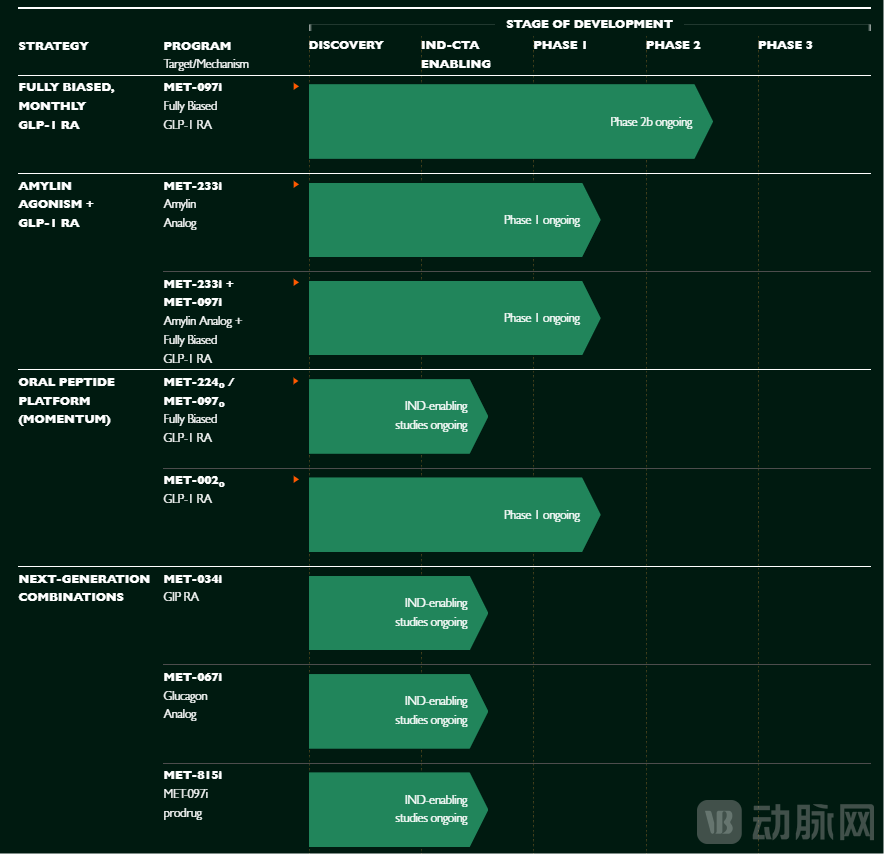
Overview of Metsera's Pipeline Layout and Progress
In terms of injectable products, the core pipeline MET-097i is developed based on the HALO platform., as a once-a-month injectable GLP-1 receptor agonist, not only has the longest half-life among current similar drugs but also does not require dose titration. Its efficacy can last for 8 weeks after discontinuation, and it has now advanced to the late clinical stage. Another injectable pipeline, MET-233i, is an amylin analog peptide with a half-life highly matched with MET-097i, supporting the two to be formulated into a mixed preparation at a fixed ratio. It can be independently developed as a single drug or used in combination with MET-097 to further expand treatment scenarios.
The oral products rely on the MOMENTUM platform to layout two pipelines — MET-224 and MET-097, both of which are oral GLP-1 agonists.According to animal experimental data, its efficacy can rival traditional injectable GLP-1 drugs. Meanwhile, it has more advantages in terms of production cost control and scalability for industrial production. The company plans to advance the registration process through the Biologics License Application (BLA) pathway, aiming to fill the market gap for oral obesity treatment drugs.
The Superimposed Effect of Market Explosion and Technology Scarcity
Metsera Sparks Bidding War Between Novo Nordisk and Pfizer: Essentially, the Result of the Combined Effect of the Growth Potential in the Global Obesity Treatment Drug Market and the Company's Own Technological Differentiation.
From a macro perspective, obesity is becoming a global public health challenge.According to the "2025 World Obesity Map" forecast, by 2030, the global obese population is expected to exceed 1.1 billion people. In addition, the weight-loss drug market represented by GLP-1 is rapidly expanding. Novo Nordisk's GLP-1 drug, Semaglutide, achieved approximately $29 billion in global sales in 2024, while Eli Lilly's Tirzepatide also reached about $16.5 billion in revenue, clearly indicating strong market growth.
For Novo Nordisk, the acquisition of Metsera is both a strategy to consolidate its leading position and an extension to address competitive pressures.According to the company's 2025 first-half financial report, its obesity treatment business revenue increased by approximately 58% year-over-year, with core products like Wegovy showing strong performance. HoweverMeanwhile, Eli Lilly's tirzepatide series continues to expand its global market share, with growth rates surpassing those of Novo Nordisk; whereas the market penetration of semaglutide has gradually stabilized, with growth momentum entering a plateau phase.If Metsera's long-acting GLP-1 candidate drug MET-097i can achieve "once-a-month injection," it will fill the gap in Novo Nordisk's long-acting formulation layout and complement its existing products, helping to extend its growth curve.
Pfizer's considerations are more about filling the gap. The company previously halted the development of its self-developed GLP-1 drug Danuglipron due to safety concerns, leaving a temporary void in its obesity treatment pipeline.With the叠加 of declining demand for COVID-19 vaccines and the expiration of key drug patents, Pfizer urgently needs to return to high-growth areas through external acquisitions. Metsera's four pipelines cover both long-acting injectable and oral formulations, which can quickly fill the product gap in Pfizer's metabolic disease treatment sector. This also prompted Pfizer to initiate an acquisition at a premium of approximately 160% over Metsera's listed market value.
Notably, Metsera's core competitiveness lies not only in the pipeline itself but also in the long-term value brought by its technical differentiation.Current weight-loss drugs generally face three major problems: high dosing frequency leads to poor compliance, side effects impact treatment continuity, and the lack of oral formulations limits population coverage.Metsera's R&D strategy is to address these three aspects simultaneously — reducing the frequency of injections per month, minimizing gastrointestinal side effects with amylin analogs and combination therapies, and developing an oral pipeline to expand medication use scenarios, forming a systematic solution targeting industry pain points.
Its proprietary peptide engineering platform further enhances this advantage. The platform can simultaneously optimize drug potency, half-life, bioavailability, and manufacturability at the molecular level, with potential for cross-indication expansion. In addition to obesity and metabolic diseases, the platform is also expected to extend to other endocrine fields in the future. This platform capability not only improves R&D efficiency but also adds extra premium to corporate valuation, becoming Metsera's technical trump card for attracting M&A attention.
For innovators and investment institutions in the biopharmaceutical field, this incident is also of reference value:In the obesity and metabolic disease sector, projects featuring "long-acting," "oral administration," and "combination therapy" are more likely to gain market favor.; At the same time, a company's platform-based R&D capabilities and industrial scalability are becoming core indicators for evaluating long-term value.
Currently, the bidding for Metsera is still in the window period, and the final outcome has yet to be determined. However, it is clear that regardless of the eventual direction of the deal, this event will become a pivotal milestone in the competitive landscape of the global weight-loss drug industry. It will drive more companies to focus on technological innovation and patient needs, thereby influencing the future direction of treatment advancements.