AI4LS Industry Report Shakes the Sector: Chinese Innovation Rises as Small Molecules Enter the Generative AI Era!
StoneWise
AI-Driven Drug Discovery Company

AboutAI for Life Science: A Major Report Has Just Been Released!
On October 30, Frost & Sullivan released"2025 China AI4LS Industry Development Blue Paper", presenting a panoramic and in-depth view of the development process, driving factors, application scenarios, and future trends of AI for Life Science.
The Blue Book pointed out that, after experiencing the first four paradigms of empirical science, theoretical science, computational science, and data-intensive science,With the support of AI, current scientific research is moving towardsThe Fifth Paradigm——The Evolution of Intelligent Scientific Research Directions Centered on AI.
As ofIn 2024, the market size of AI4S in China has reached 4.7 billion yuan, covering core areas such as drug research and development, synthetic biology, gene sequencing, materials development, and batteries and energy storage. From a medium- to long-term development perspective, the market size of AI4S is expected to exceed 100 billion yuan.
Among them,Life sciences rely on a strong data foundation and highComplexIssues and broad application prospects are gradually becomingOne of the most ideal application scenarios for AI4S.
The Blue Paper points out that different types of enterprises are engaging in diverse explorations around platform construction, model-driven approaches, and implementation capabilities. Representative companies, through differentiated technical pathways and application models, are driving progress.AI's Leap from Tool to Empowering Entity.
In the drug research and development scenario, founded inIn 2018StoneWise, representative companies selected for this Blue Paper.
Relying on the breakthrough in the underlying theory of AI-driven drug discovery, the deep governance of drug discovery data, the accumulated knowledge of the drug discovery industry, and strong software and engineering capabilities, StoneWise has built a multimodalAI 3D Molecular Generation Large Model as the Core Base PlatformMolVado, the platform can accurately generate molecules or molecular scaffolds that fit the structure of the target pocket, and increase the probability of their wet-lab activity through a series of computational evaluation tools.
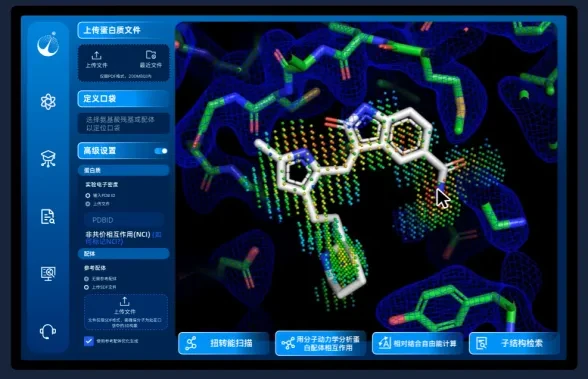
Figure: MultimodalAI 3D Molecular Generation Large Model Base MolVadoPlatformSchematic Diagram
The molecular generation model of the company can also serve as a base model, upon which partners are able to fully integrate their own data, knowledge, and models to carry out customized iterations.Currently, nearly a hundred pharmaceutical companies and research institutions are using it on a daily basis.
The feasibility of the technology has been fully validated in practice: a leading innovative pharmaceutical company in China has utilizedMolVado Platform,Obtained a novel scaffold nanomole-level active molecule in just 3 months through 10 rounds of generationCompared with the traditional model, the early drug discovery cycle of 1-3 years has been significantly shortened, and the cost of early synthesis and experimental verification has been reduced by 80%.
Relying on this model, the company's internal self-developed pipeline has achieved significant results, with the fastest pipeline already entering phase one clinical trials, while also being based on generativeAIEntity Library Derived from the ModelCROThe business is also actively expanding at home and abroad.
Represented by StoneWiseAIDrug discovery companies are vividly illustrating through underlying technological innovation and scaled application cases.The Paradigm Shift of AI for Life Science Triggers Historical-Level Industrial Opportunities.
In the long run, the life sciences will benefit directly fromAI, giving rise to a group of globally influential Chinese enterprises. This has facilitated a comprehensive acceleration from basic research to clinical translation.

AI Reconstruction of the Molecular Universe
Drug R&D Enters the "Generative" Era
In the landscape of modern medicine, small-molecule drugs have always held an unshakable central position.
Despite the continuous emergence of new technologies such as biologics and cell therapies, small-molecule drugs remain the mainstream choice for clinical treatment due to their excellent cell membrane penetration, high oral bioavailability, strong stability, and convenience in storage and administration.
Data shows that in the past five to six years, the United StatesAmong the new drugs approved by the FDA, small molecule drugs account for up to 70%. Looking at the global biopharmaceutical industry,Small molecule drugs still account for nearly 90% of the total share.
However, this seemingly mature field is facing profound structural challenges.
With the increasing complexity of disease targets, traditional R&D models are showing signs of fatigue, and the fundamental bottleneck lies in——A screening method that relies heavily on experience and intuition is not only inefficient but also fundamentally limits humans' ability to explore the vast chemical space.
The essence of small molecule drug discovery lies in finding a very small number of molecules with ideal pharmacological activity, safety, and developability within an extremely vast chemical space. The estimated possible order of magnitude isUp to10⁶⁰——This is a figure that far exceeds human intuitive cognition.

However, commonly used R&D methods, such as high-throughput screening (HTS) and structure optimization based on known scaffolds, only dozens to hundreds of compounds can be tested each week. Even with the integration of virtual screening technology, the chemical space actually explored by humans amounts to less than one-billionth (0.000000001%) of the total.
This also makes the existing small molecule R&D almost completely dependent on"Known" areas are subject to minor optimizations, confined within the human mindset and inherent understanding in drug design, while largely overlooking the vast unknown territories.
It is against this backdrop that generativeAI Becomes a Key Force in Breaking Through the Bottleneck of Chemical Space Exploration.By learning the structure and property data of a vast number of known molecules, capturing potential physicochemical laws and bioactivity correlations, intelligently navigating chemical space, predicting and generating entirely new molecules with specific attributes, and redefining the boundaries of drug discovery.
Recently, a series of cutting-edge models have been successively released, demonstrating astonishing efficiency in practical applications, becomingA Powerful Proof of AI Empowering Drug Research and Development.
Chai-2As a milestone in generative AI designing proteins from scratch, it possesses "zero-shot" design capabilities—able to directly generate new antibodies with binding activity even for unknown targets without any experimental data.
Experiments show,The average success rate of Chai-2 in designing antibodies from scratch is as high as 15.5%, which is a hundredfold increase compared to the previous success rate of only 0.1%.
By MIT andRecursion Jointly LaunchedBoltz-2, setting a new benchmark in affinity prediction, becoming a deep learning model that approaches physics-based Free Energy Perturbation (FEP), with a 1000-fold increase in speed.
Researchers can perform large-scale, high-precision virtual screening of molecules, rapidly trial and error through dry lab simulations, significantly reduce ineffective wet lab experiments, and lower R&D costs and cycles.
In the field of small molecules, the Chinese team has made earlier arrangements and already achieved groundbreaking results.
As early asBy the end of 2020, StoneWise had released its first-generation tool primarily focused on scaffold hopping and derivatization for ligand-based drug discovery scenarios.2D Generative Model AI Scaffold。
The model excels in molecular novelty and has assisted numerous pharmaceutical companies both in China and abroad.The patent breakthrough and accelerated R&D achieved in the BIC project have established its first-mover advantage in the field of AI molecular design.
In 2022, the StoneWise research team achieved a critical leap by pioneering a 3D molecule generation technology based on experimental electron density and releasing the 3D molecule generation model v1.0. This innovation optimizes the shape complementarity and interaction patterns between molecules and protein pockets, significantly enhancing the drug-like potential of generated molecules and successfully accelerating the R&D progress of multiple FIC drug projects.
In 2024, StoneWise《Nature Machine Intelligence》Publish Major Research Findings, Officially LaunchLingo3DMol。
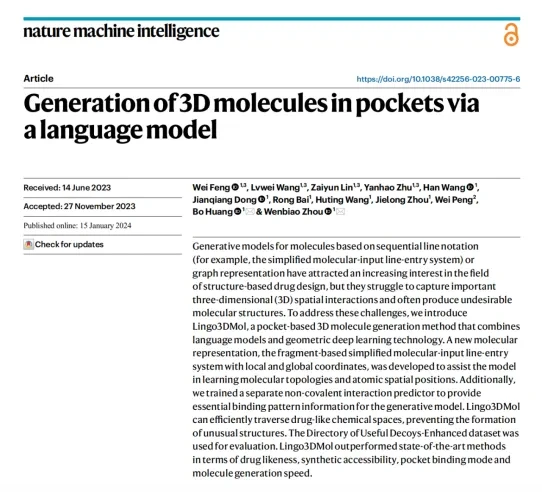
Figure: StoneWise in "Nature Machine Intelligence Publishes Groundbreaking Research Findings
Compared with the industry's general reliance on graph neural networks (Different from the GNN) technical route, Lingo3DMol innovatively integrates language models with geometric deep learning, demonstrating superior performance in key metrics such as active molecule reproduction rate, molecule-pocket binding scores, and molecular conformation.
Today, StoneWise officially launchesMultimodalAI 3D Molecular GenerationBaseLarge ModelMolVado Platform,Capable of deeply analyzing the three-dimensional conformation of target pockets, combining key fragment features of reference molecules, and rapidly generating libraries of millions of compounds; it also supports custom parameter configuration to precisely synthesize targeted molecules with specified structures.
Traditional drug development requires the synthesis of hundreds of molecules for validation,StoneWise PassesAfter AI generation and conformation validation, the number can be reduced to 20-50; the cost of synthesis and experimental validation is reduced by about 70%~80%.
The platform will have a brand-new framework.The discovery cycle of Hit has been compressed from 1-3 years in the past to within 1-6 months, enabling the rapid generation of structurally novel molecules that fit the pocket.
Practice has shown,MolVado can significantly break through the bottleneck of traditional research sample quantity, greatly shorten molecular design time, and achieve efficient and precise drug design.Has the disruptive potential to rival international top models such as Chai-2 and Boltz-2.
In a sense, we are getting closer to the ultimate vision of small molecule research and development: simply describe the desired molecular function or target,AI can generate a batch of molecular designs that are highly likely to "hit," and these designs are genuinely effective in experiments, achieving "design as discovery."
The future of small molecule drug research and development will no longer be"Generate Better" Instead of "Screen More".
ThisThe paradigm revolution driven by AI is fundamentally reshaping the future landscape of new drug development — in that vast chemical universe, the next blockbuster drug might be waiting to be designed from scratch by AI.

Collective Heavyweight Betting
AI Rewrites the Rules of Small Molecule Drug Development
NumerousSigns indicate that,AISmall molecule drug development is approaching a critical turning point., becoming the core engine of drug innovation.
Large pharmaceutical enterprisesBy means of strategic adjustments and cooperation, increase investment inInvestment in AI; investment institutions are also betting on itHuge Amount of Money, supporting the development of key technologies and ecosystems in this field.
For example, by the Nobel Prize in Chemistry laureateIsomorphic Labs, founded by Demis Hassabis, not only completed a massive $600 million financing round but also, in collaboration with Novartis, developedSmall Molecule Therapies Targeting Three Undisclosed Targets, with a total cooperation value of$1.2 billion.
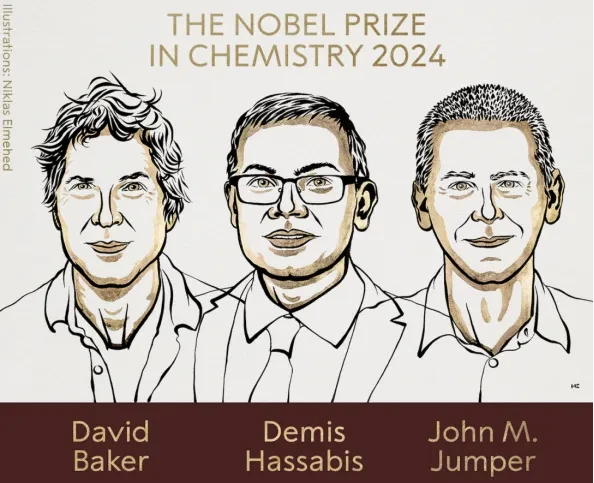
Figure:Demis Hassabis for itsAIContributions in the Field of Proteins2024 Nobel Prize in Chemistry
As early as a few years ago, AstraZeneca, a multinational pharmaceutical giant, stated that half of itsSmall Molecule DevelopmentThe project is ongoingUseAIDepthAuxiliaryR&D。This YearIn June, AstraZeneca reached a significant collaboration with CSPC Pharmaceutical Group, with a total amount of up to 5 billion US dollars. Both parties will rely on CSPC's AI drug discovery platform, involving molecular candidate drugs for multiple targets.
China's pharmaceutical giantis also actively laying out, Hengrui Pharmaceutical has established a computational chemistry andAIAuxiliary Drug Design (AIDD) Team and Platform, UtilizingAITarget discovery, virtual compound screening, molecular structure optimization, and clinical trial protocol optimization, etc.Field。
ReStarPharmaceuticals and many in the industryAIPharmaceutical companies reach deep cooperation,China Biopharmaceuticals, through self-constructionAI—PROTACDrug Design Platform, the first blood tumor project has been approved to enter clinical trials.
These actions all send a clear signal:The industrial value of AI small molecule R&D is being recognized by mainstream pharmaceutical companies.The entire pharmaceutical industryCorrectAccept and EmbraceAI, hoping to bring faster and better drugs to the industry.
Despite the rapid development of biologics in recent years, small molecule drugsAlwaysIs the cornerstone of the pharmaceutical industry.Data shows,Best-Selling Drugs Worldwide in 2024TOP100In the list, small moleculesIn42 drugs capture nearly half of the market.
Small molecule drugs have the advantages of convenient oral administration, low synthesis cost, flexible and extensive targets, and good patient compliance, making them still one of the most universal treatment methods.
In addition, small molecule drugs are based on traditional chemical drugs, through molecular glue,PROTAC(Targeted Protein Degradation Chimeras) and other technological breakthroughs“Undruggable”Target, bringing newImagination Space。
Data shows,The small molecule drug discovery market size is estimated at USD 56.9 billion in 2024 and is expected to reach USD 86.7 billion by 2029, growing at a compound annual growth rate (CAGR) of 8.76%.
Not only that,AIThe application in small molecule drug research and development has long surpassed the scope of traditional chemical drugs, and is now advancing into molecular glues,ADC(Antibody-Drug Conjugates),PROTAC, as well as small molecule components in cell therapy and gene therapy, playing a revolutionary role in cutting-edge fields., with broad market prospects.
StoneWiseMultimodal3DMolecular Generation Large ModelAs the core, and integrated withIntegrate upstream and downstream tools, EffectiveImprove the efficiency and quality of drug design.In this platform,Drug researchers can, likeChatGPTInteract with the model in the same way,Can also be based onDevelopment and Integration of Historical Project Data Required, helping R&D personnel break through design bottlenecks.
AndIn Response to the Two Major Pain Points Commonly Found in the Industry,Non-Drug-Like Molecules“Score brushing”Phenomena and inability to accurately evaluate moleculesThe Difficult Problem, StoneWise has pioneered“Stepwise Evaluation Mechanism”And“Validation of Active Molecular Reproduction”The strategy effectively enhancedDrug Feasibility of Generated Molecules。
Today, nearly a hundred pharmaceutical companies have adopted this small-molecule drug discovery solution, and it has gained recognition from medical institutions both in China and overseas, including Qilu Pharmaceutical, Shenzhen Chipscreen Biosciences, Tайде Pharmaceutical, Qilu Rui Ge, Baylor College of Medicine, Cancer Research UK, Tsinghua University, and Fudan University School of Medicine.
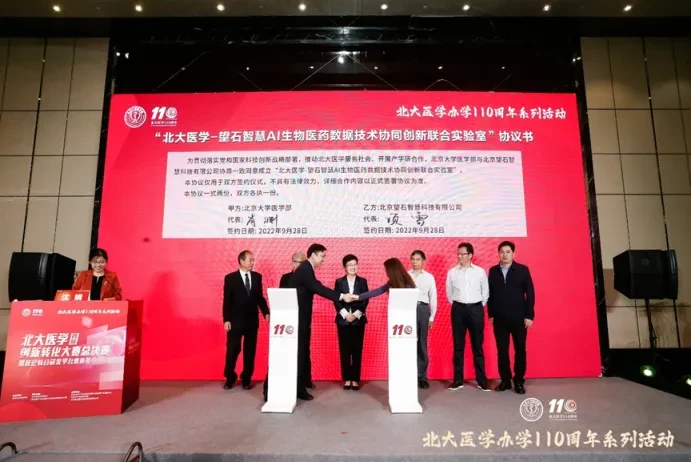
Fig.: Peking University Health Science Center——StoneWiseAIJoint Laboratory for Collaborative Innovation in Biomedical Data Technology Officially Inaugurated
These industry cases prove that,AI small molecule generation has moved from a laboratory concept to industrial-level application, truly bringing measurable R&D acceleration and commercial value to partners.
More noteworthy is that,The AI small molecule platform has not only achieved external empowerment but also made breakthrough progress in the internal pipeline, demonstrating the company's full-process capability from early research and development to clinical implementation.
In the first half of this year, the first according toAI Platform Designed and Optimized byHematopoietic Progenitor Kinase1(HPK1)Small Molecule InhibitorsSWA1211 TabletsDosed First Patient, Successfully EnteredFor advanced solid tumorsPhase Ⅰ Clinical Study。
This drug demonstrates differentiated advantages compared to the traditional R&D pathway, featuring not only a novel scaffold but also superior activity and selectivity over similar projects.
In addition,With molecular generation capabilities as the cornerstone,StoneWiseStarting from small moleculesGeneration CapabilityExtended to molecular glue, peptides, covalent compounds, cyclic peptides,RDCetc.Emerging Fields.
Through"External Collaboration + Internal Pipeline"The dual-driven model of StoneWise AI molecular generation platform is transforming from a tool into the core engine of drug research and development.
A series of cases have proven that,AI-Driven Small Molecule Generation Has Moved from Lab Concept to Industrial Application, Truly Bringing Measurable R&D Acceleration and Commercial Value to Partners. As a Leader in the Field, StoneWise Has Established a Complete Industrial Solution Driven by AI, Spanning Molecular Design to Validation, Becoming a Key Force in Shaping the Future Landscape of Biopharmaceuticals.

AI Molecular Generation Reshapes the Industry, China's Strength Rises
The long-term development of innovative drugs belongs toIn the "scientific" domain, there is a high reliance on researchers' experience and inspiration; however, the deep empowerment of AI is driving this field towards an engineering paradigm shift – moving from sporadic breakthroughs to a new era of systematic, repeatable, and scalable delivery.
As the founder of NVIDIA,As CEO Huang Renxun observed:"In human history, biology has the chance to become a discipline of engineering rather than science for the first time."
And in this historic process, the integration of physical realityAI is building a powerful technical foundation for drug research and development: it models molecular conformations, target pockets, and interaction force fields with high precision, and achieves automated scoring and optimization, rapidly transforming hypotheses into verifiable molecular entities.
In the future,The role of molecular generation platforms in drug innovation will be likeGPUs play the same role in AI. Whoever can access better foundational platforms will be able to accelerate development progress and better position themselves in new disease areas and R&D pipelines, which will fundamentally reconstruct the R&D process, cost structure, and value distribution logic.
Traditional drug research and development relies on high-throughput experiments, which is essentially a"The traditional 'finding a needle in a haystack' passive screening, while AI molecular generation technology, through the full exploration of the 10^60 chemical space, can directly design novel molecular structures with specific properties based on target information or desired functions, achieving an 'on-demand customization' active creation."
Especially for small molecules, their synthesis cycle is longer and the cost of experimental verification and trial-and-error is higher. However, if starting from dry-lab computational simulations, it enables upfront optimization and quality control in the R&D process.This efficiency improvement is directly reflected in the significant reduction of time and cost in the early exploration phase.。
This transformation has given rise to a completely new business value model:In the past, a team often only possessed specific vertical domain patent knowledge and capabilities, such as drug patents (IP) as the core.Today, AI points to a more versatile platform capability,Not binding to specific targets, not relying on specific hypotheses, quickly bypassing patent barriers to generateNew molecules with IP potential.
This means that the value anchor of the industry in the future will no longer belong solely to the final marketed drugs, but more importantly, to the platforms themselves that can continuously produce high-quality molecules.。A PassedFully Validated Molecular Generation Platform, which itself is a reusable and scalable asset,That is the moat.
Of course, alsoIt must be clearly recognized that, despiteAISignificant achievements have been made in the fields of protein design and antibody optimization, and de novo design of small molecules (de novo design) is still in the early stages in a practical sense, and its engineering maturity is far lower than that in the protein field.
AndThe greater the challenge, the deeper the moat; the higher the threshold, the more unshakable the first-mover advantage. The value reassessment of small molecule generation platforms is just beginning.——What it carries goes far beyond efficiency improvement or cost reduction; it is the subversion of underlying R&D paradigms and the entireInnovative DrugReconstruction of the Value Chain.
This potential has not yet been fully recognized by the market, nor has it been priced. The true value explosion is still ahead.
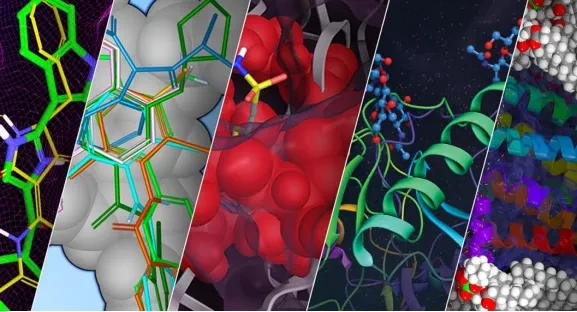
CurrentIn the field of AI small molecules,SeaInThere have emerged several leaders abroad.AndForm different competitive advantages, Worth Industry Attention。
Isomorphic LabsCore PersonnelOriginated fromDeepMindLife Sciences Team, and by2024Nobel Prize in Chemistry WinnerDemis HassabisLeader.
Based onThe groundbreaking achievement of AlphaFold2 has enabled this world-class team to rapidly iterate on the underlying AI algorithms. The company’s next-generation R&D model, AlphaFold3, is now making large-scale predictions on the interaction patterns between proteins and ligands.,EspeciallyAccuracy of Small Molecule Binding, therebyFind promising lead compounds more quickly. Recently, the company has beenAIDesigned Anti-Cancer Drug to Begin Human Trials, becoming a key milestone event in validating this platform.
Not only that, but powerful algorithms require high-quality data to feed on in order to achieve maximum effectiveness.Terray TherapeuticsWith its unique and high-quality data assets, it stands out in the competition.
Terray TherapeuticsFounded by former senior executives of Schrödinger, a long-standing computational chemistry company, throughIts proprietaryHigh-throughputExperimental Platform,Terray Built the world's largest chemical dataset,Approximately the total number of all publicly available chemical data50 times.
The company's platformValue Has Been Recognized by Industry Giants,Terray Not only gained globalNVIDIA, the AI powerhouse, has made multiple rounds of investments and also reached a deep collaboration with pharmaceutical giant Bristol-Myers Squibb (BMS) to jointly develop small molecule therapies.
In ChinaIn the enterprise, StoneWise relies on top algorithm models and high-quality data assets,Representing ChinaLeading Level in the AI Small Molecule Field.
After8Years of technical沉淀,StoneWise Successfully BuiltDifferentiated Industrial-Grade Molecular Generation Large Model。Through Deep Data Governance and Automation GenerationAnd other methods,WeeklyApproximatelyProcessing2TBHigh QualityData, integrating coverage of physicochemical properties, affinity, and in vitro bioactivity,ADMEand multi-dimensional information on safety and toxicology, forAIDrug Discovery ProvidesHigh-Quality Data Foundation。
Based on an in-depth understanding of molecular designStoneWiseIn the powerful generativeAIBased on the model, constructA full set of industrial-grade small molecule drug solutions,IntegrationGenerativeAI、CADDCalculation and evaluation tools, compound libraries, and screening services build a dry-wet linkage solution.
Another unique advantage of the company lies in, throughBase Model + Customized ServicesMethod,The platform is able to utilize historical project data from enterprises andKnow-How, reduce entry costs and amplify R&D efficiency, forming a unique competitive barrier for the company, and accelerating the development of entirely newIPMolecular Generation.
More worth looking forward to is,Innovation in large pharmaceutical models is moving towards AI Agent (AI Agent)Directional Evolution.Around its generativeAI Model,StoneWiseAlso inAIMulti-Agent Collaboration and Multi-Source Knowledge EnhancementIn-depth Layout,Achieve more efficient human-machine collaboration and accelerate the promotion of candidatesMoleculeTo ClinicalDrugConversion。
From this perspective, the futureThe opportunities in AI-driven small molecule drug discovery will belong to companies that possess outstanding algorithm models, high-quality data, and the ability to transform these into industrial-grade solutions—companies that will fundamentally revolutionize the paradigm of new drug discovery.
Written at Last
Currently, China has become a key force in global drug innovation.。
China's Innovative Drug Fieldlisence-outTransactionContinuously being refreshed, according to statistics72 Overseas Deals Reached in the First Half of 2025, with a total amount as high as484Billion dollars. Global pharmaceutical transactionsTOP10In China, the contribution rate of China's innovative drug assets exceeds80%。
Behind this isChinaEnterprise Based on R&DCost andSpeedAdvantages,Participate in the global redistribution of pharmaceutical value.AIDriven New Drug R&D Model, is becoming the core engine of this trend.
Among them, Chinese companies represented by StoneWise are expected to rely on their strongAI Molecular Generation Capabilities and Engineering Advantages,打通The Entire Process from Early R&D to Clinical Translation, providing a steady stream of effective molecules to the world, empowering breakthroughs in next-generation therapies。
Under this vision, Chinese companies are no longer just followers and participants in pharmaceutical R&D; they are also expected to lead industry transformation.
—END—