Zimmer Biomet: The Underperformance of a Mega-Merger – A Decade-Long Reflection on the Zimmer-Biomet Integration

Biomet
Surgical and Non-Surgical Product Design and Manufacturer

Johnson & Johnson
Medical Device R&D and Manufacturer
In the early 2010s, as the medical device industry was generally considered a scale-driven industry where larger companies could secure better transaction terms with large hospitals and group purchasing organizations, the industry began to experience accelerated consolidation.
During 2010-2020, the medical device field witnessed numerous large-scale mergers and acquisitions, many of which ranked among the top twenty largest M&A deals in the medical device industry. For instance, Medtronic's acquisition of Covidien, Abbott's acquisition of St. Jude Medical, and BD's acquisition of Bard.Siemens Acquires Varian.
It is the same in the orthopedic field. Johnson & Johnson in 2012 withAcquired for $21 billionSynthes, and its orthopedic departmentDePuy merger creates largest orthopedic company at the timeDePuy Synthes. Stimulated by Johnson & Johnson's acquisition, Stryker, Smith & Nephew, Medtronic,ZimmerCompanies such as [Company Names] have also begun active expansion (M&A).
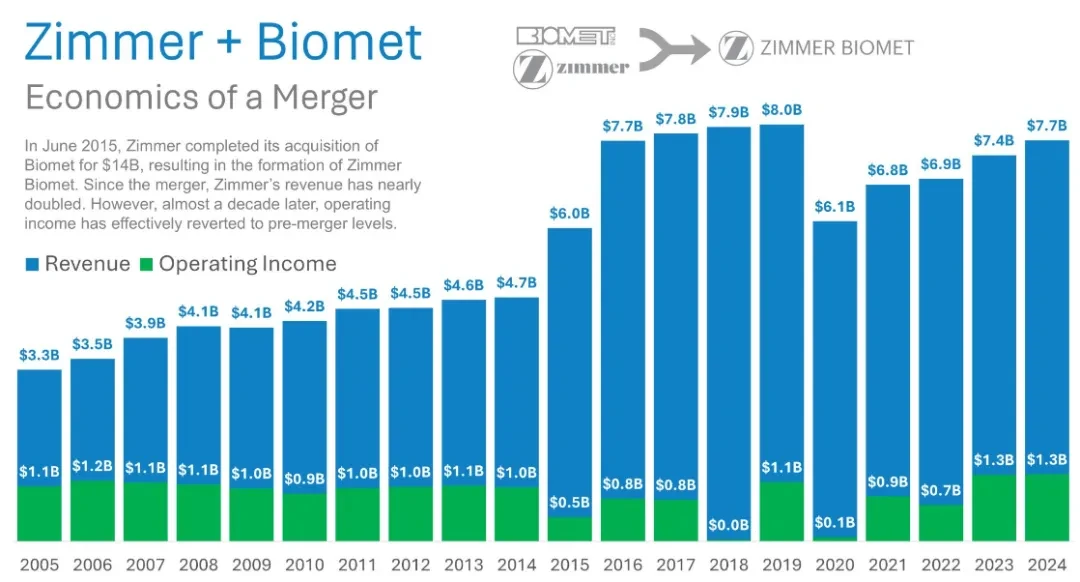
In the face of fierce expansion by competitors,Zimmer felt tremendous pressure. Therefore, in 2014, Zimmer reached out to Biomet, and the same year announced with$13.35 billion acquisitionBiomet. After the acquisitionZimmer Renamed toZimmer Biomet(Zimmer Biomet)。Through acquisitionBiomet, once madeZimmer Biomet becomes the world's second-largest orthopedic company, thereby gaining the ability to compete with Johnson & Johnson (DePuy Synthes)Stand up to
At that timeZimmerCEODavid DvorakCalling this acquisition "a strategic move," and listed numerous reasons, ranging from "market leadership," "portfolio expansion," "geographic expansion" to "synergies" and "cost reductions."
This kind of acquisition euphoria did not last long.
Despite the merger of the two companies, the post-merger integration posed enormous challenges. The entire company was riddled with chaos in sales, manufacturing, and the supply chain after the merger. Instead of improving efficiency and reducing costs, the integration significantly increased costs, effectively eroding profits. As a result, operational profits did not achieve "1 plus 1 is greater than 2," but instead became "1 plus 1 equals 0."
Two years after the completion of the deal, under pressure from investors,Zimmer BiometAnnounced as CEO in July 2017David DvorakWill step down, and the company will search for new leadership.
December 2017,Zimmer BiometHireBryan HansonTo reorganize execution and rebuild credibility.Bryan HansonAttempting to address supply chain challenges and reshape the company's business portfolio. The spin-off of spinal and dental assets into ZimVie in 2022 is a prime example.
Despite improvements in operational discipline,Zimmer BiometStill struggling to restore profit margins. The impact of the COVID-19 pandemic and its disruption to the supply chain has made the situation even more severe. Therefore,Zimmer BiometThe story in the capital market remains unchanged.
In 2023,Bryan HansonDeparture, Former Chief Operating Officervan TornosBecomeZimmer BiometThe new CEO. Since taking office, he has continued to focus on improving operational discipline, restoring profitability, driving growth, and revitalizing the company's brand.
Ten Years After the Acquisition
A decade after the acquisition of Biomet,Zimmer BiometRevenue doubled, but operating profit only returned to pre-acquisition levels, indicating that no value was created. This is also reflected inZimmer Biometin the capital market performance. Nowadays,Zimmer BiometThe market value and stock price are roughly the same as they were a decade ago. During the same period, the S&P 500 Index has risen more than threefold, reminding us that in the business world, bigger doesn't always mean better.