
Editor's Note
The 76th Annual Meeting of the American Association for the Study of Liver Diseases (AASLD 2025) was held in Washington, D.C., USA, from November 7 to 11, 2025, local time. During the meeting, several research advances in new hepatitis B drugs were disclosed, and Hepalink Jun selected some important progress to share with everyone.
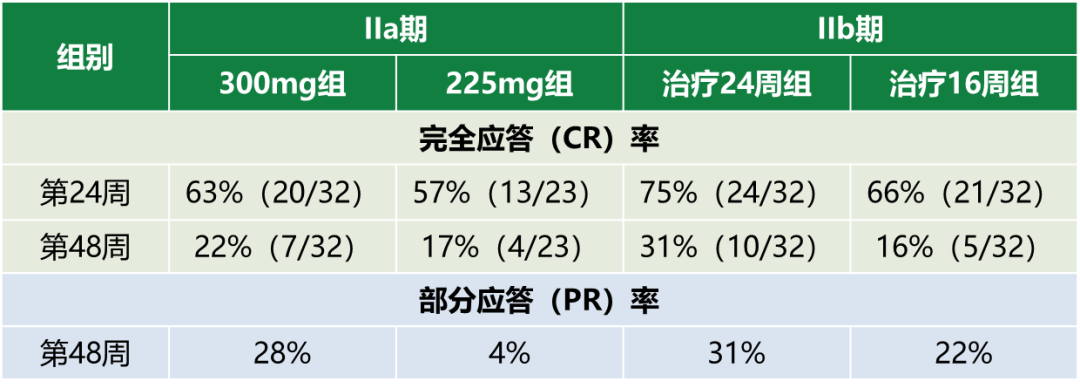
AHB-137, an antisense oligonucleotide drug developed by AusperBio, is currently in Phase III clinical trials. Previously disclosed results from Phase IIa and IIb studies showed that 63% and 75% of HBeAg-negative chronic hepatitis B patients previously treated with nucleos(t)ide analogs (NA) achieved complete response (HBsAg < 0.05 IU/mL and HBV DNA < 10 IU/mL) at the end of 24 weeks of treatment with AHB-137 300mg.
The abstract of the AASLD2025 conference disclosed the overall efficacy data at Week 48 of these two Phase II studies — 24 weeks after the end of treatment and 24 weeks after discontinuation of AHB-137 follow-up (while maintaining NA treatment). The results showed that this proportion decreased to 22% and 31%, respectively, and only 39% of subjects who achieved a complete response at Week 24 maintained a complete response at Week 48.

Research Methods
Two Phase II studies enrolled 119 chronic hepatitis B patients who were receiving continuous NA treatment, HBeAg-negative, with HBV DNA < 100 IU/mL, and HBsAg > 100 and ≤ 3000 IU/mL. In the Phase IIa (NCT06115993) study, participants received AHB-137 (300mg or 225mg) for 24 weeks. In the Phase IIb (NCT06550128) study, participants received AHB-137 300mg for 24 weeks or placebo for 8 weeks followed by sequential AHB-137 300mg for 16 weeks. After the end of AHB-137 treatment (EOT), all participants continued on NA monotherapy for 24 weeks. At week 48, participants were selected to continue or discontinue NA based on NA withdrawal criteria and entered an additional 24-week follow-up period. Discontinuation of NA required participants to achieve a complete response (CR), defined as HBsAg < 0.05 IU/mL and HBV DNA < 10 IU/mL. Partial response (PR) was defined as HBsAg ≥ 0.05 to < 10 IU/mL and HBV DNA < 10 IU/mL.
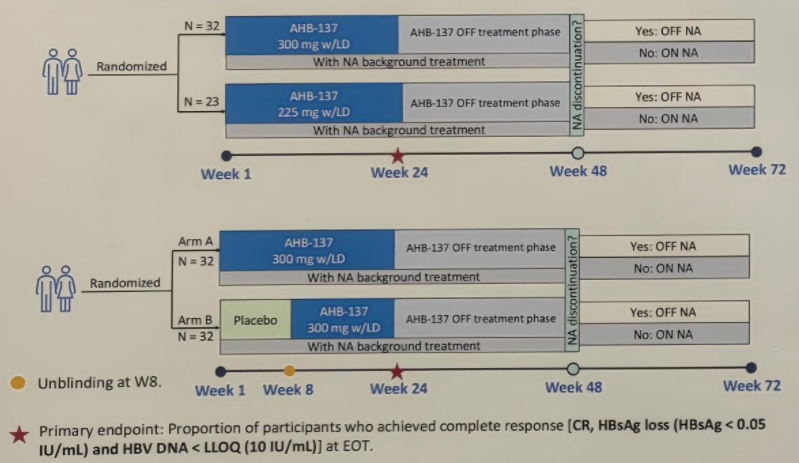
Phase IIa and IIb Trial Design
Research Results
All subjects completed the 48-week follow-up. All subjects were Chinese, and the distribution of baseline demographic characteristics was balanced across the treatment groups.
(1) Overall efficacy
At Week 48, the AHB-137 300mg 24-week treatment regimen demonstrated more significant and sustained efficacy.
CR and PR Rates at Weeks 24 and 48 in Each Treatment Group from Two Phase II Studies
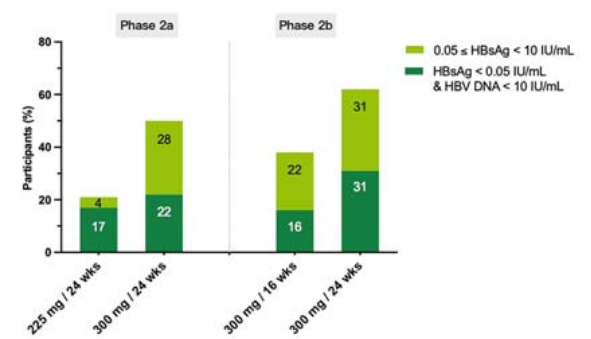
Proportion of Patients Achieving CR and PR at Week 48 in Two Phase II Studies
(II) Summary of Efficacy for the 300mg Treatment over 24 Weeks
CR Rate at Week 48 in the Subgroup Receiving AHB-137 300mg for 24 Weeks
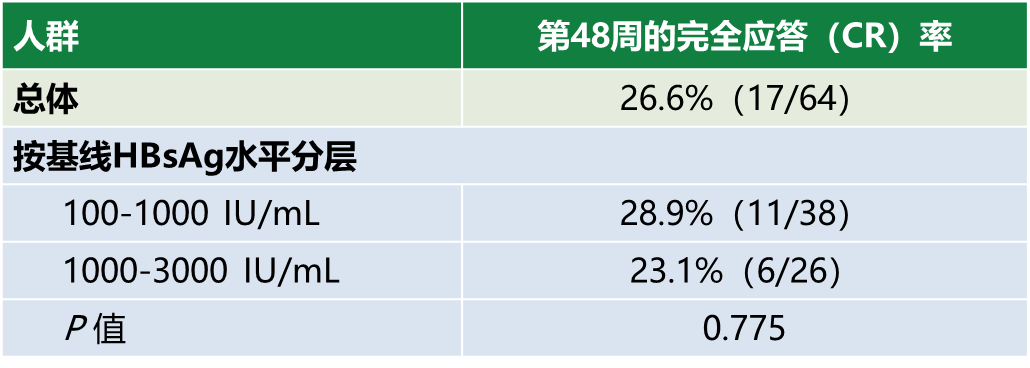
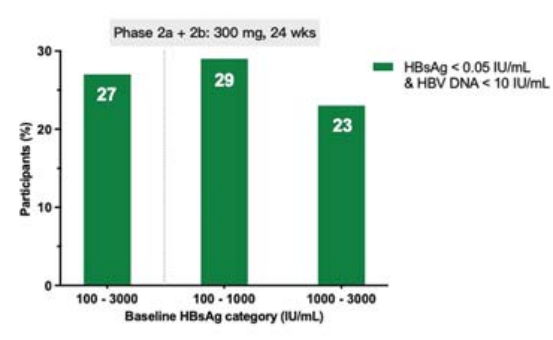
CR Rate at Week 48 in the Subgroup Receiving AHB-137 300mg for 24 Weeks (Stratified by Baseline HBsAg Levels)
At week 48, 71% (12/17) of CR subjects had anti-HBs levels ≥ 10 IU/L at week 48.
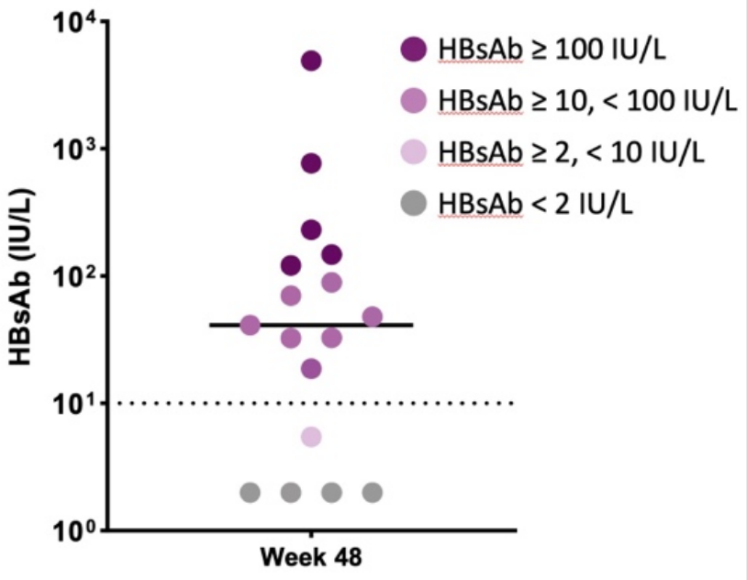
HBsAb Levels in Patients Reaching CR at Week 48 in the Subgroup Treated with AHB-137 300mg for 24 Weeks
Among the subjects who achieved CR at Week 24, with 24 weeks of follow-up NA maintenance therapy, 39% maintained CR at Week 48, while 61% of patients experienced HBsAg relapse and/or HBV DNA relapse; 82% had HBsAg < 10 IU/mL at Week 48.
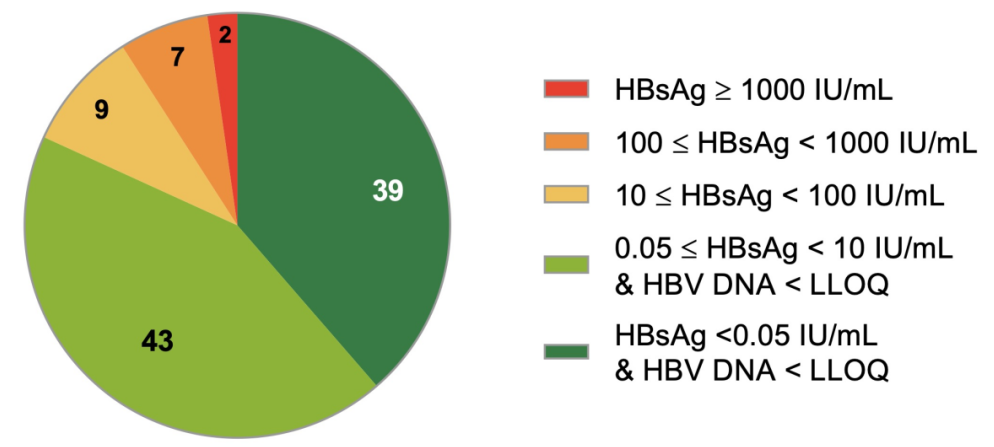
HBsAg Distribution at Week 48 in Patients Who Achieved CR at Week 24 in the Subgroup Treated with AHB-137 300mg for 24 Weeks
(III) Safety
AHB-137 was well-tolerated, with AEs mainly being Grade 1 or 2, and most occurred during the treatment period. No treatment-related SAEs were reported, nor were there any AEs leading to discontinuation or death. Grade 3 or higher AEs included laboratory abnormalities and injection site reactions, most of which were transient and resolved without intervention. Acute ALT elevation coincided with rapid HBsAg decline and clearance, and spontaneously resolved without an increase in direct bilirubin. Some patients who achieved CR at Week 48 did not experience acute ALT elevation during AHB-137 treatment.
Liver Lin Jun Has Something to Say
Clinical cure of hepatitis B refers to the sustained negativity of HBsAg with or without the appearance of anti-HBs and HBV DNA below the lowest detection limit after stopping treatment, a concept that emphasizesSustained Response After Discontinuation of All Medications, including HBsAg and HBV DNA responses. Drugs capable of achieving this goal are very limited.
In the current pipeline of new drug development, antisense oligonucleotides have shown unique advantages in reducing HBsAg, but the rebound after discontinuation remains severe. The representative drug, GSK836, achieved HBsAg clearance and undetectable HBV DNA in 26% of patients at the end of treatment; however, this proportion dropped to 9-10% by 24 weeks post-treatment (while NA was still maintained), with a recurrence rate as high as 62-65%.
AHB-137 300mg: The proportion of patients who achieved HBsAg clearance and undetectable HBV DNA at the end of 24 weeks of treatment exceeded 60%, but dropped to 27% at 24 weeks post-treatment (while NA was still maintained). However, among patients who responded at the end of treatment, only 39% maintained their response by week 48, meaning a recurrence rate of 61%, which is similar to that of GSK836. It can be inferred that there may be further recurrence during the continued follow-up after NA discontinuation—a trend already observed in subsequent follow-ups of GSK836.
We will continue to monitor the subsequent NA discontinuation data of AHB-137. We also look forward to the emergence of more optimized solutions, enabling patients to achieve true clinical cure and long-term benefits after safe discontinuation of medication.
References:
Niu JQ, Ding YH, Liang XE, et al. High proportion of participants achieved sustained complete response 24 weeks after end of AHB-137 treatment in HBeAg negative chronic hepatitis B participants on NA therapy: pooled analysis of two phase 2 studies in China. AASLD2025, Late-Breaking Abstract (5022).