Over $34.2 Billion in Deals! Lilly, Novartis and Other MNCs Double Down on Small Nucleic Acids, with Cardio-Metabolic and CNS Diseases Emerging as Key Focus Areas

SANEGENEBIO
Small Nucleic Acid Drug Developer
The Logic Behind SANEGENEBIO's Collaboration with Eli Lilly:
Dual Complementarity in Platform Technology and Disease Areas
Lilly's move this time is regarded by the industry as another significant layout in the field of metabolic diseases. The key reason SANEGENEBIO attracted Lilly lies in the synergy between its platform technology value and disease area strategy.
Betting on "Unmet Needs," Expanding Treatment Boundaries: Cardiometabolic diseases are one of Eli Lilly's core strategic areas, where products such as GLP-1 receptor agonists have achieved certain successes. However, existing therapies are mostly protein-based or small-molecule drugs, which often require frequent dosing.
siRNA technology can intervene in disease progression at its root by silencing the expression of disease-related genes, potentially achieving long-acting treatments that last for half a year or even a year. For patients with chronic diseases requiring long-term management, this represents a disruptive treatment experience. This move by Eli Lilly is an extension of its strategy "from short-term intervention to long-term management," aiming to establish next-generation "disruptive therapies" that surpass current treatments and consolidate its leading position in the field of metabolic diseases.
Focus on the Technology Platform, Not a Single Product: The core of this collaboration is not centered around a single pipeline but rather SANEGENEBIO's proprietary LEAD™ (Ligand-Enhanced And Delivery) platform. It is a tissue-selective delivery technology capable of efficiently and specifically delivering siRNA drugs to extrahepatic tissues such as fat, muscle, immune cells, and the central nervous system. This enables highly efficient, safe, and long-lasting silencing of disease-causing genes while significantly reducing the dosing frequency.
Extracellular delivery technology is the key to breaking through the application bottleneck of small nucleic acid drugs. If efficient and safe extracellular targeting can be achieved, it will greatly expand the range of indications for small nucleic acid drugs. This may also be the core motivation for Eli Lilly's substantial investment in collaboration, paving the way for its future deployment of siRNA drugs in more disease areas.
The Small Nucleic Acid Trading Boom in 2025:
The MNC Scramble Behind Over $34.2 Billion
SANEGENEBIO's collaboration with Eli Lilly is not an isolated case. According to incomplete statistics, since 2025, there have been frequent transaction activities in the global small nucleic acid field, with disclosed transactions totaling over 34.2 billion US dollars, involving multiple technological directions such as siRNA, ASO, and microRNA.
The following table summarizes some representative transactions during the year:
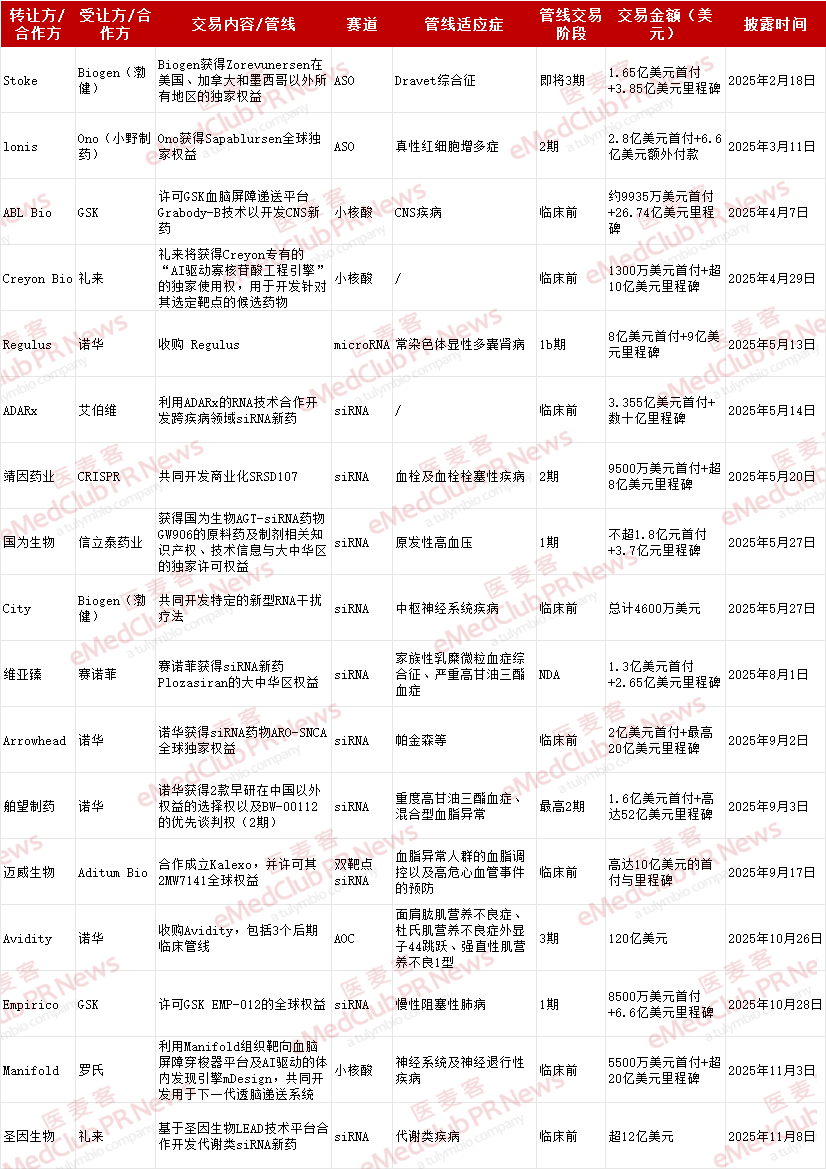
From the above transactions, we can clearly see that since 2025, BD in the small nucleic acid field has been extremely active. Whether it is the licensing of heavyweight assets in the clinical stage or platform collaborations involving multiple early-stage projects, they have been emerging one after another.
Due to the length limitation of the article, these transactions will not be analyzed one by one here. However, it is not difficult to see several major development trends of small nucleic acid drugs now and in the future from behind these transactions:
Indications Rapidly Expand from "Rare Diseases" to "Major Chronic Diseases"
Early small nucleic acid drugs mainly focused on treating rare diseases, such as spinal muscular atrophy. However, this year's deals clearly demonstrate that common chronic diseases with large patient populations, such as cardiometabolic disorders and central nervous system (CNS) diseases, have become key areas of corporate focus. For example, GW906 from Guowei Bio targets essential hypertension, while EMP-012, a collaboration between Empirico and GSK, is aimed at chronic obstructive pulmonary disease. These fields represent vast market potential and address the significant unmet needs of poor patient compliance or insufficient efficacy in current therapies.
The rapid expansion of indications has led to an exponential increase in the commercial potential of small nucleic acids, with their market potential being reassessed by the capital markets. Breakthroughs in technologies such as extrahepatic delivery have also brought new hope for tackling key diseases in the central nervous system, such as Alzheimer's disease.
Transaction Stage Moves Forward, Platform Technologies Gain Favor
Although there are still late-stage cases like Avidity (Pipeline Phase 3) being acquired by Novartis for $12 billion, the majority of deals focus on preclinical/early clinical (Phase 1-2) stages.
More notably, MNCs are vying to place their bets, valuing not just a specific drug, but the technological platform behind it. Platform-based collaborations enable large pharmaceutical companies to quickly lock in multiple targets and reduce the risks of independent research. Whoever masters more efficient, safer, and broader-target delivery technologies will seize the high ground of the next generation of nucleic acid drugs. This kind of "platform-based" deal has also driven up the valuation of Biotech companies with core platform technologies.
MNCs Actively "Stock Up," China's Innovation Role Upgrades
In 2025 transactions, MNCs such as Biogen, GSK, Eli Lilly, Novartis, and Sanofi have frequently acted, with upfront payments ranging from tens of millions to hundreds of millions of dollars and milestone amounts generally reaching billions to tens of billions of dollars. This reflects, to a certain extent, the strong confidence of MNCs in the future commercial value of the small nucleic acid track, and the cumulative investment of over 34.2 billion US dollars will also greatly accelerate the R&D process of related pipelines.
Moreover, it can be seen that this year, many local companies such as Jingyin Pharma, Guowei Biotech, Viagene, Bowang Pharma, Mabwell, and SANEGENEBIO have secured funding and global commercialization channels through pipeline licensing/technology transfer. These collaborations have transformed China from a "market follower" in the small nucleic acid field into an "important participant" and "technology contributor," significantly enhancing its innovative voice in areas like metabolism and CNS.
Challenges and Opportunities in the Golden Age
The explosive deals in the small nucleic acid field in 2025 mark the beginning of a golden age for this technology, but the road ahead remains full of challenges.
In terms of opportunities, the iteration of technology will continue to improve the success rate and efficacy of drugs; the continuous expansion of indications also means that a larger market space than the current market expectations is being opened up. Meanwhile, cooperation on a global scale will accelerate technology integration and innovation.
However, the challenges cannot be ignored. The delivery system is the core barrier for small nucleic acid drugs, and efficient and safe extrahepatic delivery remains a global challenge; reducing production costs and ensuring supply chain stability are also issues that must be addressed for industrialization; more importantly, a large number of early-stage pipelines will eventually need to undergo large-scale clinical trials to verify their long-term safety and efficacy, which still needs to be confirmed by data.
In summary, the transactions in the small nucleic acid field in 2025 are a microcosm of the industry's rapid development. It can be foreseen that, driven by multiple factors such as technology, capital, and clinical demand, small nucleic acid drugs are expected to usher in a period of explosive growth in the near future. For Chinese companies, the transaction boom in 2025 is both an "opportunity" and a "test" — how to form a "differentiated competitive edge" in terms of technological innovation and pipeline layout will determine whether they can secure a place in the global small nucleic acid arena.