

TIDES Weekly Digest | Global Peptide and Oligonucleotide Therapeutics News (Nov 8–14)

SANEGENEBIO
Small Nucleic Acid Drug Developer
Recently, Beijing Yookon Sci-Tech Innovation Pharmaceutical Technology Co., Ltd. and Hangzhou Tianlong Pharmaceutical Co., Ltd., subsidiaries of Yookon Pharmaceutical Group Co., Ltd., received the "Drug Clinical Trial Approval Notice" issued by the National Medical Products Administration (NMPA) for the injection YKYY013 intended for the treatment of chronic hepatitis B virus infection. Yookon Pharmaceutical will commence Phase I clinical trials of this product.
YKYY013The injection is a conjugate independently developed by Yuankang Innovation and Hangzhou Tianlong.N-N-Acetylgalactosamine (N-acetylgalactosamine,GalNAc) Chemical synthesis of double-stranded ligandssiRNA Drug, throughRNA Effective Silencing by InterferenceHBVMessenger of Genomic TranscriptionRNA(Messenger RNA,mRNA), thereby inhibiting the production of hepatitis B pathogenic proteins and suppressingHBVreplication, and create conditions for the host's immune reconstitution, ultimately achieving functional cure of hepatitis B. Clinically intended for the treatment of chronic hepatitis B virus infection.
Preclinical study results indicate that the YKYY013 injection demonstrated significant hepatitis B virus (HBV) inhibitory activity both in vivo and in vitro, with broad-spectrum suppression across HBV genotypes A-J. In pharmacodynamic tests involving AAV-HBV transfected mice (covering genotypes B, C, and D) and HBV genotype A transgenic mice, the injection significantly reduced levels of HBV DNA, hepatitis B surface antigen (HBsAg), and hepatitis B e antigen (HBeAg) after single or multiple doses, showing a clear dose-dependent effect. Notably, in the AAV-HBV transfected mouse model, various degrees of HBV DNA and HBsAg clearance were observed across all dosing groups, accompanied by the production of hepatitis B surface antibodies (HBsAb). Furthermore, repeat-dose toxicity studies in SD rats and cynomolgus monkeys demonstrated that the YKYY013 injection has good safety and tolerability.
2025YearNovember 8, focusing on the innovation of RNAi drug research and developmentSANEGENEBIO(SANEGENEBIO), today announced a global research and development collaboration and licensing agreement with Eli Lilly and Company ("Lilly"). The two parties will jointly advance the development of RNAi candidate drugs targeting metabolic diseases based on SANEGENEBIO's proprietary LEAD™ platform.

LEAD™ (Ligand and Enhancer Assisted Delivery, a novel ligand and enhancer co-delivery) platform is a tissue-selective delivery technology independently developed by SANEGENEBIO. It enables efficient and specific delivery of RNAi drugs to tissues and cells outside the liver. Based on this platform, a breakthrough therapy for metabolic diseases requiring only two subcutaneous injections per year could be developed.
SANEGENEBIO will be responsible for screening and identifying the optimal RNAi active molecules for the collaborative projects based on the LEAD™ platform, while Eli Lilly and Company will handle the subsequent drug's IND application research, clinical development, and commercialization.
According to the terms of the agreement, SANEGENEBIO will receive near-term payments including an upfront payment and equity investment. In addition, SANEGENEBIO is also entitled to receive subsequent development, regulatory, and sales milestone payments of up to $1.2 billion, as well as tiered royalties on commercial sales.
On November 9, 2025, Rona Therapeutics, a global biopharmaceutical company focused on developing next-generation RNAi therapies, presented the Phase I clinical trial results of its long-acting siRNA drug RN0361 targeting ApoC3 at the American Heart Association Annual Meeting. The oral presentation was delivered by Chief Medical Officer Dr. Alex M. DePaoli. The first-in-human study demonstrated that RN0361 achieved significant and sustained reductions in ApoC3 and triglycerides, with efficacy lasting at least six months, showcasing potential best-in-class characteristics. This drug may be used to prevent pancreatitis associated with severe hypertriglyceridemia and reduce cardiovascular disease risks caused by atherosclerotic lipoproteins.
This study is a randomized, placebo-controlled, single ascending dose clinical trial that enrolled subjects with baseline triglyceride levels >80 mg/dL. The results showed that RN0361 was well-tolerated, with no serious adverse events occurring throughout the trial. Only mild, self-resolving reactions were observed at the injection site; transient increases in alanine aminotransferase (ALT) and aspartate aminotransferase (AST) were consistent with the typical characteristics of GalNAc-conjugated siRNA drugs. The drug demonstrated dose-dependent significant inhibition of apolipoprotein C3 (ApoC3) and triglyceride (TG) levels, with effects lasting up to 180 days post-dosing, achieving maximum reductions of 93% and 69%, respectively. Additionally, non-high-density lipoprotein cholesterol, very low-density lipoprotein cholesterol, and remnant cholesterol also showed significant and sustained decreases. Compared with the placebo group, there were no statistically significant differences in fasting blood glucose or glycated hemoglobin (HbA1c) in the treatment group.
On November 10, 2025, SANEGENEBIO and Innovent Biologics, Inc. ("Innovent") jointly announced the primary results of the first-in-human (FIH) Phase I clinical study of SGB-3908 (Innovent's research code: IBI3016), a small interfering RNA (siRNA) drug targeting angiotensinogen (AGT). The findings were presented at the digital poster session of the 2025 American Heart Association (AHA) Scientific Sessions. Dr. Fangfang Wang from Peking University Third Hospital delivered an oral presentation of the study results on-site.
The FIH study (NCT06501586 / CTR20242500) of SGB-3908 (AGT siRNA) is a randomized, double-blind, placebo-controlled, single ascending dose trial conducted in healthy subjects and patients with mild hypertension. It aims to evaluate the safety, tolerability, pharmacokinetics (PK), and pharmacodynamics (PD) profiles following subcutaneous administration of SGB-3908.
As of July 1, 2025, a total of 40 healthy subjects and subjects with mild hypertension were randomly assigned to 5 cohorts (the ratio of the SGB-3908 dose group to the placebo group in each cohort was 6:2).All subjects were Chinese, with a median age (range) of 37 years (24-54 years), 30% were female, the average BMI was 25.2 kg/m², and the baseline 24-hour ambulatory blood pressure mean was 122/74 mmHg. There were no significant differences in baseline characteristics among the groups.
IBI3016 (SANEGENEBIO R&D Code: SGB-3908) is a siRNA drug targeting Angiotensinogen (AGT) co-developed by Innovent Biologics and SANEGENEBIO for the treatment of hypertension. IBI3016 is developed based on SANEGENEBIO's proprietary small nucleic acid drug development platform, utilizing its self-owned intellectual property GalNAc liver-targeting delivery technology, and inhibits AGT synthesis through the RNAi mechanism. Preclinical trial data show that IBI3016 can inhibit the synthesis of AGT in the liver, potentially leading to a sustained reduction in AGT protein, further resulting in decreased Ang II levels, ultimately causing vasodilation and blood pressure reduction.
2025YearNovember 12Eli Lilly and Company announced positive results from the Phase 2 clinical study of eloralintide, an investigational once-weekly selective amylin receptor agonist. The study evaluated the safety and efficacy of eloralintide in 263 obese or overweight adult participants without type 2 diabetes but with at least one weight-related comorbidity. At week 48, all dose groups of eloralintide met the primary endpoint, with average weight reductions ranging from 9.5% to 20.1%, surpassing the placebo group’s average reduction of 0.4% (using the efficacy estimand). These findings were presented at the Obesity Week 2025 conference and simultaneously published.In The Lancet.
In the study, all dose groups of eloralintide showed clinically meaningful improvements over placebo in secondary endpoints such as weight reduction and BMI improvement. Eloralintide was also associated with improvements in multiple cardiovascular risk factors, including waist circumference, blood pressure, blood lipids, blood glucose control, and inflammatory markers.

Eloralintide (LY3841136) is an investigational once-weekly, selective amylin receptor agonist. Studies suggest that eloralintide may reduce calorie intake by influencing satiety. Lilly is currently conducting a Phase 2 study (NCT06603571) to evaluate eloralintide alone or in combination with tirzepatide for weight management in obese or overweight adults with type 2 diabetes.
On November 13, 2025, Ascletis Pharma Inc. (HKEX code: 1672, referred to as "Ascletis") announced that the combination formulation of ASC36, a once-monthly next-generation amylin receptor agonist, and ASC35, a once-monthly next-generation GLP-1R/GIPR dual-target agonist, has entered the clinical development stage. Ascletis is expected to submit an Investigational New Drug (IND) application to the U.S. Food and Drug Administration (FDA) for the combination formulation of ASC36 and ASC35 for the treatment of obesity in the second quarter of 2026.
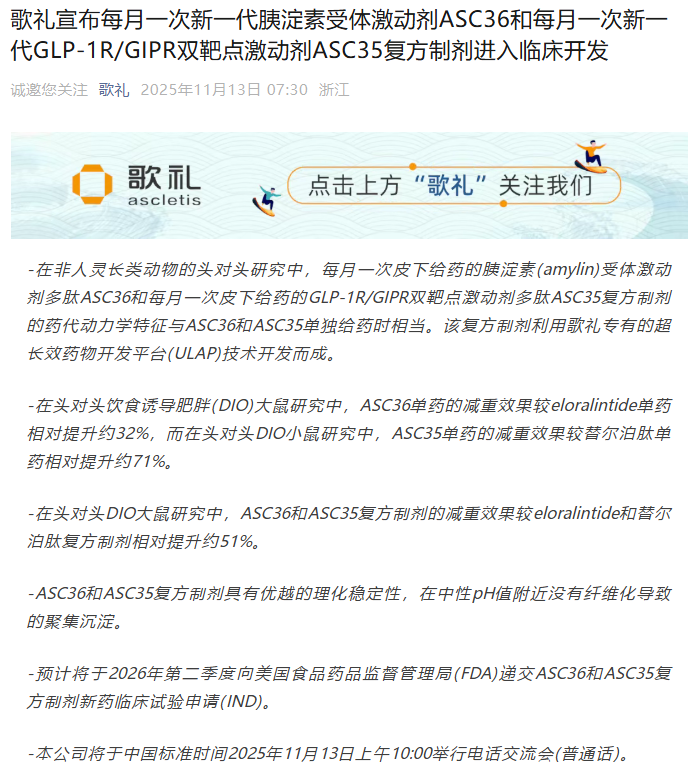
Monthly ASC36, a Next-Generation Amylin Receptor Agonist, and Monthly ASC35, a Next-Generation Dual GLP-1R/GIPR Agonist, were Both Independently Developed by Ascletis Using its AI-Assisted Structure-Based Drug Discovery (AISBDD) and Ultra-Long-Acting Platform (ULAP) Technologies. Leveraging ULAP technology, Ascletis has successfully formulated ASC36 and ASC35 into a proprietary ultra-long-acting combination formulation for once-monthly subcutaneous administration. The ASC36 and ASC35 combination formulation exhibits excellent physicochemical stability, with no aggregation or precipitation caused by fibrillation near neutral pH. Some amylin receptor agonist peptides tend to aggregate and precipitate around neutral pH, leading to reduced efficacy, cloudiness/particles, device clogging, and higher immunogenicity risks.
About Ascletis Pharma
Ascletis Pharma Inc. is a fully integrated biotechnology company focusing on the development and commercialization of potentially best-in-class and first-in-class drugs for the treatment of metabolic diseases.
2025YearNovember 13, the CDE official website shows that Eli Lilly'sGlucose-dependent insulinotropic polypeptide (GIP) andThe new indication application for tirzepatide injection, a glucagon-like peptide-1 (GLP-1) receptor dual agonist, has been accepted.
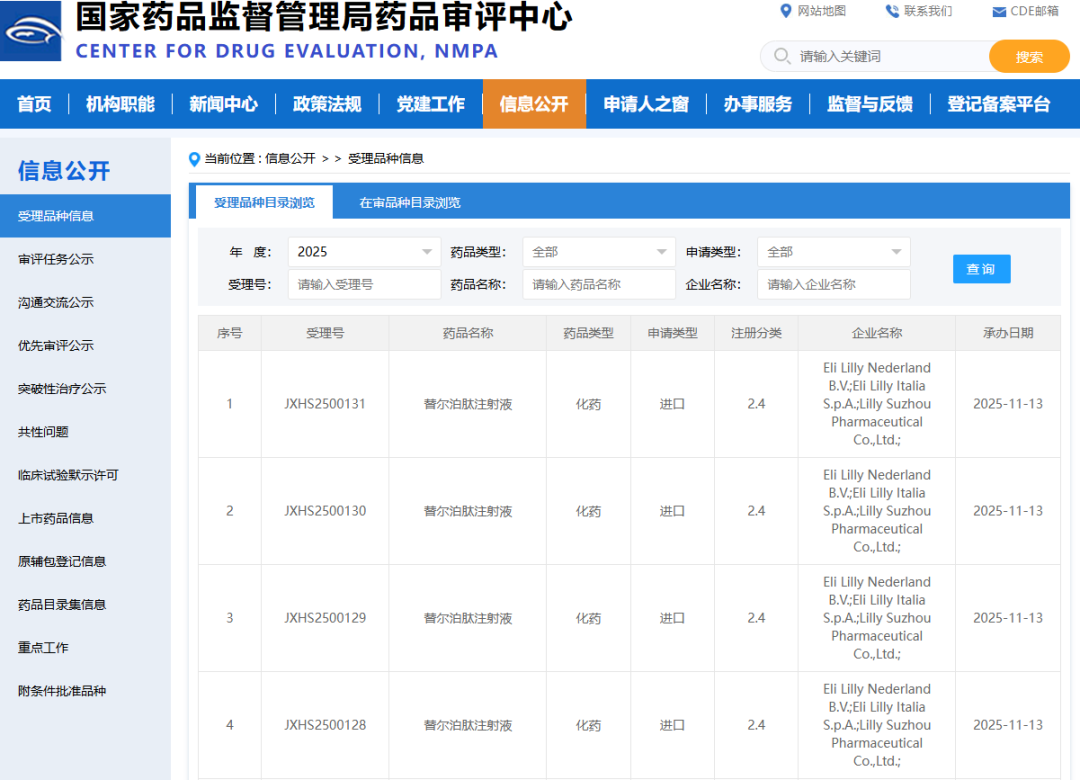
In May 2022, tirzepatide was first approved by the FDA for marketing to treat type 2 diabetes. In May 2024, tirzepatide was first approved for marketing in China, indicated for adults whose blood glucose remains inadequately controlled on metformin and/or sulfonylurea therapy, in addition to diet and exercise.Type 2 Diabetes(T2DM) patients.
In July 2024, tirzepatide was approved in China for a new indication: long-term use in adults with a body mass index (BMI) meeting the following requirements, in addition to controlled diet and increased exercise.Weight Management: ≥28 kg/m2 (obesity), or ≥24 kg/m2 (overweight) accompanied by at least one weight-related comorbidity (e.g., hypertension, dyslipidemia, hyperglycemia, obstructive sleep apnea, cardiovascular disease, etc.).
In June this year, tirzepatide was approved in China for its third indication:For the treatment of moderate to severe obstructive sleep apnea (OSA) in adult obese patients.
2025YearNovember 14, focusing on innovative RNAi drug research and developmentSANEGENEBIO(SANEGENEBIO) announced that the results of the Phase I clinical trials of its complement C3-targeted small interfering RNA (siRNA) drug, SGB-9768, conducted separately in New Zealand and China, were presented in a poster session at the ASN Kidney Week 2025, the annual meeting of the American Society of Nephrology. Dr. Nicholas Cross from the New Zealand Clinical Research Center (principal investigator of the Phase I clinical trial of SGB-9768 in New Zealand) presented the findings on-site.

SGB-9768 is the first domestically produced innovative siRNA drug in China targeting complement C3 independently developed by SANEGENEBIO. The drug utilizes the company's proprietary GalNAc liver-targeting delivery technology and specifically inhibits C3 expression through the RNA interference (RNAi) mechanism, thereby suppressing the overactivation of the complement system at its source. It provides a novel therapeutic option for various complement-mediated kidney diseases, including IgAN, C3G, and immune complex-mediated membranoproliferative glomerulonephritis (IC-MPGN). Phase I clinical trial data show that after a single subcutaneous injection, SGB-9768 demonstrated good safety and tolerability, with dose-dependent, significant, and long-lasting reductions in C3 protein levels and complement pathway activity. Compared with other siRNA products targeting the same site, SGB-9768 achieves higher target protein knockdown at the same dose and maintains the knockdown effect longer, showing "best-in-class" potential. Due to its remarkable long-acting properties, SGB-9768 has the potential to be administered once every three or six months, greatly improving patient convenience. Currently, the drug is undergoing Phase II clinical trials in China and has been granted Orphan Drug Designation by the U.S. FDA for the treatment of C3G.