In early November, Insilico Medicine updated its Hong Kong IPO prospectus once again.Within the year, May 8thThe company had previously submitted an IPO application to the Hong Kong Stock Exchange. Six months later, with the company yet to complete the listing hearing, updating the prospectus indicates its ongoing push for a Hong Kong IPO. Since 2023, Insilico Medicine has maintained a yearly rhythm of filing for an IPO.
On November 12, a reporter from The Paper inquired Insilico Medicine about the dynamics related to its IPO on the Hong Kong stock market. Insilico Medicine stated that, according to the requirements of the Hong Kong Stock Exchange, the company is temporarily unable to respond.
Insilico Medicine is a star company in the industry, founded in 2014 and labeled as "Artificial Intelligence (AI) pharmaceuticals." According to its official website, the company boasts an impressive lineup of investors, including Warburg Pincus, Qiming Venture Partners, WuXi AppTec, Lilly Asia Ventures, Blue Lake Capital, and Baidu Ventures.
During the COVID-19 pandemic, baricitinib, identified by AI, received Emergency Use Authorization (EUA) from the U.S. Food and Drug Administration (FDA). The combination therapy with remdesivir was approved, allowing investors to see the potential of AI entering the pharmaceutical industry.
Subsequently, new AI pharmaceutical companies have continuously emerged worldwide. Among them is Evolutionary Scale, a unicorn company that focuses on protein design models and raised $142 million in seed funding. Its founding team comes from Meta (formerly Facebook). However, it has recently been integrated into the CZI organization, founded by the Zuckerberg couple, telling a story of how a top AI startup team was acquired by a giant in charitable scientific research.
Among Chinese companies, in June 2024, XtalPi successfully listed on the Hong Kong Stock Exchange, becoming the only AI drug discovery company in China to successfully go public amid a downturn in the global capital markets. Within the “AI Pharmaceutical Four小龙,” Jetta Technology completed its D-round financing within the year, while Deep Intelligent Pharma completed its C-round financing in October of last year. Additionally, DP Technology also completed its round in October last year, which is...Nobel Prize Goes to AI"During the same period, it secured the seventh round of financing.
However, no second company in China's AI pharmaceuticals sector has emerged to take the baton and ring the IPO bell, making the success or failure of "leading player" Insilico Medicine's IPO highly anticipated. If the company successfully goes public, it would add credibility to the AI pharmaceuticals narrative. However, given its repeated filings up to now, regulators likely have already provided their answer.
Insilico Medicine's pioneering nature is reflected in the fact that it is one of the first biotechnology companies globally to advance drug development, based on its self-developed AI platform, into clinical trials. To date, its core asset Rentosertib (ISM001-055) — an investigational drug discovered and designed by AI for the treatment of idiopathic pulmonary fibrosis (IPF) — has completed Phase IIa clinical research (GENESIS-IPF) in China. In April this year, ISM001-055 received Breakthrough Therapy Designation from the Center for Drug Evaluation (CDE).
According to the latest version of the prospectus, the Center for Drug Evaluation has confirmed that Insilico Medicine can proceed with Phase III clinical trials after achieving positive results from the Phase IIa study, which is expected to be completed in August 2024. This means that if Insilico Medicine decides to advance ISM001-055 into Phase III clinical trials, it would become the world's first AI-discovered and designed drug to enter Phase III clinical trials. Of course, whether ISM001-055 will proceed to Phase III clinical trials and whether it can complete Phase III clinical trials remain inconclusive.
On the other hand, the progress of ISM001-055 also indicates that Insilico Medicine, which has been established for a decade and received substantial financing, still does not have a single drug candidate in Phase III clinical trials. If this were merely an innovative pharmaceutical company, such a pace would be somewhat disappointing, let alone being at the forefront of China's innovative drug sector in the past five years.
For any company, one of the functions of an IPO is to raise funds, especially for innovative drug companies without commercialized drugs and requiring huge R&D investments, such as Insilico Medicine. However, its cash reserves are still relatively robust.
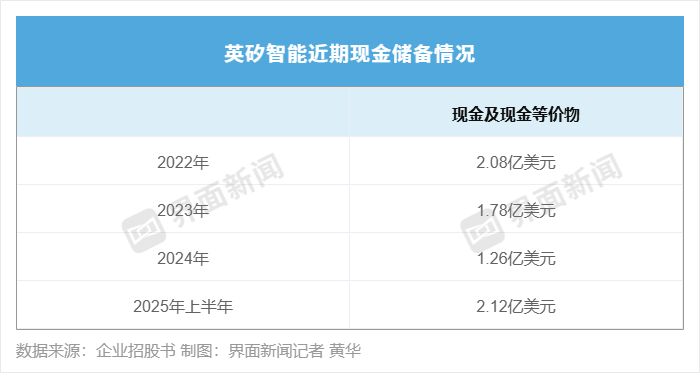
Data shows that by the end of the first half of this year, Insilico Medicine's cash and equivalents increased from US$126 million at the end of last year to US$213 million, mainly due to a US$123 million Series E financing round completed in the first half of this year. Based on the company’s R&D expenditure of just over US$90 million for 2023 and 2024, maintaining stable operations in the short term should not be a difficult task.
Corporate Cash Reserves SituationChart by Huang Hua, Reporter of Interface News
However, if Insilico Medicine's drug candidates can successfully advance to Phase III clinical trials, its cash situation may face more challenges, highlighting the necessity of the company's IPO. Meanwhile, cash reserves remain a crucial condition that restricts the development of startups.
From Insilico Medicine's response, although the company does not have commercial revenue from drugs, it has a series of commercial licensing income and R&D service income. For example, licensing the drug under research ISM3091 to Exelixis, licensing ISM5043 and undisclosed drugs under research to Stemline. In these two collaborations with Stemline, Insilico Medicine received an upfront payment totaling $32 million. In addition, Insilico Medicine’s collaborators also include Fosun Pharma and Sanofi.
In terms of the commercial licensing model, only upfront payments represent real value, indicating the licensee's level of recognition for the molecule under research. A smaller amount suggests limited confidence from the partner at present. Additionally, the uncertainty regarding whether a company can receive milestone payments in the future is relatively high, which is also a limitation of this model.
Moreover, for Insilico Medicine, AI capability is the core competitiveness of the company. However, compared to a decade ago, companies of all sizes today place greater emphasis on AI. There are quite a few companies in the industry that can provide AI + drug development services, and the wave of large model popularity triggered by Chat GPT and Deep Seek has further accelerated this trend. This means that if Insilico Medicine cannot further enhance its technological capabilities, its survival pressure will continue to increase.
Moreover, in current research on the role of AI in the drug development phase, the conclusions generally presented are that AI can accelerate drug discovery and the preclinical stage, but it has no significant impact on entering clinical trials or subsequent stages, nor can it improve the success rate of clinical trials or the number of drug approvals. In other words, from a longer-term perspective, the role of AI is currently limited.
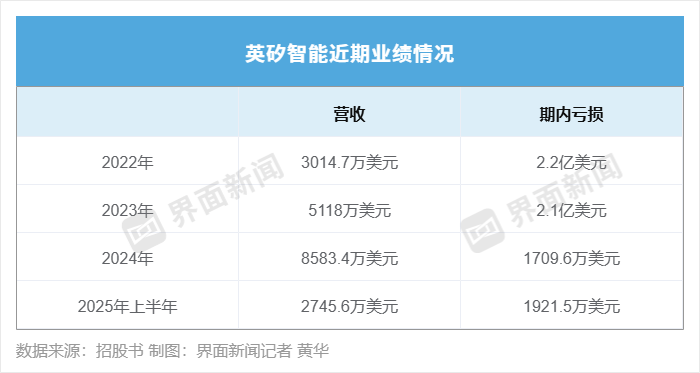
In terms of operating performance, Insilico Medicine's business condition improved in 2024, with not only a significant increase in revenue but also a substantial reduction in losses. From 2022 to 2024, the company’s revenue grew from $30.1 million to $85.8 million, and its net loss narrowed from $222 million to $17.1 million.
Corporate Performance Chart: Huang Hua, Reporter of Interface News
Moreover, Gao Chengyuan, Chairman and CEO of Tiaoyuan Consulting, also told Interface News when commenting on Insilico Medicine's IPO,Sentiment for Hong Kong Stock 18A Has Yet to RecoverIn the AI pharmaceuticals sector, three companies in the same track that were in the queue at the same time have seen two switch to Nasdaq, while one has paused its financing. The characteristics of poor liquidity and high rates of falling below issue price have made long-term funds dare only look at consumer healthcare with higher profit certainty. Without anchored orders, sponsors do not dare to push hard, and the listing hearing period naturally drags on until it is abandoned.
Interface News reporter |Huang Hua
Interface News Editor |Xin Xie
In early November, Insilico Medicine updated its prospectus for the Hong Kong stock market once again.May 8th within the yearThe company had previously submitted an IPO application to the Hong Kong Stock Exchange. Six months later, with the company yet to complete the listing hearing, updating the prospectus signifies its ongoing push for a Hong Kong IPO. Since 2023, Insilico Medicine has maintained a frequency of submitting an application once per year.
On November 12, a reporter from The Paper inquired Insilico Medicine about the dynamics related to its IPO in Hong Kong. Insilico Medicine stated that, according to the requirements of the Hong Kong Stock Exchange, the company is temporarily unable to respond.
Insilico Medicine is a star company in the industry, founded in 2014, labeled as "Artificial Intelligence (AI) Pharmaceutical". According to the official website, the company boasts a strong lineup of investors, including Warburg Pincus, Qiming Venture Partners, WuXi AppTec, Lilly Asia Ventures, Blue Lake Capital, and Baidu Ventures.
During the COVID-19 pandemic, baricitinib, identified by AI, received Emergency Use Authorization (EUA) from the U.S. Food and Drug Administration (FDA). The combination therapy with remdesivir was approved, allowing investors to see the potential of AI entering the pharmaceutical industry.
Subsequently, new AI pharmaceutical companies have continuously emerged worldwide. Among them is Evolutionary Scale, a unicorn enterprise specializing in protein design models that raised $142 million in seed funding, with its founding team hailing from Meta (formerly Facebook). However, it has recently been integrated into the CZI organization, founded by the Zuckerberg couple, marking a story where a top-tier AI startup team was acquired by a giant in charitable scientific research.
Among Chinese companies, in June 2024, XtalPi successfully listed on the Hong Kong Stock Exchange by leveraging favorable conditions. After the global capital market downturn, it also became the only AI pharmaceutical company in China to successfully go public so far. Of the “AI Pharmaceutical Four小龙,” JettyBio completed its D-round financing within the year, while Deep Intelligent Pharma completed its C-round financing in October last year. Additionally, DP Technology also completed a financing round in October last year, which is...Nobel Prize Goes to AI" during the same period, secured the seventh round of financing.
However, no second company in China's AI pharmaceuticals sector has emerged to take the baton and ring the IPO bell, making the success or failure of "leading player" Insilico Medicine's IPO highly anticipated. If the company successfully goes public, it would add credibility to the AI pharmaceuticals narrative. However, given its repeated filings to date, regulators likely have already provided their answer.
Insilico Medicine's pioneering nature is reflected in the fact that it is one of the first biotechnology companies globally to advance drug development, based on its self-developed AI platform, into clinical trials. To date, its core asset Rentosertib (ISM001-055) — an investigational drug discovered and designed by AI for the treatment of idiopathic pulmonary fibrosis (IPF) — has completed Phase IIa clinical research (GENESIS-IPF) in China. In April this year, ISM001-055 received Breakthrough Therapy Designation from the Center for Drug Evaluation (CDE).
According to the latest version of the prospectus, the Center for Drug Evaluation has confirmed that Insilico Medicine can proceed with Phase III clinical trials after achieving positive results from the Phase IIa study, which is expected to be completed in August 2024. This means that if Insilico Medicine decides to advance ISM001-055 into Phase III clinical trials, it would become the world’s first AI-discovered and designed drug to enter Phase III clinical trials. However, whether ISM001-055 will advance to Phase III or complete Phase III remains inconclusive.
On the other hand, the progress of ISM001-055 also indicates that Insilico Medicine, which has been established for a decade and received substantial financing, still doesn't have a single drug candidate in Phase III clinical trials. If this were merely an innovative pharmaceutical company, such a pace would be somewhat disappointing, not to mention leading the pack in China's innovative drug sector over the past five years.
For any company, one of the functions of an IPO is to raise funds, especially for innovative drug companies without commercialized drugs and in need of huge R&D investment, such as Insilico Medicine. However, its cash reserves are still relatively robust.
Data shows that by the end of the first half of this year, Insilico Medicine's cash and equivalents increased from US$126 million at the end of last year to US$213 million, mainly due to the US$123 million raised in Series E financing in the first half of this year. Based on the company’s R&D expenditure of just over US$90 million in 2023 and 2024, maintaining stable operations in the short term should not be a difficult task.
Corporate Cash Reserves SituationChart by Huang Hua, Reporter of Interface News
However, if Insilico Medicine's drug candidates can successfully advance to Phase III clinical trials, its cash situation may face more challenges, highlighting the necessity of the company's IPO. Meanwhile, cash reserves remain a crucial condition constraining the development of startups.
From Insilico Medicine's response, although the company does not have commercial revenue from drugs, it has a series of commercial licensing income and R&D service income. For instance, it licensed the drug under research ISM3091 to Exelixis, ISM5043 to Stemline, as well as undisclosed drugs under research. In these two collaborations with Stemline, Insilico Medicine received an upfront payment totaling $32 million. Additionally, Insilico Medicine’s collaborators also include Fosun Pharma and Sanofi.
In terms of the commercial licensing model, only the upfront payment represents tangible value, indicating the licensee's level of recognition for the molecule under research. A smaller amount suggests limited confidence from the partner at present. Additionally, there is significant uncertainty regarding whether a company will receive milestone payments in the future, which is one of the limitations of this model.
Moreover, for Insilico Medicine, AI capability is the core competitiveness of the company. However, compared with ten years ago, nowadays companies of all sizes pay more attention to AI. There are quite a few companies in the industry that can provide AI + drug development services. The craze for large models triggered by Chat GPT and Deep Seek has further accelerated this trend. This means that if Insilico Medicine cannot further enhance its technical capabilities, its survival pressure will increase further.
Moreover, in the current research on the role of AI in the drug development phase, the conclusions generally presented are that AI can accelerate drug discovery and the preclinical stage, but it has no significant impact on entering clinical trials or subsequent stages, nor can it improve the success rate of clinical trials or the number of drug approvals. In other words, from a longer-term perspective, the role of AI is currently limited.
In terms of operating performance, Insilico Medicine's business condition improved in 2024, with not only significant revenue growth but also a substantial reduction in losses. From 2022 to 2024, the company’s revenue increased from $30.1 million to $85.8 million, and its net loss narrowed from $222 million to $17.1 million.
Corporate Performance Chart: Huang Hua, Reporter of Interface News
Moreover, Gao Chengyuan, Chairman and CEO of Tiaoyuan Consulting, also told Interface News when commenting on Insilico Medicine's IPO,Sentiment for Hong Kong Stock 18A Has Yet to RecoverIn the AI pharmaceuticals sector, three companies in the same track that were in the queue during the same period have seen two of them switch to Nasdaq, and one has paused its financing. The characteristics of poor liquidity and high rate of trading below IPO price have made long-term funds dare only look at consumer healthcare with higher profit certainty. Without anchored orders, sponsors don't dare to push hard, and the hearing period naturally drags on until it is abandoned.
Image Source: Visual China
Interface News reporter |Huang Hua
Interface News Editor |Xin Xie
In early November, Insilico Medicine updated its prospectus for the Hong Kong stock market once again.May 8th of the yearThe company had previously submitted an IPO application to the Hong Kong Stock Exchange. Six months later, with the company yet to complete the listing hearing, updating the prospectus signifies its ongoing push for a Hong Kong IPO. Since 2023, Insilico Medicine has maintained a yearly rhythm of filing for an IPO.
On November 12, a reporter from The Paper inquired Insilico Medicine about the dynamics related to its IPO on the Hong Kong stock market. Insilico Medicine stated that, according to the requirements of the Hong Kong Stock Exchange, the company is temporarily unable to respond.
Insilico Medicine is a star company in the industry, established in 2014, labeled as "Artificial Intelligence (AI) pharmaceuticals." According to the official website, the company boasts an impressive lineup of investors, including Warburg Pincus, Qiming Venture Partners, WuXi AppTec, Lilly Asia Ventures, Blue Lake Capital, and Baidu Ventures.
During the COVID-19 pandemic, baricitinib, identified by AI, received Emergency Use Authorization (EUA) from the U.S. Food and Drug Administration (FDA). The combination therapy with remdesivir was approved, allowing investors to see the potential of AI entering the pharmaceutical industry.
Subsequently, new AI pharmaceutical companies have continuously emerged worldwide. Among them is Evolutionary Scale, a unicorn company focusing on protein design models that raised $142 million in seed funding. Its founding team originated from Meta (formerly Facebook). However, it has recently been integrated into CZI, an institution established by the Zuckerberg couple, marking a story where a top-tier AI startup team was acquired by a giant in charitable scientific research.
Among Chinese companies, in June 2024, XtalPi successfully listed on the Hong Kong Stock Exchange, becoming the only AI pharmaceutical company in China to successfully go public amid a downturn in the global capital market. Within the "AI Pharmaceutical Four小龙 (小龙translates as 'Little Dragons')," JettyPharma completed its D-round financing within the year, while Deep Intelligent Pharma completed its C-round financing in October of last year. Additionally, DP Technology also completed its [context unclear] in October last year.Nobel Prize Goes to AI" during the same period, secured the seventh round of financing.
However, no second company in China's AI pharmaceuticals sector has emerged to take the baton and ring the IPO bell, making the success or failure of "leading player" Insilico Medicine's IPO highly anticipated. If the company successfully goes public, it would add credibility to the AI pharmaceuticals narrative. However, given its repeated filings up to now, regulators likely have already provided their answer.
Insilico Medicine's pioneering nature is reflected in the fact that it is one of the first biotechnology companies globally to advance drug development based on its self-developed AI platform into clinical trials. To date, its core asset Rentosertib (ISM001-055) — an investigational drug discovered and designed by AI for the treatment of idiopathic pulmonary fibrosis (IPF) — has completed Phase IIa clinical research (GENESIS-IPF) in China. In April this year, ISM001-055 received Breakthrough Therapy Designation from the Center for Drug Evaluation (CDE).
According to the latest version of the prospectus, the Center for Drug Evaluation has confirmed that Insilico Medicine can proceed with Phase III clinical trials after achieving positive results from the Phase IIa study, which is expected to be completed in August 2024. This means that if Insilico Medicine decides to advance ISM001-055 into Phase III clinical trials, it would become the world's first AI-discovered and designed drug to enter Phase III clinical trials. However, whether ISM001-055 will proceed to Phase III clinical trials and whether it can complete Phase III clinical trials remain inconclusive.
On the other hand, the progress of ISM001-055 also implies that Insilico Medicine, which has been established for a decade and received substantial financing, still hasn't had any drug in its pipeline enter Phase III clinical trials. If this were just an innovative pharmaceutical company, such a pace would be somewhat disappointing, let alone taking the lead in China's innovative drug sector over the past five years.
For any company, one of the functions of an IPO is to raise funds, especially for innovative drug companies without commercialized drugs and requiring huge R&D investment, such as Insilico Medicine, which is at a similar stage. However, its cash reserves are relatively robust.
Data shows that by the end of the first half of this year, Insilico Medicine's cash and equivalents increased from US$126 million at the end of last year to US$213 million, mainly due to a US$123 million Series E financing round in the first half of this year. Based on the company’s R&D expenditure of just over US$90 million for 2023 and 2024, maintaining stable operations in the short term should not be too difficult.
Corporate Cash Reserves SituationChart by Huang Hua, Reporter of Interface News
However, if Insilico Medicine's drug candidates can successfully advance to Phase III clinical trials, its cash situation may face more challenges, highlighting the necessity of the company's IPO. At the same time, cash reserves remain a critical condition constraining the development of start-up companies.
From the response of Insilico Medicine, although the company does not have commercial revenue from drugs, it has a series of commercial licensing revenue and R&D service revenue. For instance, it licensed the drug under research ISM3091 to Exelixis, ISM5043 to Stemline, as well as other undisclosed drugs under research. In these two collaborations with Stemline, Insilico Medicine received an upfront payment totaling $32 million. Additionally, Insilico Medicine’s collaborators also include Fosun Pharma and Sanofi.
In terms of the commercial licensing model, only the upfront payment represents tangible value, indicating the licensee's level of recognition for the molecule under research. A smaller amount suggests limited confidence from the partner at present. Additionally, the uncertainty regarding whether a company can receive milestone payments in the future is relatively high, which is also a limitation of this model.
Moreover, for Insilico Medicine, AI capability is the core competitiveness of the company. However, compared to a decade ago, companies of all sizes now place greater emphasis on AI. There are quite a few companies in the industry that offer AI + drug development services. The surge in large models triggered by Chat GPT and Deep Seek has further accelerated this trend. This means that if Insilico Medicine cannot further enhance its technological capabilities, its survival pressure will continue to increase.
Moreover, in the existing research on the role of AI in the drug development phase, the conclusions generally presented are that AI can accelerate drug discovery and the preclinical stage, but it has no significant impact on entering clinical trials or subsequent stages, nor can it improve the success rate of clinical trials or the number of drug approvals. In other words, from a longer-term perspective, the role of AI is currently limited.
In terms of operating performance, Insilico Medicine's business condition improved in 2024, with not only a significant increase in revenue but also a substantial reduction in losses. From 2022 to 2024, the company’s revenue grew from $30.1 million to $85.8 million, and its net loss narrowed from $222 million to $17.1 million.
Corporate Performance Chart: Huang Hua, Reporter of Interface News
Moreover, Gao Chengyuan, Chairman and CEO of Tiaoyuan Consulting, also told Interface News when commenting on Insilico Medicine's IPO,Sentiment for Hong Kong Stock 18A Has Yet to RecoverIn the AI pharmaceuticals sector, three companies in the same track that were in the queue at the same time have seen two switch to Nasdaq, and one halt its financing. The characteristics of poor liquidity and high rates of falling below issue price have made long-term funds only dare to look at consumer healthcare with higher profitability certainty. Without anchored orders, sponsors don't dare to push hard, and the listing hearing period naturally drags on until it is abandoned.
Interface News reporter |Hua Huang
Interface News Editor |Xie Xin
In early November, Insilico Medicine updated its Hong Kong IPO prospectus once again.Within the year, May 8th, the company had previously submitted an IPO application to the Hong Kong Stock Exchange. Six months later, with the company yet to complete the listing hearing, updating the prospectus indicates its ongoing push for a Hong Kong IPO. Since 2023, Insilico Medicine has maintained a frequency of submitting applications once a year.
On November 12, a reporter from The Paper inquired Insilico Medicine about the dynamics related to its IPO on the Hong Kong stock market. Insilico Medicine stated that, according to the requirements of the Hong Kong Stock Exchange, the company is temporarily unable to respond.
Insilico Medicine is a star company in the industry, founded in 2014, labeled as "Artificial Intelligence (AI) pharmaceuticals." According to the official website, the company boasts a strong lineup of investors, including Warburg Pincus, Qiming Venture Partners, WuXi AppTec, Lilly Asia Ventures, Blue Lake Capital, and Baidu Ventures.
During the COVID-19 pandemic, baricitinib, identified by AI, received Emergency Use Authorization (EUA) from the U.S. Food and Drug Administration (FDA). The combination therapy with remdesivir was approved, allowing investors to see the potential of AI entering the pharmaceutical industry.
Subsequently, new AI pharmaceutical companies have continuously emerged worldwide. Among them is Evolutionary Scale, a unicorn enterprise with a founding team from Meta (formerly Facebook). This company focuses on protein design models and secured $142 million in seed funding. However, it has recently been integrated into the CZI organization, founded by Mark Zuckerberg and his wife, telling a story of a top-tier AI startup being absorbed by a giant in charitable scientific research.
Among Chinese companies, in June 2024, XtalPi successfully listed on the Hong Kong Stock Exchange, becoming the only AI drug discovery company in China to successfully go public amid a global capital market downturn. Within the “AI Drug Discovery Four小龙,” Jetta Technology completed its D-round financing within the year, while Deep Intelligent Pharma completed its C-round financing in October of the previous year. Additionally, DP Technology also completed its round in October of the previous year, which is...Nobel Prize Goes to AI" during the same period, secured the seventh round of financing.
However, no second company in China's AI pharmaceuticals sector has emerged to take the baton and ring the IPO bell, making the success or failure of "leading player" Insilico Medicine's IPO highly anticipated. If the company successfully goes public, it would add credibility to the AI pharmaceuticals narrative. However, given its repeated submission of prospectuses up to now, regulators likely have already provided their answer.
Insilico Medicine's pioneering nature is reflected in the fact that it is one of the first biotechnology companies globally to advance drug development based on its self-developed AI platform into clinical trials. To date, its core asset Rentosertib (ISM001-055) — an investigational drug discovered and designed by AI for the treatment of idiopathic pulmonary fibrosis (IPF) — has completed Phase IIa clinical research (GENESIS-IPF) in China. In April this year, ISM001-055 received Breakthrough Therapy Designation from the Center for Drug Evaluation (CDE).
According to the latest version of the prospectus, the Center for Drug Evaluation has confirmed that Insilico Medicine can proceed with Phase III clinical trials after achieving positive results from the Phase IIa study, which is expected to be completed in August 2024. This means that if Insilico Medicine decides to advance ISM001-055 into Phase III clinical trials, it would become the world’s first AI-discovered and designed drug to enter Phase III clinical trials. Of course, whether ISM001-055 will advance to Phase III or complete Phase III remains inconclusive.
On the other hand, the progress of ISM001-055 also indicates that Insilico Medicine, which has been established for a decade and received substantial financing, has yet to have a single drug candidate enter Phase III clinical trials. If this were merely an innovative pharmaceutical company, such a pace would be somewhat disappointing, not to mention being at the forefront of China's innovative drug sector in the past five years.
For any company, one of the functions of an IPO is to raise funds, especially for innovative drug companies without commercialized drugs and in need of huge R&D investment, such as Insilico Medicine, which is at a similar stage. However, its cash reserves are relatively robust.
Data shows that by the end of the first half of this year, Insilico Medicine's cash and equivalents increased from US$126 million at the end of last year to US$213 million, mainly due to a US$123 million Series E financing round in the first half of this year. Based on the company’s R&D expenditure of just over US$90 million in 2023 and 2024, maintaining stable operations in the short term should not be too difficult.
Corporate Cash Reserves Chart: Huang Hua, Reporter of Interface News
However, if Insilico Medicine's drug candidates can successfully advance to Phase III clinical trials, its cash situation may face more challenges, highlighting the necessity of the company's IPO. Meanwhile, cash reserves remain a critical condition constraining the development of startups.
From Insilico Medicine's response, although the company does not have commercial revenue from drugs, it has a series of commercial licensing income and R&D service income. For example, licensing the drug under research ISM3091 to Exelixis, licensing ISM5043 and undisclosed drugs under research to Stemline. In these two collaborations with Stemline, Insilico Medicine received an upfront payment totaling 32 million US dollars. Additionally, Insilico Medicine’s collaborators also include Fosun Pharma and Sanofi.
In terms of the commercial licensing model, only upfront payments represent real value, indicating the licensee's level of recognition for the molecule under research. A smaller amount suggests limited confidence from the partner at present. Additionally, the uncertainty regarding whether a company can receive milestone payments in the future is relatively high, which is also a limitation of this model.
Moreover, for Insilico Medicine, AI capability is the core competitiveness. However, compared to a decade ago, companies of all sizes today are placing greater emphasis on AI. There are quite a few companies in the industry that can offer AI + drug development services. The wave of large model popularity triggered by Chat GPT and Deep Seek has further accelerated this trend. This means that if Insilico Medicine cannot further enhance its technological capabilities, its survival pressure will continue to increase.
Moreover, in the current research on the role of AI in the drug development phase, the conclusions generally presented are that AI can accelerate drug discovery and the preclinical stage, but it has no significant impact on entering clinical trials or subsequent stages, nor can it improve the success rate of clinical trials or the number of drug approvals. In other words, from a longer-term perspective, the role of AI is currently limited.
In terms of operating performance, Insilico Medicine's business condition improved in 2024, with not only a significant increase in revenue but also a substantial reduction in losses. From 2022 to 2024, the company’s revenue grew from $30.1 million to $85.8 million, and its net loss narrowed from $222 million to $17.1 million.
Corporate Performance Chart: Huang Hua, Reporter of Interface News
Moreover, Gao Chengyuan, Chairman and CEO of Tiaoyuan Consulting, also told Jiemian News when commenting on Insilico Medicine's IPO,Sentiment for Hong Kong Stock 18A Has Yet to RecoverIn the AI pharmaceuticals sector, three companies in the same track that were in the queue during the same period have seen two of them switch to Nasdaq, and one suspend financing. The characteristics of poor liquidity and high rate of breaking below issue price make long-term funds only dare to look at consumer healthcare with higher profitability certainty. Without anchoring orders, sponsors do not dare to push hard, and the listing hearing period naturally drags on until it is abandoned.