

Johnson & Johnson to Acquire Halda Therapeutics for $3.05 Billion to Advance Oral RIPTAC Platform in Oncology

Johnson & Johnson
Healthcare Product Manufacturers, Health Service Providers
Halda
Cancer Drug Developer
Recently, Johnson & Johnson, a multinational healthcare giant, announced that it would acquire Halda Therapeutics, a biotech startup focused on novel targeted therapies, for $3.05 billion in cash.
This startup, founded by Professor Craig Crews of Yale University, has developed the innovative RIPTAC (Regulated Induced Proximity Targeting Chimeras) drug platform that precisely targets cancer cells through a "hold and kill" mechanism. Its core pipeline is HLD-0915, an oral candidate drug for the treatment of metastatic castration-resistant prostate cancer (mCRPC).
Halda just announced the first batch of Phase 1/2 clinical data in October, showing that the drug was safe and well-tolerated in patients with advanced prostate cancer who were unresponsive to multiple lines of treatment. Additionally, levels of prostate-specific antigen (PSA) and circulating tumor DNA (ctDNA) significantly decreased in some patients.
Halda Therapeutics: Protein Degradation Pioneer Explores New Pathways, RIPTAC Overcomes Cancer Drug Resistance Challenges
Halda Therapeutics, LLC. was founded in 2019 by molecular biologist Craig Crews. Professor Crews co-founded Proteolix, which developed the multiple myeloma drug Kyprolis, and Arvinas, the world's first PROTAC drug company, and is considered a pioneer in the field of targeted protein degradation. The name Halda originates from the Old Norse word for "to hold," symbolizing the ability of its RIPTAC drugs to "hook" two proteins and exert their effects.
According to the official website introduction,RIPTAC is a bifunctional small molecule, with one end binding to tumor-specific proteins and the other end binding to essential cellular proteins. The two are tightly pulled together to form a novel ternary complex, shutting down the activity of key functional proteins and inducing cancer cell death.This mechanism directly targets "undruggable" molecules or those associated with resistance, overcoming the limitations of traditional precision therapies prone to failure by creating novel protein-protein interactions.
Halda's research and development focus is on oral RIPTAC anti-cancer drugs. Currently, its most advanced pipeline candidate is HLD-0915.Targeting the common driver factor of prostate cancer, the androgen receptor (AR), and the key transcription factor BRD4. HLD-0915 is designed with one end binding to AR (highly expressed in prostate cancer cells) and the other end binding to the essential protein BRD4, forming a ternary complex and shutting down BRD4 function within tumor cells, thereby selectively killing prostate cancer cells. Importantly, this "hold" mechanism does not rely on tumor-driving mutations; even if AR mutates, HLD-0915 can still effectively induce loss of BRD4 function and exert its anticancer effects.
In animal experiments, oral administration of HLD-0915 led to shrinkage of prostate cancer tumors and a decrease in PSA levels, while demonstrating an excellent therapeutic index. Halda initiated a Phase 1/2 clinical trial for HLD-0915 in September this year. Preliminary data shows that HLD-0915 is well-tolerated, with significant reductions in PSA and ctDNA levels observed in several advanced-stage patients, along with tumor shrinkage noted on imaging for some patients. HLD-0915 has received Fast Track designation from the U.S. FDA and is currently being evaluated for earlier lines of treatment in mCRPC.
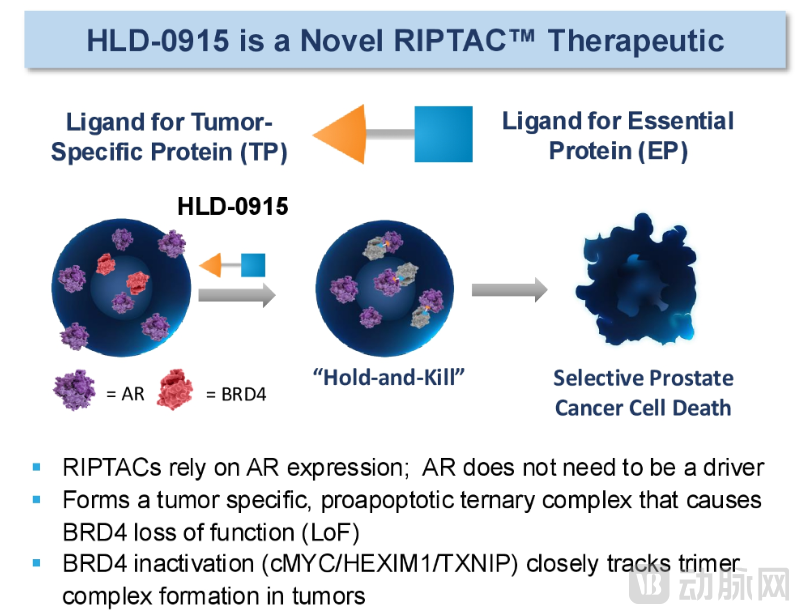
Halda's first RIPTAC candidate drug, HLD-0915, functions through a "grasp-and-kill" mechanism.
(One end targets prostate cancer cells using the androgen receptor (AR) as a tumor marker, while the other end binds to the key protein BRD4, forming a ternary complex and inhibiting BRD4 function, selectively triggering prostate cancer cell death.)
In addition to prostate cancer, Halda's pipeline also includes the RIPTAC program for estrogen or progesterone receptor-positive (HR+) metastatic breast cancer., currently in the preclinical to preclinical optimization stage. The company claims that by utilizing a marker protein highly expressed in breast cancer cells, this RIPTAC can focus its killing activity on the tumor area and trigger cancer cell death.
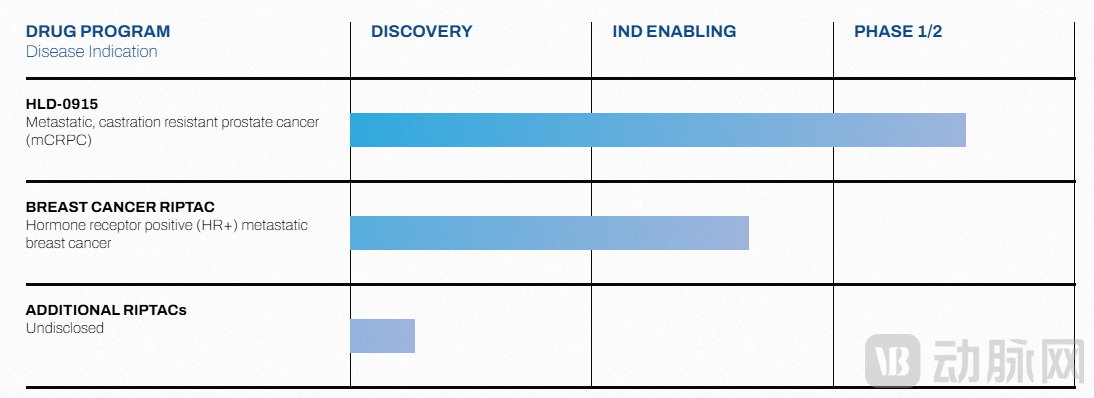
Overview of Halda Pipeline Progress
Currently,Halda has cumulatively raised over 200 million US dollars.Its key investors include Canaan, Access Biotechnology, Deep Track, Frazier, RA Capital, Vida Ventures, Boxer Capital, and Taihe Venture Capital, among others. From its establishment to gaining industry recognition, Halda has attracted seasoned managers from the biopharmaceutical field to join, such as CEO Christian Schade, who previously served as a partner at Flagship Pioneering.
Johnson & Johnson: Two Major Acquisitions Within the Year, Focused on Innovative Therapies
In recent years, to address the challenge of losing patent exclusivity for its core drugs such as the immunological heavyweight Stelara, Johnson & Johnson has been actively expanding into high-growth therapeutic areas. This acquisition marks Johnson & Johnson's second major deal this year.
In January this year, Johnson & Johnson acquired Intra-Cellular Therapies, a developer of neuropsychiatric drugs, for approximately $14.6 billion, gaining access to its marketed depression drug CAPLYTA and pipeline projects. This acquisition of Halda marks Johnson & Johnson's second major acquisition in 2025; additionally, last year, Johnson & Johnson acquired Shockwave Medical, a provider of interventional cardiology devices, for $13.1 billion. Clearly,Johnson & Johnson is rapidly expanding in the fields of innovative drugs and high-end medical devices through a series of mergers and acquisitions, seeking new points of performance growth.
In the field of oncology, Johnson & Johnson has a strong R&D pipeline and product portfolio.: Its main drugs for prostate cancer include Zytiga (abiraterone acetate tablets), Akeega (niraparib + abiraterone acetate), and Erleada (apalutamide). In addition, Johnson & Johnson acquired the anti-PSMA antibody-drug conjugate ARX517 (acquired through the $2 billion acquisition of Ambrx in 2024) and has other research projects such as the KLK2-targeted bispecific antibody pasitomig.
Overall, Johnson & Johnson has established a strong foundation in the field of prostate cancer treatment. The decision to acquire Halda this time not only reflects an interest in the entirely new drug modality RIPTAC but also demonstrates Johnson & Johnson's intention to address the limitations of traditional treatments with innovative therapies. Halda’s technology aligns with Johnson & Johnson’s existing oncology drug development capabilities and serves as a mid-to-long-term catalyst the company seeks. Meanwhile, Johnson & Johnson’s management emphasized that this acquisition aligns with their preference—innovative acquisitions within fields where they already possess internal capabilities and expertise. It is foreseeable that after the completion of Halda’s acquisition, the new platform will be integrated into Johnson & Johnson’s existing pipeline to enhance its precision oncology treatment portfolio.
TPD Technology Shows Growing Potential, Becoming a Core Track in Cancer Treatment
Behind Johnson & Johnson's Significant Investment in Halda Lies the Surge and Growing Market Demand in the Targeted Protein Degradation (TPD) Field.
From a macro perspective,The global cancer drug market is large in scale and continues to grow at a high rate.IQVIA report points out that global spending on cancer treatment drugs reached approximately $252 billion in 2024 and is projected to grow to $441 billion by 2029; the American Cancer Society estimates that new cancer cases in 2025 will reach about 2 million. Meanwhile,TPD Technology Gains Increasing Favor from Pharmaceutical Companies and InvestorsMarket research firm Mordor Intelligence predicts that the global targeted protein degradation market size will be only about US$544 million in 2024, increase to US$650 million in 2025, and is expected to reach approximately US$1.6 billion by 2030. Moreover, around 60% of active protein degradation projects are focused on the oncology field.
These data indicate that,TPD technology has particularly great potential in the direction of cancer treatment., multiple cases have corroborated this trend: for instance, the company Arvinas, founded earlier by Professor Crews, has made progress in PROTAC drugs for prostate cancer and breast cancer. In 2024, its anti-AR PROTAC drug completed Phase II clinical trials; companies such as Kymera Therapeutics are also actively advancing several degraders into clinical trials.
Looking ahead, the prospects of targeted protein degradation in the field of oncology are widely optimistic, but extensive clinical validation is still required to verify its efficacy and safety. Johnson & Johnson's investment in Halda not only reflects trust in this emerging technology but is also expected to accelerate the R&D progress in this field.