GE HealthCare Announces $2.3 Billion All-Cash Acquisition of Intelerad to Accelerate Cloud and AI-Driven Imaging Strategy

GE Healthcare
Digital Solution Provider
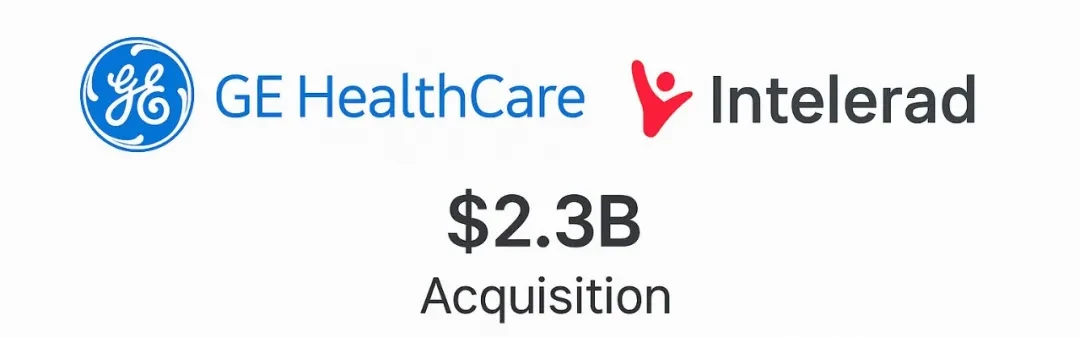
On November 20, GE HealthCare announced that it would$2.3 billion (approximately RMB 16.3 billion)All CashAcquisition of Intelerad. This is GE HealthCare's largest software-related acquisition since its spin-off and IPO, and one of the most notable transactions in the imaging IT field in recent years.
The amount of this deal is eye-catching enough, but what is more noteworthy is:
GE Healthcare is advancing its imaging business from "equipment logic" to "cloud logic," with SaaS as the growth engine for the next phase.
Against the backdrop of growing global demand for imaging examinations and the rapid expansion of outpatient networks, the real bottleneck in imaging departments lies in scattered data, fragmented workflows, and the difficulty of multi-scenario collaboration. GE HealthCare's $2.3 billion acquisition of Intelerad is a very clear strategic statement:
The future competition in imaging will not be between devices, but between systems.
# $2.3 Billion Acquisition: Why Is GE HealthCare Willing to Pay This Price?
The terms of the deal show that GE HealthCare will complete the acquisition in cash and plans to pay through a combination of its own funds and debt financing.

From the perspective of the scale of the acquisition, the $2.3 billion deal indicates that GE HealthCare views Intelerad as a strategic part of its future, rather than just a supplementary addition to its product line.Key Financial Structure of Intelerad:
Expected revenue of approximately $270 million by 2026;
Of which about 90% is sustainable recurring revenue (subscription/services);
EBITDA exceeds 30%, which is a very healthy level for a software company;
The annual growth rate remains in the low double digits and has the potential to accelerate within GE HealthCare's system.
Compared with the cyclical fluctuations of traditional imaging equipment businesses, the high recurring SaaS model can significantly improve GE HealthCare's business structure.
Therefore, this deal is not about "buying scale," but ratherBuy business models, buy growth certainty, buy future cash flow quality。
GE Healthcare also noted in the announcement that Intelerad's business will be integrated upon completion of the acquisition.Immediately increase the company's revenue growth rate and EBIT profit margin, even if there is a slight dilution of EPS in the short term, it can quickly release returns in the coming years.
In a nutshell: In GE HealthCare's growth story, the $2.3 billion purchase is for "the future profit model."
# What GE Healthcare Wants Is Not a Company, but a "Cloud Imaging Portal"
If we only look at the product, Intelerad is a cloud-first imaging IT vendor.
But from an industry perspective, its significance goes far beyond that. GE HealthCare's imaging business has traditionally focused on large hospital systems (particularly hospital-based imaging equipment + traditional PACS).
But in the past five years, the fastest-growing area of imaging in North America has shifted from hospitals to:
Ambulatory care (Outpatient network)
Outpatient Imaging Centers (Independent Imaging Centers)
Teleradiology (Remote Imaging Services)
And these high-growth areas are precisely Intelerad's strengths.
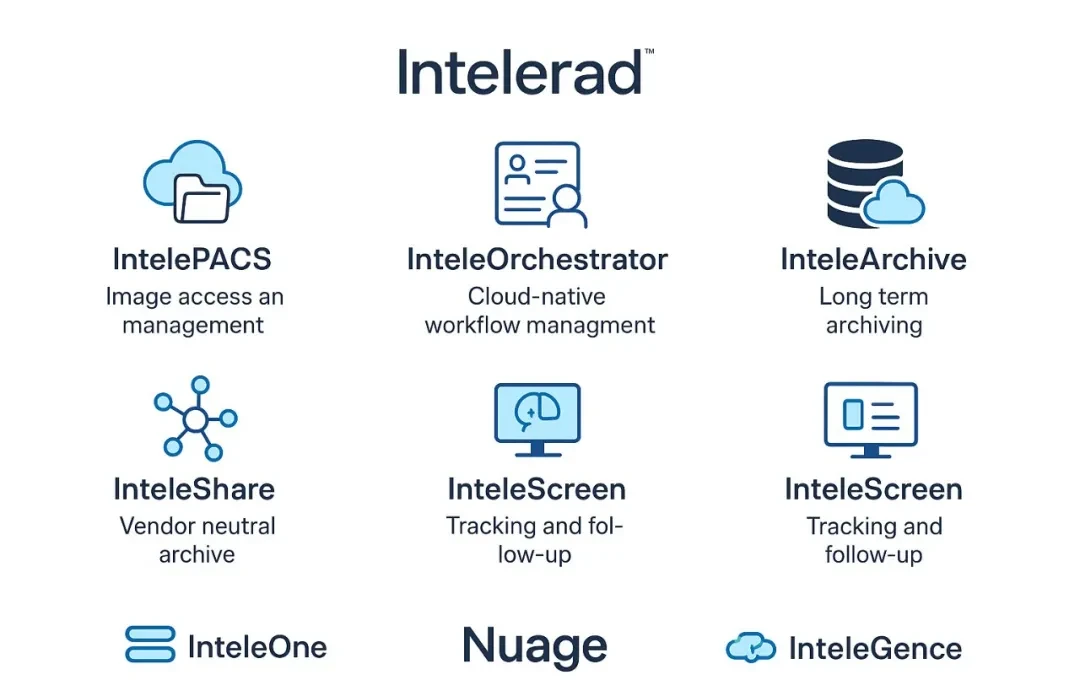
Intelerad's Core Values:
Full-Stack Cloud Architecture (Cloud-Native)
Cross-Scenario Integrated Imaging Workflow (Workflow Orchestration)
Strong Outpatient and Third-Party Imaging Center Network Penetration
Naturally Suitable for Remote Reading and Multi-Institutional Collaboration
In other words, Intelerad is the "gateway to the new imaging ecosystem," while GE HealthCare is the leader of the "traditional imaging ecosystem."
This deal truly pieces the two together into a complete picture:
From hospitals to outpatient clinics, from equipment to the cloud, from imaging capabilities to imaging workflows.
GE HealthCare CEO Peter Arduini also directly pointed out in the press release: "We are transitioning from being an imaging equipment supplier to becoming a provider of healthcare solutions."
This is an acquisition with extremely clear strategic intent.
# Why Now? The Inflection Point of the Imaging Industry Has Arrived
The timing of this acquisition is crucial. The imaging industry is undergoing a structural change:
The volume of imaging examinations continues to rise, and the hospital side is already approaching saturation:Outpatient clinics and independent imaging centers are taking on an increasing number of initial consultations and follow-up examinations, with growth significantly higher than that at hospitals.
The core value of PACS is being replaced by workflow:In the past 20 years, hospital imaging IT has mainly focused on "image storage and viewing."
The core矛盾 now is: doctors frequently switching between multiple systems; difficulties in collaboration between hospitals; increased reading volume without a corresponding increase in doctors; AI models unable to be implemented in fragmented systems.
Intelerad's "Unified Workflow" capability addresses these pain points perfectly.
AI imaging must be based on the foundation of "cloud + unified data layer."Without a unified data system, AI cannot scale.
GE Healthcare's imaging AI was previously limited by differences in installation environments, and this acquisition provides a natural foothold for its AI products. Therefore, the background of this deal is not simply market contraction or increased competition, but rather—The imaging industry itself is transitioning from equipment-driven to system-driven, and from local systems to cloud-based systems.
The timing is perfect.
# Synergistic Logic: How Intelerad’s “Outpatient Capability” and GEHC’s “Hospital Capability” Form a Closed Loop?
In this acquisition, the most critical synergy point is not "product complementation," butSupplement Scenario。
For a long time, GE HealthCare has had a complete layout in imaging equipment, PACS, and AI capabilities on the hospital end, but its coverage has mainly concentrated on larger-scale, highly structured hospital systems—this is also the most familiar scenario for traditional imaging equipment giants.
But the growth in imaging demand has already occurred on the other side:
Outpatient and independent imaging centers have become the fastest-growing areas in terms of imaging volume in North America;
Teleradiology has become the main form to alleviate the shortage of radiologists;
The complete chain of inspection-reading-feedback is gradually migrating from hospitals to the end closer to patients.
Intelerad happens to be deeply engaged in this high-growth area, covering more than 1,500 medical institutions, with client types spanning: independent imaging centers, outpatient networks, multi-institutional groups, remote reading companies, and cross-regional healthcare alliances.
This segment of users was previously unreachable for GE HealthCare through hardware logic.
The core synergy of this acquisition is:
GEHC Provides "Imaging Capabilities" (Equipment + AI)
Intelerad Provides "Imaging Workflow" (cloud PACS + Orchestration)
Together, they form a truly comprehensive full-scenario imaging system.
This brings three direct strategic benefits to GE HealthCare:
Redefine "Corporate Shadow"Like"Boundary:From the past hospital-centric enterprise imaging to the current multi-setting imaging network that spans hospital-outpatient-remote imaging.
Allow GEHC's AI products to gain a unified landing entry for the first time:AI is not a "point function" installed in equipment, but a "system function" embedded in a cloud-based workflow.
Incorporate growth scenarios outside of hospitals into the GEHC ecosystem:The expansion speed of outpatient facilities is much faster than that of hospitals, especially in the United States, where outpatient imaging has already become aHigh-growth markets exceeding $20 billion。
Therefore, from a synergistic perspective, this is not an ordinary "horizontal merger and acquisition" but a "structural acquisition that transforms GE HealthCare from an imaging hardware company into an imaging systems company."
# Conclusion
The essence of this deal is not about expanding the product line, nor is it about addressing software weaknesses, but rather:Install a new operating system for GE HealthCare's imaging business。
Intelerad fills the key capabilities of GEHC in outpatient networks, remote imaging, cloud-based workflows, and SaaS models. Meanwhile, GEHC possesses equipment, AI, hospital channels, and a global installed base. The combination of the two enables GEHC to have "full-scenario imaging capabilities" in the true sense for the first time.
As imaging examinations become saturated in hospitals and continue to expand in outpatient services, as AI moves towards large-scale deployment and the value of workflow keeps rising, and as cloud imaging becomes a definitive direction for global healthcare IT, this transaction is likely to become an important marker of changes in the competitive landscape of the imaging industry in the coming years.
$2.3 billion is GE HealthCare's clear answer to its future direction.
Recent Articles
The Era of Chinese-Made Medical Devices Has Arrived!
A "Doctor-Savvy" Robotic Arm Unveils a New Era for Orthopedic Robots
From Fragmentation to Symbiosis: Viewing Medtronic's Systems Thinking at the CIIE
Another Medical Company Successfully IPOs, Reflecting the Industry's Ups and Downs
Global Medical Device Watch
▌Capital Radar|Money Flow
Overseas Financing Events |Financing Events in China |Overseas Acquisition Cases |Domestic Acquisition Cases
Foreign Enterprise IPO |IPO of Chinese Enterprises |Foreign Enterprise Earnings Reports |Earnings Reports of Domestic Companies
Exhibition Preview/Review/Roundup
SIYU Annual Activity Review:The First Global Ophthalmology Conference | The First Global Orthopedics Conference | The First Global Cardiovascular Conference| The First Global Medical Aesthetics Technology Conference |The 2nd Global Medical Technology Conference|The 3rd Global Surgical Robotics Conference
Content Declaration:"SiYu MedTech" tracks global medical technology advancements, aiming to convey technical and industry knowledge. All content is for industry exchange and academic discussion only, and does not constitute medical advice or commercial promotion. Information about companies, products, and registrations mentioned in the articles is sourced from publicly available materials or verified channels. If there are any errors or omissions, please contact us for corrections. Email: jacky@suribot.com
Copyright Statement:The original article of "SiYu MedTech" is owned by Beijing SiYu BoTe Technology Co., Ltd. Without authorization, it cannot be reproduced, excerpted, or mirrored on other websites, WeChat Official Accounts, or commercial platforms. For reprinting, please contact the backend to obtain authorization. This platform reserves the right to pursue legal responsibility for unauthorized full-text reproduction, content rewriting, or adaptation.