

Sun Yat-sen University to Transfer Key RNA Editing Patents for RMB 399,560 to Shixi (Guangzhou) Biotech Co., Ltd.

RecoRNA
Innovative Drug Developer

BeOne
Developer of Molecular Targeted and Immune Anti-Tumor Drugs
Recently, Sun Yat-sen University released a public notice on the transformation of scientific and technological achievements, proposing to conduct the transaction through the挂牌交易方式 on the Guangzhou Property Rights Exchange.Four RNA Editing-Related PatentsThe partial interest held by Zhongda was transferred to the co-owner RECORNA (Guangzhou) Biotechnology Co., Ltd., with a transfer amount ofRMB 399,560。
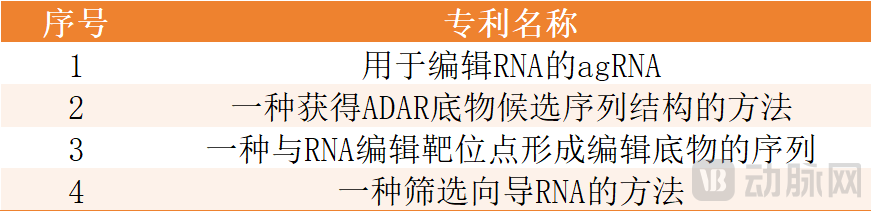
Four RNA Editing Patent Names
The main inventor of the patent for this transformation isResearch Team of Zhang Rui from Sun Yat-sen UniversityThe core members include Yang Wenbing, Li Jin, etc. Researcher Zhang Rui, as the team leader, has profound research accumulation in the field of RNA editing and gene therapy.
Zhang Rui:Professor at the School of Life Sciences, Sun Yat-sen University, and doctoral supervisor. Selected as a distinguished member of Sun Yat-sen University in 2015."Talent Introduced by the 'Hundred Talents Program'",2015National High-Level Overseas Talent, 2017 Guangdong Province"Zhujiang Talent Plan" Innovation and Entrepreneurship Team Talent.Served as a member of the Committee of the Guangdong Provincial Bioinformatics Society. In the past five years, as the corresponding author, published multiple papers in internationally renowned academic journals. The work in RNA editing and RNA m5C has been widely recognized by peers in the RNA field. Invited to participate in the writing of the textbook *Epigenetics* led by Fudan University, responsible for the chapter on "RNA Editing"; invited as a keynote speaker at important international and domestic academic conferences in the RNA field, such as the RNA Editing Gordon Research Conference and the National Ribonucleic Acid (RNA) Academic Symposium, among others. Reviewed projects for the National Natural Science Foundation of China, the United States-Israel Binational Science Foundation, and the Austrian Science Fund, among other international funding programs.
The team has long been committed to developing novel RNA editing systems and their applications in disease treatment.The team has achieved multiple innovative breakthroughs in nucleic acid design, optimization of editing tools, and high-throughput screening methods.
The recipient of this patented technology, RECORNA (Guangzhou) Biotechnology Co., Ltd., is an innovative biopharmaceutical company focusing on the research and development of small nucleic acid drugs. Currently in the early stages of R&D and platform construction, the company is actively building its RNA editing technology patent pool and advancing preclinical research for its core pipeline. The company's founder and core R&D leader is Researcher Zhang Rui — he is not only the legal representative and chairman of the enterprise but also the core inventor of the transferred patent.
Previously, the company had also received investments from multiple institutions, including Zhongguan Village Development Group, Gingko Valley Capital, Beijing Life Science Park Ventures, and TianTu Investment. Notably, RecoRNA is located in the BeOne Medicines BioIsland Innovation Center, and the latter holds 1.39% of the shares in the former.
It is reported that on April 15, 2024, RECORNA and the BioIsland Innovation Center of BeOne Medicines officially reached an in-depth cooperation to jointly create a strategic cooperation center for nucleic acid innovative therapies. The BioIsland Innovation Center of BeOne Medicines not only provided financial support during the financing process but also offered professional guidance and empowerment to the company in drug target selection and indication exploration, further strengthening the cooperative relationship between the two parties in the field of nucleic acid new drug research and development.
In terms of product pipelines, RecoRNA, relying on its "Xihe" RNA editing platform, is developing multiple innovative therapeutic solutions. Currently, the company has laid out a series of products including RNA correction drugs for specific hereditary neurological diseases, target regulation sequences for tumor immunotherapy, and a universal guide RNA toolkit based on high-throughput screening.
The core application scenario targeted by this patent,It is to utilize RNA editing technology to treat a wide range of genetic diseases caused by specific point mutations.These diseases are typically caused by errors in single bases within the gene sequence, such as mutations in adenine (A), leading to abnormal or missing protein functions. The applications cover cystic fibrosis, Duchenne muscular dystrophy, hereditary transthyretin amyloidosis, and hereditary cancer syndromes driven by mutations in genes such as APC.
In recent years, gene editing technology has brought hope for curing genetic diseases, among whichDNA Editing Technology Based on CRISPR-Cas SystemIt is particularly noteworthy. However, this DNA editing method itself has insurmountable flaws. It achieves editing by making permanent cuts to the genome, which are irreversible. If off-target editing occurs at non-target sites, it may cause irreparable genomic damage, such as potential carcinogenic risks.
At the same time, exogenous Cas proteins may trigger immune responses in the human body, and the efficient delivery of large protein-RNA complexes into the nucleus poses significant technical challenges. These safety concerns severely limit their widespread clinical application. Existing clinical treatment options have notable limitations. Traditional small-molecule drugs or protein replacement therapies often only alleviate symptoms and cannot fundamentally correct errors in the genetic code, making them strategies that address the symptoms but not the root cause.
Compared to DNA editing, RNA editing corrects RNA sequences without altering the genome, offering significant safety advantages due to its reversibility and controllability. However, the existing RNA editing methods mentioned in the patent background, such as RESTORE or LEAPER, have fundamental design limitations. The guide RNAs they design form nearly fully paired double-stranded structures with the target site, which is not the optimal working environment for endogenous ADAR proteins in the human body (the key enzyme responsible for catalyzing A-to-I editing). This results in these methods being effective only for a small number of "UAN" motif edits that ADAR naturally prefers strongly, while showing extremely low editing efficiency for most other types of motifs (such as AAN, CAN, GAN) potentially involved in genetic diseases, falling far short of therapeutic requirements. This greatly limits their clinical application scope.
This invention is aimed at overcoming the core bottleneck of low efficiency in existing RNA editing tools.The team successfully circumvented the pitfalls of traditional artificial design strategies by innovatively mining the most preferred and efficient substrate structure of the ADAR protein in a natural environment from massive human data. Based on this, they designed guide RNAs, providing a powerful core tool and platform for developing the next generation of RNA drugs capable of efficiently and precisely treating various point mutation genetic diseases.
Against the backdrop where existing targeted RNA editing technologies, especially single-molecule systems, face challenges such as rough guide RNA design, low editing efficiency, and high dependence on specific motifs, this invention provides a completely new solution. Its core advancement lies in,It abandons the traditional mindset of "manual design, complete pairing."Turning to learn from natural double-stranded RNA structures that have been efficiently edited by ADAR proteins through hundreds of millions of years of evolution in nature, a data-driven bionic design pathway has been pioneered.
The primary advantage of this patent lies in its data-driven structure discovery mechanism.Existing methods such as RESTORE or LEAPER use structures that are mostly based on theoretical speculation rather than empirical evidence.
This invention systematically analyzes large transcriptome databases such as GTEx and RADAR, accurately screening out sites with high editing levels located in natural double-stranded structures (such as inverted repeat Alu elements, lncRNA, etc.) from a vast number of endogenous RNA editing events in the human body, and based on this...Built a large "ADAR preference substrate library"This means that every candidate structure we obtain has been a "template" upon which the ADAR protein has acted genuinely and efficiently within the human body, fundamentally ensuring its biological activity and efficacy.
Furthermore,This invention realizes a motif-based classification and optimization strategy, achieving "tailored strategies according to motifs."ADAR proteins exhibit significant differences in editing efficiency across different sequence contexts (i.e., motifs such as UAG, AAC, GAA, etc.). Traditional methods are only effective on a few motifs like UAN. This invention takes the lead in classifying the screened high-efficiency substrate structures based on their triplet motifs (NAN) at the editing sites.
On this basis, within each class of motifs, they are further sorted according to the editing efficiency, thereby providing a group of experimentally validated, highly efficient structural references for any target motif. Experimental data fully demonstrates the power of this strategy: even for the traditionally difficult-to-edit GAG motif, by simulating the optimized structures selected through this invention, it is possible to achieve a leap from near-zero editing to up to 40% editing efficiency.
More importantly, by embedding the aforementioned optimized structural features into the design of guide RNA (referred to as mcRNA in the text), this invention significantly enhances the efficiency and specificity of editing. This is not a simple replication of the entire sequence but rather an abstraction and simulation of its key structural features, such as specific base mismatches (M), wobble pairing (W), bulges, and internal loops, integrating them into the region complementary to the target sequence. This "structurally and functionally similar" design enables the guide RNA to not only recruit endogenous ADAR proteins more efficiently but also direct their precise action on the target adenosine site.
The experimental results confirmed this: whether at different motif sites of the APC or GAPDH genes, the mcRNA designed based on the structure of the present invention showed significantly higher target site editing levels compared to the control without structural characteristics. Moreover, in most cases, it effectively constrained editing activity to the target site, reducing off-target editing upstream and downstream.
Ultimately, all these advantages converge on one point:This invention lays a solid foundation for the development of highly efficient RNA editing therapies with broad applicability.It breaks the dependency of existing technologies on "friendly" motifs, greatly expanding the range of disease sites that can be targeted for editing.
At the same time, since this method relies on the recruitment of endogenous ADAR proteins, it avoids the introduction of exogenous editing enzymes, eliminating concerns about immunogenicity and long-term safety, and shows great potential in clinical translation and drug development.
At present, the targeted RNA editing technology based on endogenous ADAR has shown great therapeutic potential,but always faces low editing efficiency and high dependence on specific "friendly" motifs for target design.And the core bottleneck that is difficult to achieve precise control in a complex human body environment. This global technological dilemma has prompted biotechnology companies at home and abroad to actively explore distinctive solutions.
Wave Life SciencesIt is one of the highly regarded companies in the field. Its developed WVE-006 is a short-chain, chemically modified oligonucleotide (AIMer) capable of precisely guiding adenosine deaminase (ADAR) within cells to perform A-to-I RNA editing on mismatched bases of specific mRNAs, thereby correcting genetic errors that cause protein dysfunction. WVE-006, delivered subcutaneously via a GalNAc delivery carrier, is an innovative RNA-editing oligonucleotide therapy, with global exclusive licensing rights held byGSKHold.
AIRNARecoRNA is a rising star in this field, with its core editing platform named RESTORE. This platform optimizes the delivery process of chemicals, sequences, and oligonucleotides, ensuring precise binding to target RNA sites upon intracellular delivery, aiming for accurate, efficient, and safe RNA editing. RecoRNA has cumulatively received$90 millionThe financing, the first round of which was led by a well-known venture capital companyARCH VentureLead investment.
ProQR Therapeutics, a company from the Netherlands/United States, is also dedicated to the clinical drug research of endogenous ADAR. In 2022, the company focused onLeber Congenital AmaurosisPhase 2 clinical trial of Type 10 unfortunately declared failure, causing the company's stock price to plummet by 75% at one point.
However, just last month, the company announced good news, stating that its Axiomer™ RNA Editing Technology Platform has been used to develop a treatment forCongenital biliary atresia and primary sclerosing cholangitisThe investigational drug AX-0810 has received clinical trial application approval from the EU regulatory authorities and will soon initiate a Phase 1 clinical study involving healthy volunteers in the Netherlands. Perhaps, this company is about to embrace new development opportunities.
Turning our attention to China, the market competition is equally fierce. As the recipient of this patent,RecoRNA, whose pipeline directly demonstrates the transformation achievements of patented technology. The company's independently developed candidate drug RC001 for specific neurological disorders has successfully obtained FDA approval.Orphan Drug Designation.
EdiGeneA treatment platform centered on gene editing technology has been built, covering a variety of advanced therapies, including ex vivo therapies from the hematopoietic stem cell platform, ex vivo therapies from the universal CAR-T platform, and in vivo therapies from the RNA base editing platform. Particularly, the in vivo therapy from the RNA base editing platform is based on the innovative RNA single-base editing technology LEAPER™, focusing on the development of treatments for...Ophthalmic diseases, neuromuscular disorders, and other hereditary conditionsAnd precision treatment plans for non-hereditary diseases.
HuiDa GeneFounded in 2018 by Yang Hui, Yao Xuan, and others, focused on discovering, designing, and developing gene editing tools and gene therapies with the aim of rewriting the future of genomic medicine. Its long-term goal is to treat genetic disorders and chronic diseases that threaten human health through gene editing technology.
The company has built a comprehensive suite of CRISPR tools, covering technologies such as DNA cutting, RNA interference, base editing, and epigenetic regulation. Based on the specific characteristics of different diseases, appropriate technical pathways can be selected to advance the application research of various gene-editing therapies. In this process,Ophthalmic Drug HG004Successfully completed international multicenter clinical Phase 1/2First Subject Dosed。
RuiZheng GeneFounded in 2021, focused onNon-viral vectorThe research, industrialization, and commercialization of in vivo gene editing drugs. The company has built an industry-level end-to-end in vivo gene editing technology platform and successfully developed a series of core gene editing and delivery patent technologies, including those that have been obtained.Base editor with U.S. patent.
In August 2025, Raygen Gene successfully completedRound AFinancing, amounting to75 million US dollars,KangzheThus becoming the controlling shareholder.
Overall, the research on ADAR RNA editing solutions worldwide exhibits significant characteristics of diversified targets and a broad range of indications. International giants and emerging forces in China are advancing side by side. Although their technological approaches focus on recruiting endogenous ADAR, distinctive layouts have been formed in specific disease areas, target selection, and delivery tools.