Amygdala Neuro Presents Breakthrough Long-Term Large Animal Data for Endovascular BCI at IEEE NER 2025

AMYGDALA NEURO
Developer of Neuroregulation and Brain-Computer Interface Technologies and Products

InNovember 2025 in San Diego, USAThe 12th International Conference on Neural Engineering(IEEE EMBS Neural Engineering Conference, NER 2025) in ChinaNeuroscienceInnovative EnterpriseShenzhen CityAMYGDALA NEUROCo., Ltd.(Amygdala Neuro, hereinafter referred to as"AMYGDALA NEURO") officially reported its independently developedInterventional Brain-Computer Interface——IntracranialVascular Stent ElectrodeBrain-ComputerSystem implementation in large animal modelsLong-term ImplantationKey Achievements. The study is titled《Evaluation of a Novel Endovascular Electrode Array for Long-Term Cortical Recording and Stimulation》, marking AMYGDALA NEUROBrain Science in Brain-Computer InterfaceIn brain-computer interface (BCI) Core Technology Field Achieves Substantial Breakthrough,This work not only verifiedInterventional Brain-Computer InterfaceThe long-term feasibility of the architecture also paves the way for the future.Clinical translation of BCI systems provides a new pathway.
The core of this study lies in the first verification in a large animal model that a mechanically structured intracranial vascular stent-electrode array has dual-modal functionality for nearly half a year (Record+Stimulation) Functional stability. Compared with existing technologies, its mechanical braiding structure is lower in cost and more flexible in process, which is expected to accelerate localization in China.The R&D Progress of BCI Devices.
# Long-term Animal ExperimentVerificationInterventional Brain-Computer Dual Modality (Recording+Stimulation) Function
Research inConducted in three adult Hu sheep, guided by digital subtraction angiography (DSA), the electrode array was precisely implanted.Superior Sagittal Sinus(SSS), covering the motor cortex area. The experiment started from the postoperative recovery period and continued monitoring untilIn the past six months, The main evaluation indicators include:
1. Electrode-Tissue Interface StabilityAnalysis(EIS Analysis)
Through weekly electrochemical impedance spectroscopy (EIS) Measurement found:
Initial Impedance (1 kHz) approximately 1188 Ω, increased to 2333 Ω on the 31st day post-operation, then gradually decreased to 1365 Ω by the 140th day;
The trend of phase angle changes suggests possible early endothelialization, and all effective electrodes maintained functional integrity throughout the cycle.
This indicates that the intracranial vascular stent electrodeInExcellent long-term electrochemical stability in the intravascular environment.
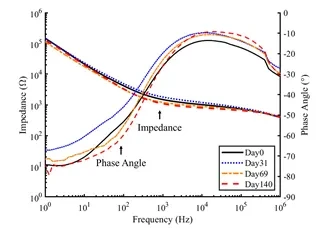
Average Impedance and Phase Angle Measurement Curves
2. Quality of Neural Signal RecordingAnalysis
UseThe Apollo-I system collects electrocorticography (ECoG) signals, which are then filtered and segmented for multiWindow Method Analysis(multitaper method). The results showed:
InTypical EEG rhythms can be stably recorded in the θ (4–8 Hz), α (8–14 Hz), β (14–30 Hz), and low γ (30–50 Hz) frequency bands;
Although the overall power spectral density (PSD) showed statistically significant differences within 145 days (ANOVA p < 0.05), but no significant changes were observed between Day 31 and Day 76 (p > 0.05 after Tukey correction), indicating highly reliable mid-term signal quality.
- The typical signal waveform remained consistent in shape at three time points (31, 76, and 147 days), confirming the long-term repeatability of the recordings.
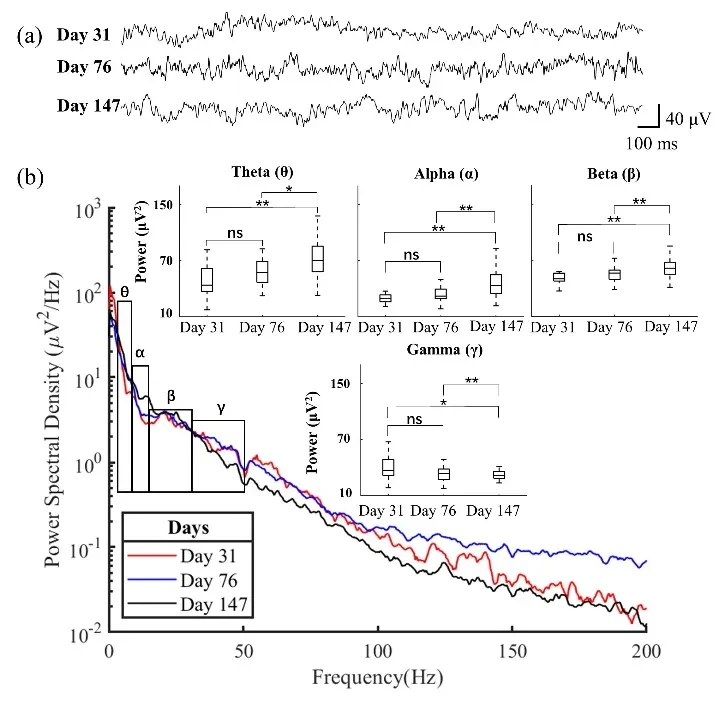
(a) Signal segments collected on Day 31, Day 76, and Day 147;
(b) Average Power Spectral Density (PSD) Estimated Based on Selected Dates
3. Intravascular Neuromodulation Capability
ThisThe study is the first to systematically evaluate thisIntracranial Vascular Stent ElectrodeStimulationEffect:
Using bipolar, biphasic, charge-balanced pulses (30 Hz, 450 μs) for cortical stimulation;
Stimulus-induced physical responses (head, neck, or limb movements) as effective indicators;
The results showed that the stimulation threshold increased over time—initially, 1–2 mA could trigger a response (success rate 68%), but after 112 days, only high currents of 3–5 mA remained effective (success rate 50%).

Excitation Rate of Electrodes at Different Time Periods Under Different Current Levels
This phenomenon may originate from the electrode.- Tissue interface changes (e.g.Endothelialization,FiberHyperplasia) or animal adaptability, but also clearly demonstratedThrough intracranial vascular stent electrodes inFeasibility of Intravascular Stimulation on a Long-Term Scale.
Recently,Synchron Announces Completion of $200 Million (Approx. RMB 1.4 Billion) Series D Financing, Led by Double Point Ventures with Participation from ARCH Ventures, Khosla Ventures, Bezos Expeditions, and Other Prominent Institutions. This is One of the Largest Single Financings in the Brain-Computer Interface Field to Date.
This news has drawn significant attention from the global medical device community. For a long time, BCI technology has mainly remained in the research and neurorehabilitation stage, while Synchron has taken the lead in entering the clinical stage of "implantable, mass-producible, and usable," marking the beginning of a substantive industrialization cycle for interventional brain-computer technology.
AMYGDALA NEUROIn 2021, AMYGDALA NEURO began independent technological research in brain-computer interface technology and successfully developed it in early 2023.The First Generation of Intracranial Vascular Stent Electrodes, Minimally Invasive Interventional Delivery Systems, and Electrophysiological Signal Acquisition SystemsUnlike the Stentrode™ developed by Synchron (based on MEMS technology), the research team used a mechanically woven nitinol stent as the supporting structure and directly clamped platinum-iridium (PtIr) microelectrodes onto insulated wires, which were then spirally wound around the stent surface. This design has the following advantages:
Lower Electrode Impedance: Conducive to improving the signal-to-noise ratio, enhancing recording sensitivity and stimulation efficiency;
Three-dimensional Conductive Network and Spatial Arrangement Optimization:Eight DFT® leads are evenly distributed, with electrodes spaced 2 mm apart axially and symmetrically arranged at 90° circumferentially, ensuring uniform sampling of the motor cortex area.
Regulatory Interface Compatibility:The terminal adopts an 8-channel connector commonly used in neuromodulation, facilitating integration with AMYGDALA NEURO's existing universal neuromodulation platform.
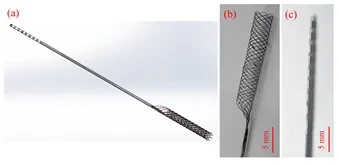
AMYGDALA NEUROCranium StudyIntravascular Stent
AMYGDALA NEURO's intracranial vascular stent design takes into account biocompatibility, mechanical compliance, and electrical performance, reflecting the deep integration of engineering practicality and neuroscience requirements. The systemIn 2023, an acute implantation experiment was first conducted in adult sheep. During the surgery, the brain stent electrode was successfully delivered to the superior sagittal sinus and transverse sinus regions of the sheep, and intraoperative electrophysiological monitoring was performed. The results verified the implantability of the electrode and its ability to acquire EEG signals.
The publication of this long-term animal data,For the first timeVerifiedValidated a non- in large animal modelsSynchron Stentrode ArchitectureIntracranial Vascular StentThe electrode is equipped withIn the past six monthsDual-modal (recording+Stimulation) Functional Stability, andSupported“Intracranial Vascular Stent ElectrodeSuperior Sagittal SinusIntravascularMotor Cortex Neuromodulation"This hypothesis provides a promising direction for the future treatment of drug-resistant epilepsy,Caused by various reasonsProvides new insights into diseases such as movement disorders.
# AMYGDALA NEURO
Content Declaration:"SiYu MedTech" tracks global medical technology advancements, aiming to deliver technical and industry knowledge. All content is for industry exchange and academic discussion only, and does not constitute medical advice or commercial promotion. Information regarding companies, products, and registrations mentioned in the text is sourced from publicly available materials or verified channels. If there are any errors or omissions, please contact us for corrections. Email: jacky@suribot.com
Copyright Statement:The original article of "SiYu MedTech" is copyrighted by Beijing SiYu Bot Technology Co., Ltd. Without authorization, it is prohibited to reproduce, excerpt, or mirror the content on other websites, WeChat Official Accounts, or commercial platforms. For reprinting, please contact the backend to obtain authorization. This platform reserves the right to pursue legal responsibilities for unauthorized full-text reproduction, rewriting, or paraphrasing.