

Shockwave CMO Discusses IVL: Over 1 Million Patients Treated, Yet Market Penetration Remains Low

Johnson & Johnson
Medical Device R&D and Manufacturer

Shockwave Medical
Cardiovascular Disease Treatment Device Developer
Abiomed
Cardiac System Medical Device Developer
In 2024, Johnson & Johnson acquired Shockwave Medical for $13.1 billion, becoming the largest M&A in the medical device field that year.This deal is part of Johnson & Johnson's strategy to enter the high-growth cardiovascular market, following its acquisitions of heart pump manufacturer Abiomed and left atrial appendage closure device maker Laminar in the past two years.
Through the acquisition of Shockwave Medical, Johnson & Johnson has gained access to a rapidly growing therapy for coronary artery disease (the most common form of heart disease). Known as "intravascular lithotripsy," this technology uses sound waves to break up calcified plaque deposits and clear arteries. It is also used to treat peripheral artery disease, which involves reduced blood flow to the limbs due to narrowed vessels.
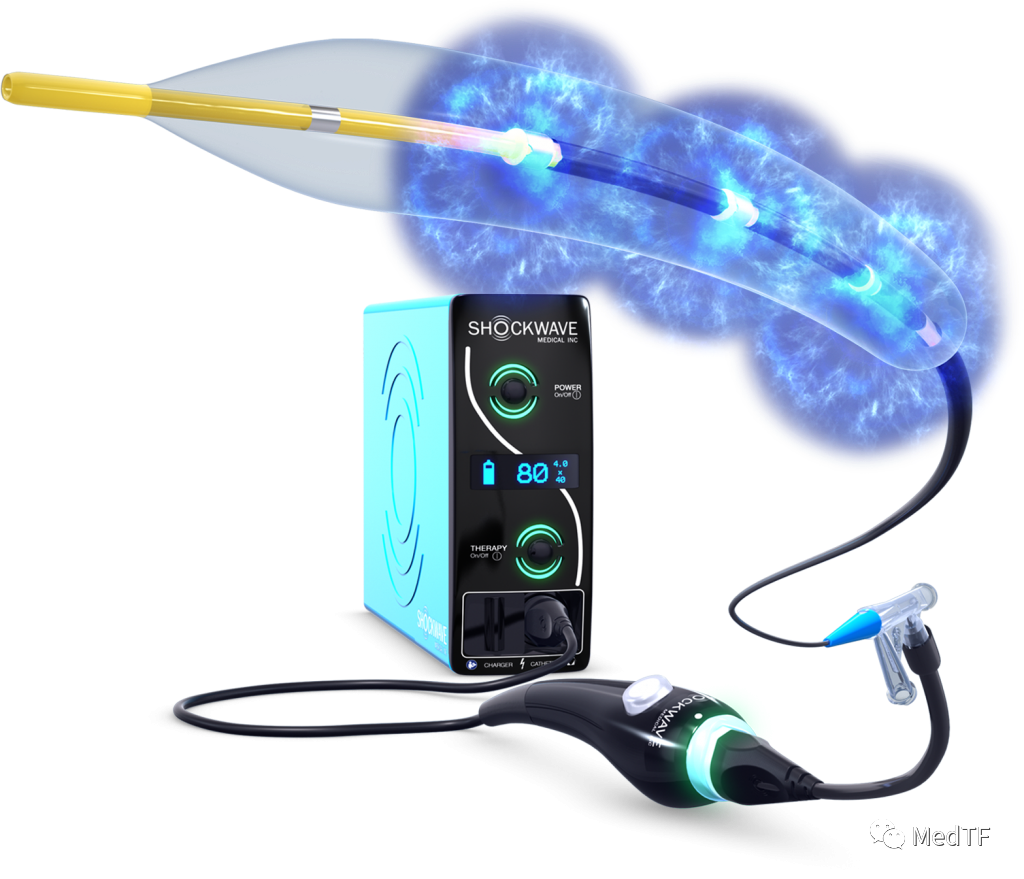
Recently, Nick West, Chief Medical Officer of Shockwave Medical, discussed why the application of IVL technology is continuously growing and the future development direction of this technology.
Question 1: How does Shockwave IVL work? What are the advantages over plaque excision in terms of clearing arterial blockages?
IVL technology is derived from extracorporeal shock wave lithotripsy, a very mature method for treating kidney stones. IVL was the creative idea of inventor John Adams, who considered whether this technology could be miniaturized for use inside blood vessels.
Vascular calcification is part of the aging process. Unfortunately, if we live long enough, everyone will encounter this problem. With the aging population, the incidence of significant vascular calcification is increasing.
Our existing standard tool is the balloon. The balloon works well for relatively soft tissue, pushing aside blockages. But sometimes the balloon is not enough to deal with very hard calcified deposits. This is where tools like atherectomy come in.
Atherectomy has been around for a long time, with a history of two to three decades in the fields of coronary and peripheral vascular interventions. Although these tools are highly effective, they also have certain disadvantages. They require specialized training, dedicated equipment, and demand that operators possess considerable technical proficiency, as these burrs and drills rotate at tens of thousands of revolutions per minute within the blood vessels.
Clearly, when the procedure goes smoothly, the results are good; but if it doesn’t, fairly serious complications can arise.
The beauty of IVL technology lies in the fact that when they demonstrated it could be miniaturized and placed within a balloon catheter, this means every interventional cardiologist, interventional radiologist, and vascular surgeon performing these procedures knows how to use a balloon. By extension, if you can place a balloon, all you need to do next is press a button to deliver shockwave therapy.
The same technology, miniaturized and integrated into a balloon, emits ultrasonic pressure waves into the tissue. When these pressure waves strike hard calcified tissue through various physical processes, they cause the calcified plaque to fracture, allowing the balloon to expand.
If you cannot sufficiently dilate the blood vessel, we know that this is one of the primary indicators predicting future re-occlusion or the need for repeated intervention in peripheral lower limb procedures. In coronary interventions, this leads to incomplete stent expansion, which is associated with restenosis and, more critically, stent thrombosis.
Question 2: What percentage of the market has currently shifted to IVL technology?
IVL has only been available as a therapy for eight years. In that time, we have treated 1 million patients worldwide.IVLHas transformed from an innovative and intriguing therapy to one that is now almost included in everyone's treatment plan for managing such patients.
It expands the scope of complex coronary artery calcification interventions. Looking back to 2018-2019, before the introduction of IVL, only about 5% or 6% of patients undergoing coronary angioplasty used some form of atherectomy (either orbital or rotational) to address severe coronary artery calcification.
Significant calcification may be present in approximately 30% of coronary intervention cases. This means that in the past, many patients did not receive adequate treatment. Since the introduction of IVL, within the first 12 to 18 months after its release, the usage rate of IVL surged to nearly 7% of all cases, capturing market share from rotational and orbital atherectomy, and expanding the overall market space. In fact, if we look at this year's situation, IVL has now penetrated slightly over 10% of all [percutaneous coronary intervention] cases in the United States.