

Who Is the Next Trillion-Dollar Pharma After Eli Lilly?
Johnson & Johnson
Medical Device R&D and Manufacturer

AstraZeneca
Pharmaceutical Technology Research and Development Provider
Source: Ouryao Dandelion Compiled by: Qingyulan
As of November 24, 2025, before the U.S. stock market opened, the global biopharmaceutical field reached a milestone moment — 15 companies surpassed the $100 billion market capitalization mark.
Among them, 13 are pharmaceutical companies. This not only demonstrates the vigorous vitality of the healthcare industry but also reveals a new trend of capital focusing deeply on innovative R&D and core therapeutic areas.
And the Leader's GiftComing in at a $1 trillion market value to blaze a trail in the industry.
Panoramic Scan of the Hundred-Billion-Dollar Club
The 13 pharmaceutical companies shortlisted this time have jointly built a value highland for the global pharmaceuticals and healthcare industry with their outstanding R&D capabilities, competitive core products, and robust financial performance.
Leader's GiftTo blaze a trail in the industry with a market value of 1 trillion US dollars,Its price-to-earnings ratio of 54.41 times fully reflects the market's high recognition of the company in the metabolic disease field, especially in the GLP-1 receptor agonist track. Star products such as Trulicity and Mounjaro have supported the company’s 38.29% stock price increase within the year, while a rich R&D pipeline has made investors highly optimistic about its future growth.
Johnson & JohnsonAs a diversified healthcare giant, it has become more focused on its core businesses of pharmaceuticals and medical devices after completing the spin-off of its consumer health business. Behind the company’s market value of $491.255 billion lies a robust price-to-earnings ratio of 19.56 and a dividend yield of 2.49%, while the stock price increase of 44.39% year-to-date confirms the success of its strategic adjustments.
Notably, some companies are undergoing significant transformation moments.
AbbVieWith a high P/E ratio of 174.87, the market shows great attention to its "post-Humira era" strategy. The company is expanding into neuroscience and medical aesthetics through acquisitions, attempting to build new growth drivers after the expiration of Humira's patent.
Similarly,Merck & Co.Under the pressure of Keytruda's patent expiration, the company is actively expanding its pipeline through acquisitions, with its 3.36% dividend yield serving as a crucial value support during the current stable transition period.
Differentiated Performance in Niche Areas
In the field of metabolic diseases, Novo Nordisk and Eli Lilly jointly lead the GLP-1 wave, but the former's 43.10% drop in stock price within the year reveals the intensity of market competition and the impact of pricing pressure on companies. This contrast highlights the importance of individual corporate strategy execution and product differentiation capabilities within the same popular track.
The field of oncology continues to be a focal point for innovation.AstraZeneca Achieves 41.85% Stock Price Increase with Key Products like Tagrisso, Gaining Market Recognition for Its Strong R&D Capabilities in Oncology and Expansion Strategy in Emerging Markets. Amgen Strengthens Rare Disease Portfolio by Acquiring Horizon Therapeutics, Demonstrating the Strategic Approach of Large Pharmaceutical Companies Expanding Pipelines Through External Growth.
In the antiviral field,Gilead Sciences has demonstrated its continued competitiveness in the HIV and hepatitis fields with a 40.01% increase year-to-date, while its strategy of expanding its oncology pipeline through acquisitions is yielding results.
Value Reconstruction in Industry Transformation
Pfizer's case is particularly noteworthy. Facing the challenge of revenue回调 in the post-pandemic era, the company has strengthened its oncology pipeline through acquisitions such as Seagen, while maintaining investor confidence with a high dividend yield of 6.87%, demonstrating the adjustment wisdom of traditional pharmaceutical enterprises in the industry cycle.
Vertex Pharmaceuticals' near-monopoly position in the cystic fibrosis treatment field, along with its expansion into cutting-edge areas like gene editing, represents the successful path of a focused biotechnology company. Its price-to-earnings ratio of 29.46 reflects the market's valuation logic for highly specialized R&D-driven enterprises.
Hengrui Medicine Ranks AmongNo. 22
Notably, China's pharmaceuticalEnterpriseHengrui MedicineWith a market value of approximately US$56.7 billionRanking 22nd, becoming part of the TOP30 list this timeThe only enterprise from China,Marks a systemic recognition of China's innovative drug capabilities by global capital markets. This breakthrough suggests that the global pharmaceutical landscape may undergo a deeper restructuring.
As Eli Lilly ushers in the "trillion-dollar market value era," the global pharmaceutical industry is entering a new phase of accelerated innovation and value reassessment.
In the future, with the maturation of new technologies such as gene therapy and digital healthcare, the competitive landscape among global pharmaceutical giants will continue to evolve. However, the core logic of innovation and value creation will always guide the industry's development direction.
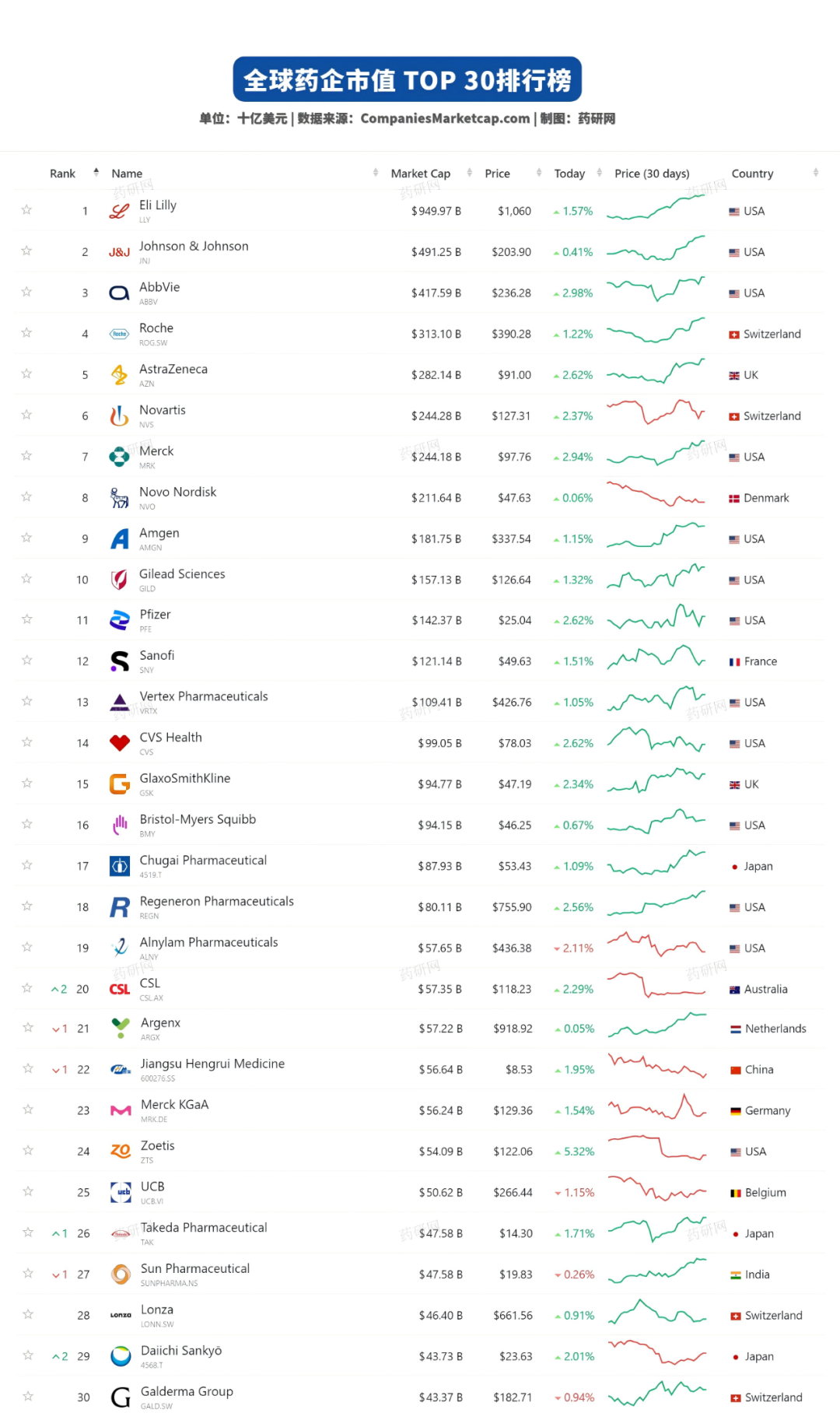
Image source: Pharma Research Network
Reference: Pharmaceutical FinancePharmResearch Network


Oral Semaglutide Fails in AD Treatment, Phase III Study Misses Primary Endpoint
Double Celebration! Novartis Receives Approval for Two Major New Drugs
Once a Month! World's First IgA Nephropathy Drug Approved by FDA for Market Launch
Oral Semaglutide Fails in AD Treatment, Phase III Study Misses Primary Endpoint
Double Celebration! Novartis Receives Approval for Two Major New Drugs
Once a Month! World's First IgA Nephropathy Drug Approved by FDA for Market Launch
Oral Semaglutide Fails in AD Treatment, Phase III Study Misses Primary Endpoint
Double Celebration! Novartis Receives Approval for Two Major New Drugs
Once a Month! World's First IgA Nephropathy Drug Approved by FDA for Market Launch
Oral Semaglutide Fails in AD Treatment, Phase III Study Misses Primary Endpoint
Double Celebration! Novartis Receives Approval for Two Major New Drugs
Once a Month! World's First IgA Nephropathy Drug Approved by FDA for Market Launch
Oral Semaglutide Fails in AD Treatment, Phase III Study Misses Primary Endpoint
Double Celebration! Novartis Receives Approval for Two Major New Drugs
Once a Month! World's First IgA Nephropathy Drug Approved by FDA for Market Launch
Oral Semaglutide Fails in AD Treatment, Phase III Study Misses Primary Endpoint
Double Celebration! Novartis Receives Approval for Two Major New Drugs
Once a Month! World's First IgA Nephropathy Drug Approved by FDA for Market Launch