Over $11.7 Billion in Big Pharma Bets: FGF21 Emerges as the Next Frontier in Metabolic Disease Therapeutics

GSK
Pharmaceutical R&D Manufacturer
In October, Novo Nordisk announced a high-priced acquisition of Akero Therapeutics for $5.2 billion, bringing the FGF21 analog Efruxifermin under its wing. In September, Roche acquired 89bio for up to $3.5 billion, gaining another FGF21 analog, Pegozafermin. In May, GSK secured Efimosfermin alfa for $2 billion….
In 2025, MNCs finalized a high frequency of deals in the FGF21 field. This series of intensively advanced, high-value transactions highlights the pharmaceutical giants' strong recognition of the clinical value of this target and reflects the broad application prospects of the FGF21 target in the treatment of metabolic diseases.
A global R&D and commercialization race targeting FGF21 has officially begun.
1
The Breakthrough Logic of FGF21
Metabolic Dysfunction-Associated Steatohepatitis (MASH)Is a metabolic-related liver disease. This liver disease, triggered by metabolic issues such as obesity and diabetes, progressively undergoes steatosis, inflammation, and fibrosis, potentially leading to cirrhosis, liver failure, or even liver cancer.
With the continuous rise in global obesity rates and diabetes prevalence,The population affected by MASH is continuously expanding.According to Frost & Sullivan's forecast, based on the current annual incidence rate increase of 3.2%, the number of MASH patients in China and globally is expected to reach 56 million and 490 million respectively by 2030. The corresponding drug market size is projected to exceed RMB 35.5 billion and USD 32.2 billion, respectively. The large patient base and unmet medical needs generate highly attractive commercialization potential.
But the R&D for MASH treatment is truly a "thorny path.", it has been dubbed the "R&D black hole" in the past few decades, with more than a hundred drugs in development failing. The pathogenesis of MASH involves the intersection of multiple pathways such as metabolic disorders, oxidative stress, and inflammatory responses. The initial hit is triggered by the accumulation of liver fat, while the second hit comes from the叠加损伤 of inflammatory factors and oxidative stress. This multi-dimensional pathological feature makes it difficult for single-target drugs to achieve comprehensive coverage.
In March 2024, Madrigal Pharmaceuticals'Resmetirom(THR-β agonist) receives FDA approval, becomingWorld's First MASH Drug, achieving a "from 0 to 1" breakthrough; in August 2025, Novo Nordisk'sSemaglutideApproved for use in non-cirrhotic MASH adult patients with moderate to severe liver fibrosis (F2 to F3 stage), becoming the first approved for this indication.GLP-1 Therapy。
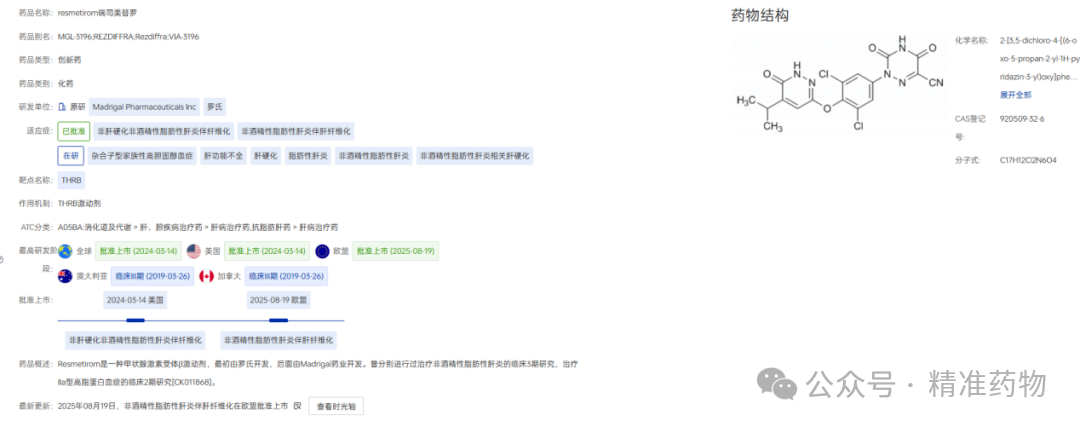
Resmetirom Drug Overview
Source of the image: Pharma Data - Global Drug Analysis System
Nevertheless, existing therapies still fall far short of meeting all clinical needs, especially as personalized treatments for different disease stages and pathological characteristics remain unavailable.
Against this background,Fibroblast Growth Factor 21 (FGF21)As a key signaling protein in metabolic regulation, it has received increasing attention.
FGF21 belongs to the endocrine FGF subfamily,The core function is to regulate glucose and lipid homeostasis as well as energy metabolism.As the primary source organ of FGF21 in the body, the liver can improve hepatic lipid metabolism, reduce steatosis, and enhance glucose uptake in adipocytes through its action. Studies show that FGF21 can alleviate hepatocyte stress, inhibit hepatic steatosis, and delay MASH-related inflammation and fibrosis progression, making it one of the most promising potential targets for MASH following GLP-1.
2
The Hottest Track
If the biological advantages of FGF21 are the foundation of its rise, then the billion-dollar acquisitions by overseas pharmaceutical companies have completely ignited the热度 of this赛道.
Since 2025,The pursuit of FGF21 assets by overseas pharmaceutical companies has entered a feverish stage.Novo Nordisk, Roche, and GSK Invest Over $10.7 Billion Within Six Months; China's Minwei Biotech Partners with Denmark’s Sidera Bio in a Deal Worth $1.045 Billion. Rough estimates indicate that overseas pharmaceutical companies’ total transactions in the FGF21 field have reached...Over $11.7 Billion, which has become the hottest M&A direction in the innovative drug sector this year.
October 31,Lepu MedicalMinwei Biotechnology, a subsidiary of the group, and DenmarkSidera BioReached a cooperation agreement to license the overseas rights of the GLP-1/GIP/FGF21 triple agonist MWN105 injection to the partner for a total transaction value of $1.045 billion, including a $35 million upfront payment and up to $1.01 billion in milestone payments. Minwei Bio simultaneously acquired 9.99% of Sidera's equity.
October 9,Novo NordiskAnnounced at a high price of $5.2 billion forAkero TherapeuticsProceed with the acquisition of Efruxifermin, a once-weekly subcutaneous injectable FGF21 analog currently in global Phase III clinical trials. In Phase IIb studies, Efruxifermin achieved a 76% MASH resolution rate and demonstrated a 39% cirrhosis reversal in F4 stage patients, significantly outperforming placebo.
Novo Nordisk's Semaglutide was approved in August 2025 for use in non-cirrhotic patients with moderate to severe hepatic fibrosis (F2-F3 stage) MASH. Now, through the acquisition of Akero, Novo Nordisk is rapidly strengthening its position in the MASH field. Although Semaglutide has been approved for MASH, Efruxifermin has shown therapeutic potential in clinical studies for more advanced compensated cirrhosis (F4 stage) patients. This acquisition is expected to help Novo Nordisk build a comprehensive portfolio covering all stages of MASH.
Moreover, Novo Nordisk's strategic intent in acquiring Akero is not solely for single-drug competition but rather to pursue synergistic effects.Early research suggests that GLP-1 and FGF21 drugs have synergistic potential in mechanism. Semaglutide mainly controls systemic metabolism by regulating appetite and improving insulin sensitivity, while Akero's Efruxifermin, an FGF21 analog, directly targets the liver to improve lipid metabolism and reverse hepatic fibrosis. This also sets the stage for Novo Nordisk to explore combination therapies.
September 18,RocheAnnounced the acquisition at $14.5 per share in cash plus up to $6 per share in non-trading value rights89bio, with a total value of up to 3.5 billion US dollars, thereby acquiring its once-weekly FGF21 analog Pegozafermin. The drug is currently in Phase III clinical trials, targeting indications covering moderate to severe fibrosis (F2-F3 stage) and cirrhosis (F4 stage) MASH patients.
Roche pointed out that Pegozafermin, with both anti-fibrotic and anti-inflammatory effects, has the potential to offer better efficacy for patients with moderate to severe MASH. It also creates possibilities for combination therapies with the company’s existing pipelines in cardiovascular, renal, and metabolic diseases.
May 14,GSKAnnounced up to $20 billion acquisitionBoston PharmaceuticalsThe core asset, Efimosfermin alfa, is a once-monthly subcutaneously administered FGF21 analog, also in Phase III development.
Efimosfermin alfa was initially developed byNovartisDeveloped by GSK and licensed to Boston Pharmaceuticals in 2020. Phase II data show that Efimosfermin alfa can rapidly and significantly reverse liver fibrosis in patients with F2/F3 stage MASH and halt its progression, with good tolerability. Notably, its effect on fibrosis improvement is considered potentially superior to other therapies and is unaffected by the background use of GLP-1 drugs.
GSK's strategic intent is very clear: to quickly enter the MASH track with Efimosfermin and plan to combine it with the investigational siRNA therapy GSK4532990, forming"Anti-fibrosis + Gene Regulation"The synergistic combination aims to establish a competitive advantage in the late-stage patient细分市场. In October 2025, GSK initiated two Phase III clinical trials (ZENITH-1 and ZENITH-2), enrolling nearly 2,500 patients to comprehensively evaluate its efficacy across all stages of MASH patients.
3
The Breakthrough of Chinese Pharmaceutical Companies
While MNCs are heavily investing in FGF21 single-target drugs, pharmaceutical companies in China are also accelerating their efforts, but with a strategy that leans more towards developing FGF21 in combination with targets such as GLP-1, GCGR, and GIP.Dual-target or Triple-target Agonists, to enhance efficacy through mechanism synergy and build differentiated competitiveness.
Huadong MedicineHolding SubsidiaryDaor BiologicsOfDR10624, is a representative product in China's FGF21 field. DR10624 is a long-acting trispecific agonist targeting FGF21R, GCGR, and GLP-1R. On November 9, 2025, Daor Biotech announced the primary results of a Phase II study of DR10624 for the treatment of severe hypertriglyceridemia (SHTG): during the 12-week treatment period, all dose groups achieved rapid and significant reductions in triglycerides, with a maximum median reduction of up to 74.5%; simultaneously, liver fat content (LFC) showed a maximum median reduction of 67%, accompanied by improvements in multiple metabolic indicators (such as adiponectin, uric acid, body weight, HbA1c, etc.). The drug was well-tolerated, with main adverse events being mild to moderate.
Currently, DR10624 has been approved for multiple clinical trials in both China and the United States, covering various indications such as SHTG, MASH, obesity, and diabetes. Among these, the MASH indication is in Phase II clinical trials, with core data expected to be released in the first half of 2026.
Dongyang Light DrugHEC88473It is an FGF21/GLP-1 dual receptor agonist that exhibits comprehensive metabolic benefits potential by synergistically regulating glucose and lipid metabolism and inhibiting liver fibrosis. A Chinese Phase Ib/IIa study showed that after 5 weeks of treatment, the average relative reduction in liver fat content (MRI-PDFF) in the 30.6 mg dose group reached 47.21%, significantly better than the placebo group; all patients in the high-dose group (68 mg) had a fat content reduction of over 30%.
In November 2024, Dongyang Guangya Pharmaceutical reached a licensing agreement with Apollo, granting the latter global rights outside Greater China for HEC88473. The potential total value of the deal is $938 million, including a $12 million upfront payment.
April 2022,China TianqingAndAnyuan PharmaceuticalsCooperation, IntroductionAP025(FGF21 Single Target) andAP026(FGF21/GLP-1 dual-target) rights in the Asian region, with a total transaction value of 342 million yuan plus single-digit sales royalties.
TQA2225 (AP025) is a fully human long-acting FGF21 fusion protein that uses a design combining fully human FGF21 with IgG2 FC, retaining the biological activity of natural FGF21 while extending its half-life in the body. TQA2225 has become a key product in China Biologic's liver disease pipeline.
AP026 is a FGF21/GLP-1 bifunctional protein fused with the antibody FC end using An Yuan Pharmaceutical's unique linker platform technology, effectively enhancing molecular stability. It is currently in the clinical application stage in China.
4
Conclusion
In the future, with the gradual release of Phase III clinical data and the in-depth exploration of combination therapies, FGF21 is not only expected to reshape the treatment landscape for MASH but also extend to multiple metabolism-related indications such as obesity, diabetes, and hyperlipidemia, becoming a core pillar in the field of metabolic health management.
The Battle for the Billion-Dollar Blue Ocean of MASH Has Begun: The Race for the FGF21 Target Is Just Getting Started. Whether it’s the active positioning by multinational corporations (MNCs) or the differentiated breakthroughs by Chinese pharmaceutical companies, the ultimate beneficiaries will be the vast number of patients. With continuous advancements in research and development, FGF21-based drugs hold the potential to bring a therapeutic revolution to patients with MASH.
Note: This article is for information exchange only. The views expressed in the article do not represent the position of Pharma Intelligence, nor are they a recommendation for treatment plans. For guidance on treatment options, please visit a正规 hospital.
References:
Pharmaceutical Intelligence Data - Global Drug Analysis System
Hua Fu Securities, Open Source Securities
Official Websites and Financial Reports of Various Companies
Disclaimer: The publication/reproduction of this article is solely for the purpose of information dissemination, and does not represent the views of this official account or confirm the authenticity of its content. Any judgment made based on this content will be at your own risk.If there is any infringement, it will be deleted upon notification!
Press and hold to follow this official account