

Stairway Medical Advances Core BCI Technologies and Accelerates Industrialization Strategy

StairMed
Developer of Implantable Brain-Computer Interface Technology
Recently, the Economic Reference published an article focusing on the brain-computer interface field, highlighting the outstanding performance of StairMed at the 2025 Brain-Computer Interface Conference.
The report mentioned that the two core brain-computer interface products of StairMed have become the focus, with significant technological breakthroughs, while accelerating industrial layout. Relevant products won the first prize in China's Disruptive Technology Innovation Competition. The Economic Reference News commented that it demonstrated the hardcore strength of China's brain-computer interface innovation.
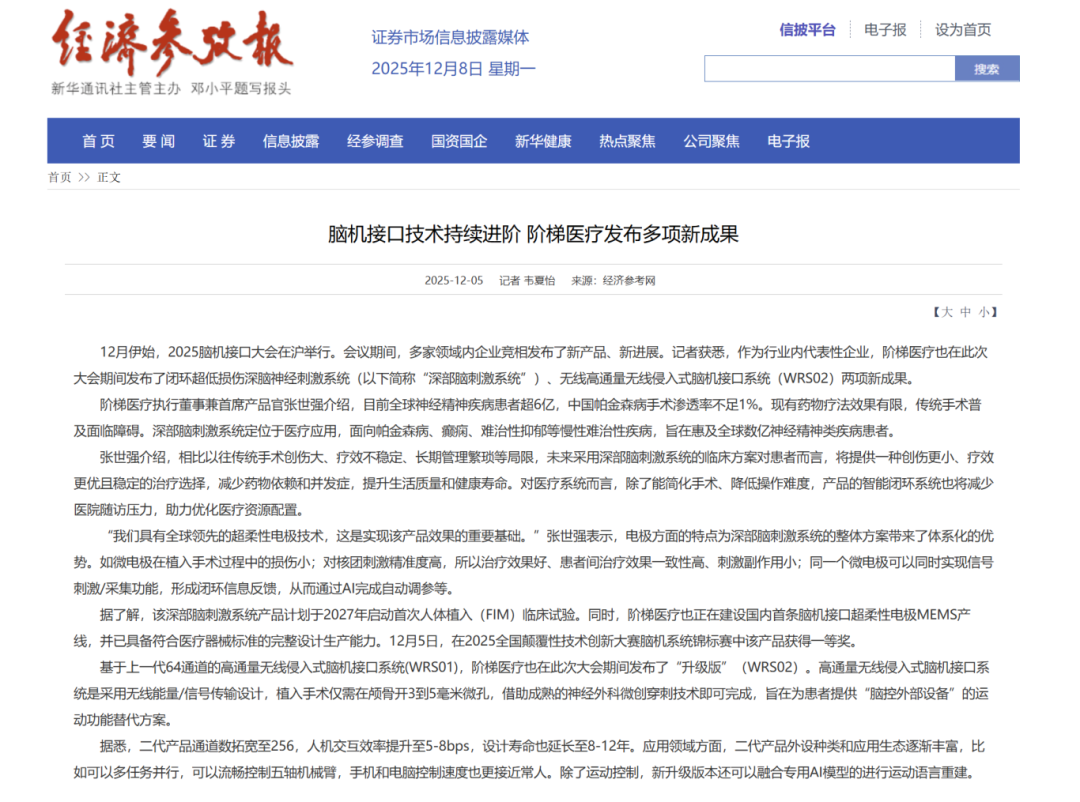
The following is the original report:
At the beginning of December, the 2025 Brain-Computer Interface Conference was held in Shanghai. During the conference, multiple companies in the field unveiled new products and updates. It was reported that StairMed, a representative company in the industry, also announced two new achievements during the event: the closed-loop ultra-low damage deep brain stimulation system (hereinafter referred to as the "deep brain stimulation system") and the wireless high-throughput invasive brain-computer interface system (WRS02).
Shi Qiang Zhang, Executive Director and Chief Product Officer of StairMed, introduced that currently, there are over 600 million patients with neurological and psychiatric diseases globally, and the surgical penetration rate for Parkinson's disease in China is less than 1%. Existing drug therapies have limited efficacy, and the popularization of traditional surgeries faces obstacles. The Deep Brain Stimulation System is positioned for medical applications, targeting chronic and treatment-resistant diseases such as Parkinson’s disease, epilepsy, and refractory depression, aiming to benefit hundreds of millions of patients with neurological and psychiatric disorders worldwide.
Zhang Shiqiang introduced that, compared with the limitations of traditional surgeries in the past, such as large trauma, unstable efficacy, and complicated long-term management, the future clinical application of deep brain stimulation systems will provide patients with a less invasive, more effective, and stable treatment option. This approach will reduce drug dependence and complications while improving life quality and healthy lifespan. For the healthcare system, besides simplifying procedures and lowering operational difficulty, the product's intelligent closed-loop system will also alleviate hospital follow-up pressure, helping to optimize the allocation of medical resources.
"We have the world's leading ultra-flexible electrode technology, which is an important foundation for achieving the product's effects," said Zhang Shiqiang. The characteristics of the electrodes bring systematic advantages to the overall solution of the deep brain stimulation system. For example, the microelectrodes cause minimal damage during implantation surgery; they offer high precision in nucleus stimulation, resulting in good treatment outcomes, high consistency in treatment effects among patients, and minimal stimulation side effects; the same microelectrode can simultaneously achieve signal stimulation/acquisition functions, forming a closed-loop information feedback system, thereby enabling automatic parameter adjustment through AI.
It is reported that the Deep Brain Stimulation (DBS) system product is planned to initiate its First-In-Man (FIM) clinical trial in 2027. Meanwhile, StairMed is constructing China's first MEMS production line for ultra-flexible electrodes used in brain-computer interfaces and already possesses complete design and production capabilities compliant with medical device standards. On December 5th, this product won the first prize in the Brain-Computer System Championship at the 2025 China Disruptive Technology Innovation Competition.
Based on the previous generation of 64-channel high-throughput wireless invasive brain-computer interface system (WRS01), StairMed also released an "upgraded version" (WRS02) during this conference. The high-throughput wireless invasive brain-computer interface system adopts a wireless energy/signal transmission design, and the implantation surgery only requires a 3 to 5 millimeter micropore in the skull, which can be completed with the help of mature minimally invasive neurosurgical puncture technology, aiming to provide patients with a motor function alternative solution of "brain-controlled external devices."
It is reported that the second-generation product has increased the number of channels to 256, improved human-computer interaction efficiency to 5-8 bps, and extended the design life to 8-12 years. In terms of application fields, the types of peripherals and application ecosystems for the second-generation product have gradually enriched, such as enabling multi-tasking, smoothly controlling a five-axis robotic arm, and achieving control speeds for mobile phones and computers closer to that of an average person. In addition to motion control, the newly upgraded version can also integrate with dedicated AI models for motion-language reconstruction.
Previous Review:
Jiefang Daily Report | Ultra-flexible Brain-computer Interface Welcomes "Shanghai Solution"