Janssen's First-in-Class KLK2/CD3 Bispecific Antibody JNJ-78278343 (Pasritamig) Designated for Breakthrough Therapy in China for Metastatic Castration-Resistant Prostate Cancer

Johnson & Johnson
Medical Device R&D and Manufacturer
On December 9, the CDE website showed that Johnson & Johnson's Class 1 new drug JNJ-78278343 injection is proposed to be included in the breakthrough treatment category, indicated for patients who have received androgen receptor(AR)Pathway Inhibitors and Taxane Chemotherapy TreatmentMetastatic Castration-Resistant Prostate Cancer(mCRPC)Adult Patients. According toInsight database, this drug isThe world's first and currently only Phase III clinical stageKLK2-Targeted Drugs。
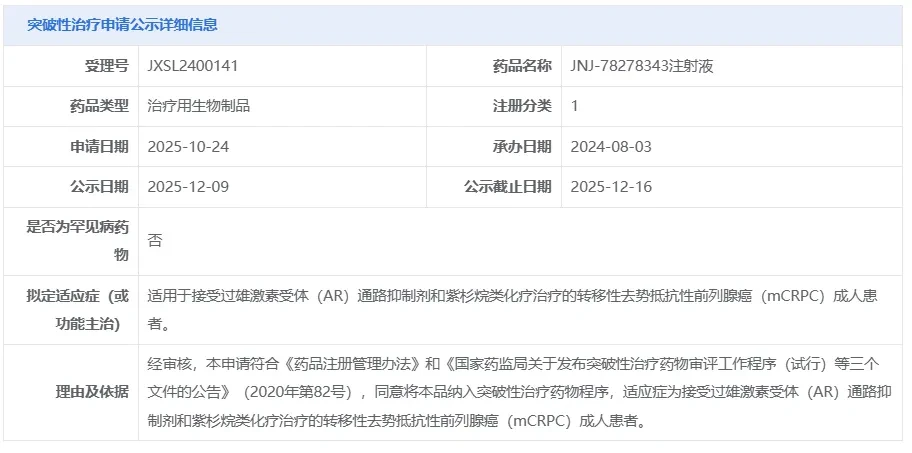
Screenshot source: CDE official website
JNJ-78278343(Pasritamig)Developed by Johnson & JohnsonA Potential First-in-Class Subcutaneous TCE(T Cell Bridging Agent)Dual Antibody, which can simultaneously target CD3 and KLK2. KLK2, fully known as human kallikrein 2 in Chinese, is a protein expressed on the surface of prostate cancer cells but has very limited expression in normal tissues.
Currently, Johnson & Johnson is conducting an international multicenter Phase III clinical trial in multiple countries and regions, including China, the United States, Japan, France, and others.(CTR20254394), to evaluate the efficacy and safety of JNJ-78278343 in combination with best supportive care in patients with metastatic castration-resistant prostate cancer. The study is expected to be completed in May 2028.
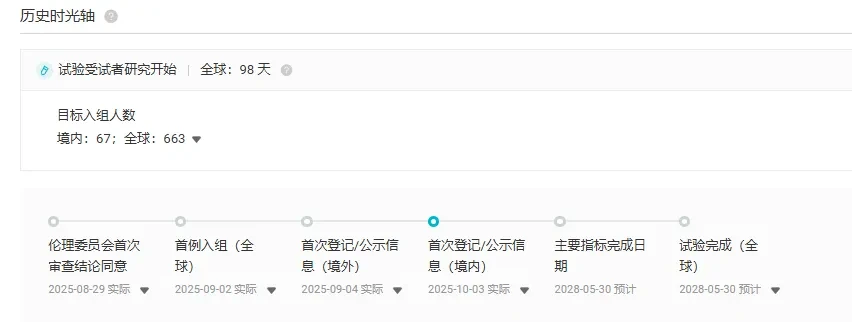
Screenshot source: Insight database
At the ASCO conference held in June 2025, Johnson & Johnson announced for the first time the Phase I clinical study results of JNJ-78278343. The enrolled subjects were patients with metastatic castration-resistant prostate cancer who had previously received at least one treatment regimen. The study'sThe primary objective is to determine the safety of JNJ-78278343 and the recommended dose for Phase II.(RP2D), secondary objectives include a preliminary assessment of its anti-tumor activity.
As of October 7, 2024, a total of 174 subjects have received JNJ-78278343 treatment, with a median of 4 prior lines of systemic therapy. The data shows:
Of the 174 subjects, 144 (82.8%) Occurrence of Treatment-Related Adverse Events (TRAE), including 17 patients who experienced TRAEs of grade ≥3.
RP2D was determined as: 3.5 mg on Day 1, 18 mg on Day 8, 300 mg on Day 15, followed by 300 mg intravenously every 6 weeks.. In the RP2D safety population (n = 45) In China, Infusion-Related Reactions (24.4%)、Fatigue(15.6%)、Cytokine Release Syndrome(CRS, 8.9%, all Grade 1)And elevated lipase(8.9%) The most common TRAE; all events were grade 1 or 2.
In the RP2D efficacy population(n = 33)In China,Median radiological progression-free survival was 7.85 months.(95% CI, 2.89 months to unable to estimate); Among the 33 subjects, there were 14(42.4%)Prostate-Specific Antigen (PSA) A ≥50% decrease from baseline.
In summary, the study concluded that JNJ-78278343 demonstrated a favorable safety profile, with a very low incidence of cytokine release syndrome, allowing for safe administration in an outpatient setting. Additionally, preliminary anti-tumor activity data confirmed the potential of KLK2 as a target for prostate cancer, warranting further investigation of JNJ-78278343.
Summary
KLK2 is a potential target for prostate cancer drug development.Insight database shows that there are only 7 drugs under research globally.KLK2 Active Pipeline,Among them, only three have entered the clinical stage, all from Johnson & Johnson.. In addition to the new dual-antibody drugJNJ-78278343, Johnson & Johnson has also developed targetedCAR-T and RDC for KLK2 are currently in Phase I clinical trials.
Cover Source:Corporate Logo
Disclaimer:This article is for information sharing only and does not represent the position or viewpoint of Insight. It does not recommend or introduce any treatment plans. If necessary, please consult and contact正规医疗机构.
Editor: Xinyao
PR Article Coordination: WeChat insightxb