

Deep Intelligent Pharma Secures Nearly $50 Million in Series D Funding to Advance AI-Native Clinical Trial Platform

Deep Intelligent Pharma
AI-Driven Drug Discovery Platform
Text|Hu Xiangyun
Editor|Hai Ruojing
36Kr learned that Deep Intelligent Pharma, a global leader in AI pharmaceuticals, has recently raised nearly 50 million US dollars in D-round financing. This round of financing was led by CDH Baitong, with continued investment from existing shareholders New Ding Capital and Sequoia China. Index Capital served as the exclusive financial advisor. The funds raised will be mainly used for the technical research and development iteration of the "multi-agent collaboration network" and the construction of a global delivery network.
Deep Intelligent Pharma was founded in 2017. Compared to the early exploration of single technical points, over the past three years, Deep Intelligent Pharma has completed an intergenerational leap from "single-point AI technology validation" to an "AI-Native Clinical Research Platform." This evolution has allowed it to move beyond the scope of traditional software suppliers, transforming into a core business partner capable of delivering end-to-end results throughout the clinical trial process.
In the view of Li Xing, the founder and CEO of the company, the future of pharmaceuticals R&D does not lie in the substitution of single functions, but in the reconstruction of cognition. With the outbreak of generative AI, Deep Intelligent Pharma has taken the lead in upgrading its underlying NLP capabilities to a "multi-agent collaboration system" comprising tens of thousands of vertical domain intelligent agents.
"We are no longer delivering single-function modules, but rather an 'AI intelligent agent cluster' capable of collaboratively completing the entire clinical trial process," Li Xing told 36Kr. "Our core barrier lies in reconstructing the R&D process using the 'Cognitive Atomism' theory. The system breaks down complex clinical trials into tens of thousands of tiny atomic tasks, each handled by specialized Agents. They are interconnected through a synapse-like neural network, achieving a level of expertise far surpassing general large models."
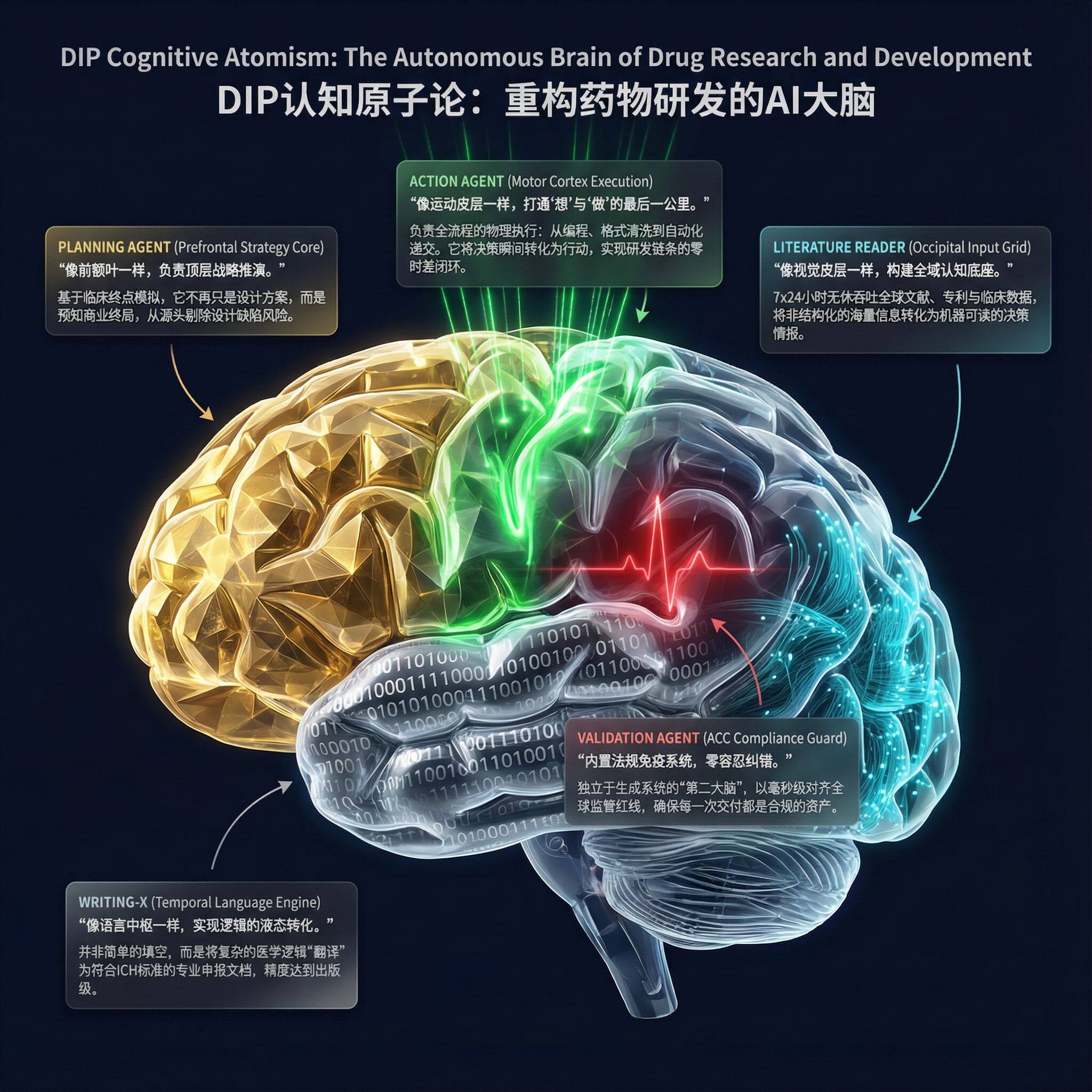
Source: Deep Intelligent Pharma
This evolution of the technical architecture has, to a certain extent, driven the transformation of business models. While the industry generally adopts the traditional model of "charging per head/hour," Deep Intelligent Pharma has begun to explore milestone-based value payment (Outcome-based Model).
This is mainly due to the mutual verification mechanism between the "Planning Agent" and the "Execution Agent" constructed by Deep Intelligent Pharma. When AI is corrected by human experts in actual projects, the system triggers a "Self-Reflection" mechanism, automatically retracing and correcting the code logic. This unique "Bidirectional Validation Feedback Flywheel" mechanism gives the system an intuition similar to human experts, enabling it to learn by analogy.
Take the cooperation between the company and Japan's innovative pharmaceutical enterprise Immunorock as an example. Deep Intelligent Pharma’s service model is equivalent to providing a "Digital Rehearsal" for them. According to reports, traditional clinical trial protocol designs often rely on the personal experience of experts, which can easily lead to logical loopholes. Deep Intelligent Pharma’s system uses "digital twin" technology to simulate the entire process before actual patient enrollment, modeling the entire chain from patient screening to data statistics, and preemptively avoiding risk points that could lead to high dropout rates. In the end, this solution helped the client obtain one-time approval from Japan's Pharmaceuticals and Medical Devices Agency (PMDA).
In terms of data security, regarding the highly sensitive issue of data sovereignty for pharmaceutical companies, Deep Intelligent Pharma adheres to the principle of "data does not land, model does not remember." Each client project runs in an independent physical sandbox, which is destroyed after the project ends, retaining only the desensitized "error logic" to enhance the system's robustness.
According to data provided by Deep Intelligent Pharma, the company has served over 1,000 pharmaceutical enterprises and verified the versatility and stability of this system in complex pharmaceutical scenarios through the practical delivery of more than 40,000 projects.
"The pharmaceutical R&D industry is at a historical turning point, transitioning from 'labor-intensive' to 'intelligence-intensive.'" Li Xing stated that Deep Intelligent Pharma's vision is not to become a service provider but to build a new generation of 'pharmaceutical R&D operating system.' By utilizing AI agents to automate complex processes, scientists can be freed from data documentation to focus on genuine scientific innovation.