Kersen Science & Technology Sells Medtronic Supplier Subsidiary to Exit Medical Device Sector

Medtronic
Medical Device Manufacturer

Pioneer in Medical Device Media Reports
Share Professional Medical Device Knowledge
On the evening of December 8, an announcement by Kesen Technology (603626), a listed company in the precision manufacturing sector, drew industry attention—The company plans to sell 100% of its wholly-owned subsidiary, Kesen Medical, to Yaoling Technology for a consideration of 915 million yuan, with a transaction premium rate as high as 206.45%.The completion of this premium transaction marks the official and complete exit of this enterprise, which has consumer electronics precision structural components as its core business, from the medical device field that it has deeply cultivated for many years.
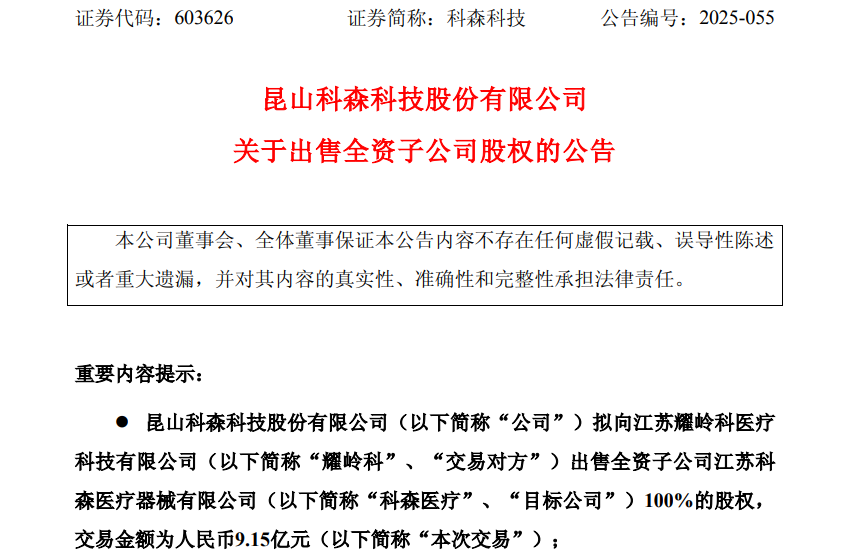
For the acquirer Yaoling Technology, which focuses on healthcare investment (backed by LYFE Capital, managing over $2 billion in assets), this is a precise strategic move; but for Coson Technology, it marks an important shift from medical cross-border expansion to strategic contraction.
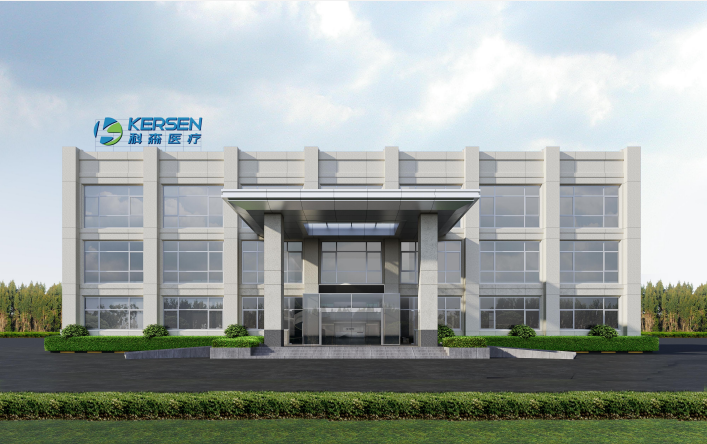
The collaboration between Koson Medical and global medical giant Medtronic represents a classic starting model for precision manufacturing enterprises entering the medical field. As early as 2009, before the establishment of an independent medical subsidiary, Koson Technology began its cooperation with Medtronic, relying on the latter's technical support to build its medical business from scratch. After the official establishment of Koson Medical in 2018, this cooperation deepened further, becoming a core pillar of its business development.
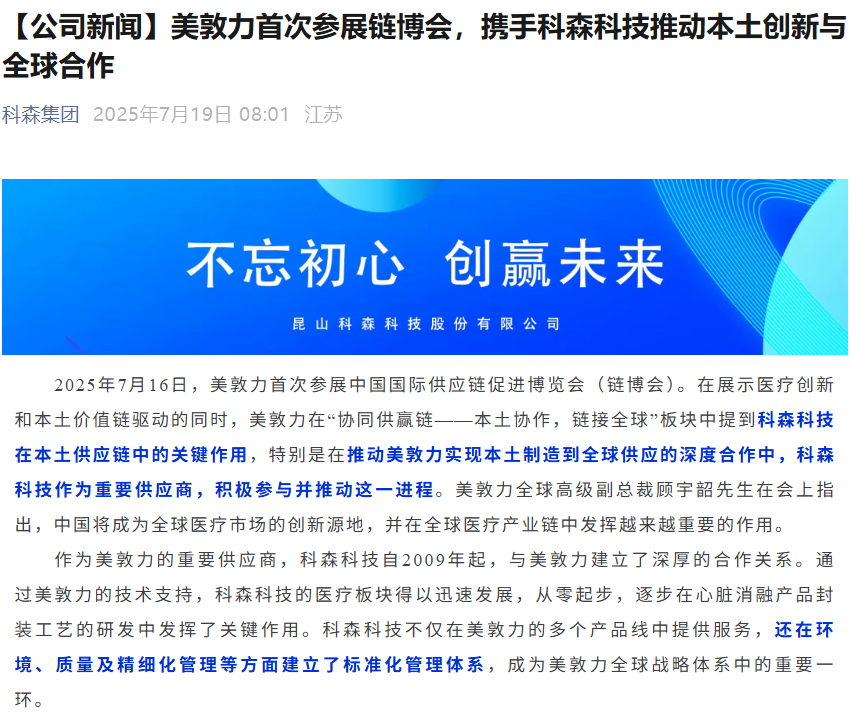
As an important supplier to Medtronic, Coson Medical's business covers the entire chain from basic structural components to core process R&D.In terms of products, it serves Medtronic,Zimmer, Johnson & JohnsonWaiting for customersPrecision components are provided for several core products such as pacemakers, cardiac ablation products, and minimally invasive surgical knives, involving key components like bone screws, scalpel handles, and hemostatic forceps. These products demand "zero-tolerance" levels of manufacturing precision and material toughness. Kesen, relying on its technical expertise in CNC machining, laser welding, and other fields, perfectly meets these requirements.
In terms of cooperation depth, Coson not only serves more than 10 global product lines of Medtronic but also participates in the core R&D of the encapsulation process for cardiac ablation products. Additionally, through the empowerment of Medtronic's system, Coson has established an environmental, quality, and refined management system that meets international standards, becoming an indispensable part of its global supply chain.
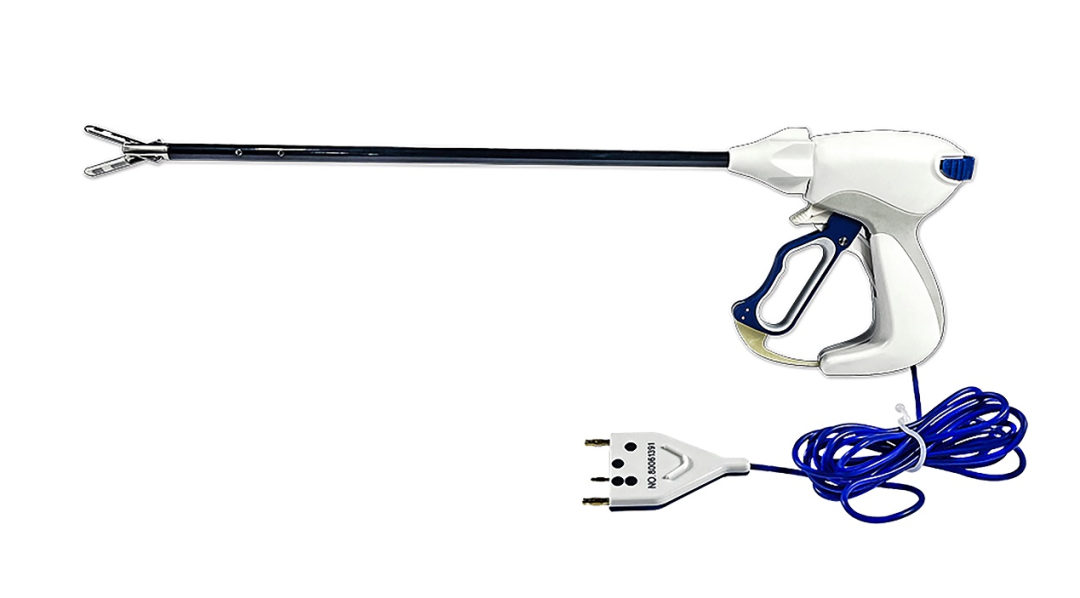
It is worth mentioning that Cosin Medical is not merely a contract manufacturing enterprise. Its "Ultrasonic Scalpel Waveguide Rod" project, jointly developed with the Institute of Metal Research and the Institute of Acoustics of the Chinese Academy of Sciences, has improved the product's lifespan and energy transmission efficiency through innovations in titanium alloy materials, demonstrating independent R&D capabilities. The project was also awarded as an outstanding scientific and technological project.
From the operating data, Kesen Medical's business itself is profitable. In 2024, its revenue reached 366 million yuan, with a net profit of 41.1218 million yuan; in the first three quarters of 2025, revenue was 354 million yuan, and net profit further increased to 48.2414 million yuan. By the end of September 2025, its net assets reached 298 million yuan. Why would such a well-profitable subsidiary be completely divested by its parent company?
Kesen Technology's decision to exit essentially reflects a strategic focus choice amid the pressure on its core business, behind which lie three layers of practical challenges in cross-border healthcare.
The primary reason isThe Synergy Between Main and Side Businesses is MissingThe core business of Kesen Technology is precision structural components for consumer electronics, serving tech giants such as Apple, Huawei, and Meta. Its products include mobile phone frames, VR device shells, and more. The technical path emphasizes scaled and fast-iterating manufacturing capabilities. In contrast, its medical business serves clients like Medtronic and Johnson & Johnson, where the key requirements are compliance, stability, and high precision. The technical standards and customer demands in these two sectors differ significantly. Although Kesen Medical is profitable on its own, it fails to create resource synergy with the company's consumer electronics main business, instead diverting management focus and R&D investment. Kesen Technology explicitly mentioned this in its announcement."The technological path and customer base of Cosent Medical differ from the core business, with limited synergies," which has become one of the core reasons for the divestiture.
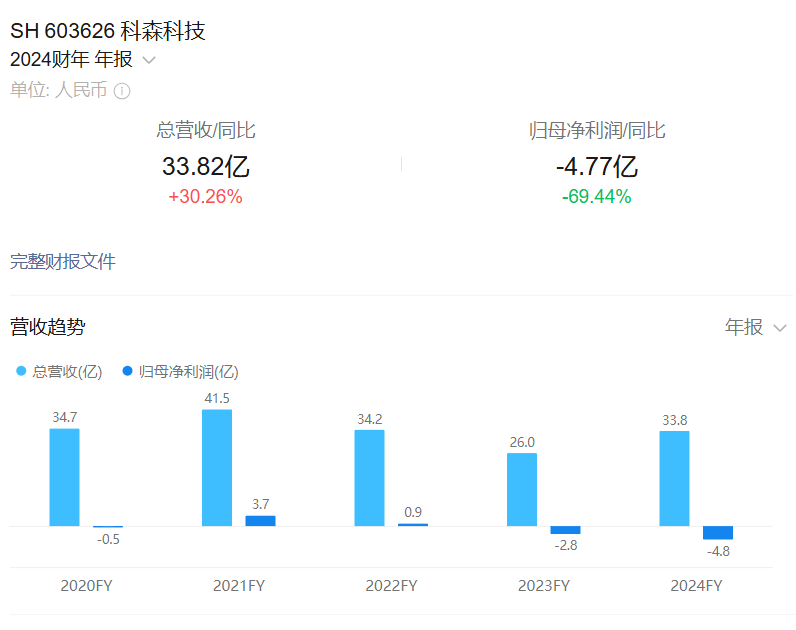
Secondly,Performance Pressures on Parent Company Force Strategic ContractionAfter a sharp decline in net profit in 2022, Kesen Technology has incurred losses for two consecutive years: the net profit attributable to shareholders was -RMB 2.81 billion in 2023, and the loss widened to -RMB 4.77 billion in 2024; although the loss narrowed year-on-year in the first three quarters of 2025, the net profit attributable to shareholders still stood at -RMB 1.15 billion, with the non-recurring net profit at -RMB 1.79 billion. Amid ongoing pressure on its core business, selling Kesen Medical became the optimal solution for quickly recouping funds. Meanwhile, Kesen Technology is concentrating resources on its consumer electronics core business, which saw overseas revenue grow by 26.45% year-on-year in 2024, and plans to build a new production base in Malaysia to address fluctuations in international trade, naturally leading to the medical business being deemed "non-core assets" to be divested.
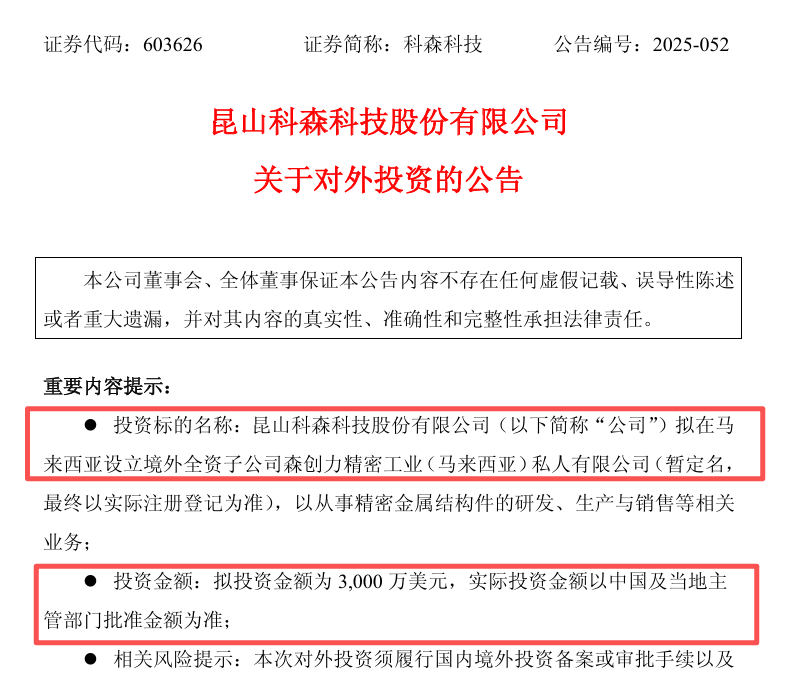
Finally,Challenges in the External Environment of the Medical IndustryKesen Medical's core business is the processing and export of minimally invasive surgical instruments, and the ongoing Sino-US trade friction continues to impact this field. Data shows that tariffs on medical devices and core components produced in the U.S. have risen, which not only increases export costs but also brings risks to supply chain stability. Although Kesen Medical has mitigated some pressure by serving Medtronic’s global supply chain, in the long term, fluctuations in the international trade landscape remain a looming risk. Additionally, the medical device industry is characterized by long certification cycles and high R&D investment. For Kesen Technology, which focuses on short-term performance improvements, the cost-effectiveness of continuous investment has significantly decreased.
The departure of Kosen Technology is not only a strategic choice of an individual enterprise but also reflects the widespread difficulties currently faced by the medical device industry. Although the revenue growth rate of the medical device sector turned positive in Q3 2025 (a year-on-year increase of 2.05%), the industry as a whole has yet to emerge from the adjustment period.Wind data shows that, in the first three quarters of 2025, the total revenue of 131 A-share medical device companies amounted to 179.21 billion yuan, a year-on-year decrease of 2.24%; net profit attributable to shareholders was 26.732 billion yuan, a year-on-year decrease of 13.93%. The industry as a whole is under significant pressure.
Specifically, industry challenges focus on three dimensions:
First,Pressure on volume and price brought by policy and market competitionCentralized bulk procurement has covered most commonly used high-value consumables, and fields such as in vitro diagnostics are facing the dilemma of "both volume and price falling." The in vitro diagnostics product lines of leading enterprises all saw revenue declines in the third quarter of 2025. Among China's top five chemiluminescence companies, only New Industries Biomedical achieved slight revenue growth, but its net profit still dropped by 12.92% year-on-year. Policies like the unbundling of test packages have further impacted terminal testing volumes, which are unlikely to recover in the short term.
Secondly,Dual Impact of International Trade and Supply Chain RisksChina's medical device industry has a high dependency on imported core components, with 80% of critical parts such as CT tubes and superconducting magnets relying on imports. The China-U.S. trade friction has led to a 34%-125% increase in import costs, causing some grassroots hospitals to even shelve their equipment upgrade plans. At the same time, export companies are facing dual challenges of tariff barriers and market access. The business difficulties faced by Kesen Medical are a microcosm of this trend.
ThirdlyThe Dilemma of Balancing Innovation Investment and ProfitabilityThe high-end development of the medical device industry relies on continuous investment in research and development. For instance, the ultrasonic scalpel waveguide rod project participated in by Coson Medical requires long-term collaboration with scientific research institutes. However, the current decline in industry profit growth makes it difficult for small and medium-sized enterprises to bear the high R&D costs. Although leading enterprises can maintain their investment, they also face the issue of a long innovation transformation cycle. Despite growth achieved through "innovation + overseas expansion" in niche areas such as orthopedics and electrophysiology, most companies are still seeking a balance between profitability and innovation.
For Cosmo Technology, selling its medical business is a strategic contraction of "sacrificing a pawn to save the rook"; for the acquirer LYFE Capital, this is an excellent opportunity to lay out high-end medical device precision manufacturing. The industry's differentiation and adjustment continue, and those companies that can focus on core areas, balance innovation with profitability, and address supply chain risks are likely to be the first to recover after the turning point.
More exciting content
Welcome to follow WeChat Video Channel


Imaging Leader, New Round of Large-Scale Layoffs
The Largest Medical Device IPO of the Year Kicks Off
Heavyweight Releases Accelerate the Clinical Adoption of World's Top Radiation Therapy Equipment
GE Healthcare China Imaging Business: Major Personnel Changes
Signing a Ten-Year Agreement, Siemens Healthineers Partners with China
Major Breakthrough in Chinese-Made Endoscopes and Surgical Robots
"China's No.1 Mobile Healthcare Entry Point" Acquired
13.4 Billion, Imaging Giant Plans IPO
Johnson & Johnson's Product Rejected Unanimously
For the First Time, China's National Healthcare Security Administration Plans to Construct a Price Framework for Surgical Robots and Remote Surgeries

BusinessBusiness cooperation email: qxzj@landianyiliao.com